Authorization for Expenditure (AFE)
An Authorization for Expenditure (AFE) is the document an operator uses to estimate and approve the cost of a proposed oil and gas operation, such as drilling, completion, a major workover, facilities, or plugging and abandoning a well.
If you hold a working interest, this is the estimate you are being asked to approve, and your share is charged to you whether the final cost lands above or below it.
A useful AFE answers four questions:
- What work is being proposed?
- How much is it expected to cost, and broken down how?
- Who must approve the spending?
- Can a working-interest owner tell whether the estimate and timeline are realistic before approving?
An AFE is prepared before or during planning. It is a budget and authorization tool, not a bill for actual costs.
Quick Reference
| Term | Authorization for Expenditure |
| Abbreviation | AFE |
| Category | Cost estimate and capital approval document |
| Usually prepared by | The operator or proposing party |
| Usually reviewed by | Internal management and, when applicable, working-interest partners |
| Used for | Drilling, completions, workovers, facilities, plugging, and other major operations |
| Governing context | JOA, other operating agreement, and internal company approval rules |
| Government filing? | No |
| Commonly confused with | JIB and capital call |
| Main purpose | Estimate costs, approve spending, and track actual costs against budget |
How Does an AFE Work?
The AFE process usually starts when an operator plans a new well or another major operation.
The operator's engineering, drilling, operations, and accounting teams prepare the scope of work and estimate the expected cost. The AFE then moves through the operator's internal approval process.
If other working-interest owners are involved, the operator may send the proposal and AFE to them as part of the notice and election process required by the joint operating agreement (JOA) or other governing agreement.
The exact process depends on the contract. A working-interest owner may be asked to consent to the operation or elect not to participate. The consequences of non-consent are controlled by the governing agreement, not by the AFE alone.
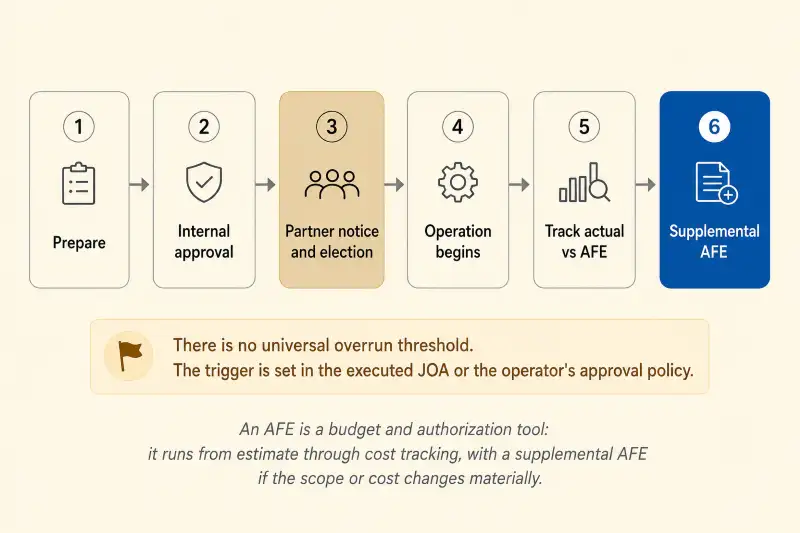
Once the operation begins, the operator tracks actual and projected costs against the AFE. If costs change materially, the operator may revise the estimate, seek additional approval, or issue a supplemental AFE, depending on the agreement and company procedures.
What Is Included in an AFE?
A typical oil and gas AFE may include:
- Well or project details: well name, location, legal description, and operation type
- Scope of work: what the operator plans to do
- Itemized cost estimate: expected costs by activity or service
- Intangible costs: labor, fuel, drilling fluids, cementing, fracturing, and similar costs
- Tangible costs: casing, tubing, wellheads, tanks, and other equipment
- Contingency: an allowance for expected uncertainty or minor cost changes
- Working-interest shares: each party's share of the estimated cost
- Approval or election information: signatures, approvals, or election instructions when required
- Supporting assumptions: timing, service costs, design, and other factors used to build the estimate
The exact format varies by operator and project.
AFE Cost Variance
An AFE is an estimate. The final cost of an operation may be higher or lower.
Operators commonly compare actual or projected spending with the approved estimate using cost variance:
Cost Variance % = (Actual or Projected Cost − AFE Estimate) ÷ AFE Estimate × 100
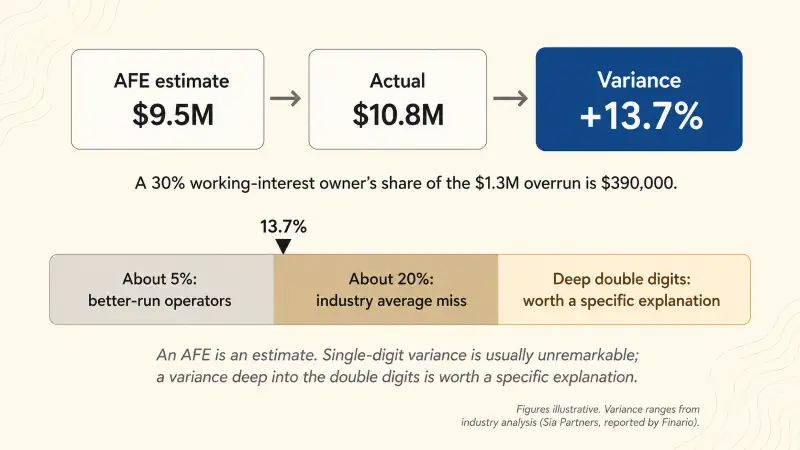
For example, assume a well has an AFE of $9.5 million and the actual cost reaches $10.8 million.
- Cost overrun: $1.3 million
- Cost variance: 13.7%
- A 30% working-interest owner's share of the original AFE: $2.85 million
- Its 30% share of the $1.3 million overrun: $390,000
Whether additional approval is required depends on the executed JOA or other governing agreement.
For context on what a normal variance looks like: industry analyses have found that average AFE estimates in oil and gas often miss final costs by around 20 percent, while better-run operators hold that gap closer to 5 percent (Sia Partners, reported by Finario). A single-digit variance is usually unremarkable. A variance deep into the double digits is worth a specific explanation from the operator.
What Is a Supplemental AFE?
A supplemental AFE is a revised cost estimate and authorization prepared when the expected scope or cost of an operation changes materially.
For example, a supplemental AFE may be needed when:
- Drilling problems increase the expected cost
- The well design changes
- Additional work is added
- Service or equipment costs rise significantly
- Projected spending exceeds an approval limit
There is no universal AFE overrun percentage that applies to every oil and gas operation. Some agreements and company procedures use specific approval thresholds, but the exact rule must be checked in the executed JOA, operating agreement, or internal authorization policy.
The supplemental AFE gives the operator and other approving parties an updated view of the expected total cost.
AFE vs JIB vs Capital Call
These three terms are related, but they are not the same.
| Document | What it is | When it is used |
|---|---|---|
| AFE | Estimated cost and spending authorization | Before or during planning of the operation |
| Joint Interest Billing (JIB) | Statement of actual costs charged to the joint account | After costs are incurred |
| Capital call | Request for funds from participating owners | Before or as funding is needed |
The easiest way to remember the difference is:
- AFE = expected cost and approval
- JIB = actual costs charged
- Capital call = request for funds
Non-operating working-interest owners can compare JIB charges with the AFE to understand where actual spending differs from the original estimate.
Intangible vs Tangible Costs on an AFE
Many AFEs separate costs into intangible and tangible categories.
| Cost type | Examples |
|---|---|
| Intangible drilling costs (IDC) | Labor, fuel, drilling fluids, cementing, and certain services |
| Tangible costs | Casing, tubing, wellheads, tanks, and equipment |
This separation can matter for accounting and federal tax treatment. However, an AFE is a budget document, not tax advice. The actual tax treatment depends on the facts and circumstances of each party and should be reviewed with a qualified tax professional.
Why Is an AFE Important to Operators?
For an operator, an AFE creates a clear financial plan before major spending begins.
It helps the operator:
- Define the scope of the operation
- Estimate the total cost
- Obtain internal and partner approvals
- Track spending against the budget
- Identify cost overruns early
- Explain material changes in cost
- Compare estimated and actual well costs
- Improve future cost estimates
A well-managed AFE process also helps engineering, operations, accounting, procurement, and management work from the same approved cost baseline.
Latest AFE Update: Where Well Costs Are Running in 2026
For a working-interest owner, the most useful recent news is not a new AFE tool. It is where drilling and completion costs are actually landing, since that is the number a proposed AFE has to match.
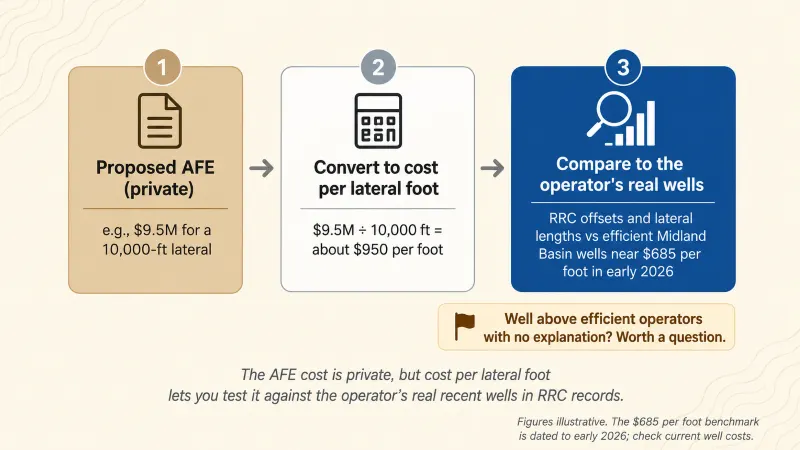
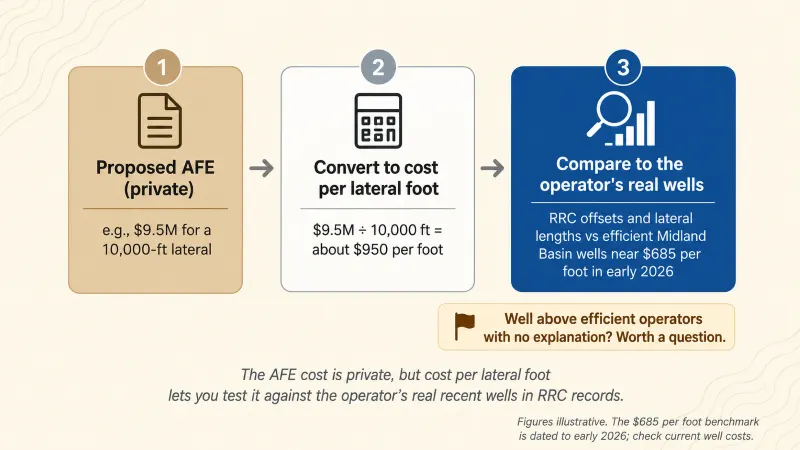
In its first-quarter 2026 results, Permian Resources, one of the lower-cost Midland Basin operators, reported drilling and completion costs of about $685 per lateral foot, around 6 percent below its 2025 results. Deeper wells and less efficient operators usually cost more, so read that as a low end, not an average.
Here is why it helps you: cost per lateral foot lets you compare any AFE to real wells, whatever the lateral length. If a proposed figure sits well above what efficient operators are reporting, that is worth a question to the operator. You can check it against their own recent wells by pulling offset completions and lateral lengths from RRC records.
On the billing side, the COPAS overhead factor (the fixed overhead an operator charges the joint account under most JOAs) resets every April 1. So the rate on a current bill may differ from the one when an older AFE was approved. Check this year's factor on the COPAS Economic Factors page before assuming last year's still applies.
How Operators Use an AFE in Practice
Suppose an operator plans a horizontal well with an estimated completed cost of $9.5 million.
A 30% working-interest owner's estimated share is $2.85 million.
During drilling, unexpected downhole problems increase the projected total cost to $10.8 million. The operator now compares the revised forecast with the original AFE, identifies the cause of the increase, and determines what additional approval or notice is required under the governing agreement.
The important point is that the AFE gives everyone a common starting point.
It shows:
- What the operation was expected to cost
- How much the estimate has changed
- Why the cost changed
- What approval may be needed next
Is an AFE Filed With the Texas Railroad Commission?
No. An AFE is generally a private business and financial document. It is not filed with the Texas Railroad Commission (RRC).
The operation connected to the AFE, however, may appear in public records. For example, an operator may file a Form W-1 drilling permit, completion records, and production reports for the well.
This creates an important distinction:
- The AFE shows the private cost and approval process.
- The RRC records show the public regulatory and operating activity.
- The AFE itself usually remains within the operator and working-interest partner group.
AFE and Texas Operator Data
An AFE may be private, but the operator activity behind it is often visible in public data.
Before evaluating a proposed operation, a working-interest owner may review:
- The operator's recent drilling permits
- Wells drilled in the same county or area
- Completion activity
- Drilling pace
- Nearby well activity
- Production from comparable wells
This information does not reveal the operator's private AFE cost. However, it can provide useful context about whether the proposed timing and operation fit the operator's actual development program. Mineral View operator data lets you review operator, well, lease, permit, completion, and production activity together.
AFE Standards and Governing Documents
An AFE does not operate by itself. The rights and obligations of the parties depend on the agreements and procedures that govern the operation.
Important references may include:
| Reference | Why it matters |
|---|---|
| Joint Operating Agreement (JOA) | Controls proposals, elections, consent, non-consent, and other rights between parties |
| COPAS Accounting Procedure | Provides the accounting framework for charges to the joint account |
| Internal company approval policy | Sets the operator's own spending and approval limits |
| IRC §263(c) | Relevant to the federal tax treatment of qualifying intangible drilling costs |
| IRC §168 | Relevant to depreciation rules for qualifying tangible property |
| Texas RRC Form W-1 | Public drilling permit for a Texas well; the AFE itself is not filed |
The executed agreement always matters more than a general industry rule.
Common AFE Mistakes
- Treating the AFE as a bill for actual costs
- Assuming the final cost must equal the AFE estimate
- Assuming every JOA uses the same overrun threshold
- Calling the AFE the governing contract instead of checking the JOA
- Failing to compare actual and projected costs with the approved estimate
- Treating a supplemental AFE as a routine form instead of reviewing why the cost changed
- Confusing an AFE with a JIB or capital call
- Assuming the AFE is filed with the Texas Railroad Commission
Frequently Asked Questions
An Authorization for Expenditure (AFE) is a detailed estimate of the expected cost of a proposed oil and gas operation. It is also used to obtain the approvals required before or during major spending.
The operator or proposing party usually prepares the AFE with input from engineering, drilling, operations, procurement, and accounting teams.
Approval depends on the operation and governing agreements. An AFE may require internal company approval and, when applicable, approval or an election from other working-interest owners.
Not by itself in every situation. The party's obligations depend on the JOA, operating agreement, election process, and other governing documents. The AFE should be read together with those agreements.
An AFE shows the estimated cost before or during the planning of an operation. A JIB shows actual costs charged to the joint account after those costs are incurred.
A supplemental AFE is an updated cost estimate and authorization prepared when the expected cost or scope of an operation changes materially.
There is no single threshold that applies to every operator or JOA. The exact approval limit must be checked in the executed agreement and the operator's approval procedures.
No. An AFE is an estimate and approval tool. Actual costs may be higher or lower because of drilling conditions, scope changes, service costs, equipment needs, or other factors.
No. The AFE is generally a private financial and approval document. The well or operation may appear in RRC permits, completion records, and production reports, but the AFE itself is not filed.
Important
This page explains common oil and gas industry usage. The executed JOA, operating agreement, accounting procedure, and other governing documents control the rights and obligations of the parties. This page is not legal, tax, or accounting advice.