Known for its high production rates, oil and gas production is the one thing responsible for keeping our world running. Fuel is provided for homes, transport, and industries. But just how is it done? What does it mean for our planet? Take a journey through the amazing world of oil and gas production; understand what its life cycle entails from start to finish.
We will examine how these resources, natural gas production included, are found, extracted, and prepared into the actual energy we use every day. But more than that, we shall look at how this impacts the world globally—from its influence on economic systems to its support of jobs and the effects on the environment.
Regardless of whether you are new to the subject or simply want to refine your knowledge, this guide will help you get to the root of oil and gas production and how it is instrumental in our modern world. Let us start by explaining what oil and gas production is.

What is Oil and Gas Production?
Generally, the production of oil and gas is a chain of connected processes to extract, process, and move natural gas and crude oil from underground reservoirs to end-users across the globe. The intricate route guarantees homes, industry, and transportation networks' energy requirements are met effectively and efficiently.
The three major stages of the production process are upstream, midstream, and downstream. Upstream exploration and drilling and pumping of oil and gas reservoirs are some examples of upstream operation activities.
Shipping these raw materials to processing plants, often through rail, ships or pipelines, is the primary objective of midstream operations. In addition, the downstream process involves marketing and delivering the end product to the customers as well as refining crude oil into usable products such as jet fuel, diesel, and gasoline.
The oil and gas industry is one of the prime drivers of economic growth and diversification, and it is a fossil fuel-based sector. It generates high revenues for the country through taxation and royalties, provides a huge number of employment opportunities, and fuels the world with growing energy needs, thus providing global energy security. But there are downsides to these advantages. It has become an extremely sophisticated industry requiring advanced equipment, the latest technologies, and complete adherence to safety and environmental standards.
Firms operating in this sector are continuously seeking a balance between efficiency, operational efficiency, sustainability, and safety. Beyond economic importance, the oil and gas industry is responsible for reducing impacts on the environment, such as greenhouse gas emissions and disruptions in the ecological system. Consequently, the future of the industry is being driven by increased investments in cleaner technology and the inclusion of renewable energy.
The Lifecycle of Oil and Gas Production
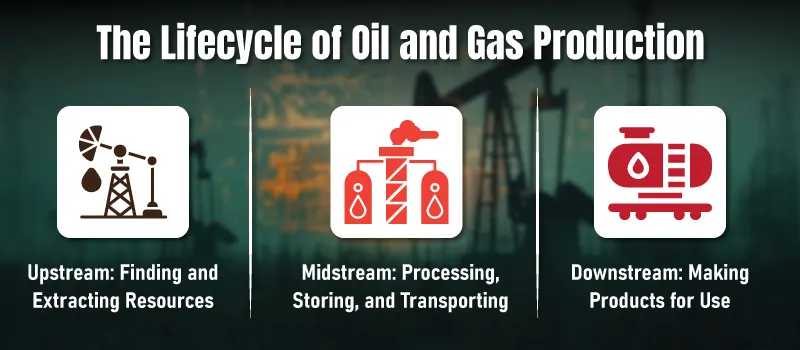
The life cycle of oil and gas production is a value chain that spans three main phases: Upstream, Midstream, and Downstream.
The production and utilization of oil and gas, being significant sources of energy, involve a multi-step complicated process. Every step is essential in the transformation of such natural resources into functional end products, ranging from warming homes to fueling the transport systems. Understanding this process makes one aware of the way oil and gas drive the world today.
Upstream: Finding and Extracting Resources
The upstream process is where oil and gas are found and extracted from the ground.
-
Exploration:
This is the initial step in discovering oil and gas. Geologists analyze the surface of the Earth with techniques such as seismic surveys and satellite imagery in order to determine where there could be proven reserves of oil and gas beneath the surface.
-
Drilling:
Once they are explored, wells are drilled to access the oil and gas. This is either on land (onshore) or underwater (offshore), where offshore drilling takes an essential part in accessing reserves underwater. Drilling rigs provide an entry point to the reserves far beneath the surface.
-
Extraction:
After the well is drilled, the gas or oil is taken out of the ground. If the natural flow is not sufficient, other processes such as injecting water or gas can be used to drive the oil or gas out.
Midstream: Processing, Storing, and Transporting
Midstream operations connect the upstream and downstream operations by treating and moving oil and gas
-
Processing:
After extraction, the raw gas and oil are cleaned to remove dirt and impurities. This makes them suitable for refining and consumption.
-
Storing:
The processed oil and gas are stored in storage tanks or specialized facilities until ready to be shipped out to refineries.
-
Transportation:
Pipelines, trucks, or ships transport the oil and gas from storage to refineries or other processing plants.
Downstream: Making Products for Use
The downstream phase is responsible for converting oil and gas into products and distributing them to consumers.
-
Refining:
Refined products such as gasoline, diesel, jet fuel, and asphalt are produced from crude oil. Natural gas is refined to generate propane, butane, and other products.
-
Distribution:
After refining, the products are distributed and marketed. Gas stations, heating suppliers, and industries utilize products to satisfy everyday demands.
Production of oil and gas is dependent on sophisticated machinery, ranging from drilling equipment, pipelines, storage tanks, and refining equipment to effectively find, drill, move, and refine these precious resources.
Equipment Used in Oil and Gas Production
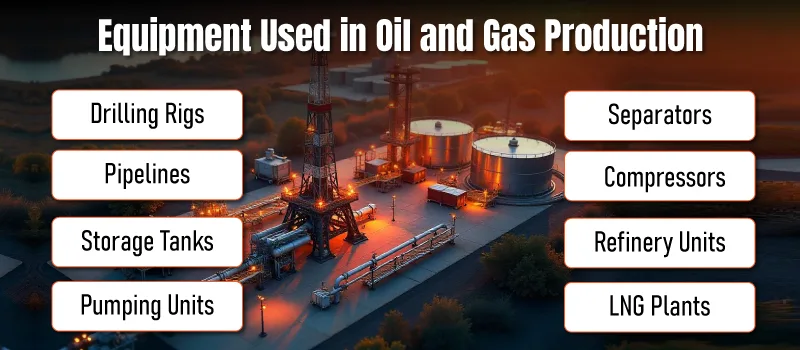
Production of oil and gas employs numerous specialized equipment and devices to achieve effective extraction, processing, and transportation of the precious resources. Below are some essential elements and their functions:
Drilling Rigs:
These are important devices used to create holes in the crust of the earth for the purpose of extracting oil and gas.
Pipelines:
They are transportation systems that carry oil and gas from extraction facilities to refineries and processing plants.
Storage Tanks:
Oil and gas are stored safely at various stages of production, ensuring secure handling and availability.
Pumping Units:
When the natural pressure in a well is deficient, pumping units lift oil to the surface.
Separators:
This equipment separates oil, gas, water, and sand during extraction, thus ensuring efficient processing.
Compressors:
They compress the volume of natural gas, making it easier and cheaper to transport.
Refinery Units:
They refine crude oil into useful products such as gasoline, diesel, and jet fuel.
LNG Plants:
LNG plants liquefy natural gas so that it can be stored and transported over a long distance.
This set of equipment works in harmony to enable the complex process of extracting oil and gas from subsurface reservoirs to end-users across the world. They all have a central role in making the industry efficient, safe, and dependable, offering various benefits to the industry.
Benefits and Techniques Behind Oil and Gas Production
Oil and gas are the lifeblood of modern life, powering homes, vehicles, and industries. It supports millions of jobs globally and drives economic growth. Additionally, by-products of oil and gas, plastics, and chemicals are essential to day-to-day devices: medicines, electronics, and clothing.
The process of production can be broken down into a number of main steps:
Exploration:
The use of seismic surveys and 3D imaging by companies to identify deposits of oil and gas beneath the earth.
Drilling:
Once identified, wells are drilled to extract the reserves.
Extraction:
Pressure systems and pumps move the resources to the surface.
Transportation:
Products are moved to consumers via pipelines, trucks, and ships.
Processing:
Natural gas and crude oil are refined into products consumed by consumers like gasoline, diesel, and natural gas, to be used as fuel for heating.
Methods such as hydraulic fracturing (fracking) and horizontal drilling have made production more efficient, tapping into what were earlier inaccessible reserves. More recent technologies, including carbon capture and storage (CCS), seek to minimize the footprint on the environment.
While the sector enhances energy security and economic growth, issues such as pollution and global warming are steering innovations towards cleaner and more sustainable production processes.
Top Oil and Gas Producing Countries
| Rank of the Country | Name of the Country | Key Highlights |
|---|---|---|
| 1 | United States | World’s top producer; major regions include Texas, North Dakota, and the Gulf of Mexico. |
| 2 | Saudi Arabia | Leader in crude oil exports; rich reserves in Ghawar, the world’s largest oil field. |
| 3 | Russia | Major exporter of oil and natural gas; key production areas include Siberia. |
| 4 | Canada | Home to vast oil sands in Alberta and significant natural gas production. |
| 5 | China | Largest energy consumer; produces oil and gas domestically, especially in the Bohai Bay region. |
| 6 | Iraq | Rich in oil fields like Rumaila, oil exports drive its economy. |
| 7 | United Arab Emirates | Key producer in the Middle East, Abu Dhabi is the hub for oil operations. |
| 8 | Brazil | Major offshore oil reserves; pre-salt fields are significant sources. |
| 9 | Eran | Huge reserves of oil and gas; faces export restrictions. |
| 10 | Kuwait | Rich reserves are concentrated in the Burgan field, one of the largest globally. |
These nations collectively dominate the global oil and gas markets, ensuring energy supply to millions worldwide.
Final Thoughts
Oil and gas production plays an important role in powering the modern world in that it powers transportation, industries, and homes and thereby supports the world's economy to grow. This intricate process entails exploration, extraction, transport, refining, and distribution, transforming raw materials into usable energy.
Despite its economic benefits, the industry faces environmental challenges, pushing innovation towards greener technologies and sustainability.
Some of the leading countries in the world, such as the United States, Saudi Arabia, and Russia, lead the world in production, promising energy security as well as economic growth. With the world moving towards renewable energy, oil and gas remain pivotal in fulfilling energy demands in line with a greener future.
People Also Ask
What is the Production Process of Oil?
Extracting oil from the ground, separating it from gas and water, and sending it for refining.
What are Production Operations in Oil and Gas?
Day-to-day tasks like extracting, processing, and maintaining equipment to ensure smooth production.
What are the Production Activities in Oil and Gas?
Includes drilling, pumping, separating fluids, and storing or transporting the extracted resources.
What does Production mean in Oil and Gas?
The process of bringing oil and gas to the surface and preparing them for sale or use.