To transfer mineral rights in Texas, the owner must execute a valid deed (Mineral, Royalty, or Gift Deed) containing a precise legal description of the property. This deed must be notarized and filed with the County Clerk where the land is located, followed by submitting a certified copy to the oil operator to update pay records.
The process of how to transfer mineral rights in Texas does not necessarily need to seem like a foreign language. Although the legal system does not establish these rights as more important than a physical house, there is a very specific map that should be followed.
It does not matter whether you are selling one acre in the Permian Basin or a giant family ranch; this is exactly how you can go through the transfer process without the legal headaches.
Understanding the "Split" Estate
Before we jump into the "how," you have to understand the "what." In Texas, property is like a double-decker sandwich. There is the surface estate (the dirt, the house, and the fence) and the mineral estate (the oil and gas).
These two layers can be "severed." This means you could sell your ranch to a developer but keep 100% of the oil rights for yourself. Because of this, selling a piece of land doesn't automatically mean you have sold the minerals.
If you are wondering how to transfer mineral rights in Texas, the very first thing you must do is check if those rights were actually yours to begin with. Many owners are shocked to find that a great-grandfather reserved the minerals back in 1940, leaving the current "owner" with only the surface rights.
The 4 Most Common Ways to Transfer Mineral Rights in Texas
Depending on your situation, you will likely follow one of these four paths:
- Selling: You sell your rights to a company or individual for a lump sum.
- Warning (SB 17): As of September 1, 2025, it is illegal to sell real property in Texas to citizens or entities of China, Russia, Iran, or North Korea. You must verify the buyer's status to avoid a void transaction.
- Gifting: You convey ownership to a family member or a Trust for $0 (often for estate planning).
- Probate (With a Will): You inherit rights from a loved one who left a clear will.
- Heirship (Without a Will): You inherit rights from a relative who passed away without a will (Intestacy).
Required Mineral Transfer Documents (Deeds & Affidavits)
| Document Type | What it Does | Best For... |
|---|---|---|
| Mineral Deed | Moves the whole "ownership" bucket. | Sales and permanent family gifts. |
| Royalty Deed | Only moves the "check-receiving" right. | Keeping control but sharing the money. |
| Affidavit of Heirship | Proves you are the rightful heir. | Avoiding full probate for small interests. |
| Executor’s Deed | Moves minerals out of a deceased person's estate. | Handling a will through the court. |
How to Transfer Mineral Rights in Texas via Sale or Gift
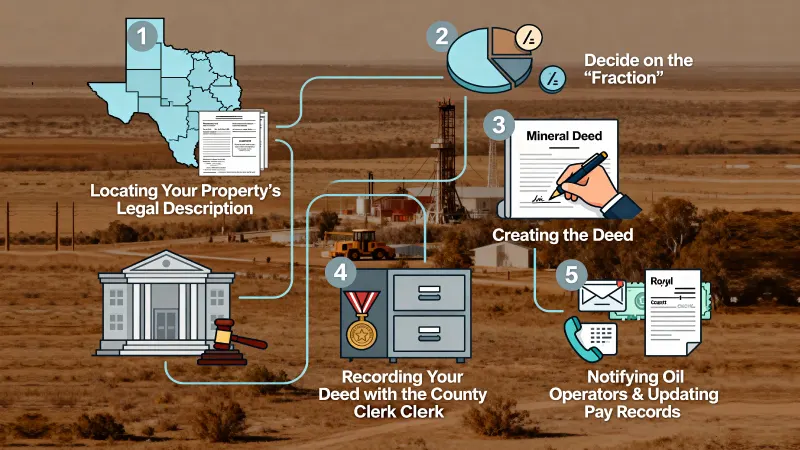
If you are currently the owner and want to transfer your interests to someone else, follow these five steps. Doing this correctly the first time prevents "suspended royalties," the dreaded situation where an oil company holds your money in a bank account because they are not sure who to pay.
Locating Your Property's Legal Description
Don't guess what you own. You need to find your Legal Description. This is a particular set of coordinates rather than a street address, such as 'Abstract 42, Block 5, Section 10, 40 acres out of the Jones Survey.' (Always use the description from your previous deed, not the tax roll)."
Action: Look at your last "Division Order" (the document the oil company sent you).
Action: Check your most recent royalty check stub. It usually lists the county and your "Decimal Interest."
Decide on the "Fraction"
You don't have to transfer everything. You can choose to:
Transfer 100% of your interest.
Transfer a "fractional undivided interest" (like 50% to your son and 50% to your daughter).
Transfer the royalties but keep the "Executive Rights" (the power to sign new leases).
Creating the Deed (The Most Important Part)
This is where most people fail when figuring out how to transfer mineral rights in Texas. A Texas deed must be in writing and include:
Confidentiality Notice: The top of Page 1 MUST list the statutory 'Notice of Confidentiality Rights' (Texas Property Code § 11.008) in bold, uppercase text.
Marital Status: The Grantor must be listed as 'a single person' or 'husband and wife' to satisfy title insurers.
Grantee's Address: You must list the Grantee’s mailing address, or the County Clerk will charge a penalty fee.
The Grantor & Grantee: Clear identification of who is giving and who is receiving."
Pro Tip: Avoid "Quitclaim Deeds." In Texas, oil companies hate them. They don't guarantee that you actually own the minerals; they just say, "If I own anything, I am giving it to you." Use a General Warranty Deed or a Special Warranty Deed instead.
Disclaimer: This information is provided for educational purposes only and is not legal advice. For specific transactions or legal document execution, please consult with a licensed Texas attorney.
Recording Your Deed with the County Clerk
A deed is not a "legal" transfer in the eyes of the public until it is recorded.
- Sign it in front of a Notary Public.
- Take the original to the County Clerk’s office in the county where the minerals are located. (Leave a 3-inch blank margin at the top of Page 1 for the clerk's stamp. Also, bring your Photo ID (SB 16); effective 2026, the clerk must scan the ID of the person physically filing the document.)
- Pay the fee. It's usually around $25-$50 for the first page.
- Get it back. The clerk will stamp it with a Volume and Page number. This is your "receipt" to the world.
Notifying Oil Operators and Updating Pay Records
The County Clerk doesn't call the oil company for you. You must send a certified copy of the recorded deed to the Division Order Department of every company currently drilling on your land. Once they see the recorded deed, they will issue a new "Division Order" to the new owner. You must also send a copy to the County Appraisal District. If you don't, the property tax bill will go to the wrong person, which could lead to penalties or foreclosure.
How to Transfer Mineral Rights in Texas After a Death
When an owner passes away, the process of how to transfer mineral rights in Texas changes. Texas law treats minerals as "real property," meaning they don't just automatically move to the next of kin without paperwork.
If There is a Will (The Probate Path)
If the owner had a will, it must be "admitted to probate" in a Texas court.
(Note: Texas law generally requires wills to be probated within 4 years of death. If it has been longer, you may need a 'Muniment of Title' instead.)
The Executor's Role: The court-appointed executor will sign an Executor's Deed to the heirs listed in the will.
Recording: Just like a sale, this deed must be recorded in the county where the minerals are.
The "Out of State" Problem: If the owner died in Oklahoma but owned minerals in Texas, you usually have to do an Ancillary Probate (legal process of transferring Texas mineral rights from a deceased out-of-state owner to their heirs) in Texas. You cannot just file Oklahoma paperwork and expect a Texas oil company to pay you.
If There is No Will (The Heirship Path)
Many families use an Affidavit of Heirship. This is a document signed by two "disinterested witnesses" (family friends or neighbors who don't benefit from the minerals).
It outlines who the deceased person was, who they married, and who their children are.
Once recorded, this creates a "link" in the chain of title from the dead owner to the living heirs.
Warning: Large oil companies (like Exxon or Chevron) sometimes refuse Affidavits of Heirship for high-value wells. They may require a "Judicial Determination of Heirship," which involves a judge making the final call.
Special Hurdles: Trusts, Divorces, and LLCs
Divorce Settlements
In case you obtained the minerals in a divorce, a "Divorce Decree" would not suffice to make any changes with the oil company records. You have yet to have signed a Special Warranty Deed by your ex-spouse, which must be registered in the county books.
Living Trusts
Relocating minerals to a Trust to evade probate is a brilliant action. In order to accomplish this, you (the person) need to sign a deed where the rights are conveyed to the [Your Name] Family Trust. Your Successor Trustee will be able to transfer you to your children without setting foot in a courtroom when you pass away.
The "Fractional" Trap
Mineral rights have a tendency to be divided into small pieces through the generations. Considering that a grandfather had 100 acres and had 10 kids, and the 10 kids had 5 kids, the end result is people owning 0.002345 of an acre. When in this case, then it is frequently better to organize an LLC or Family Partnership to possess the entire mineral collectively so that the oil company need not write 50 small checks to the 50 cousins.
Common Mistakes When Transferring Texas Mineral Interests
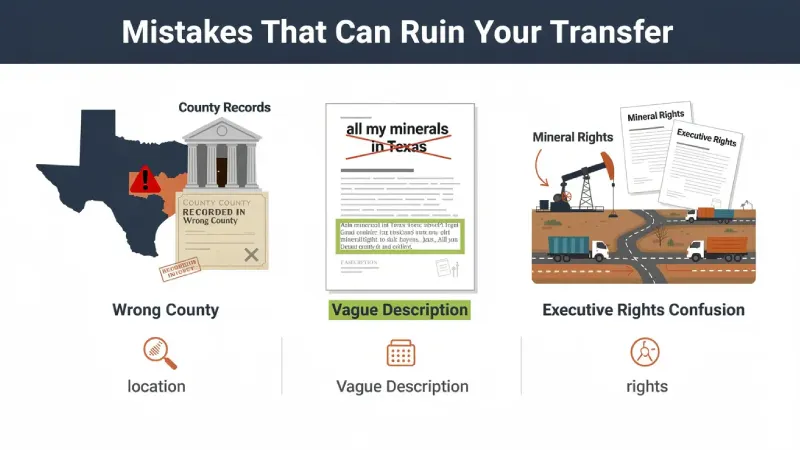
Missing the County: If your minerals are in Reeves County, but you record the deed in Harris County, the transfer is legally invisible. You must record in the county where the land is.
Vague Descriptions: Writing "all my minerals in Texas" is too broad. While it might work in some narrow cases (called a "Mother Hubbard" clause), oil companies often reject it. Be specific.
Ignoring the "Surface" Owner: In Texas, the mineral owner has the right to use the surface to get to the oil. However, if you are transferring rights, make sure you clarify if you are also giving away the Executive Rights (the power to negotiate where the trucks and rigs go).
Final Thoughts on Professional Help
You might be wondering if you can do this yourself. If the interest is small and the chain of title is clean, a savvy person can learn how to transfer mineral rights in Texas using standard forms.
However, if you are dealing with
Multiple deceased generations who never probated a will.
Minerals across five different counties.
A high-producing well paying thousands a month.
In those cases, hire a Professional Landman or an Oil and Gas Attorney. They can run a "Title Opinion" to make sure there are no "gaps" in your ownership that will haunt you ten years from now.
Summary Checklist: How to Transfer Mineral Rights in Texas
Find your Legal Description (Survey/Abstract).
Draft a General or Special Warranty Deed.
Get the deed notarized.
File the deed with the County Clerk.
Send the recorded copy to the Oil & Gas Operator.
Sign the new Division Order and start receiving checks.
Conclusion
Knowing how to transfer mineral rights in Texas is about more than just signing a piece of paper; it is about protecting a legacy. Because oil and gas law in the Lone Star State is unique, you must be diligent. Whether you are dealing with a complex mineral interest or simple oil and gas royalties, the process requires a clean paper trail.
Start with a thorough title search in the county deed records to verify the current mineral ownership and ensure there are no hidden gaps in the chain of title. If you have inherited mineral rights, the transition to new ownership often requires more than just a death certificate.
You will need to ensure all recorded original documents, such as probate orders or heirship affidavits, are filed correctly to bridge the gap between the land and mineral rights. Unlike a standard home sale, where a title company handles every detail, a mineral rights transfer puts the responsibility on you to ensure the mineral deed form is drafted perfectly to reflect the exact royalty interest being moved.
Navigating the split between surface and mineral rights can be tricky, and many families find that an initial consultation with a professional helps clarify their goals. By using the correct property deeds and ensuring every document is recorded in the proper county, you ensure that the wealth generated from under the ground stays exactly where it belongs, in the hands of the new mineral owner.
Ultimately, doing it the "Texas way" ensures your oil and gas royalties keep flowing without a hitch. Whether you are selling for a windfall or passing a blessing to the next generation, a precise transfer is the best gift you can leave behind.