Are you trying to decipher how to buy mineral rights in texas? Surely, It is a clinical process with risk involved. However, we will give you a clear understanding of buying texas mineral rights!
Through this comprehensive buying guide (with leasing and selling), you will understand the legal background of the deal, drivers of value, regional peculiarities, risks and the entire process of buying the minerals.
Whether you want to buy, lease, or sell mineral rights, or just calculate your royalty interests, this guide will assist you in everything! But before we go ahead, let’s understand the types of mineral rights, values, and interests.
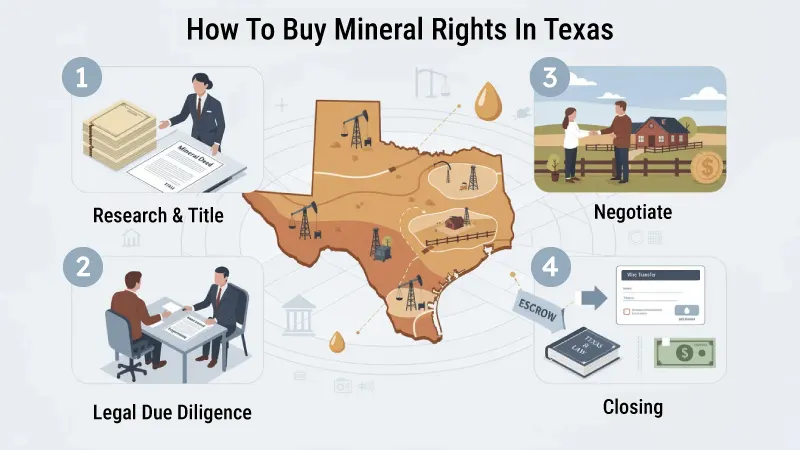
Facts you Should Know
Texas residency is not required to buy minerals.
Mineral ownership is determined from county records, not surface deeds.
There is no minimum acreage, but very small interests may be uneconomic.
Surface use restrictions must be written into legal documents.
First royalty checks usually arrive 2–4 months after recording.
Types of Mineral Rights Values and Interests
The term “buying mineral rights” specifically refers to oil and gas operations, production, and other mineral assets like natural gas. Throughout time, Mineral ownership can be divided among several mineral owners based on the well trajectory or tract.
Regardless, here are the major types of mineral estate interests that are included in mineral rights:
- Mineral Estate: 100 percent ownership of minerals, leasing & bonuses and royalties.
- Royalty Interest: The portion of production revenue without any control over leasing.
- Non-Participating Royalty Interest (NPRI): Revenue without executive rights.
- Working Interest: Interests with drilling and operating costs liabilities.
According to the Texas law, the mineral estate is considered dominant, which implies that the mineral owners or leased area are allowed to utilize the surface reasonably as required to develop it, but it is governed by the doctrines and negotiated pacts.
What a Mineral Owner Should Know Before Buying Mineral Rights
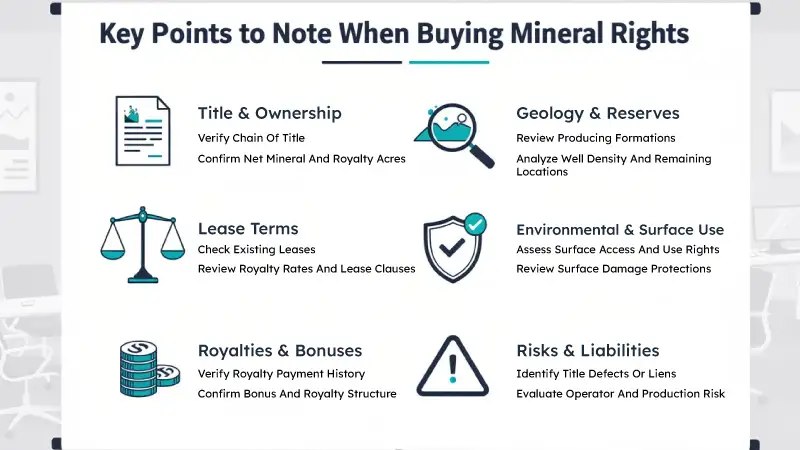
Before making an offer, confirm exactly what interest is being purchased. County records are essential, but attorneys and landmen provide clarity. Mineral values are not stable. The higher or lower value of minerals mainly depends on location, production status, and commodity prices; there is no statewide average.
The typical way to buy mineral rights in Texas involves pricing, defining strategy, due diligence, signing agreements, recording deeds, and notifying operators and appraisal districts. Remember that minerals are depleting assets with swings in price, title risk, and tax considerations.
Before jumping into the core section of the topic, here is a basic but important understanding of the difference between leasing and buying mineral rights that you should know.
Leasing vs. Buying Mineral Rights in Texas
Texas landowners face a fundamental choice: they can lease their existing minerals to an oil and gas operator, or they may purchase or sell minerals and royalty interests outright. Knowing the differences between each path's capital requirements and risk profiles will help you make decisions about your investment strategy.
Leased Mineral Rights from the Owner’s Perspective
Leasing typically involves a 3–5 year primary term, a 12.5%–25% royalty, and an upfront bonus. Operators bear drilling risk, while leases may be held by production for decades.
Buying Mineral Rights Outright
Buying minerals needs upfront investment but provides long-term upside from royalties and future leasing. The strategy carries risk from declining production, title defects, or lack of development.
Option Agreements in Texas
Options allow the purchaser to protect the right to purchase minerals later, limiting risk if anticipated drilling does not occur.
Quick Comparison: Leasing vs. Buying
| Factor | Leasing Your Minerals | Buying Minerals |
|---|---|---|
| Capital required | None upfront | Full purchase price |
| Risk level | Low (operator bears drilling costs) | Higher (you bear the acquisition cost) |
| Income timing | Bonus at signing, royalties if production | Royalties from existing production, future bonuses |
| Control | Limited after signing | Full ownership rights |
| Best for | Landowners with existing minerals | Investors building mineral portfolios |
Market Forces That Influence Mineral Values in Texas
Mineral pricing in Texas is not standardized. Values are privately negotiated and heavily influenced by broader oil and gas markets, time required for development, and geology. Two tracts of identical size in different counties can have valuations differing by a factor of ten or more.
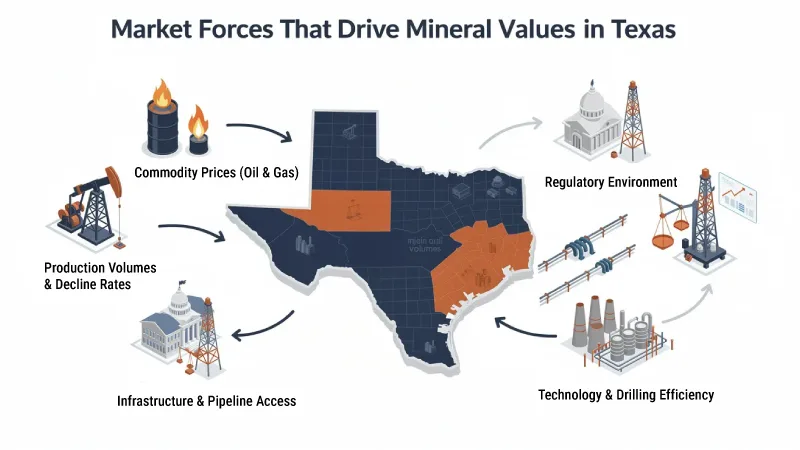
Here are the major factors that influence mineral values in Texas:
Commodity Prices
When World Texas Intermediate (WTI) crude trades above $80 per barrel and Henry Hub natural gas prices remain strong, mineral buyers typically pay more than the current cash flow. Operators generate more revenue per barrel, which flows through to royalty owners and makes mineral investments even better.
In low-price environments, offers shrink dramatically. Some buyers pause acquisitions entirely, waiting for distressed sellers or better entry points. This cyclicality means the timing of a mineral purchase may heavily influence both the price paid and long-term returns.
Basin and County Location
Permian Basin counties can give you better value per net royalty acre than less active areas. A producing mineral interest in Midland or Martin County might trade at $25,000-$50,000 per Net Royalty Acre (NRA) or more, while similar production volumes in a peripheral county might fetch only a fraction of that price.
Natural gas price outlooks have a greater impact on gas-focused locations, such as the Haynesville field in East Texas, than crude oil prices. Buyers in these regions pay close attention to Liquid Natural Gas (LNG) export capacity expansions along the Gulf Coast, which directly impact long-term gas demand.
Activity Indicators Texas Mineral Buyers Watch
Sophisticated mineral buyers monitor several leading indicators:
- Drilling permits filed with the Texas Railroad Commission (RRC) signal operator intentions
- Active rigs within a few miles of the tract suggest near-term development
- Drilled but uncompleted wells (DUCs) already spud on or near acreage represent wells awaiting completion crews
- Unitization and density patterns help you understand how many wells per section are typical in that field
Mineral View’s Lease Notification Hub or Mineral View Maps can help you understand drilling permits, active rigs and their production stats in just a few clicks.
Infrastructure and Midstream Build-Out
- New oil and gas pipelines improve takeaway capacity
- Gas processing plants and Natural Gas Liquids (NGL) facilities add revenue streams
- Produced water disposal systems in the Permian lower operating costs significantly
Large pools of capital mineral funds, family offices, and private equity compete aggressively in core Texas basins. This competition raises pricing for high-quality packages while also allowing for off-the-beaten-path negotiations between local landowners to occur.
Large Capital Players in Texas Mineral Rights
Since around 2010, specialized mineral and royalty funds, public mineral companies, pension-backed vehicles, and family offices have raised hundreds of millions of dollars specifically to acquire Texas royalties and minerals. These groups frequently target on a scale within certain basins. Midland Basin only, for example, and can proceed swiftly, even exceeding smaller local buyers.
Individual Texas landowners can still Find Good Chances in these Ways:
- Working directly with neighbors or heirs who want to sell
- Focusing on smaller scattered interests (under 10 net mineral acres) that institutional funds typically ignore
- Being flexible on deal structure, offering installment payments, partial purchases, or creative terms that big funds won’t consider
Operators as Non-Operated Interest Owners
Many exploration and production companies that operate wells also own non-operated working interests or mineral interests in other operators’ wells. This creates occasional opportunities for mineral buyers.
Smart purchasers can purchase high-quality assets at fair rates when an operator leaves a region and sells non-core mineral or royalty positions. In a similar way, individual purchasers may discover appealing ways to enter when operators sell non-operated positions or overriding royalty interests to raise money.
Following operators’ “areas of interest” through courthouse and RRC filings helps anticipate where drilling will expand, potentially identifying mineral acquisition targets before activity heats up.
Individual landowners should exercise caution about partnering directly in working interests due to joint interest billing responsibilities, which may require substantial monthly capital contributions during drilling and completion phases.
Natural Gas, NGLs, and the Energy Transition
Gas-heavy regions such as the Haynesville shale play and parts of the Eagle Ford depend on LNG demand, infrastructure, and gas prices. Despite energy transition trends, Texas hydrocarbons are expected to produce substantial amounts in the future.
Did you Know?
For East Texas landowners, mineral value ties more closely to long-term gas price expectations and LNG export capacity than to global crude prices. New gas pipelines, processing infrastructure, and flaring restrictions all improve economics for gas-heavy wells and thus the value of royalties tied to them.
Evaluating a Texas Mineral or Royalty Deal
As a Texas landowner or investor, you need to be aware of the production status, acreage, type of interest, and possible upside before making an offer to purchase mineral or royalty interests. When these elements come together, they either add value to the quote or show that the asking price is too high.
Here are some crucial terminologies that you should know regarding mineral or royalty deals:
Production Status: Non-Leased, Leased, and Producing
Non-leased, non-producing minerals are highly speculative. They can be acquired cheaply, sometimes for a few hundred dollars per net mineral acre in non-prospective areas, but may never be drilled. If a tract sits outside core development zones, lacks infrastructure, or presents geological challenges, your royalties could be well near nothing or zero.
Leased but non-producing minerals usually hold more value because an operator has already committed capital to acquire a lease. However, risk remains significant if the lease term is nearly expired without a well being spud. Always confirm lease expiration dates and any drill-to-earn provisions.
Producing minerals are valued primarily on existing royalty income plus realistic upside from additional wells. Producing interests are valued at a multiple of the net cash flow for the previous 12 months in Texas, with adjustments made for well age, decline rate, and anticipated commodity prices.
Decline Curves and Well Age
Modern horizontal wells in Texas shale plays (Permian, Eagle Ford, and Haynesville) typically show:
- Very high Initial Production (IP) in the first year
- Steep declines over the years two through five
- A long tail of lower-rate production extending for years afterward
Buyers without reservoir engineering expertise often rely on production charts from the Railroad Commission (RRC) or third-party tools to find decline rates.
For comprehending decline curves and well age, we provide MVestimate and the Lease and Well Cash Flow Analysis tool, which are the best on the market.
Register and claim any lease from Texas to access its MVestimate and Cash Flow Analysis.
Acreage: Net Mineral Acres and Net Royalty Acres
Net mineral acres (NMA) represent your proportionate ownership of the mineral estate. If you own 50% of the minerals under a 40 acre tract, you own 20 NMA. This determines your share of any lease bonus and production revenue.
Net royalty acres (NRA) standardizes comparisons between deals with different royalty rates. For example, 1 NMA leased at a 25% royalty rate might be treated as 2 NRA if 12.5% is the baseline, since 25% doubles the revenue per acre compared to the standard.
A Pro Tip for the market:
Verify NMA and NRA claims against recorded deeds, leases, and division orders. Misunderstandings, concerns, and errors are surprisingly common in older Texas title chains, where mineral ownership has passed through multiple generations.
Example: A Texas landowner buying 5 NMA under a 640-acre unit with a lease paying 20% royalty would own 5/640 of the unit’s mineral interest. Their share of each well’s production would equal that fraction multiplied by 20%. If the unit has one well producing $100,000 monthly in gross revenue, the landowner’s monthly share before taxes would be approximately $156 ($100,000 × 5/640 × 0.20).
Step-by-step verification
Given:
Net Mineral Acres (NMA): 5
Unit size: 640 acres
Royalty rate: 20% (0.20)
Gross monthly well revenue: $100,000
Mineral ownership fraction
5/640 = 0.0078125
This is the landowner's share of the unit's minerals.
Apply the royalty rate
0.0078125 x 0.20 = 0.0015625
This is the landowner's Net Royalty Interest (NRI).
Apply to the monthly revenue
$100,000 x 0.0015625 = $156.25
Permits, Rigs, DUCs, and Unit Sizes
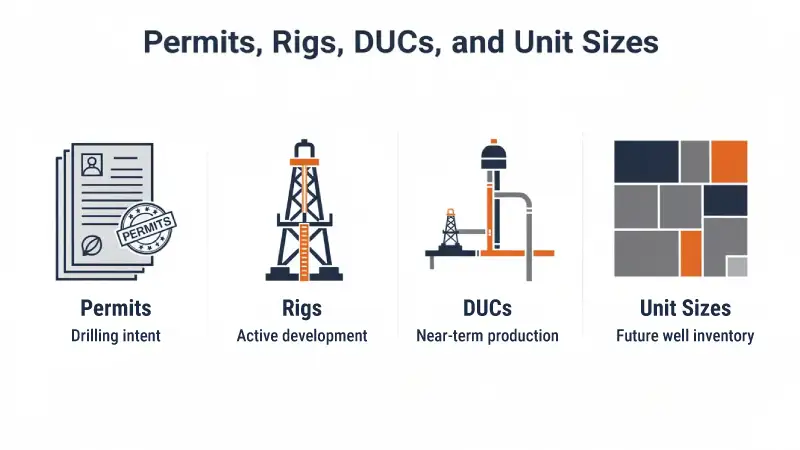
Signs of success include active drilling permits on or close to the target tract. Rigs operating within a 1-3 mile radius suggest an operator is actively developing that field and may soon drill on the buyer’s tract.
If you want to find out how many wells there are in any part of Texas within five miles or who the top operator is in your county or area, use a visual GIS map. Mineral View's Map is the ideal tool to obtain all these facts.
Unit Size Matters Significantly for Upside Potential:
Texas units range from small conventional 40-acre units to 640-acre sections or larger for horizontal wells.
Operators pursuing “cube development” and multi-bench drilling in the Permian can drill dozens of wells per section.
A 640-acre horizontal unit in Howard County with 2 existing wells but room for 8-10 additional wells may justify a premium purchase price due to the remaining drilling inventory.
Operator Quality
Research which operator runs the wells or holds the leases covering the minerals you want to acquire:
- Large, creditworthy operators like ExxonMobil, Pioneer, Diamondback, or EOG generally have capital to drill and complete wells on schedule
- Smaller private operators may develop more slowly or sell assets, potentially delaying upside
- Check operator drilling history in the county through RRC data
- Review safety and environmental records
- Consider any public information about financial health
Explore Mineral View’s Operator Hub
The Texas Mineral Buying Process: Step-by-Step
Get your notepads out and start jotting down!! Below is the step-by-step process for buying mineral rights in Texas:
Define Your Strategy and Budget
Before contacting sellers, clarify your reason for buying mineral rights. You can be pulling family-owned interests together, trying to get a regular flow of income from producing wells, or investing in long-term upside in an emerging Texas play.
With a clear goal, then you can establish a reasonable budget that encompasses purchase price, title work, legal fees and county filing costs. Deals of a bigger size can likewise involve engineering investigations or expert valuations. Diversify counties or basins to eliminate concentration risk.
Determine an Offer Price
In Texas, the prices of the mineral are not centrally negotiated, and there is no single central market. Offers are often made under a price per net mineral acre, net royalty acre or various times the recent royalty income. Purchasers normally consider six to twelve years of production history, make adjustments on decline rates, and consider future prospects of drilling. Different counties and well ages have different market conditions, and pricing benchmarks are nothing beyond reference points. A lot of buyers will begin with a non-binding offer range and narrow it down after first reading it.
Negotiate and Set a Due Diligence Period
Preliminary bids are normally approached by writing directly to mineral owners by letter, email, or personal discussion, occasionally through the involvement of a broker. After the principal agreement between the two parties, a due diligence time is initiated to authenticate title and production information.
Small dealings take about 20-45 days and multi-track packages will take even longer. Buyers are able to reinvent or back away during this period in case problems occur. Effective written communication prevents miscommunication even in family dealings.
Run Title and Legal Due Diligence
Title due diligence in Texas is the process through which the ownership of minerals can be traced by records of the county to establish what is being sold. In this process, values are realized in terms of ownership percentages, reservations, liens and lease conditions.
It is highly advisable to recruit the services of a landman or Texas oil and gas attorney in most of the deals that exceed 10,000. Title expenses are different according to the complexity, particularly on old West Texas real estate. Due diligence helps keep the buyers out of expensive post-close surprises.
Draft and Sign the Purchase and Sale Agreement
After due diligence has been done, an agreement is then recorded in a Purchase and Sale Agreement. This contract will specify the parties, description of legal property, purchase price, timescales, and representations on the title and authority to sell.
It also outlines the process of amendments or conflicts in case of finding some problems. A bigger or more complicated transaction would be better reviewed by law. The PSA anticipates expectations prior to the execution of the mineral deed.
Closing, Funding, and Recording the Deed
When closing, a deed to minerals or royalties signed by the seller is notarized, and the buyer brings money in the form of wire or cashier. Closings can be in person, by mail or via an escrow agent like a title company or attorney.
The act should then be registered at the county clerk in the place where the minerals are found. Recording charges are usually minimal and it depends on the county to process the record. Legal descriptions are necessary to prevent title problems in the future.
Notify Operators and Appraisal Districts
Once recorded, the operators should be informed of the ownership transfer by submitting a copy of the deed and a signed W-9. Buyers are expected to act quickly on the orders to make royalty payments by responding to division orders.
It is common to have delays in payment because operator systems might take weeks to implement the change. An update should also be done to the county appraisal districts to send out the tax bills to the rightful owner. Planned expenditures should be in the form of ongoing property taxes.
Additional Risk, Taxes, and Practical Tips for Texas Landowners
Buying minerals involves concentration risk, declining wells, title defects, and operator uncertainty. Minerals are depleting assets, unlike traditional real estate. Royalty income is federally taxable, with benefits such as percentage and cost depletion. Consult oil-and-gas-experienced CPAs.
Practical Tips:
Keep records, review statements, start small, prioritize a clean title, and work with Texas professionals.
Conclusion
It takes thorough due diligence research, disciplined valuation, and legal knowledge to understand how to buy mineral rights in Texas. Buyers can make well-informed judgments and steer clear of expensive blunders by comprehending area dynamics, market factors, production dangers, and the detailed acquisition process.
Texas mineral ownership can be a significant long-term asset with the correct approach and expert assistance.
Disclaimer: This article is for educational purposes only and does not constitute legal, tax, or investment advice.