The US holds numerous shale plays and basins that enhance the outlook of the oil and gas industry. These shale plays act as a transformative tool for the energy industry, ultimately contributing to the nation’s financial growth.
Among all the shale plays, there is one high-potential shale, Marcellus Shale—the shale with less recognition, holding extensive natural gas reserves. In this informative blog you will explore all the crucial aspects of Marcellus Shale—navigating an uncertain future in oil and gas.
Predicting the future of oil and gas may be complex, as price fluctuations in the market, market demand, environmental issues and shifts in the energy market influence the industry significantly. However, shale plays like Marcellus shale contribute in shaping the landscape of this industry. Let's understand what the Marcellus Shale basin is.
What Is the Marcellus Shale Basin?
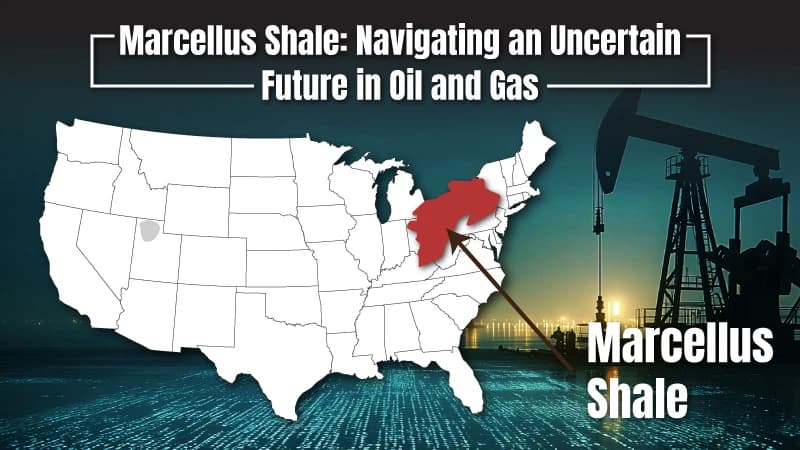
The Marcellus Shale basin is the middle Devonian-aged massive sedimentary formation that holds the high-potential hydrocarbon reserves. It is made up of small amounts of lighter shale, interbedded limestone and predominant black shale.
The shale’s black color due to these elements and radioactive footprints makes it easy to detect in the field for mineral experts. It is widely spread in an area of approximately 90,000 miles and lies under the northern Appalachian region. The area of this shale covers the maximum of these states: New York, Ohio, Pennsylvania, Maryland and West Virginia.
The shale formation lies in an intense, deeper region around 9000 feet down in the earth. Due to its presence in deeper earth, several high-potential hydrocarbon reserves are left to be recovered. According to mineral experts, this shale could hold the natural gas in trillions of cubic feet, which could be extreme growth for the energy independence of the US.
Since its discovery, oil and gas companies have drilled fewer wells in the area. Yet, today’s technology, such as hydraulic fracturing and horizontal drilling, can bring positive production output from this field. Let's explore how this shale has come to rise through its history.
History of the Marcellus Shale Basin
The Marcellus shale basin was uncovered till the late 19th century and discovered later. Below is the detailed timelined history of the shale.
-
Middle Devonian Period (~ 390 million years ago)
-
The Marcellus shale basin started forming in the Appalachian region as a part of an inland sea. It was under the water
-
Due to its early beginning in water, marine life continued combining with fossilized and sedimentary rocks, making a high carbon-rich shale formation.
-
-
Post Middle Devonian Period
-
The formation remained forming and came out of water bodies.
-
-
1839
-
The member of the New York State Geological Society, James Hall, first discovered the formation. Since it was in Marcellus, Onondaga County, New York, he gave it a name as “Marcellus Shale”.
-
-
1930s
-
The vertical well drilling approximately 1000 feet deep began in the region, discovering the high potential natural gas reservoirs.
-
However, this gas was not commercially viable due to isolated gas pockets.
-
-
Late 1970s to Early 1980s
-
Due to the implementation of coring and exploratory drilling, the Marcellus Shale distribution was mapped in Pennsylvania. It was the first step towards commercial gas exploration.
-
Later, the Pennsylvania Geological Survey discovered the shale as the massive field of natural gas regardless of its minimum permeability.
-
-
Up to 2005
-
The well drilling continued in the field. Around 100 vertical wells were able to produce less than 1.5 million SCF per day of natural gas.
-
-
After 2005
-
The mineral experts identified the potential of shale and decided to utilize the latest drilling techniques in the shale. The Range Resources became the first to implement hydraulic fracturing and horizontal drilling on the field, enhancing the production output.
-
The integration of these techniques marked the significant production within the shale basin, making it one of the largest shale gas plays in the US. It covered the area of approximately 104,000 m²across Virginia, Ohio, Pennsylvania and New York.
-
-
Present Day
-
Around 14,000+ wells have been drilled in the shale basin, which are able to produce around 25 billion SCF of natural gas each day. This production is nearly one-third of the US's total natural gas production.
-
Due to its maximum natural gas production, several oil and gas companies and mineral owners have owned the Marcellus Shale Mineral Rights. However, to earn substantial returns, selling these mineral rights can be the right option.
-
Best Time to Sell Marcellus Shale Mineral Rights
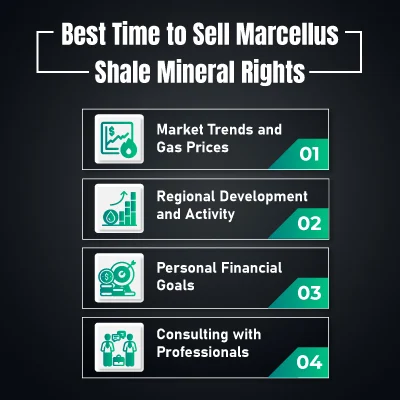
Knowing when to sell your mineral rights can have a big impact on your financial return if you possess oil and gas minerals in Pennsylvania's Marcellus Shale. A number of variables, such as market demand, gas prices, and area development activities, might affect when you sell in the Marcellus Shale, a natural gas deposit with abundant reserves. Instead of waiting for a range of erratic market conditions to occur, the majority of landowners choose the assured lump sum payout.
Below are some important factors you should keep in mind before selling Marcellus Shale Mineral Rights.
-
Market Trends and Gas Prices
Strong market demand and high natural gas prices frequently correlate with the ideal time to sell mineral rights. You can determine when these conditions are good by monitoring changes in the energy market. It's important to keep updated because prices may change based on seasonal demand shifts, geopolitical events, and economic considerations.
There has been a decline in oil and gas during the past 12 months. Additional facilities are prohibited from exporting LNG by the current administration. Natural gas prices are negatively impacted by this. So before selling your mineral rights you must be aware of market trends and gas prices.
-
Regional Development and Activity
An appropriate time to sell mineral rights may also be indicated by increased drilling and development activities in the Marcellus Shale region. The announcement of new pipelines or infrastructure projects frequently increases buyer interest, which could raise the value of mineral rights.
Due to pipeline limitations, the Marcellus Shale has fewer buyers than the Permian Basin and Haynesville Shale. Your best bet for getting the most money for your oil and gas rights is to work with local Marcellus buyers.
-
Personal Financial Goals
Think about your objectives and financial status. A sizable lump sum payment from the sale of mineral rights may be appropriate for investing in other projects or reaching personal financial goals. A recession is about to hit the economy. Paying off debt (credit card, mortgage, etc.) would be good, wouldn't it?
To earn maximum financial profit from these debts, you can sell all or a portion of your oil and gas rights. You can then utilize these lump sum payments to take that dream vacation or purchase that vacation home you've always wanted.
-
Consulting with Professionals
The last and best option is consulting with professionals in the field who are familiar with the specifics of the Marcellus Shale market might yield insightful information before making a decision. They can guide you through the intricacies of the sale process and provide advice catered to your unique situation.
Marcellus Shale: A Natural Gas Revolution
The Marcellus Shale is an area that is as resource-rich below as it is beautiful above, covering 104,000 square miles in Pennsylvania, New York, West Virginia, and Ohio. Prior to recent developments in drilling technology, it was challenging to reach the enormous natural gas reserves found in this shale formation.
Drillers were previously aware of the gas pockets but found it difficult to economically extract them. The problem? Rock with low permeability traps shale gas. These resources weren't available until 2008, when hydraulic fracturing (fracking) and horizontal drilling were introduced. Since then, the Marcellus Shale has grown to be the United States' greatest natural gas source, igniting what many refer to as a contemporary gold rush.
The effect on the economy has been revolutionary. There are now nearly 7,000 drilled wells in Pennsylvania alone, up from just 4 in 2005. In addition to creating 139,000 jobs, the industry has brought in $11.2 billion in local revenue. But there has been some debate about this boom.
Strict state laws are the result of worries about environmental hazards such spills, contaminated water, and pollutants. Compared to other states, Pennsylvania has among of the strictest fracking regulations in the country, which drives up costs by about $1 million per well.
Although the development of natural gas has boosted economic growth, discussions about its effects on the environment continue. In this crucial area, finding a balance between sustainability and energy development is still difficult. Yet in future this may deliver the positive production results-stated by mineral experts.
The Future Outlook for Marcellus Shale
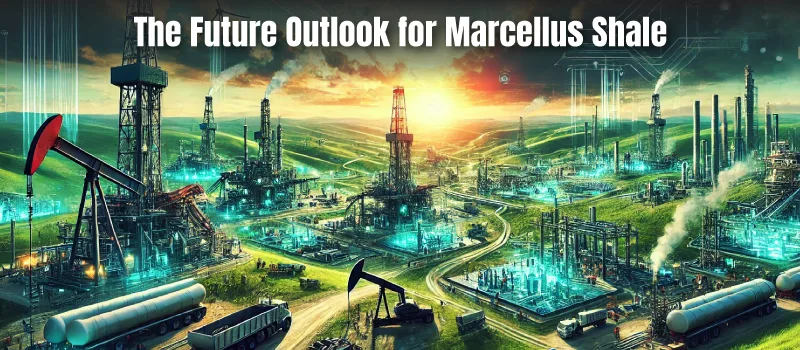
One of the biggest natural gas deposits in the US is still the Marcellus Shale, which is found in the Appalachian Basin. Technology breakthroughs and the rising demand for greener energy sources like natural gas bode well for its future.
Improved hydraulic fracturing and drilling methods have made natural gas extraction more economical and efficient, which is one of the main factors propelling its expansion. Natural gas is also a desirable substitute due to the United States' transition to energy independence and the worldwide movement to lessen dependency on coal.
However there are some issues. Stricter rules may result from environmental worries about methane emissions, water use, and community effects. For energy firms, they could result in higher expenses. Pipeline capacity limitations and other infrastructure obstacles make it difficult to get the gas to markets.
The future is bright despite these issues. It is anticipated that infrastructure investments, such as new pipelines and export facilities, will improve accessibility and profitability. Additionally, natural gas from the Marcellus Shale is positioned as a crucial bridging fuel as the globe moves toward low-carbon energy options. Similar to the Marcellus shale basin there are other shale plays that produce a significant amount of oil and natural gas.
Top 10 Major Shale Plays in the U.S. Shaping the Oil and Gas Industry
| Company | Location | Oil Production (Barrels/Day) | Natural Gas Production (Cubic Feet/Day) | Key Features |
|---|---|---|---|---|
| Permian Basin | Western Texas | 1.3 million | 5 billion | Started drilling in the 1920s; advanced tech improved yield. |
| Eagle Ford Shale | Southern Texas | 1.2 million | 6 billion | Covers 400 miles; four companies handle 45% of drilling. |
| Marcellus Shale Play | Appalachian Basin | 50,000 | 13 billion | Largest gas producer; 80% of drilling focuses on gas. |
| Niobrara | South Dakota, Colorado, Nebraska, Wyoming | 287,000 | 4.6 billion | Major drilling in northeast Colorado spans four states. |
| Barnett Shale Play | Texas | 15,500 | 4.5 billion | Largest onshore natural gas field; challenging extraction. |
| Haynesville | Louisiana, Arkansas, Texas | 57,000 | 6.7 billion | Provides 10% of U.S. daily gas; reduced gas prices significantly. |
| Bakken Shale | Montana, North Dakota | 1 million | 1 billion | Significant oil discovery; tech advancements enabled drilling. |
| Anadarko-Woodford Shale | West-Central Oklahoma | 1,300 | 47,000 | Nearly 900 wells; estimated 22.2 Tcf of recoverable gas. |
| Granite Wash | Texas, Oklahoma | 3,200 | 27 million | New play; up to 15 frac stages; production expected to grow. |
| Utica Shale | New York, Pennsylvania, Ohio, West Virginia | 1,425 | 9.5 million | Newest discovery (2011); potential for significant growth. |
Conclusion
With its enormous natural gas reserves propelling economic expansion and energy independence, the Marcellus Shale is a significant contributor to the American energy sector. Improvements in drilling technology have unleashed tremendous potential, despite ongoing obstacles such shifting market pricing, environmental concerns, and infrastructure constraints.
This shale play is still a significant factor in determining the energy landscape by striking a balance between sustainability and economic prospects. Its place in the changing energy market becomes more apparent when one is aware of its past, present, and potential future.