IoT is the collective network of interconnected equipment and technology that helps improve the critical tasks now that have arrived in the oil and gas industry. According to Startview Research, the IoT in the oil and gas industry is anticipated to influence the global market with $22.24 billion by 2029.
IoT applications can support oil and gas companies to better monitor and control their assets, operations, and workforce. However, the oil and gas industry often faces multiple challenges that can be efficiently addressed by implementing IoT. In this post you will explore what concerns the oil and gas industry faces and how IoT helps overcome these concerns.
Let's start with the introduction of IoT.
Introduction to IoT in the Oil and Gas Industry
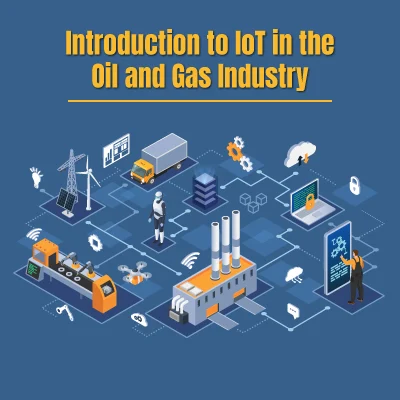
The Internet of Things (IoT), a relatively new concept in digital technology, It facilitates the connection of everyday objects and industrial equipment via the internet, enabling them to exchange, analyze, and collect data. IoT devices range from small sensors and cameras to household equipment and bigger industrial machinery. All these applications interact with each other through the internet to improve efficiency, decision-making abilities, and automation.
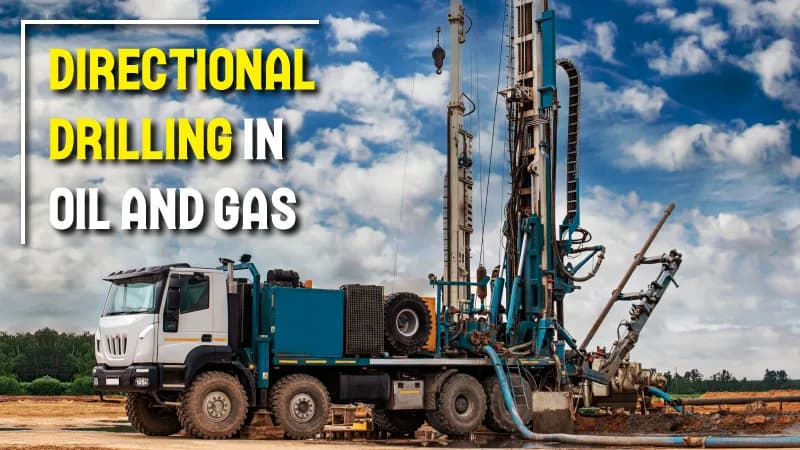
In the past few years, IoT has received intense significance across several industries, including the oil and gas industry. IoT helps reshape this industry by offering predictive maintenance, data-driven insights, and real-time monitoring. During the exploration and production of oil and gas, IoT sensors are installed on pipelines and drilling equipment to observe temperature, flow rates, and pressure. Such data helps enhance drilling practices, minimize downtime, and improve security.
Additionally, it enhances refinery operations by ensuring equipment reliability and identifying anomalies. Moreover, in oil and gas transportation and distribution, IoT installed monitoring and tracking systems upgrade the supply chain efficiency and minimize leakages or accidents. Enabling IoT also improves environmental monitoring.
Utilizing IoT in the oil and gas industry revolutionizes the landscape of the overall mineral sector as well as having its specific impact on upstream, mid-stream and downstream industries. Let us understand how IoT supports these industries.
-
Upstream Industry:
IoT sensors are installed on drilling rigs, wellheads, and equipment for consistent asset monitoring. It enables operators to schedule maintenance and prevent potential breakdowns. With IoT, operators can carry out real-time remote observation of drilling undertakings from a central control room, enabling easier and instant action to any concern.
By gathering vast amounts of data, IoT devices support data analytics in enhancing drilling techniques and predicting equipment failure. Moreover, IoT sensors easily detect leakages and heavy pressure, ensuring workers' security.
-
Midstream Industry:
IoT sensors are installed along pipelines to observe the flow rates, temperature, and pressure and quickly detect corrosion, leakages, and other concerns. Inspecting this data permits midstream firms to forecast the maintenance requirements with lesser downtime, reducing the risks of accidents or spills.
Furthermore, IoT assists in monitoring environmental conditions around storage facilities and pipelines, ensuring appropriate responses to environmental challenges.
-
Downstream Industry:
IoT sensors enhance refinery operations by optimizing equipment functionality, enabling fine-tuning for greater efficiency and reduced energy consumption.
IoT equipment also benefits in inventory management. They monitor storage tank levels and distribution centers, ensuring better product availability. Moreover, the consistent monitoring by sensors secures the quality of product meets industry standards before distribution.
This is all about the use of IoT in these industries. Let us grasp the major benefits of IoT in the oil and gas industry.
Benefits of IoT in the Oil and Gas Industry
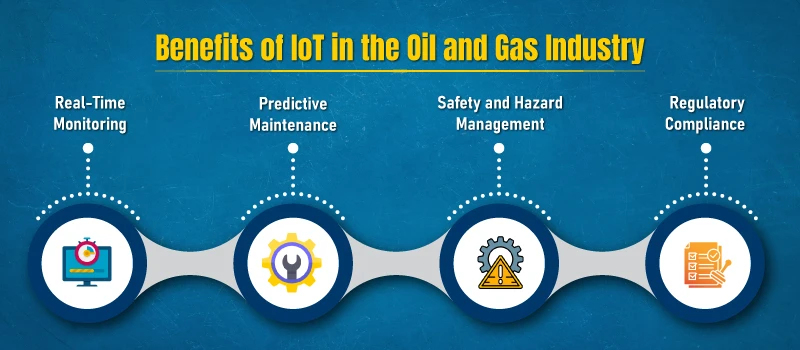
Real-Time Monitoring
IoT facilitates seamless real-time monitoring of devices and operations in the oil and gas industry. This is achieved by installing numerous sensors and devices across the production and distribution processes. IoT uses sensors such as temperature, pressure, flow, and humidity sensors. These sensors continuously gather data from equipment and operations without interruption.
That data is sent to a cloud-based source or central control system in real-time. The operators and engineers are able to fetch this data remotely. Later the data is processed and shown in a feasible manner with the use of analytics devices and dashboards. Such user-friendly data permits an operator to observe the equipment status and process in real-time.
Predictive Maintenance
One of IoT’s most significant contributions to the oil and gas industry is predictive maintenance. IoT utilizes its sensors and advanced analytics like machine learning that spots any unusual patterns and anomalies in the data.
By analyzing this data, IoT can predict when equipment is likely to fail. This helps operators to schedule accurate predictive maintenance. It also reduces the additional cost required to repair the faulty equipment or equipment replacement.
Safety and Hazard Management
IoT enhances safety by improving hazard detection in the oil and gas industry. IoT sensors spot the volatile elements and existence of hazardous gasses in real time. They also spot environmental factors like humidity, air quality and temperature.
This data helps operators to take immediate action on leakages, avoid accidents, and ensure safe working conditions. IoT also tracks the exact location of equipment and personnel working in hazardous areas to offer emergency response and provide safety.
Regulatory Compliance
IoT plays a crucial role in meeting industry regulations and compliance requirements. IoT automatically documents and reports data related to safety, environmental conditions, and operations, simplifying compliance. IoT’s real time monitoring tool ensures the operations are going on according to regulatory standards, helping firms to keep companies away from additional fines and penalties.
Challenges and Considerations
IoT is transforming the outlook of oil and gas industries in a positive manner. It has the potential to offer unconditional advantages ranging from real-time monitoring to cost reduction. However, some challenges also need to be addressed to ensure the successful implementation of IoT in the oil and gas industry. Below are three major challenges belonging to utilization of IoT in the oil and gas industry.
Data Security and Privacy
IoT devices generate large datasets, including sensitive information. It captures the occurrence of cyber theft. To overcome such challenges robust cybersecurity initiatives can be implemented.
It involves accessing monitoring and control, encryption of data and frequent safety audits. Moreover, the blockchain technology can also be utilized to obtain the security of data storage and transactions.
Power and Connectivity in Remote Sites
Many oil and gas operations occur in remote and harsh environments. In such areas lack of power and slow internet connectivity issues may occur as IoT systems require a significant amount of internet to function properly.
To minimize this concern low power IoT devices can be used. The power sources such as solar or wind energy can be put into service as an alternative option for IoT. Also, operators can implement the satellite or long-range wireless connectivity technologies to assure stronger connectivity in remote sites.
Requirement of Skilled Workers
IoT technologies often need expertise in several fields such as IoT device management, cybersecurity, and data science. Finding employees with such advanced technical skills can be challenging.
To overcome this issue training and development programs can be arranged for existing workers that help them to become expertise in handling Iot technology. Also collaborating with industry associations and educational institutes can also help develop a pipeline of skilled employees. Moreover, assigning specific IoT tasks to expert service providers can also help overcome such challenges.
Future Trends and Outlook
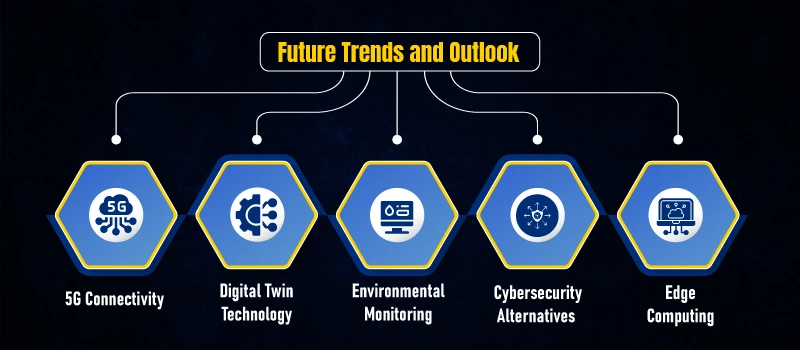
Emerging IoT technologies will bring new models and improved functionalities. It holds the potential to significantly impact multiple industries, including oil and gas. As we contemplate ahead, many future trends will impact this industry. Some future trends of IoT are given below.
5G Connectivity
The implementation of 5G connectivity will allow IoT applications to flourish in the oil and gas industry, making faster operations with stronger connectivity in remote areas. It will offer lower latency connections and higher operating speed, facilitating the ability to connect and manage a huge number of devices at a single time. This will also enable more robust remote monitoring and trouble-free control of drilling undertakings, refineries, and distribution networks.
Digital Twin Technology
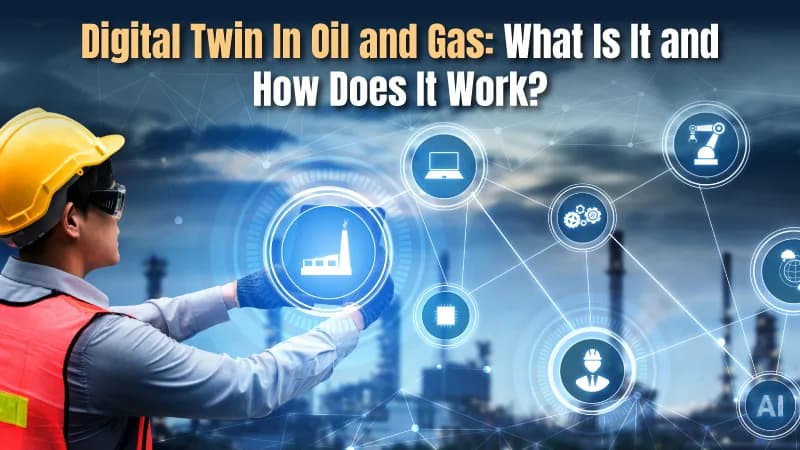
Digital twin technology is the 3D virtual representation or replica of any process, system, or physical object. It utilizes real-time data from sensors, equipment, and other sources to create the 3D replica. The upcoming IoT technologies will come with this benefit. It will create virtual models of pipelines, oil and gas rigs, drilling equipment, and other such assets. It will help operators to detect faults easily without visiting the site. Operators will also prepare maintenance schedules and predict equipment failure in a fraction of the time. This technology also helps exceed the lifespan of complex infrastructure.
Environmental Monitoring
The oil and gas industry often faces the risk of increased pressure in order to reduce its environmental impact. The alternative option to this is to put IoT into service. The sensors in upcoming IoT technology will help monitor water quality, soil conditions, and emissions in real-time. Such data sensed by sensors will support mineral firms in complying with environmental safety measures and minimizing their carbon footprint.
Cybersecurity Alternatives
Today multiple industries and sectors are adopting IoT to enhance their tasks. Due to such vast use it needs to be protected from cyber thefts as it stores the large and sensitive data. Upcoming IoT technologies will incorporate enhanced cybersecurity measures, including encryption protocols and AI-driven theft detection. It will help manage the critical data sets, offering improved safety against cyber theft.
Edge Computing
Edge computing includes processing data near the data generation source instead of transferring the data to centralized cloud servers. Implementing this tool in the oil and gas industry can help obtain quick data analysis and easier decision-making, especially in complex operations. Edge equipment and gateways are able to assemble the data and analyze it from sensors, minimizing latency and allowing real-time monitoring of pipelines, reservoirs, and equipment.
Conclusion
The integration of IoT in the oil and gas sector has emerged as a game-changing means that facilitates efficient operations and increased productivity. IoT enabled sensors and devices offer the quick data accumulation and real time monitoring of equipment. IoT has specifically influenced the upstream, midstream, and downstream industries. With the use of IoT it is possible for operators to manage the drilling undertaking effectively.
Despite some challenges, IoT comes with the latest functions, such as 5G connectivity, digital twin, and improved cybersecurity. Market research forecasts indicate that the IoT in the oil and gas sector will show a Compound Annual Growth Rate (CAGR) of approximately 22% worldwide throughout the predicted years from 2021 to 2027.
Continued IoT adoption will further revolutionize the oil and gas industry, delivering financial advantages both locally and globally.
FAQ’s
What is the Impact of IoT in the Oil and Gas Industry?
IoT in the oil and gas industry has enhanced the drilling operations, simultaneously improving efficiency and security. This technology enables real time monitoring of the equipment, pipelines and reservoirs. It also offers predictive maintenance, reducing downtime and risks.
What are the Major Use Cases for Industrial IoT?
Some major use cases for industrial IoT are Location Tracking, Warehouse Management, Predictive Maintenance, Energy Consumption Optimization, and Environmental and Workforce Safety.
How has Digital Technology changed the Oil and Gas Industry?
Technology is transforming the oil and gas sector in several ways. It includes digitalization, automation, and advanced exploration techniques. This sector is implementing smart sensors and AI-driven tools for real-time monitoring and robotics to improve security and efficiency.