Exploration and Production
E&P stands for exploration and production. It refers to the companies and activities in the upstream sector of the oil and gas industry: the ones that search for underground oil and gas, drill the wells, and bring hydrocarbons to the surface. When an operator leases your minerals and develops wells on your tract, leasehold, or pooled unit, that company is usually acting in the E&P role.
For a mineral owner, the E&P company is the most important business relationship you have. They may negotiate your lease, pay your bonus, develop the wells, and either pay your royalties directly or cause royalties to be paid through an operator, purchaser, or designated payor. Understanding what E&P companies do, and how they make money, helps you understand where your royalty income comes from and what to expect from the company developing your minerals.
What This Means for Mineral Owners
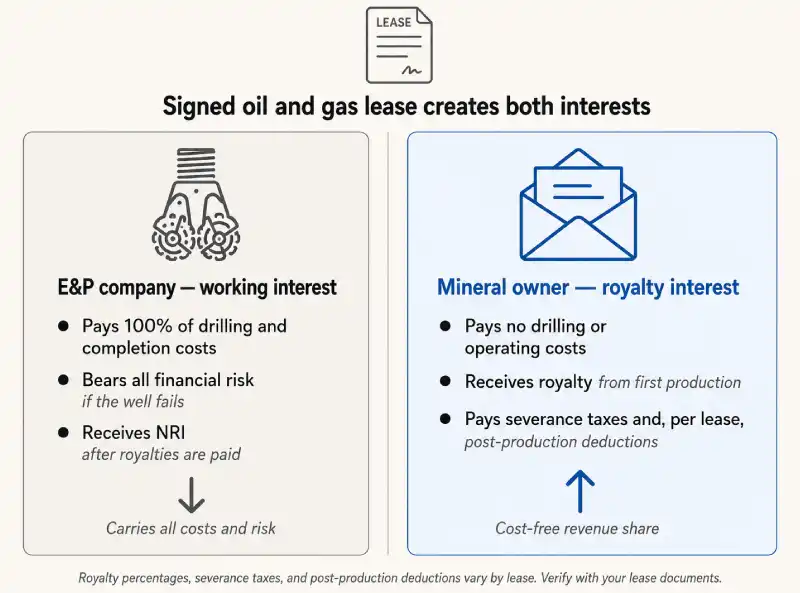
The E&P company is the party on the other side of your mineral ownership. The working-interest owners, which may include the operator and other non-operating partners, bear the drilling and operating costs and carry the financial risk. You hold the royalty interest, which means you receive a negotiated share of production revenue without paying any of the drilling or operating costs.
This division is the foundation of mineral ownership. The working-interest owners may spend millions to drill and complete a well. If the well fails, those working-interest owners absorb the loss, not the standard leased royalty owner. If the well succeeds and production is sold, you are entitled to your royalty share under the lease, subject to title review, division-order and payment setup, statutory payment timing rules, and any minimum-payment thresholds. Your main royalty-statement deductions are usually severance taxes and, depending on your lease, post-production costs. Separately, producing mineral interests may also create income-tax and county ad valorem/property-tax considerations.
Key point for mineral owners
Knowing which E&P company operates your minerals, and what kind of company they are, helps you set expectations. A well-capitalized, disciplined operator is more likely to develop your minerals efficiently and pay reliably than one that is overextended or inexperienced.
What E&P Companies Do
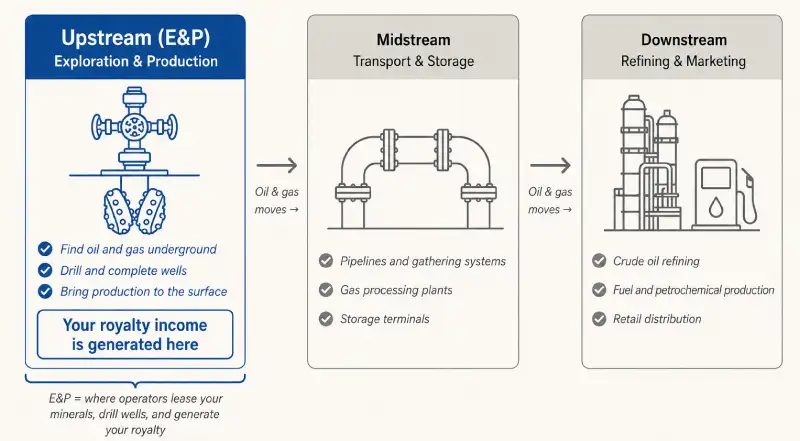
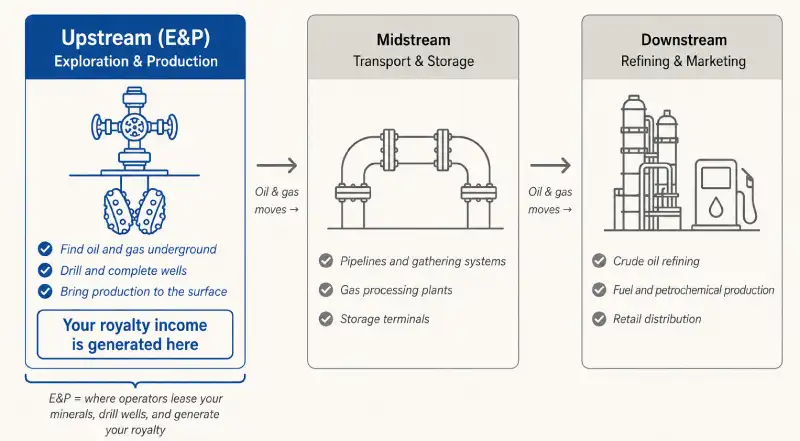
E&P sits in the upstream portion of the oil and gas industry. The industry is usually divided into three segments, and knowing where E&P fits helps you understand where your royalty income originates.
Upstream (E&P)
The exploration and production segment. This is where oil and gas are found and brought out of the ground. Your royalty income is generated here, from the production of your minerals.
Midstream
The transportation and storage segment. Pipelines, gathering systems, and processing plants that move and treat the oil and gas after it leaves the wellbore.
Downstream
The refining and marketing segment. Refineries that turn crude oil into gasoline and other products, and the retail outlets that sell them.
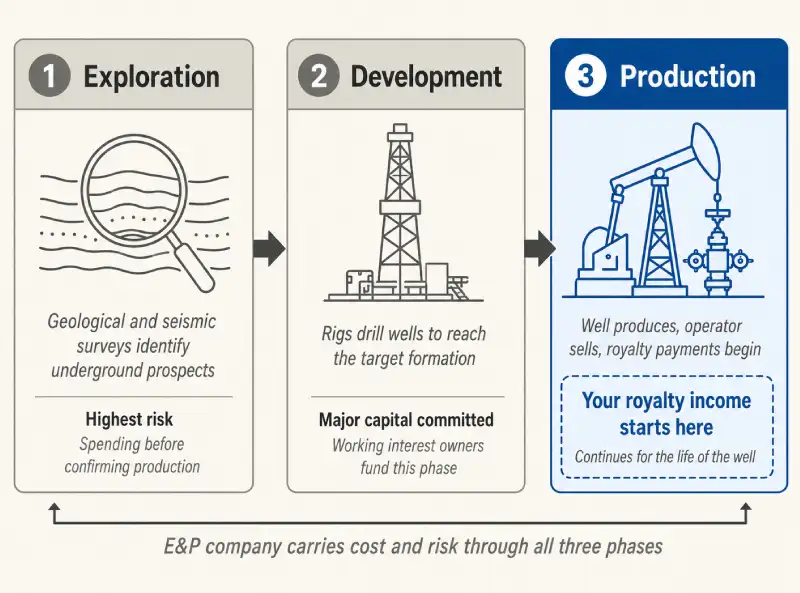
Within the upstream segment, an E&P company's work moves through three phases:
Exploration
Using geological and geophysical data, including seismic surveys, to identify where oil and gas are likely trapped underground. This is the highest-risk phase, where a company spends money before knowing whether a well will produce.
Development
Once a prospect is identified, the company moves in drilling rigs and drills wells to reach the targeted formation. This is where the working-interest holder commits major capital.
Production
Once a well is completed and producing, the company operates it to bring oil and gas to the surface, where it is sold. This is the phase that generates your royalty income, for the life of the well.
Types of E&P Companies
Not all E&P companies are the same. In Texas, they generally fall into two categories, and the type operating your minerals can affect how your lease is managed.
Independent E&P companies
These operate exclusively in the upstream sector, focused on exploration and production. They drill and produce wells, then sell the oil and gas at or near the wellhead to midstream companies for transport and processing. Independents range from small operators with a handful of wells to large publicly traded companies with extensive acreage. Many of the most active operators in the Permian Basin and other Texas plays are independents.
Major integrated oil companies
These are large corporations that operate across all three segments: upstream E&P, midstream pipelines, and downstream refining and marketing. They have significant E&P divisions but also own infrastructure throughout the supply chain. Majors tend to have deep capital resources and long operating histories.
What matters most for mineral owners
For a mineral owner, the practical difference is usually about scale and approach. Independents may be more focused and aggressive in developing acreage in a specific play, while majors bring large balance sheets and long time horizons. Neither type is inherently better. What matters is how the specific company manages its leases, develops its acreage, and handles royalty payments.
How E&P Activity Affects Your Royalty Income
The E&P company's decisions directly shape your royalty income, even though you do not participate in those decisions.
They carry all the cost and risk
When an E&P company develops your leasehold, the working-interest owners assume the capital expenditure to drill and complete the well. Working-interest owners pay the drilling and operating costs, while a standard leased royalty owner receives a royalty share without paying those well costs.
You receive royalty from first production
If the well produces, you receive your negotiated percentage of production revenue, usually paid by check or direct deposit and detailed on a royalty statement, subject to lease terms, title review, payor setup, and applicable Texas payment rules. You share in the revenue without sharing in the cost of drilling or operating.
You still bear certain costs
While you do not pay drilling or operating costs, you typically bear your proportionate share of severance taxes (state production taxes) and, depending on your lease language, post-production deductions for gathering, processing, and marketing. Your lease terms determine how much of these costs are passed through to you.
Their efficiency affects your income timing and amount
An E&P company that drills and completes wells efficiently brings your minerals to production sooner and may develop more of your acreage over time. A company's capital discipline, technical skill, and financial health all influence how fully and how quickly your minerals are developed.
For owners evaluating their income or a potential sale, Mineral View's MVestimate projects six-year royalty income based on your lease's production data, and the Lease Report shows the operator and production activity on your claimed leases.
Example Scenario
Example: Susan's Permian Basin minerals in Midland County
Susan inherited mineral rights on a 200-acre tract in Midland County, Texas, in the Permian Basin. For years the minerals produced nothing. Then an independent E&P company that had been assembling acreage in the area approached Susan with a lease offer.
The E&P company paid Susan a lease bonus and, over the following two years, invested several million dollars to drill and complete two horizontal wells on the leasehold. Susan paid none of these costs. The company, along with any other working-interest owners, carried the financial risk. If the wells had failed, the working-interest owners would have absorbed the loss.
The wells succeeded. Susan began receiving monthly royalty checks based on her negotiated royalty percentage of production revenue. Her statements showed deductions for severance taxes and, per her lease terms, a share of post-production costs, but she bore none of the drilling or operating expenses.
When Susan later researched the company, she learned it was a disciplined independent operator with a strong track record in the Permian. That gave her confidence that her minerals were being developed by a capable operator likely to continue investing in the area, which mattered for her long-term royalty expectations.
The lesson: the E&P company was the engine behind Susan's royalty income. Understanding their role, and the working-interest-versus-royalty-interest division, helped her understand both her income and her lack of cost exposure.
What to Check
Identify the E&P company operating your minerals
Knowing who operates your leasehold is the starting point for understanding your royalty income. Your lease, your royalty statement, and Mineral View's Lease Report all identify the operator. Knowing the operator lets you research their track record and financial health.
Understand the working interest versus royalty interest division
The E&P company holds the working interest and pays all drilling and operating costs. You hold the royalty interest and receive revenue without those costs. Confirm you understand which costs your lease does and does not pass through to you, particularly severance taxes and post-production deductions.
Watch development activity on your acreage
An active, well-capitalized E&P company may drill additional wells on your leasehold over time, increasing your royalty income. Tracking permits, drilling activity, and production through Mineral Views Lease Activity helps you see whether your operator is actively developing your minerals or holding the acreage with minimal activity.
Important
Mineral View can help you identify your operator, track development activity, and understand your production and royalty context. For questions about your specific lease terms, the costs passed through to you, or a particular operator's obligations, consult a qualified landman or Texas oil and gas attorney.
Common Questions
Often, but not always. The operator is the company of record responsible for operating the well. The E&P company, lessee, working-interest owners, and royalty payor may be the same company, related companies, or separate parties. In some arrangements, one company may hold the working interest while another operates the wells day to day. For many mineral owners these roles overlap in practice, but the operator of record, lessee, working-interest owner, and royalty payor are not always the same legal party.
No. As a royalty interest owner, you do not pay any share of the drilling or operating costs. The E&P company carries 100 percent of those as the working-interest holder. You do typically bear severance taxes and, depending on your lease, post-production deductions for gathering, processing, and marketing. Your lease language determines which of these apply to you.
Both can be good operators for a mineral owner. Independents are often focused and aggressive in developing a specific play, while majors bring large capital resources and long time horizons. What matters most is the specific company's financial health, technical capability, and how actively they develop your acreage, not simply which category they fall into.