Just imagine that you wake up and find out that a piece of land that was owned by your great-grandfather in the Permian Basin has been producing oil throughout the past ten years. You had no idea about the well, the oil company had lost track of you and the checks had been in a state vault at Austin. This is a common administrative reality for thousands of families under Texas Property Code Chapter 74.
Texas is the place of opportunity, but it is the place of the lost paperwork. Millions of dollars in unclaimed mineral rights and royalties are lying idle each year between the complex web of fractionalized heirship and simply the sheer amount of drilling activity in such plays as the Eagle Ford and the Haynesville.
When you are feeling that your family has ties to the oil country of Texas, you are not seeking out the lost money: you are reappropriating a part of your identity.
Key Takeaways
- Don't just search your name: Search for your parents, grandparents, and even great-grandparents.
- Use variations: Search for "J.H. Smith," "John Smith," and "John H. Smith."
- Look for Entity Names: If you consist of a family farm or a small LLC (for example, "The Miller Family Trust"), look into those as well.
- Mineral Deeds: The document that originally gave your family the rights.
- Leases: Proof that an oil company was interested in the land.
- Reservations: Often, when someone sold the "surface" of a farm, they "reserved" (kept) the minerals. This is where most unclaimed mineral rights are born.
- A copy of your Driver’s License or Passport.
- Your Social Security Number (for tax reporting—yes, the IRS wants their share of your found money).
- Probate Documents: If there was a will, you need the "Order Admitting Will to Probate."
- Affidavits of Heirship: If there was no will, you need a formal document signed by people who knew the family history, filed in the county records. This is the standard way to claim unclaimed mineral rights when a formal probate wasn't done.
- Recorded Deeds: You need a copy of the deed showing the minerals were in your ancestor's name.
- The Division Order: This is a contract from the oil company that confirms your "decimal interest", exactly how much of the pie you own.
- Address Unknown: Your check bounced back in the mail.
- Title Dispute: Two different families claim they own the same minerals.
- Death of Owner: The operator heard the owner died but hasn't received the probate papers.
- Unsigned Division Order: In Texas, an operator can technically withhold royalty payments if you refuse to sign a standard Division Order.
Ownership Doesn't Vanish:
When we talk about unclaimed mineral rights, we are usually talking about unpaid royalties or "suspense" funds held by the Texas Comptroller. Your actual ownership of the minerals remains in the county deed records.
Understanding Three-Year Rule:
Texas law requires operators to turn over unpaid funds to the state after three years of inactivity.
Documentation is Crucial:
To get your money back, you need more than a name; you need a paper trail consisting of deeds, probate records, and recorded affidavits of heirship.
Executive vs. Non-Executive:
Understanding who has the power to lease the land is often the "missing link" in finding out why royalties went unclaimed in the first place.
What Are Unclaimed Mineral Rights and Royalties in Texas?
The first thing that comes to mind when you hear about unclaimed mineral rights is panic. It feels like a squatter has taken over your property or that the state has taken possession of it. Fortunately, this is a rare case in Texas.
Mineral rights are real property in the Lone Star State. This means that they remain in your name (or in that of one of your ancestors) in the county clerk office until such a time as some one signs a deed to them, transferring them to a third party. But the money that these minerals bring about the royalties, bonuses, and shut-in payments is all taken as personal property.
Should an oil company (the operator) extract oil in your family land and fail to locate you, then they cannot simply keep the money. Once some time has passed, they must give out said cash to the Texas Comptroller of Public Accounts by law. This is what is called escheat.
The Path to "Lost" Money
How does this happen? It’s usually a simple breakdown in communication. Maybe your grandmother moved from Midland to Houston in 1974 and forgot to send a change-of-address form to the oil company. Maybe a distant cousin passed away without a will, and the operator didn't know who the rightful heirs were.
When the operator has a check they can't deliver, they place the funds in "Legal Suspense." They hold onto it, hoping you’ll call. But under the Texas Property Code, if that money sits there for three years without you claiming it, the operator must report it as unclaimed mineral rights and send the balance to Austin.
Knowing Your Interests
Before you start digging through state databases, you need to understand the different types of interests that might be generating these funds. Texas law recognizes several "flavors" of mineral ownership:
1. Royalty Interest (RI):
This is the gold standard. You own the minerals, you sign the lease, and you get a percentage of the gross production (usually between 12.5% and 25%).
2. Non-Participating Royalty Interest (NPRI):
This is a common source of unclaimed funds. An NPRI owner gets a share of the oil money but has no "executive rights", meaning they don't get to sign the lease or collect bonus money. Because they aren't involved in the leasing process, NPRIs often don't even know a well has been drilled.
3. Overriding Royalty Interest (ORRI):
This is usually held by landmen or geologists. It’s a royalty carved out of the "working interest" (the oil company’s share) rather than the mineral estate itself.
4. Non-Executive Mineral Interest (NEMI):
You own the minerals, but someone else has the right to sign the lease for you.
How to Search for Unclaimed Mineral Rights and Royalties in Texas
Searching for unclaimed mineral rights can be difficult and may require a lot of time. You won't find everything in one place. You have to look at state records, county records, communicate with other mineral owners, and look for industry data to get the details about unclaimed mineral rights.
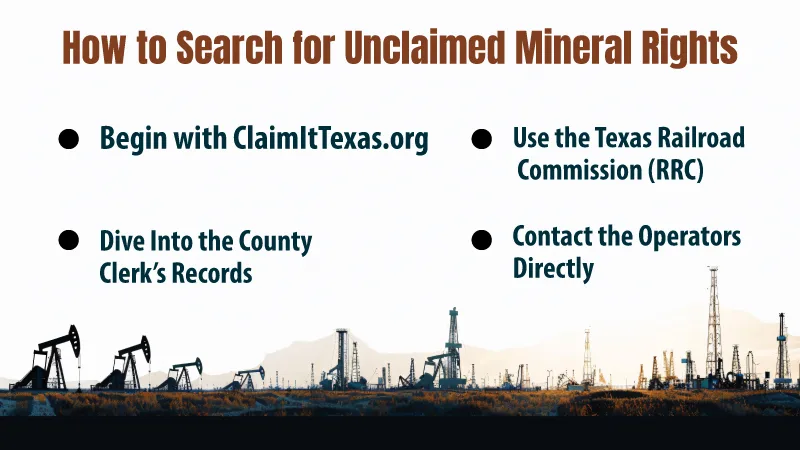
1. Begin with ClaimItTexas.org
The Texas Comptroller’s website is your first stop. This is the most important site that helps you quickly search for unclaimed mineral rights.
2. Dive Into the County Clerk’s Records
If you find a name on the Comptroller’s site, you need to verify that they actually owned the minerals. This can be done by checking the "Chain of Title" in the county where the land is located. Many Texas counties (like Reeves, Midland, or Karnes) have moved their records online. You are looking for:
3. Use the Texas Railroad Commission (RRC)
The RRC is the state agency that regulates oil and gas. Their "Public GIS Viewer" is a free map that shows every well in Texas. If you know your family owned land in "Section 12 of the AB&M Survey" in Pecos County, you can look at the map and see if there are active wells there. If there are wells, but you aren't getting checks, you likely have unclaimed mineral rights sitting in suspense.
4. Contact the Operators Directly
Every oil company has an "Owner Relations" department. If you find a well on your land, call the company that operates it. Ask them, "Is there any money in suspense for [Name of Ancestor]?" As their accounting departments find it difficult to handle "suspense" balances, they are frequently willing to assist.
Documents and Proof Needed to Recover Unclaimed Mineral Royalties
The State of Texas isn't just going to hand over a $50,000 check because you have the same last name as the person on the account. They require "clear and convincing evidence."
The Identity Checklist
First, you have to prove who you are. This is the easy part:
The Ownership Checklist
This is where it gets technical. If the money belonged to your grandfather who died in 1985, you have to bridge the gap between his death and your life.
Expert Tip: If you are dealing with a multi-generational claim (e.g., your great-grandfather’s minerals), the state may require “Distribution Deeds” or “Assents to Devise.” It’s often worth hiring a Texas landman to build a “Family Tree” or “Heirship Table” to keep the paperwork straight.
Timeframes and Why Your Royalties Are "Suspended"
One of the most common questions you may get is, "How long does this take?"
The Texas Comptroller is generally efficient. If you have all your ducks in a row, a claim for unclaimed mineral rights usually takes 30 to 90 days to process. However, if the claim involves a complex estate or multiple heirs, it can stretch to six months or a year.
Why Money Goes Into Suspense
Before the money goes to the state, it sits in "Suspense" at the oil company. There are a few reasons why an operator will "suspend" your royalties:
Money held in the Texas Unclaimed Property fund never "expires." Whether it’s been there for 5 years or 50 years, you (or your heirs) can always come and claim it.
Best Practices for Texas Mineral Owners
Having minerals in Texas is business and it should be handled as such. The interest on the smallest portion of an acre of land can be phenomenally valuable, even in the event of the discovery of a new “shale play” in which you are a mere fractional holder.
1. Annual Search
Make it a habit. Each January, check the web site of the Texas Comptroller of every branch of your family tree. The change of hands is a new reporting every year as new wells are drilled and old ones are changed.
2. Keep the County Updated
When you are the heir/heiress to miners, do not simply hang the paper work somewhere in a drawer. You should also file your probate or your Affidavit of Heirship at the County Clerk where the land is situated. That is how a landman will locate you when he is seeking people to sign new leases.
3. Communicate with Operators
Should you also relocate, forward a "Change of Address" to all oil companies which remit to you a check (or a 1099). Give them your Social Security number and a revised W-9. This makes your money not be lost as claimed mineral rights in the first place.
4. Organize Your Digital Files
Keep a folder for each county. Have a copy of your deeds, your leases and your last check stubs inside. When an oil company faces bankruptcy or is acquired by someone (this is very frequent) with such records in hand, one will be paid or will have nothing at all.
The Role of the Industry Professional
If you are a landman or a division order analyst, you know that unclaimed mineral rights are a massive administrative burden. The "due diligence" required before escheating funds to the state authorities is rigorous and time-consuming.
For many oil and gas companies, the challenge lies in the gap between oil and gas production and the ability to locate exactly where a mineral owner resides. When a royalty owner moves without providing a forwarding address, their unclaimed royalties begin to accumulate in suspense accounts.
Under Texas law, if these funds remain untouched for a certain period, the operator is legally compelled to begin the process of claiming property on behalf of the state. This is why professionals prioritize "Owner Location."
Using tools like DrillingInfo (Enverus), Ancestry.com, and social media has become the standard for this process, and Mineral View complements these efforts by providing a centralized platform where all industry professionals, from geologists and engineers to landmen and attorneys, can access the specific data they need for their unique roles.
When the industry does its job well and stays on top of the paperwork involved in gas royalties, fewer funds end up in Austin, and more money flows into the pockets of Texans where it belongs.
Conclusion: Why This Matters
Learning about the unclaimed mineral rights is not only that windfall of cash. These minerals are the labor of the past generation, the farmers and ranchers who never sold their "dirt" during the great depression or the oil busts of the 80s to many Texans.
By spending time to find these funds, you are not filing a claim, you are securing an asset that can take care of your children and grandchildren. The Texas Comptroller is holding billions of dollars of unclaimed properties at present. A large part of that is the owners of minerals who merely do not know they are owners.
And do not leave your family heritage in a state vault. Bring that money home with the instruments at hand, which are the RRC maps, the county deed indexes and the database at the Comptroller. It may be a couple of hundred dollars in a hundred small royalties or a huge check on a bonus; it is your prerogative to take what is yours.
Disclaimer: This article is for informational purposes only and does not constitute legal or financial advice. Mineral laws are complex; consult with a licensed attorney or professional landman before filing claims.