You have discovered the right ranch in Texas or Colorado. The house itself is gorgeous, the views are breathtaking, and the price appears exquisite. You put your hands together, you sign the papers and you are the owner of the land... or are you?
A property sale does not necessarily involve a clean transfer in mineral-rich states such as Texas, Oklahoma and Pennsylvania. You may purchase the dream house, but still the old owner has a legal claim to the prized assets: the oil, gas, and coal that are under a hundred feet of your new lawn. This is whereby the seller retains mineral rights in the transaction.
This informative blog will explain to you the true meaning of purchasing or selling land with severed mineral ownership. The result of this arrangement is a split estate, something that transforms all aspects of how the land can be utilized and who benefits from what is under the ground. Understanding this important legal distinction is the only way to avoid waking up to a drilling rig on your property five years down the line.
What You Need to Know Up Front

What does it Mean When a Seller Retains Mineral Rights?
When a seller retains mineral rights (or "reserves" them), it means they are selling the physical land, buildings, and surface access (the surface rights) to the buyer, but they are keeping the ownership of everything valuable beneath the ground (the mineral rights). The seller, or their heirs, will forever hold the right to explore for and extract those resources.
The Split Estate:
This retention legally separates the ownership of subsurface resources (the minerals) from the surface rights (the land you walk on). These two layers become independent properties.
The Default Rule:
Under the Texas Merger Doctrine, any intent for the seller to retain mineral rights must be explicitly written into the final recorded deed; if the deed is silent, the minerals will automatically transfer to the buyer at closing, regardless of what the prior sales contract stated.
Price and Pool:
This arrangement usually lowers the sale price and shrinks the pool of potential buyers because of the potential for future disruption.
Dominance is Key:
Buyers who purchase only the surface rights must realize that the mineral owner (or the drilling company they lease to) may have the full legal authority to access the land surface for drilling, mining, or building roads—even if it interferes with your home or crops.
Get a Specialist:
Both parties need the guidance of a licensed attorney who specializes in mineral law to draft the deeds and review the title thoroughly.
What Happens When a Seller Retains Mineral Rights?
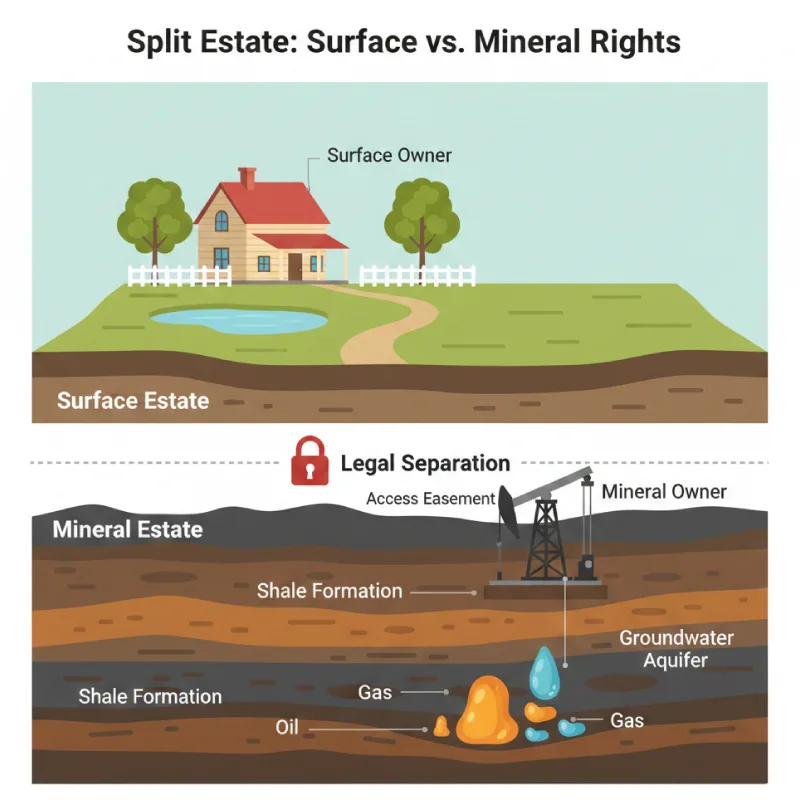
When a seller reserves the minerals, the buyer receives only the surface rights, everything you can see and touch: the house, the fences, the roads, and the soil. The seller keeps the mineral rights - the oil, gas, coal, and metals beneath the ground.
Once severed, these two property layers become independent legal assets that can be bought, sold, leased, or inherited separately forever.
The Two Layers of Property Ownership
| Ownership Type | What It Includes | Who Controls It |
|---|---|---|
| Surface Rights | Houses, structures, timber, farming/ranching use, water, and air above the land. | The Buyer (the new landowner). |
| Mineral Rights | Oil, gas, coal, metals, and the right to access and extract them from beneath the surface. | The Seller (if reserved) or their lessee. |
In most states, the seller must explicitly reserve the minerals in the final deed to keep them. If the legal document is silent, the minerals usually transfer right along with the land to the buyer. This is why the exact words in the deed matter a ton.
The Dominant Mineral Estate
This is the most critical concept for surface buyers to understand: In many states, the mineral estate is considered dominant over the surface estate.
What this Means in Practice: While the mineral estate is 'dominant,' the owner or their drilling company must exercise 'due regard' for the surface owner.
Under the Accommodation Doctrine, if a driller’s activity substantially interferes with your existing use of the land (like a home or a barn), they may be legally required to move their operations if a reasonable, industry-accepted alternative exists.
Example: A family buys a 10-acre property to build a retirement home. The seller retains mineral rights. Five years later, the seller signs a gas lease. The gas company now has the legal right to construct an access road, a drilling pad, and storage tanks on the surface, subject to state damage laws.
The new homeowner, who bought only the surface, generally has limited legal recourse to stop the activity. They must rely on state laws requiring the mineral owner to accommodate existing uses where reasonable alternatives exist (the Accommodation Doctrine), but this can be costly and difficult to enforce.
Can a Landowner Sell the Surface and Still Keep the Minerals?
Absolutely, yes. As a landowner, one can sell the surface in 2026 and retain some or all of the mineral rights by expressly reserving the mineral rights in the sales documents. This is a long-standing practice, especially in Texas and the other states where active mineral production has existed, such as Oklahoma and Pennsylvania.
On the Part of the Seller, the Reservation is Flexible:
- Retain 100%: The vendor retains all oil, gas and other minerals in any formation.
- Retain a Fractional Share: There is no transfer of ownership; only a fraction of the asset (e.g., 50% of oil and gas) is retained by the seller so that the buyer receives the remaining 50%.
- Limit by Depth: The seller can only retain the deep-lying minerals (such as those below 5,000 feet) and allow the shallow minerals to be sold to the buyer.
To the buyer, such divided ownership implies that there is less leverage with you. You may choose to:
- Take up a superficial buy, usually at a lower cost.
- Negotiate to be issued part of the mineral rights to cushion against the risk.
- Ask the seller to sign a Surface Use Agreement to regulate future access for drilling.
Any deal must be confirmed by the two parties by carrying out a proper title search to establish who is the current owner of the minerals.
The reality is that previous owners may have secured the rights many decades ago, meaning a present-day seller might not actually possess what they are attempting to retain or sell.
To verify these claims, many owners turn to Mineral View’s interactive maps. Within the state of Texas, these maps allow you to pinpoint the exact location of any well and instantly view its current status—whether it is actively producing or non-producing.
By visualizing the specific well paths, you can see exactly how the resources are being tapped, including whether a well was drilled vertically or horizontally across your property lines.
How a Seller Retains Mineral Rights, Actually
In the eyes of the law, simply stating, "I want to keep the oil," is not enough. You need precise, enforceable language. Courts strictly interpret these documents, and errors usually result in the minerals passing to the buyer.
The Steps for Reservation
- Verify What You Own: The seller must first review the chain of title and all existing deeds. You can only keep what you actually own.
- Use Reservation Language in the Contract: The initial Purchase and Sale Agreement (PSA) must contain a clear clause stating the seller retains mineral rights.
- Mirror the Language in the Deed: This is the most crucial step. The final Warranty Deed or Special Warranty Deed must include precise, identical reservation language. If the deed omits it, even if the contract mentioned it, the minerals are often considered transferred.
- Record Everything: All documents must be properly filed (recorded) in the county land records to legally establish the ownership split for future buyers and lenders.
Reservation Language: Excepting vs. Reserving
Legal professionals often distinguish between two concepts:
"Excepting" an interest: This means the seller never intended to sell the minerals because a prior owner already reserved them. The seller is merely noting that the minerals are already gone from the land they are selling.
"Reserving" an interest: This means the seller currently owns the minerals and is carving them out of the current sale to keep for themselves.
Whether the seller retains mineral rights by "excepting" or "reserving," the exact legal phrasing in the deed must be clear to avoid litigation down the line.
Options for Severing Mineral Ownership
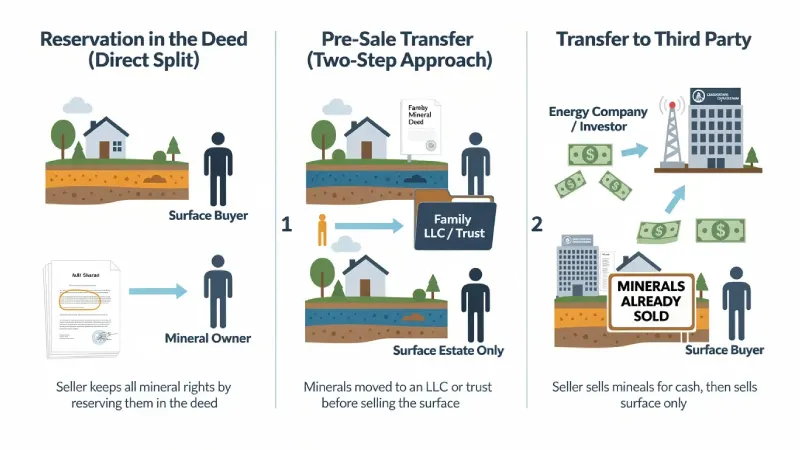
A seller can reserve the minerals in the sale, or they can use a two-step process to separate the interests before the property even hits the market.
Option 1: Reservation in the Deed (The Direct Split)
This is the most direct approach. The deed transfers the surface to the buyer but explicitly includes a clause like the one below. The seller retains mineral rights by keeping full ownership and control, including the right to sign leases, collect bonuses, and receive royalties.
Sample Reservation Clause (Not Legal Advice): "Seller hereby reserves unto Seller, Seller’s heirs, and assigns all oil, gas, and other minerals in and under and that may be produced from the Property, together with all rights and privileges necessary or convenient for mining, drilling, and operating for and producing such minerals."
Option 2: Pre-Sale Transfer (The Two-Step Approach)
Some sellers first execute a separate Mineral Deed transferring the minerals to a family LLC or trust. Then, they sell the property as a "surface estate only" to the general public.
Why use the two-step approach?
- Clarity: It makes expectations perfectly clear to the buyer from Day One.
- Estate Planning: It simplifies the inheritance of mineral wealth, often through a trust.
- Liability: Placing mineral rights into an LLC can offer liability protection to the seller from surface damage lawsuits.
Option 3: Transferring to a Third Party
A seller might decide to sell the minerals outright to an energy company or investor before listing the surface land.
This gives the seller immediate cash and completely removes the complex mineral discussion from the negotiation with the surface buyer. In this case, the seller retains mineral rights only long enough to sell them to the third party.
The contract with the surface buyer must clearly disclose that the minerals have already been transferred and name the new owner of those rights.
How the Reservation is Structured: Beyond 100%
Keeping the minerals is not a one-size-fits-all plan. The structure of the reservation can completely change who controls future leases and who receives royalty checks. Sophisticated structures are common in active oil and gas states and require specialist counsel.
Minerals In Place vs. Pure Royalty Reservations
Understanding the difference between these two types is vital for both parties:
| Reservation Type | What Seller Keeps | Control Over Leases | Future Development Rights |
|---|---|---|---|
| Minerals In Place | Full ownership of the resources underground. | Seller signs new leases and collects bonuses. | Seller benefits from all new wells drilled. |
| Pure Royalty | Only the right to royalty payments (e.g., 1/6th of the production). | Someone else (the buyer or a third party) controls leasing. | Limited only to receiving revenue; no control over development. |
Minerals In Place: The seller is reserving the asset itself. They retain full control and can decide when to lease and who to lease to.
Pure Royalty: The seller is reserving only the passive income stream. The surface owner (or another party) gets to sign the lease, but the original seller still gets a cut of the production.
Fractional, Depth, and Formation Limits
These creative deal structures can often make a surface sale more attractive to buyers while protecting value for the seller:
- Fractional Reservations: The seller reserves 50% of the minerals, and the buyer gets the other 50%. Both parties share equally in future royalties.
- Depth-Limited Reservations: The seller reserves everything below the current production zone (e.g., below 4,000 feet), letting the buyer have the shallower resources.
- Formation-Specific Reservations: The seller retains rights only to a specific, deep geologic formation (like the Permian Basin), giving the buyer all other formations.
While these complex reservations can make a deal happen, they significantly increase the need for clear legal drafting. Ambiguous language here is the source of many expensive lawsuits years later.
Benefits and Risks for the Seller Who Retains Mineral Rights
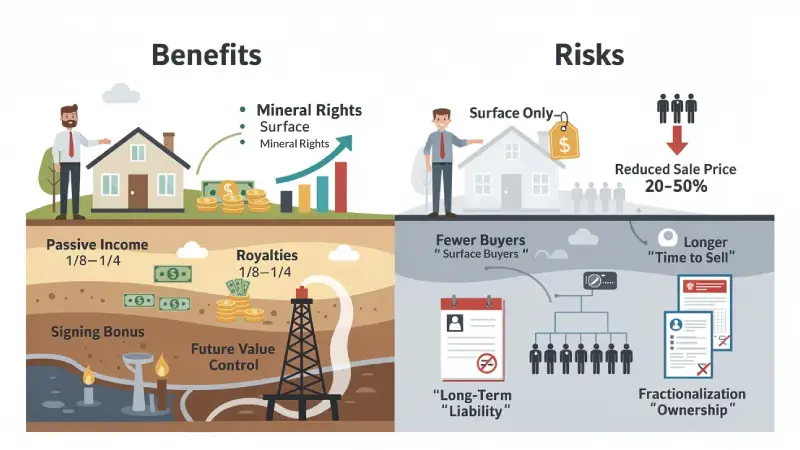
When a seller retains mineral rights, they are gambling that the future value of the resources will outweigh the current hit to the property’s sale price.
Main Benefits (Why Keep Them?)
- Passive Income: Potential long-term royalty income, often 1/8th to 1/4th of all production revenue, that can last for decades.
- Immediate Cash: Collecting large signing bonuses when they lease the rights to a drilling company.
- Future Value: Mineral interests can be sold independently later on, potentially for a much higher price if drilling activity increases nearby.
- Control: The seller retains control over development, choosing which drilling company to lease to and when.
Main Risks (The Trade-Offs)
- Reduced Sale Price: The surface price often drops significantly (20% to 50%) because the buyer faces the risk of future disruption.
- Market Shrink: The property may take much longer to sell because the pool of willing surface-only buyers is smaller.
- Long-Term Liability: The seller’s heirs may face lawsuits from the surface owner decades later if the seller's lessee (the drilling company) causes unreasonable damage or acts negligently.
- Fractionalization: Without careful estate planning (LLCs or trusts), the mineral rights can be split among dozens of heirs, making them difficult and expensive to manage.
How Retaining Minerals Can Affect the Sale Price and Marketability
Many residential and agricultural buyers strongly prefer unified ownership of both surface and mineral rights. When the seller keeps all minerals, the buyer pool shrinks.
Lenders and appraisers often discount a surface-only property because future drilling could limit use or reduce resale value. In active development areas, properties in split estates can appraise 20–50% lower than comparable properties with unified ownership.
Sellers should weigh whether expected future royalties realistically exceed:
- The immediate price reduction.
- The longer time on the market.
- The smaller pool of potential buyers.
Real estate agents and attorneys can help sellers decide between keeping all, some, or none of the minerals based on local market conditions and production history.
Long-Term Income Potential and Estate Planning Considerations
Mineral interests can generate income for decades through signing bonuses, delay rentals, and royalty payments. Because this income can continue for generations, having a clear picture of future value is essential for family legacy planning.
This is where tools like MVestimate become invaluable; by selecting your specific lease, the platform provides an estimated payout amount for the next six years.
Having this data allows you to make informed decisions about whether to hold or sell your interests before ownership begins to fractionalize among dozens of heirs.
The fractional estate problem: When a family's minerals pass to 32 heirs, each owning 1/32nd, every heir must sign lease documents. One uncooperative or unreachable heir can stall development and income for everyone.
Solution Includes:
- Forming a family LLC or trust to hold mineral rights.
- Appointing a designated manager to handle lease negotiations.
- Including mineral rights in wills with specific instructions.
Without planning, valuable resources may sit undeveloped while heirs argue, and the family loses potential income.
Consequences for Buyers: The Surface Owner’s Reality
Buyers need to enter a split estate transaction with their eyes wide open. When the seller retains mineral rights, the buyer is getting only the land, not the control over what happens on it.
Because the mineral estate is legally dominant, the buyer of the surface rights must tolerate the mineral owner (or their lessee) using reasonable portions of the surface to access the resources.
Real-World Lifestyle Impacts
Imagine these disruptions occurring without warning after you’ve bought your dream property: heavy truck traffic on your private roads, a noisy drilling rig operating just feet from your home for months, or the sudden placement of storage tanks on your best pasture.
You shouldn't have to visit your land again and again just to see what’s happening. With the Mineral View Notification Agent, you receive automated alerts the moment activity is detected.
By getting notified of new permits or rig movements early, you gain the time needed to prepare for these impacts or consult with your attorney before the first truck even arrives.
The Role of the Surface Use Agreement (SUA)
Since the original seller may no longer be involved after the sale, buyers should try to negotiate a Surface Use Agreement (SUA) with the mineral owner before closing, or immediately with the drilling company if the rights are already leased.
The SUA is a contract designed to reduce the chance of a fight later. It specifies things like:
- Setbacks: How close a well can be drilled to a home, barn, or water well.
- Access Roads: Where trucks can enter and exit the property.
- Damages: How the surface owner will be compensated for lost crops or pasture.
Without a strong SUA, the buyer is largely subject to general state laws, which offer limited protections against reasonable access by the mineral developer.
Financing, Insurance, and Resale When Seller Retains Mineral Rights
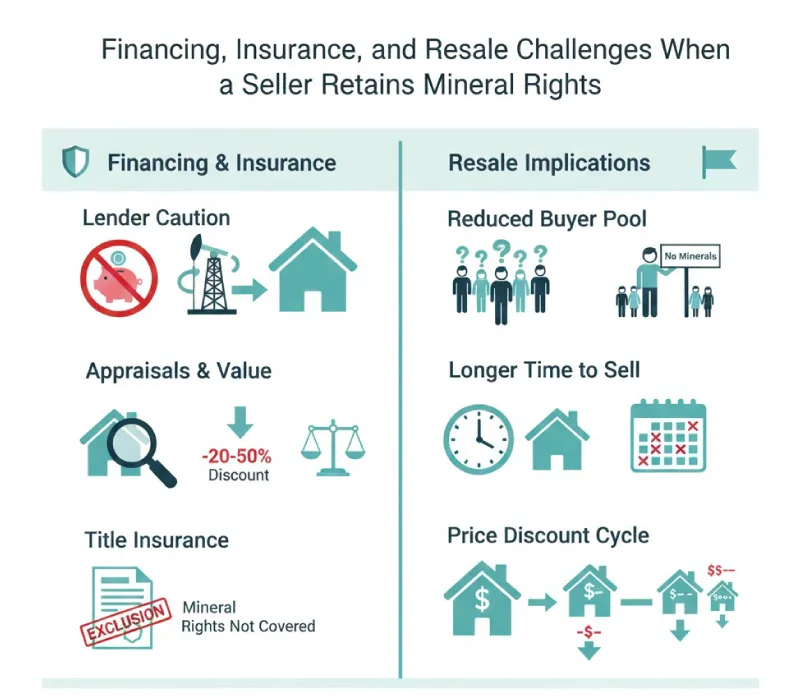
A reserved mineral interest introduces complexity that affects the entire ecosystem of a property sale.
Financing Challenges
Lender Caution: Many banks are hesitant to lend on properties with severed mineral rights because of the increased risk of surface disruption, which could damage the collateral (the home or land).
Appraisals: Appraisers often apply significant discounts (20–50%) to the property's value in active drilling areas, which reduces the loan amount a buyer can secure.
Title Insurance: Title companies often issue "exceptions" for the unverified mineral rights, meaning their policy does not cover any problems arising from future mineral development.
Resale Implications
When the seller retains mineral rights, the buyer must plan for a potentially difficult resale process:
- Reduced Buyer Pool: Future buyers may be unwilling to take on the risk of surface disruption.
- Longer Time on Market: The need for extensive disclosures and title review slows down the closing process.
- Price Discount: The discount applied by the first buyer will likely be passed on, and potentially amplified, to the next buyer.
Buyers should discuss mineral issues with their lender and real estate agent early on. They must acknowledge that buying a split estate is an investment with unique risks.
Ensuring Clear Ownership and Working With Professionals
The complexity involved in determining exactly what happens when a seller retains mineral rights makes professional guidance non-negotiable. Today’s unclear documents become tomorrow’s expensive lawsuits.
| Professional | Role | When to Engage |
|---|---|---|
| Real Estate Attorney | Drafts and reviews the Purchase and Sale Agreement (PSA) and the final deed language. | Before listing or making any offers. |
| Oil & Gas Attorney | Provides advice on the dominant estate, liability, and drafting complex fractional or depth reservations. | When mineral value is significant or the deal is complex. |
| Landman/Title Company | Researches the chain of title to ensure the seller actually owns the minerals they are trying to keep. | During the due diligence period. |
The cost of hiring an experienced professional upfront is minimal compared to the cost of litigating a title dispute decades later. Seek legal advice early—before signing any binding agreements—to ensure the intent of both the buyer and the seller is perfectly mirrored in the final recorded deed.
Final Words
Whether you are the seller seeking to protect a legacy asset or the buyer trying to secure a future home, a property sale where the seller retains mineral rights is fundamentally different from a standard real estate transaction.
This arrangement creates two independent properties and places the future of the surface land at the mercy of the resources beneath it. By getting professional counsel, using precise legal language, and fully understanding the implications of the dominant mineral estate, both the buyer and the seller can navigate this complex process with confidence.