Suppose there are two mineral owners in the center of the Permian Basin. The first owner sells his mineral rights at a life-changing price of seven figures. He achieves financial freedom, only to watch years later as new horizontal wells generate millions in royalties on land he no longer owns. The second owner decides to never sell mineral rights. He continues to get regular royalty checks which sustain his family. But he also has to deal with legal documents, taxes and ongoing operator disputes.
This decision happens every day across Texas. For some families, holding minerals builds long-term wealth. For others, selling is the smarter financial move. It is all about your ambitions, the level of risk that you bear, and what is under your land.
This guide explains why some families choose to never sell mineral rights, and why selling may be the better financial decision for others. Let’s dive deeper.

Why Families Choose to Hold
The primary reason many owners choose to never sell mineral rights is the potential for ‘generational wealth.’ In Texas, mineral interests are considered real property. They can be deeded, inherited, and even used as collateral for loans. When you hold your minerals, you are essentially betting on the future of energy technology and global demand.
The Power of Passive Income and Depletion Allowances
When you keep your minerals, you receive a "royalty interest." This is a cost-free share of production. Unlike the operator (the oil company), you don't pay for the drilling rigs, the steel pipe, or the complex hydraulic fracturing fluids. You simply receive a monthly check for your share of the oil and gas sold.
From a tax standpoint, the IRS offers a unique benefit known as the Percentage Depletion Allowance. Under IRC Section 613A, 2026 guidelines allow independent royalty owners to exclude 15% of gross royalty income from federal taxes, provided the deduction does not exceed 100% of the net income from the property or 65% of your overall taxable income. This acts as a powerful tax shield that "depletes" as the resource is extracted. If you sell the rights entirely, you lose this recurring benefit. For many, this tax advantage alone is a reason to never sell mineral rights.
Future Technology and "Behind-Pipe" Reserves
Just because a well is underperforming today doesn't mean it will be tomorrow. We have seen this across the Texas landscape: Older vertical wells are now often replaced by long horizontal wells called ‘super-laterals,’ which can extend 12,000 to 15,000 feet and produce from multiple oil zones.
It allows operators in the Midland Basins and Delaware Basins to drain multiple zones from a single pad that vertical wells simply couldn't reach. By holding, you retain the rights to deeper geological formations that we might not even have the commercial technology to reach yet.
When Selling Makes Sense
While the sentimental choice is often to hold, there are objective, cold-hard-cash reasons to consider a sale. Choosing to never sell mineral rights may sound like a rule in Texas, but it is not the right financial strategy for every family.
Mitigating the Risk of Market Volatility
The oil and gas industry is notoriously volatile. With the EIA forecasting 2026 WTI prices to average between $51 and $60 per barrel due to rising global inventories, royalty owners face a cooling market compared to previous years, making price sensitivity a critical factor in the hold-vs-sell equation. If you are 100% reliant on your royalty checks to fund your lifestyle, you are exposed to extreme risk.
Selling a portion of your minerals (often called "partial liquidation") allows you to take a lump sum and diversify it into more stable assets like real estate, bonds, or a college fund.
Solving the "Fractionalization" Problem
As minerals are passed down through the generations, the "interest" gets smaller and smaller. A grandfather might have owned 100% of the rights, but after three generations, twenty cousins might own 5% each.
Over time, mineral ownership is divided among many heirs, a process called ‘fractionalization,’ which often results in very small royalty checks. In these cases, selling is often the most logical path to simplify an estate and prevent "title clutter" for future heirs.
Navigating the Market with Professional Tools
You cannot make a sound decision to sell or hold without accurate data. In the past, mineral owners were at the mercy of whatever a landman told them at the kitchen table. Today, transparency is the new standard, and having the right tools can help you decide if you truly should never sell mineral rights.
Understanding the Surface and Subsurface
To decide your next move, you need to know exactly what is happening on your acreage and the tracts surrounding it. Using high-resolution mapping tools is the first step to understanding activity around your mineral property.
These allow you to see "unit boundaries"-the specific legal area a well is draining. If you see a flurry of new permits being filed by major operators in your direction, the market value of your minerals is likely skyrocketing, even if you don't have a producing well yet.
Monitoring the Players via the Operator Hub
Who is pulling the oil out of the ground matters just as much as how much oil is there. Some companies are aggressive, efficient drillers; others are "zombie" operators who hold leases for years without doing much work.
By checking an Operator Hub, you can see the track record of the company on your land. Are they paying royalties on time? Are they active in the basin? If a top-tier operator is moving into your area, you might find more reasons to never sell mineral rights.
2026 Market Note: While rig counts in the Permian have softened slightly this year, infrastructure investment (like the Matterhorn Express Pipeline, which hit full capacity in early 2026) continues to grow. This means even if your operator isn’t drilling today, the regional capacity to move your oil and gas tomorrow is at an all-time high, supporting long-term asset value.
The Legal Security of a Lease Report
Finally, you must look at the legal standing of your minerals. A Lease Report is essential for this. It tells you if your land is "Held by Production" (HBP) or if the lease is about to expire. If a lease expires, you become a "free agent," allowing you to sign a new lease for a fresh signing bonus, a move that is often more profitable than selling the rights entirely.
The Mvestimate Factor
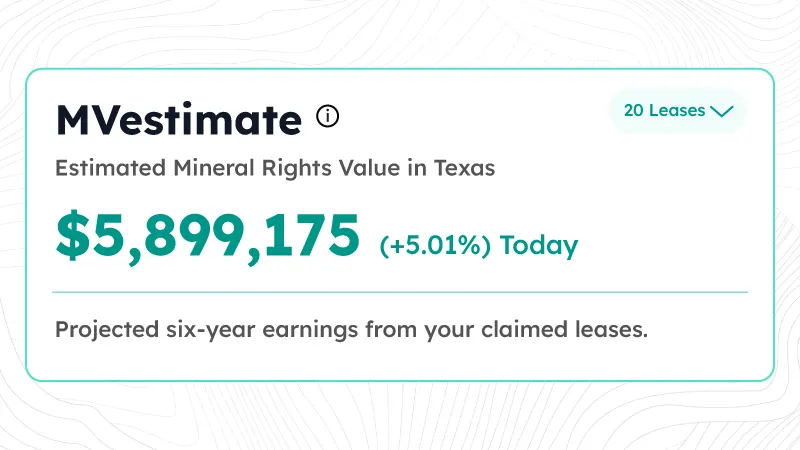
One of the hardest parts of being a mineral owner is knowing your property's value is difficult because a standard '60 to 80-month multiple' only values current production and often ignores 'PUD' (Proved Undeveloped) reserves, the untapped oil that modern 2026 drilling permits may soon target.
However, this is often a "lowball" estimate because it doesn't account for "PUD" (Proved Undeveloped) reserves, the oil that the oil company plans to drill but hasn't yet.
Using a tool like MVestimate helps mineral owners estimate the market value of their mineral rights based on production data and nearby drilling activity.
It analyzes the decline curves of existing wells and the potential for new drilling in your specific geological formation. This transparency ensures that if you decide to liquidate your minerals, you do so with a clear understanding of their true market value.
The Tax Implications
Tax implications are an important factor when deciding whether to sell or hold mineral rights. If you sell your mineral rights, the profit is generally taxed at the Long-Term Capital Gains rate (assuming you’ve held them for over a year). In 2026, long-term capital gains rates remain at 15-20% for most, a significant advantage over the top 37% marginal ordinary income rate, especially as the 15% bracket now starts at roughly $49,450 for single filers.
However, if you choose to hold, your royalties are taxed as ordinary income. While you do get that 15% depletion allowance, you are still subject to your highest marginal tax bracket.
If you sell: You get a large lump sum, but you must plan for a one-time capital gains tax hit.
If you hold: You get a steady stream of income, but you must manage annual tax filings and Texas ad valorem (property) taxes; in 2026, most Texas counties exempt mineral interests from property tax only if the appraised value is below $500.
Deciding not to sell mineral rights means committing to a lifetime of asset management in exchange for long-term growth potential.
What Happens After You Sell? A Real Example
Imagine you receive an offer to sell your mineral rights for $1,000,000. Alternatively, those same rights currently generate $100,000 annually in royalty income.
The Sell Scenario (Immediate Liquidation): If you sell for $1,000,000, assuming a 20% Capital Gains rate, you immediately owe $200,000 in taxes.
- Net upfront: $800,000.
- Future Income: $0. You have surrendered all future drilling upside.
The Hold Scenario (Generational Wealth): If you hold, you collect $100,000 annually. Because of the IRS Percentage Depletion Allowance, 15% of that income ($15,000) is shielded from federal taxes.
- Over a 15-year period, you will have grossed $1,500,000 in royalty checks.
- The real advantage: At the end of those 15 years, you still own the mineral rights. You still have the power to lease, benefit from new drilling technology, and pass a valuable asset to your children.
Comparing Your Options: To Sell or To Hold?
Before reaching a final verdict, it is helpful to look at the trade-offs side-by-side. While the tradition in Texas is often to never sell mineral rights, modern financial planning requires a more nuanced look at your personal balance sheet.
Comparison Table: Selling vs. Holding Mineral Rights
| Feature | Selling Your Mineral Rights | Choosing to Never Sell Mineral Rights |
|---|---|---|
| Immediate Liquidity | Lump Sum: Large one-time payment for immediate use. | None: Income is spread out over years or decades. |
| Tax Treatment | Capital Gains: Taxed at a lower preferential rate (15-20%). | Ordinary Income: Taxed at your regular bracket. |
| Risk Factor | Market Risk Eliminated: You lock in today’s value, though future upside is permanently surrendered. | Market Risk: Value rises and falls with oil prices. |
| Ownership Rights | Relinquished: You no longer have a say in leasing. | Retained: You keep the right to negotiate future leases. |
| Tax Incentives | 1031 Exchange: Possible to defer taxes into other real estate. | Depletion Allowance: 15% deduction on royalty income. |
| Management | Simplified: No more checks to track or taxes to file. | Active: Requires monitoring production and auditing checks. |
| Future Upside | None: The buyer gets all future "bonus" production. | Open-Ended Upside: You retain exposure to future drilling, new technology, and deeper formations. |
Note: The 15–20% capital gains rate reflects general federal tax brackets. High-earning individuals may also be subject to an additional 3.8% Net Investment Income Tax (NIIT), and state-level taxes may apply depending on your residency. Always consult a certified CPA or tax professional to evaluate the precise tax implications of liquidating your specific mineral assets.
The Factors That Can Make or Break Your Decision
Before making a permanent decision to sell, evaluate these essential factors through the lens of long-term wealth preservation:
Financial Goals:
Are you sacrificing a long-term passive income engine for short-term liquidity? Holding your mineral rights allows you to build generational wealth and leverage powerful tax shields like the Percentage Depletion Allowance.
Risk Tolerance vs. Upside Potential:
The oil and gas market fluctuates, but selling permanently eliminates your future upside. By holding, you retain the rights to deeper geological formations and "Behind-Pipe" reserves.
Administrative Complexity:
Managing leases, tax documents, and production records used to be a massive burden. However, selling your family's legacy simply to avoid paperwork is a costly mistake. Today, utilizing dedicated platforms automates the administrative heavy lifting while keeping the royalty checks flowing.
Hold or Sell? Follow This Simple Path to Decide
Do you Need Immediate Cash for a Significant Life Event?
- Yes: Consider a partial liquidation to secure the necessary lump sum while retaining the majority of your asset.
- No: Proceed to the next question.
Are you Overwhelmed by the Administrative Burden of Tracking Leases?
- Yes: Before deciding to sell, organize your assets with professional-grade data tools like Mineral View to eliminate the headache.
- No: Holding remains your strongest option for passive income.
Is there Active or Expected Future Development on Your Property?
- Yes: Hold. Selling now means the buyer gets all future "bonus" production.
- Uncertain: Hold and verify. Use high-resolution mapping tools to see if major operators are filing permits near your boundaries before entertaining offers.
Final Words
The decision to sell or never sell mineral rights is an important financial decision of families in Texas. There is no universal answer, only the answer that fits your financial goals, risk tolerance, and family legacy. Holding mineral rights can provide long-term income and potential future benefits, but it also involves uncertainty. Selling them offers immediate cash and removes industry risks, though it means giving up future royalties and possible long-term earnings.
The key is making an informed decision, not an emotional one. The most expensive mistake a mineral owner can make isn’t selling, or holding. It’s making the decision without knowing what their minerals are truly worth.
To successfully manage these assets, it is critical to use Mineral View Features. By utilizing high-resolution maps, accurate valuation tools, and comprehensive operator activity data, owners can gain a professional edge in negotiations.
Furthermore, detailed lease analysis and reporting provide the legal clarity needed to track deductions and ensure fair payment. These resources transform complex oilfield data into clear, actionable insights for every mineral owner.
Disclaimer: The above blog is for informational purposes only and does not constitute legal, tax, or financial advice. The oil and gas market is volatile, and individual tax situations vary greatly. We strongly recommend consulting with a certified CPA, financial advisor, or oil and gas attorney before making any permanent decisions regarding your mineral rights or estate planning.