Plug and Abandon
Plug and abandon, often written P&A, is the permanent closure of an oil or gas well at the end of its productive life.
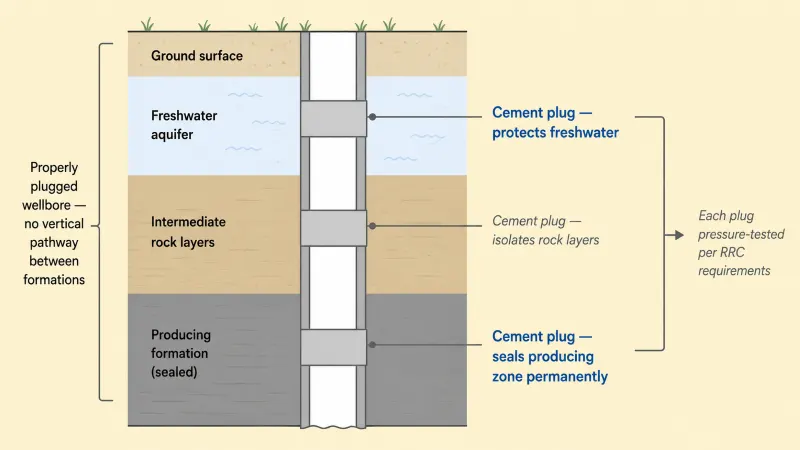
The process involves placing heavy cement plugs at specific depths inside the wellbore to seal off the producing formation, prevent fluids from migrating between rock layers, and protect freshwater aquifers from contamination. Once a well is properly plugged, the wellhead is removed, the surface casing is cut below ground, and the site is restored.
What This Means for Mineral Owners
P&A affects you in two distinct ways, both of which matter to your minerals' future value.
The first is environmental and physical. A properly plugged well protects your land from groundwater contamination and methane emissions. The cement barriers seal off the formations the well penetrated, preventing saltwater or hydrocarbons from migrating into freshwater aquifers. This protects the surface use of your land, for ranching, farming, or any other purpose, long after the well stops producing.
The second is contractual. A well that is no longer producing but has not been properly plugged can complicate your ability to enter new leases on the same acreage. Operators evaluating new opportunities want clean title and clear status on existing wells. An idle, unplugged well on your land can complicate or delay a new leasing transaction until its status is resolved.
Key point for mineral owners
Knowing the P&A status of every well on your mineral acreage is a useful piece of due diligence, particularly if you have recently inherited minerals, are considering selling, or have been approached with a new lease offer.
How the Plug and Abandon Process Works
P&A is a regulated, multi-step process. In Texas, the Railroad Commission of Texas (RRC) sets the requirements, and operators must follow them to legally close out a well.
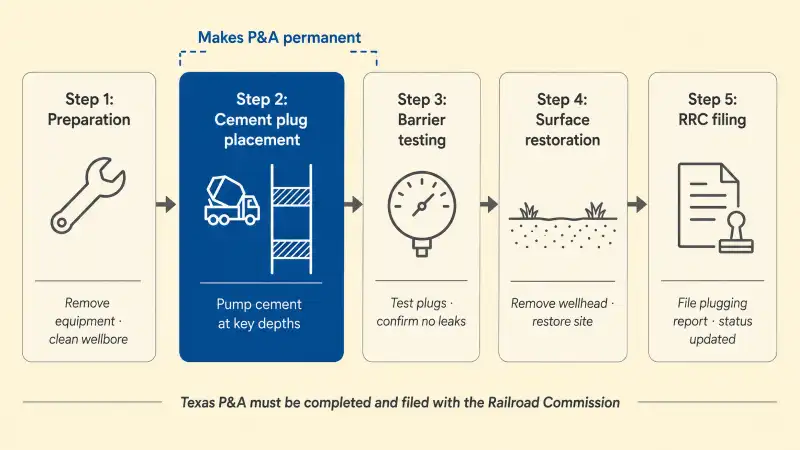
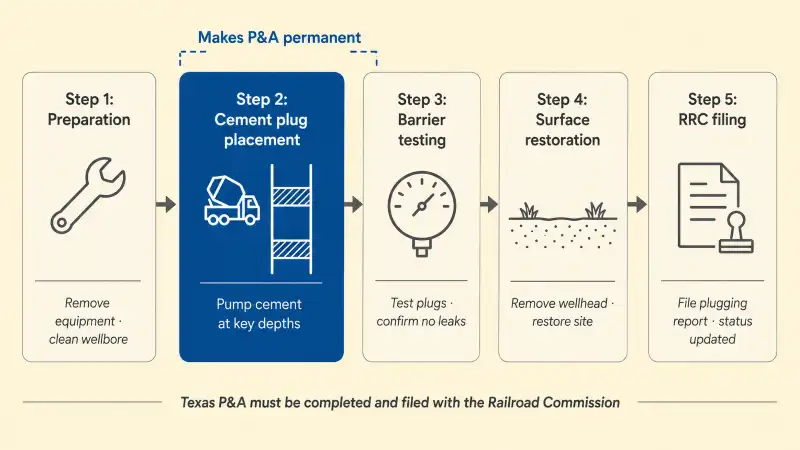
Step 1: Preparation
The operator removes production equipment from the wellbore, including the tubing string and any downhole pumps or packers. The well is cleaned out and made ready for cementing operations.
Step 2: Cement barrier placement
The crew pumps high-density cement into the wellbore at specific depths. These cement plugs are placed to seal off the producing formation, isolate freshwater zones, and create barriers between any other rock layers the well passes through. The number and location of plugs depend on the well's depth, the formations it penetrated, and RRC requirements.
Step 3: Barrier testing
Each cement plug is pressure-tested to confirm it can withstand the downhole conditions and will not leak over time. If a barrier fails the test, the operator must remediate it before continuing.
Step 4: Wellhead removal and surface restoration
Once the cement barriers are in place and verified, the wellhead is removed, and the surface casing is cut below ground level (typically at least three feet below the surface in Texas). The well location is then restored, equipment removed, pads reclaimed, and vegetation re-established where required.
Step 5: Regulatory filing
The operator files the required plugging documentation with the Railroad Commission of Texas, documenting the work performed. The well's status in regulatory records is then updated to reflect that it has been plugged and abandoned. From that point, the well is permanently closed.
Why P&A Matters Environmentally
P&A is not just paperwork. It addresses two significant environmental risks that an unplugged well can create.
Fluid migration
An open wellbore creates a vertical pathway between rock formations that nature otherwise keeps separated. Without proper cement barriers, saltwater from deep formations can migrate upward and contaminate freshwater aquifers. Hydrocarbons can leak between zones. P&A's cement plugs eliminate this pathway.
Methane emissions
Methane, the primary component of natural gas, is a significant greenhouse gas. An unplugged or improperly plugged well can leak methane to the surface for years or decades. The RRC and federal regulators increasingly track and require remediation of these "orphan" or improperly plugged wells. Proper P&A eliminates the leakage at the source.
For mineral owners, these are not abstract concerns. Surface contamination affects land value, livestock health, and your ability to use the surface for other purposes. Federal and state programs to address orphaned wells continue to expand, and being able to confirm that wells on your acreage are properly plugged helps reduce uncertainty regarding environmental and regulatory issues associated with old wells.
P&A and Your Future Leasing Options
This is the part most mineral owners do not think about until it becomes relevant.
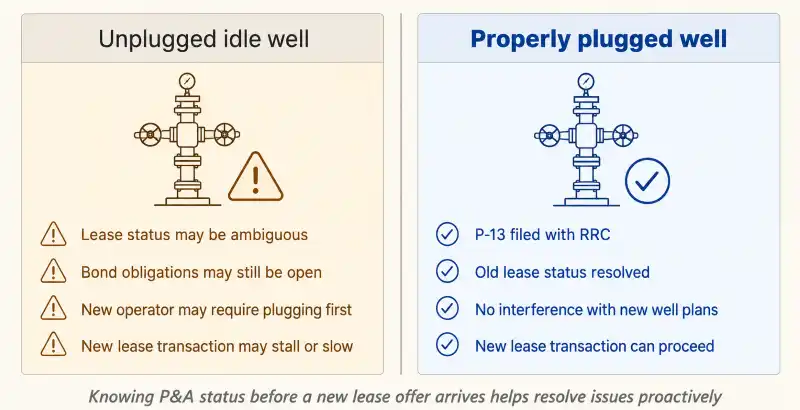
When a new operator approaches you with a lease offer, perhaps targeting a different formation than the one the old well produced from, they typically want clean title and clear status on any existing wells. A well that is no longer producing but has not been formally plugged can create complications:
- The well's status as "shut-in" versus "abandoned" may be unclear, which can affect whether the old lease has terminated under its habendum clause.
- The previous operator's bond obligations and remediation responsibilities may still be open.
- The new operator may want the old well plugged before they commit capital to drilling new wells nearby, particularly if the old wellbore could interfere with their plans.
Until the well is properly plugged and the old lease's status is resolved, a new leasing transaction can be slowed or stalled. This is why proactively tracking the status of old wells on your acreage is part of good mineral management.
To see which wells are on your minerals and check their status, Mineral View's Map shows the location and current status of wells across Texas, including plugged and abandoned wells, in one consolidated view rather than requiring you to search through multiple regulatory sources.
A Real-World Scenario
Example: David's Permian Basin acreage in Midland County
David inherited 100 acres of mineral rights in Midland County, Texas, in the heart of the Permian Basin. The acreage had an old vertical well from the 1980s that had produced modestly for years before slowing to near-zero in the early 2000s. The well stopped producing entirely, but the original operator never went through the formal P&A process. The well sat idle.
In 2023, a new operator approached David with a lease offer of $5,000 per acre, targeting a deeper formation that modern horizontal drilling had made commercially viable. David was ready to sign. (This example is provided for illustrative purposes only and does not represent any specific mineral owner, lease, or market condition.)
The transaction slowed. The new operator's title review flagged the old well: its formal status was still active on RRC records, the original lease had ambiguous expiration terms, and no P&A had been filed. Until the old well's status was resolved, either by formal plugging or by a clear title remedy, the new operator was not willing to commit to the new lease.
David engaged a Texas oil and gas attorney to work through the situation. The attorney coordinated with the original operator to complete the P&A on the old well and file the necessary paperwork with the RRC. The process took several months. Once the well was officially plugged and the title cleared, David signed the new lease.
The lesson: David's minerals had real value, and the new operator was ready to pay for it. But the unplugged old well was an obstacle that had to be cleared before the deal could close. Knowing the P&A status of wells on your acreage, and acting on it before you receive a new offer, keeps your minerals ready for the next opportunity.
What to Check
Know which wells on your acreage are still producing, shut-in, or abandoned
Mineral View's Map and Lease Report show the status of wells across your claimed leases. Wells listed as inactive or abandoned but not formally plugged are worth understanding — they may need attention before a new lease can be signed.
Watch the RRC's P-13 records for wells on your land
The Railroad Commission of Texas maintains public records of plugging reports filed by operators. Confirming that a well listed as plugged actually has a corresponding P-13 filing gives you certainty that the closure is complete and on file.
If you are considering a new lease, check the status of old wells in advance
A new operator's title review will check the status of any existing wells on your acreage. Knowing the status before you negotiate gives you the chance to resolve any open issues proactively, rather than discovering them mid-transaction.
Important
Mineral View can help you identify wells on your acreage, track their status, and understand operator activity. For questions about whether a specific well's plugging status affects your lease, your title, or a new transaction you are considering, consult a qualified landman or Texas oil and gas attorney.
Common Questions
A shut-in well is temporarily not producing but is still mechanically capable of production. The operator may bring it back online when conditions change (gas prices rise, infrastructure becomes available, a workover is completed). A plugged and abandoned well is permanently closed with cement barriers in place and cannot be returned to production. P&A is the end of the well's life, while shut-in is a pause.
The operator who holds the lease is responsible for plugging costs. Texas requires operators to post a bond or other financial assurance to cover plugging obligations. If an operator goes bankrupt or abandons the well without proper P&A, the well may become "orphaned," and state or federal programs may eventually fund the plugging. The mineral owner generally does not pay directly for P&A.
Yes. P&A closes a specific wellbore permanently, but it does not prevent new wells from being drilled on the same acreage. New wells may target different formations, use horizontal rather than vertical wellbores, or be located on a different surface site. Many Texas mineral acres that produced from old vertical wells decades ago are now producing again from modern horizontal wells targeting deeper or different formations.