Mineral rights in Texas can be a reward to own financially but also can create puzzling questions, particularly on taxes. The mineral owners are often surprised to find out that although they do not own the surface land or run a well, they might still be charged a property tax bill.
Many mineral owners are taken aback by their initial tax bill, particularly if they have no control over leasing decisions or well operations. The real question is then ‘Do You Pay Property Taxes on Mineral Rights?’
Yes, in Texas, you pay property taxes on mineral rights once they begin producing oil or gas. Because Texas law classifies producing minerals as real property, the county appraisal district will assess taxes based on the market value of your interest, separate from the surface land taxes.
This informative blog helps you explain all the important aspects of property taxes that every mineral owner should be aware of. It covers the information on the time when taxes are to be paid, how the value of minerals is to be determined by the counties, the distinction between property tax and other oil and gas taxes, and the consequences of failure to pay taxes.
Be it an executive rights holder, a non-executive heir or a new mineral owner, this guide will help you navigate tax season and avoid unnecessary penalties.

Key Takeaways
- Yes, in Texas, mineral interests are taxable real property. Once your minerals begin producing, expect an annual property tax bill from your county based on the appraised value of your interest.
- Mineral property taxes are assessed separately from surface land taxes. Counties send different bills for surface estates and mineral estates.
- Unpaid mineral property taxes can lead to tax liens, penalties, interest, and forced sale at auction.
- Property tax is separate from federal income tax and Texas severance (production) tax. In producing cases, mineral owners may owe all three.
- Non-producing mineral rights are typically appraised at zero value and are not taxed; however, this status changes immediately once a well is drilled and production is reported.
- Both executive and non-executive mineral owners receive property tax bills based on their ownership percentages, even though only executive owners control leasing.
- Understanding operator performance and production trends can help mineral owners anticipate valuation changes and tax impacts over time.
What to Do First?
- Check your ownership percentage on the tax notice: Make sure your listed ownership share is accurate, as even small errors can impact your tax amount.
- Confirm the well is actually producing: Verify that the well is active and generating production, since non-producing wells should not be taxed the same way.
- Compare this year’s value to last year’s: Look for sudden increases or inconsistencies that may signal an incorrect valuation.
- Note the protest deadline (usually May): Mark the deadline early so you don’t miss your chance to formally challenge the assessed value.
What Are Mineral Rights and Why Are They Taxed in Texas?
Texas is a split-estate system, which implies that the surface land and the mineral present below it can be owned by two different people. When you own the mineral rights, you own the oil, gas and other minerals that are found underground even when another person is the owner of the land on the surface.
The structure is highly prevalent in the oil and gas fields of Texas, including the Permian Basin, Eagle Ford Shale and Barnett Shale. The surface land was sold to landowners over the decades, and minerals remained in the possession of the latter; the heirs inherited the land again and again. The outcome is that the number of small mineral interests is dispersed among thousands of families and organizations.
According to the law of Texas, mineral interests are regarded as real property, just like a house or land. The Texas Constitution (Article VIII) and the Texas Property Tax Code (Chapters 1 and 23) authorize counties and school districts to assess all real property located in their jurisdiction, including severed mineral interests.
The county appraisal districts include mineral interests on their tax rolls once one of the wells is producing. Since then, mineral owners have been assured an annual property tax bill that is calculated on the value of the mineral or royalty interest as opposed to surface acreage or building.
Do You Pay Property Taxes on Mineral Rights?
Yes. In most producing situations, Texas mineral owners do pay property taxes on mineral rights.
The table below shows how it usually works:
| Situation | Property Tax Owed? |
|---|---|
| Non-producing minerals | Usually No |
| Producing minerals | Yes |
| Executive owner | Yes |
| Non-executive owner | Yes |
| New well drilled | Likely Soon |
Example:
A landowner in Reagan County owns both surface and minerals. After a gas well begins producing, the county issues two tax bills each year, one for the surface ranch and another for the mineral interest. Even though the well operator handles production, the mineral owner is still responsible for property taxes.
This leads many owners back to the core question: Do You Pay Property Taxes on Mineral Rights? In Texas, production almost always means yes.
How Property (Ad Valorem) Taxes on Mineral Rights Work in Texas
The taxation system in Texas is ad valorem taxation, which implies the property is taxed based on the value. The production of the oil and gas minerals is assessed in accordance with the standardized formulas that are set forth in Section 23.175 of the Texas Property Tax Code. These appraisal standards are overseen by the Texas Comptroller of Public Accounts, ensuring that counties use consistent methods to value decline rates and future revenue.
Generally the appraisal process encompasses:
- Determining future production by estimating the decline rate of production as a curve over time.
- The use of commodity price assumption, wherein most cases it is based on the average oil and gas prices of the previous year.
- Net revenue is estimated by calculating operating costs minus their cost.
- Presenting the future revenues that will accrue in discounted form with state-approved discounting rates.
- Dealing with taxable value when the owner calculates its value by using the owner’s decimal interest.
Example:
Suppose you own a 0.015 decimal interest (derived from your Net Mineral Acres) in a producing Permian Basin well. Your interest in the appraisal district is considered to be worth $100,000. Assuming the aggregate rate of taxation is 2.5, then your annual tax bill on mineral property will be approximately 2,500 dollars.
Important things to know:
- The values of minerals are reassessed on an annual basis.
- Taxes can be raised faster by higher oil or gas prices.
- Wells that deteriorate tend to have a reduced value.
- Interests should not be included on the tax roll until commencement of production.
Valuation changes usually become easier to comprehend by owners who monitor the activity of operators and their production trends. The comparison of the management of various operators in the area of decline rates, completion styles and production efficiency may be useful background information when examining appraisal notices.
Texas Income, Severance, and Property Taxes on Mineral Rights: What’s the Difference?
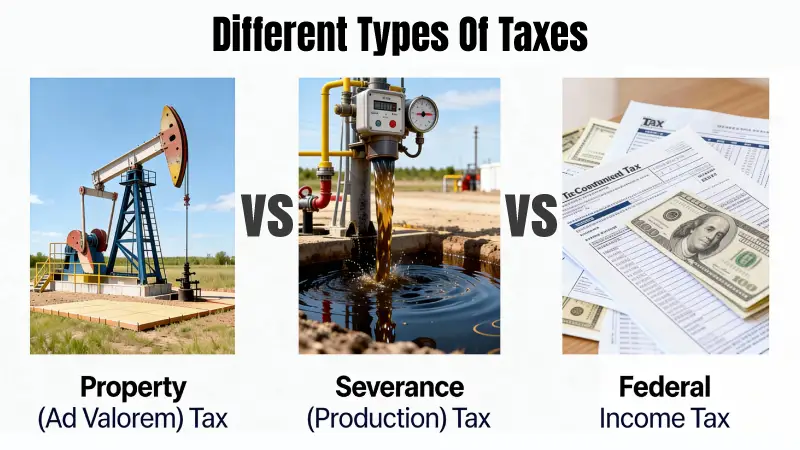
Texas mineral owners often confuse different types of taxes. Each one serves a different purpose.
Property (ad valorem) tax
- Assessed annually by local taxing authorities
- Based on the value of your mineral interest
- Paid directly to the county tax office
- Due by January 31 of the following year
Severance (production) tax
- Imposed by the State of Texas
- About 4.6% on oil and 7.5% on natural gas
- Paid by the operator
- Deducted before royalties reach you
Federal income tax
- Applies to royalty income, lease bonuses, and rentals
- Reported on Schedule E
- Texas has no state income tax
- Depletion deductions may apply
Example:
You receive $15,000 in royalties during the year. Severance tax is already deducted. You later receive an $800 mineral property tax bill and report the $15,000 on your federal return.
Executive vs. Non-Executive Rights in Texas
Executive rights holders control leasing decisions. Non-executive owners receive royalty income but do not negotiate leases.
Tax treatment is the same.
Both executive and non-executive owners:
- Pay property taxes based on ownership percentage
- Report royalty income for federal tax purposes
- Can lose interests if property taxes go unpaid
- Control does not change tax responsibility.
Key Stats and Practical Considerations for Texas Mineral Property Taxes
Texas is the U.S.'s biggest producer of oil and gas and this generates a huge tax base in the form of minerals.
- Texas consistently produces nearly 2 billion barrels of oil annually, generating a massive tax base for local counties.
- In many major producing areas, oil and gas reserves account for 20–40% of all property tax revenue.
- The local tax rates can be between 1.5 and 3 percent.
- Property taxes can reduce net royalty income, especially for small owners.
- For the 2026 tax year, owners might actually see lower valuations due to the recent price drop.
- Non-executive heirs still owe taxes even without leasing control.
- Late-life wells may generate taxes close to or higher than income.
- Price assumptions
- Decline rates
- Operating costs
- Minerals are non-producing
- Interests are very small
- County has not listed the interest yet
- Penalties and interest
- Tax liens
- Court judgments
- Forced sale at auction
- Assuming operators pay property taxes: Many owners mistakenly believe operators handle these taxes, when in most cases the responsibility falls on the mineral owner.
- Ignoring small bills until penalties grow: Small tax amounts can quickly turn into larger balances once interest and penalties are added.
- Missing protest deadlines: Failing to act before the deadline means losing the opportunity to correct an unfair or inaccurate assessment.
- Forgetting non-executive interests are still taxed: Even without leasing or decision-making rights, non-executive mineral interests are still subject to property taxes.
The knowledge of the production patterns, operator efficiency, and the behavior of the decline can assist owners to determine the future tax exposure better.
Cash-Flow Implications
Strategies to Manage or Reduce Property Tax Burden on Mineral Rights

Appeal Your Mineral Appraisal
Owners can protest valuations annually. Review:
Professional help may be worthwhile for larger holdings.
Plan for Tax Payments
Setting aside 10–20% of royalty income helps avoid surprises.
Structure Ownership Carefully
Family LLCs or trusts simplify administration.
Consider Selling Some or All Interests
Selling converts recurring property taxes into a one-time capital gains event.
When Might You Not Owe Property Taxes on Mineral Rights?
You may see little or no bill if:
Once production starts, billing usually follows.
What Happens If You Don’t Pay Property Taxes on Mineral Rights?
Failure to pay can lead to:
Both executive and non-executive owners can lose interests.
Common Mistakes to Avoid
Additional Tax Considerations Mineral Owners Should Understand
Owning mineral interests in mineral rights Texas involves more than property taxes. When an oil or gas company produces from your land, royalty checks are generally considered ordinary income and reported with other income at tax time, meaning you may still owe taxes depending on your effective tax rate.
While Texas has no income tax, state tax laws still apply through severance and property taxes, and rules vary by ownership type and county. Some owners may be able to deduct expenses, but the tax consequences depend on timing, income level, and whether a first sale to mineral buyers is based on current value. Taking sufficient time to understand these factors can prevent surprises and support better long-term decisions.
If you own producing minerals, you can predict changes in valuation and the effects of property taxes before the bill arrives by monitoring production patterns, drilling activities in the area, and operator behavior.
Conclusion
So, Do You Pay Property Taxes on Mineral Rights? In Texas, the answer is clear: if your minerals are producing, you almost certainly do.
Mineral interests are real property by Texas law and counties do not take taxation lightly. The manner in which the valuations operate, the application of various taxes and the impacts of the performance of the operators on the long-term value can help you to handle the costs and hold onto your ownership. While mineral owners can’t control drilling decisions, they can control how prepared they are for taxes and valuation changes.
You need to know the best solutions to avoid getting caught up. Whether you decide to hold, lease, or divest, ensuring your tax records are accurate is the first step to protecting your asset.