
Loading article
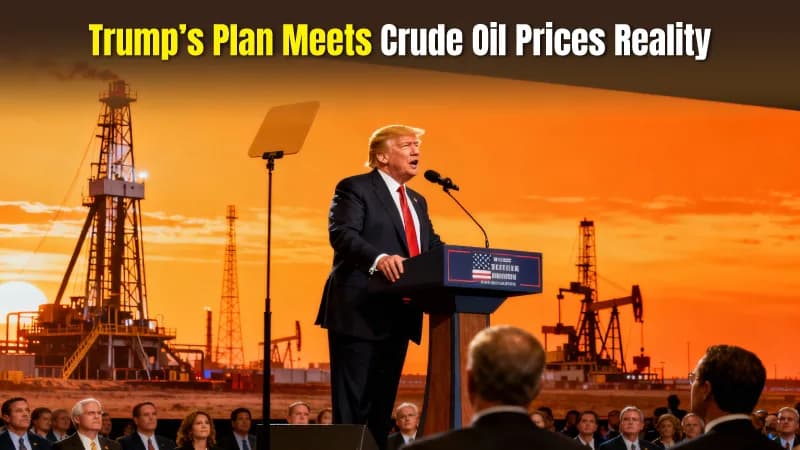
When President Donald Trump began his second term, he promised Americans an energy revival like never before. “We will drill, baby, drill,” he declared during his inauguration speech, pledging to unleash a surge in oil drilling that would flood the market with domestic energy and deliver lower prices at the pump.
Nine months later, only half of that promise seems to be coming true. Gas prices are indeed lower—but U.S. oil drilling and production activity have slowed sharply.
According to data from the Federal Reserve of Dallas, production activity in the U.S. oil and gas sector fell throughout the third quarter of 2025, marking the second consecutive quarter of decline. The same report highlighted a drop in industry confidence, with many executives saying “conditions are getting worse.”
The contraction mirrors what’s happening in the market. Crude oil prices have dropped more than 14% so far this year, and both the domestic benchmark—West Texas Intermediate (WTI)—and the global benchmark—Brent crude—are slipping into a prolonged downtrend.
| Key Metrics (2025) | Data Point |
|---|---|
| Brent crude decline | –13.5% YTD |
| WTI crude decline | –14.5% YTD |
| U.S. production forecast (2026) | ↓ 1% |
| Gasoline price forecast (2025) | $3.10 per gallon |
| Gasoline price forecast (2026) | $2.90 per gallon |
The Energy Information Administration (EIA) projects that U.S. oil output will decline slightly in 2026, while natural gas production remains flat. It’s a surprising turn for a president who built much of his economic plan on energy expansion.
The decline in crude oil price isn’t just a local issue—it’s a global storm. Analysts point to an approaching supply glut, slowing demand, and aggressive OPEC production increases.
When crude oil prices rise, oil companies invest more heavily in exploration, drilling rigs, and production infrastructure. But when prices fall—especially under $70 per barrel—many projects become uneconomical.
“The administration is pushing for $40 per barrel crude oil, and with tariffs on foreign drilling supplies, input costs are rising. Drilling will disappear,” said one respondent in the Dallas Fed’s monthly energy survey.
The industry’s sentiment reflects a harsh reality: low current oil prices make it hard to justify new wells, even with the administration’s pro-drilling rhetoric.
Part of the downward trend comes from sluggish gasoline demand in the United States. While consumption is expected to rise slightly in 2026, much of the growth in overall energy use is shifting toward renewables—especially solar power.
Meanwhile, oil consumption across Europe, Central Asia, Latin America, and China has been falling. The global energy mix is changing fast, and fossil fuels are losing ground to alternatives.
Still, lower gas prices remain a win for consumers. The EIA forecasts average U.S. retail gasoline prices at $3.10 per gallon in 2025, down from last year, and possibly $2.90 per gallon in 2026—the lowest in years.
But what’s good for drivers often hurts producers.
The OPEC cartel, led by Saudi Arabia, has played a significant role in shaping oil prices today. In September, OPEC announced plans to increase production by 137,000 barrels per day starting in October.
The move aims to grab market share from U.S. producers, many of whom have scaled back operations due to falling crude oil prices.
China, once a major driver of demand growth, is also contributing to the problem by building massive crude stockpiles. That buildup has created an artificial oversupply, putting further downward pressure on the market.
In the U.S., refineries are running at their highest capacity since mid-2022, but that’s not entirely good news. The surge in refinery utilization has created a processing bottleneck—crude is being turned into fuel faster than it’s being consumed.
This imbalance depresses crude oil prices even more, even as finished products like gasoline flow steadily to market.
So, while gas prices at the pump are easing, oil producers are struggling to keep margins healthy.
The Trump administration’s flagship energy policy, the One Big Beautiful Bill, was designed to jumpstart the sector. It opened up new federal lands for leasing and cut royalty rates for oil and gas companies, offering cheaper access to drilling opportunities.
Yet, the response from the industry has been lukewarm. Only 6% of respondents in the Dallas Fed survey believe the new policies will make a meaningful difference.
“Easing U.S. oil field regulations and the ‘drill baby drill’ mantra do not appear to be changing strategies within the industry,” wrote analysts Jonathan Waghorn and Will Riley from Guinness Global Investors.
The bill may alleviate pressure slightly, but it’s not enough to reverse the broader contraction.
Signs of retrenchment are clear across the sector.
Exxon Mobil (XOM) recently sold $550 million worth of drilling equipment from its Bakken operations to a smaller regional firm.
Chevron (CVX) announced plans to reduce its active rig count from four to three.
These moves highlight how even the largest oil producers are tightening operations amid weaker crude oil prices and reduced investment appetite.
While the oil news searched maximum times, the natural gas news tells a slightly steadier story. Natural gas prices have been edging higher, supported by strong export demand, particularly for liquefied natural gas (LNG).
The U.S. has ramped up its LNG exports to Europe and Asia, offsetting some domestic softness. Still, natural gas production is expected to remain flat, balancing rising exports with slowing internal consumption.
This stability offers a silver lining for mineral owners and gas investors, as global gas markets remain structurally tighter than oil.
Energy slowdown doesn’t just affect drillers—it impacts manufacturing and services linked to the industry.
The Dallas Fed’s latest survey revealed that factory activity in Texas expanded in September, but at a slower rate than in August.
New orders fell.
Growth in shipments slowed.
Prices for raw materials continued to rise, albeit more gradually.
One machinery manufacturer summed it up:
“We see the oil industry slowing and are more hesitant to invest in their business.”
This hesitation ripples outward, cooling down sectors from steel fabrication to logistics and transportation.
A number of one respondents in the industry indicates that the position of the Trump administration might be sticking unwillingly with the market strategy of OPEC, which is aimed at causing a reduction in the current oil prices through oversupply.
The reason behind this is quite basic: the reduction in prices is good to consumers and plays along with the political message about inflation control, yet it tightens the profitability of producers.
However, over the long run, a continuous decline in crude oil prices may deter any form of exploration and development of new projects that will eventually lead to a supply crunch in the late 2020s.
According to the EIA, the downtrend may persist. The agency expects Brent crude—currently trading around $68 per barrel—to average $59 per barrel in Q4 2025, and $50 per barrel by early 2026.
| Forecast Period | Expected Brent Price | Inventory Trend |
|---|---|---|
| Q4 2025 | $59/barrel | +1.8 million bpd |
| Q1 2026 | $50/barrel | +2.2 million bpd |
If this projection holds, U.S. producers may continue to scale back, particularly in high-cost basins like the Bakken and Eagle Ford.
Despite gas prices rising occasionally due to refinery outages or regional bottlenecks, the broader trend points downward. The irony is that while gas prices fluctuate, crude oil prices have stayed weak.
Overproduction by OPEC members
Soft global demand from China and Europe
High refinery output in the U.S.
Inventory build-ups worldwide
For consumers, this means short-term relief. For producers, it’s a reminder that energy markets remain volatile and policy-driven.
For investors and mineral owners, the current phase of the market presents both risk and opportunity.
Lower crude oil prices mean thinner profit margins.
Reduced drilling activity can limit royalty income for mineral rights holders.
Oversupply conditions can extend for several quarters.
This can be achieved through low production costs today which can give high returns with a rebound in the prices.
The energy requirement especially in the emerging economies is strong in the long term.
When the markets are faced with a downturn, it will be observed that the Investor is able to record gains in upturn.
“Every oil cycle ends the same way,” said one independent energy analyst. “Investment dries up, supply tightens, and then prices surge again. It’s not a matter of if, but when.”
As of October 2025, current oil prices hover near $68 for Brent and $64 for WTI. While far from the highs of previous years, they reflect a market adjusting to a post-pandemic, renewable-heavy world.
The Trump administration’s energy policies aim to keep prices lower for consumers, but the balance between cheap gas and strong domestic drilling remains delicate.
If crude oil price continues to hover below $60 per barrel, many shale producers may pause new investments. Yet, those who endure the current phase could benefit massively when the next cycle begins.
In the future, analysts have anticipated 2026 to be the year of stabilization in the global oil and gas market. Only slight production decreases are predicted by the EIA, which indicates that the weakening of the slowdown can be soon overcome.
Nevertheless, the energy transformation in the world is still changing the picture. Nations are going away of oil-based energy sources, forcing oil companies to be innovative, efficient, and diversify to natural gas, hydrogen, and renewables.
Still, oil isn’t going away. It is important to the global transportation, manufacturing and industrial sectors.
Even amid low crude oil prices, opportunities remain. Mineral owners can benefit from:
Long-term leasing strategies with flexible royalty structures.
Joint venture participation in gas-focused projects, which show steadier margins.
Strategic timing—selling or leasing mineral rights when market confidence returns.
Energy investors can look to capitalize on:
Infrastructure investments in pipelines and LNG terminals.
Diversified energy portfolios combining oil, gas, and renewables.
Undervalued energy stocks that may rebound as prices recover.
| Trend | Impact on Industry |
|---|---|
| Falling crude oil prices | Reduced drilling activity, lower margins |
| Lower gas prices | Relief for consumers, pressure on producers |
| Flat natural gas output | Stability amid export growth |
| OPEC output hikes | Market oversupply, weaker prices |
| Trump’s policy reforms | Limited impact so far |
It is not the energy story of collapse of 2025 it is the energy story of realignment. The offer of drill, baby, drill could be spouting nonsense, yet, the larger market is a chessboard with a lot of prospects.
Yes, there are low crude oil prices, and production is tightening. History has it though, that each decline in oil has led to the next boom.
To those investors and owners of the minerals, it may be an opportunity to wait and not to run away as when the cycle changes those who remained patient during the low price period shall be the greatest beneficiaries.
As of today, crude oil prices are around $68 per barrel for Brent crude and $64 per barrel for West Texas Intermediate (WTI). Prices fluctuate daily based on global supply, demand, and geopolitical events.
If oil hits $200 per barrel, it would trigger higher gas prices worldwide, increase production costs for businesses, and likely slow economic growth. Consumers would feel the impact at the pump, but oil and gas investors could see very high profits.
Around 80% of the world’s proven oil reserves are held by a few countries, mainly Saudi Arabia, Venezuela, Canada, Iran, Iraq, and Kuwait, with Saudi Arabia having the largest share.
Donald Trump’s economic plans focus on boosting U.S. energy production, cutting taxes, reducing regulations, promoting manufacturing, and lowering gas prices for consumers. He also emphasizes energy independence by encouraging more oil and gas drilling.
“Drill baby drill” means promoting more domestic oil and gas drilling in the U.S. to increase production, lower crude oil prices, and reduce reliance on foreign energy.
“Drain the swamp” refers to reducing corruption and inefficiency in government, cutting unnecessary regulations, and limiting special interest influence over U.S. policies.
Stocks that benefit include U.S. oil and gas companies like ExxonMobil, Chevron, and smaller shale producers. Also, energy equipment suppliers and companies involved in pipelines and drilling services tend to gain when domestic drilling increases.
Informational only — not legal, tax, or investment advice.