
Loading article
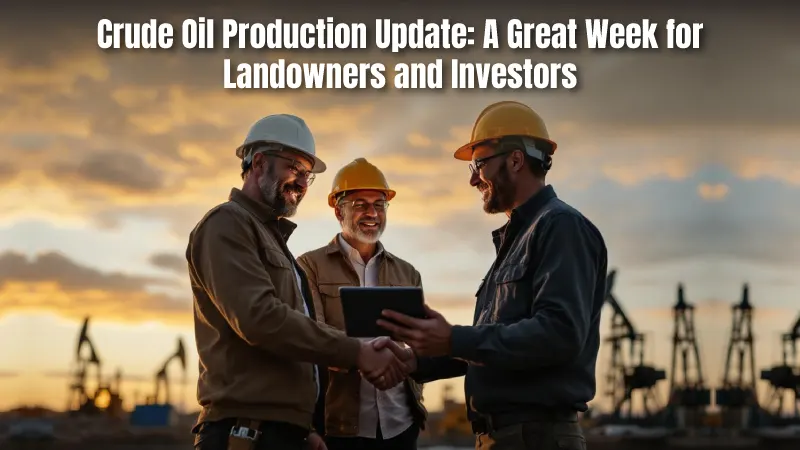
Even in uncertain times, the U.S. oil and gas industry keeps moving forward. In last week several updates were shared that demonstrate how U.S. crude oil production remains robust and is adapting in intelligent ways. These updates are important not just for companies, but also for people who own mineral rights and for investors who are putting money into the oil and gas industry
There are a few updates that talk about a small drop in output, while other updates show growth in exports, new shipping upgrades, and easier rules for energy companies. When we look at all the updates together, they show that the U.S. oil and gas business is not slowing down—it’s getting better and more ready for the future.
According to the U.S. Energy Information Administration (EIA), crude oil production could go down slightly by the end of 2025. Right now, the U.S. is producing about 13.5 million barrels of oil each day, but by the end of next year, that number might fall to 13.3 million barrels per day.
This small drop is not something to worry about. It’s mainly because fewer new wells are being drilled and oil prices are a bit lower than before. But this doesn’t mean oil work is stopping. In fact, crude oil production is still strong in many areas, and the work continues.
For mineral owners, this means checks will still come in, and drilling will continue in many places.
For energy investors, the long-term outlook is still full of opportunities. Even with a slight drop, the U.S. remains a top player in the oil world.
Russell Hardy, who leads Vitol (a large energy company), said that considering the current oil prices, U.S. oil companies are making wise decisions. He said that even if crude oil production slows down a bit, the U.S. will still be one of the biggest oil suppliers in the world.
This kind of balance is actually a good thing. When oil companies don’t overproduce and keep an eye on prices, it helps keep the market steady. And that’s great news for both mineral owners and investors. It means payments stay more regular and companies can keep growing without big problems.
The United States is doing a decent job of adapting to the shifting market, according to Hardy. This proves that crude oil output is resilient both now and in the decades to come.
The Environmental Protection Agency (EPA) shared news that it plans to make some older rules less strict. These rules were about pollution limits for gas and coal plants. By making the rules easier, the EPA believes companies could save over $1 billion each year.
This transformation may result in more projects being started in the U.S., especially in oil and gas. This change in regulations may also encourage activity in oil fields, as crude oil production frequently occurs close to natural gas projects. For people who own land with oil or gas under it, this is great news. It could lead to more drilling and more chances to earn money. And for investors, it shows that the U.S. is trying to keep the energy business healthy and growing.
An additional significant event that happened recently was the completion of a large upgrade at the Port of Corpus Christi in Texas. This project cost $625 million and deepened the shipping path so larger ships can carry more oil at once.
This is a huge step forward for oil export expansion. More oil can be exported from the United States to other nations thanks to the new channel. By creating new sales opportunities, this boosts crude oil production in the United States.
For mineral owners, this may lead to more drilling on their land to keep up with the extra demand. And for investors, this is a strong sign that U.S. oil is reaching more global markets than ever before.
Even with problems continuing in the Middle East—especially between Israel and Iran—Oil Prices have stayed fairly steady. During this time, the WTI crude oil price remained between $72 and $74 per barrel.
This is a good sign for everyone in the oil business. It means that buyers around the world still trust the U.S. to supply enough oil. Even when there’s trouble in other places, crude oil production in the U.S. helps keep oil available for everyone.
For mineral owners, steady prices mean more reliable checks. And for investors, it proves that the U.S. energy market is stable, even when other parts of the world are not.
Some oil companies, like Chevron, are asking the U.S. Supreme Court to let certain lawsuits be heard in federal courts instead of state courts. These lawsuits are about harm done to Louisiana’s coast.
If the Court agrees, it could make future legal matters easier for oil and gas companies. While this won’t directly affect crude oil production, it will make the business climate better. If companies feel safer about lawsuits, they are more inclined to spend money on new drilling.
This means more wells, more jobs, and more chances for landowners to benefit.
There is a new tax rule being talked about, called Section 899. If it becomes law, it would charge foreign oil companies a 20% tax on the money they make in the U.S.
This may sound like bad news, but it might actually help local companies. If foreign businesses pull back, it leaves more room for American companies to grow. That could lead to more crude oil production from U.S.-based drillers.
And of course, this would benefit both mineral rights holders and American investors, since the profits would stay closer to home.
Even though there are small signs that growth might slow a bit, the U.S. is still producing more oil than any other country. Crude oil production continues to be strong due to effective arranging, cost-cutting methods, and better equipment.
This means good things for both landowners and investors. The energy market is still moving ahead, and people connected to oil production are likely to see long-term benefits.
As demonstrated during the previous week, the U.S. oil industry is not only surviving but also growing. Everything suggests a bright future, from the growth of oil exports at Corpus Christi to new legislative initiatives and astute financial decisions.
A brief slowdown in crude oil output is merely a pause, not a complete halt. The U.S. oil market is doing well thanks to new initiatives, astute tactics, and sustained demand.
For mineral owners, this means continued royalty checks. For energy investors, it means growth potential and steady returns.
The U.S. oil and gas sector has recently given us many reasons to remain optimistic. Whether it’s from steady WTI crude oil prices, growing exports, or easier rules from the EPA, all signs show that crude oil production is holding strong.
This isn’t just good news for big companies. It’s also good for the people who own land with oil or gas underneath and for individuals who have confidence in the future of U.S. energy. From oil export expansion to better legal protection and new infrastructure, everything is moving in a good direction.
As we move forward, crude oil production in the U.S. will keep playing a big part in keeping the country—and the world—running.
Informational only — not legal, tax, or investment advice.