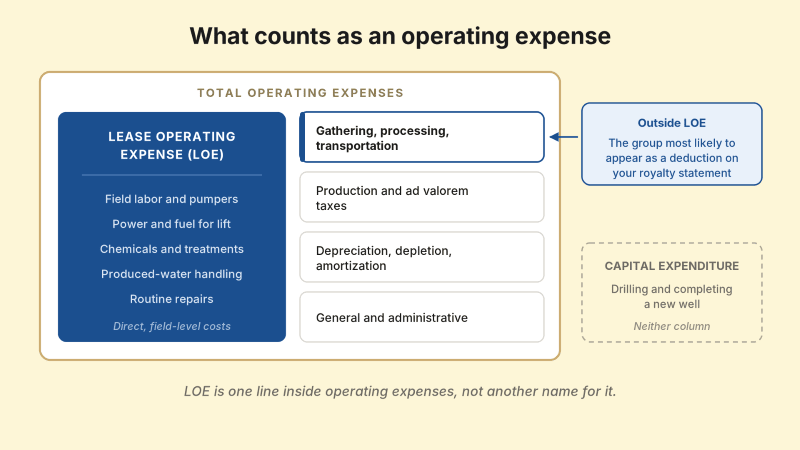
Operating Expense (OpEx)
Operating expense, or OpEx, is the ongoing cost of operating and maintaining an oil or gas well or lease. It includes expenses such as labor, maintenance, chemicals, utilities, and other services needed to keep production running.
Unlike capital expenses, OpEx continues for as long as the well is producing. These costs may increase as a well gets older and needs more maintenance.
For mineral and royalty owners, OpEx is important because it can affect how long a well remains economical. Some post-production costs may also appear as deductions on royalty statements, depending on the lease or agreement.
Operating Expense vs Lease Operating Expense
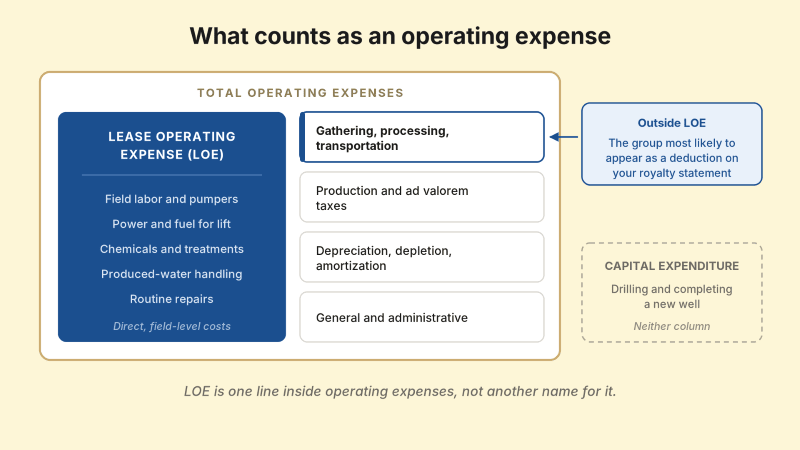
These two terms are often used interchangeably, but they describe different scopes. Lease operating expense (LOE) is one line inside operating expenses, not another name for it.
LOE covers the direct, field-level cost of keeping a producing lease running. Operating expense is the broader total on an operator's income statement, which includes LOE alongside midstream costs, production taxes, depletion, and corporate overhead.
| Cost | In LOE | In total operating expenses |
|---|---|---|
| Field labor and pumpers | Yes | Yes |
| Electricity and fuel for artificial lift | Yes | Yes |
| Chemicals and well treatments | Yes | Yes |
| Produced-water handling and disposal | Yes | Yes |
| Routine repairs and maintenance | Yes | Yes |
| Gathering, processing, transportation | No | Yes |
| Production and ad valorem taxes | No | Yes |
| Depreciation, depletion, amortization | No | Yes |
| General and administrative | No | Yes |
Drilling and completing a new well belongs in neither column. That is capital expenditure, a separate category covered below.
Why this matters to you: the costs most likely to reach your royalty check (gathering, compression, transportation, and processing) sit outside LOE but inside operating expenses. If someone tells you LOE is never deducted from royalty, that can be true while post-production deductions still appear on your statement, because those are a different line.
For the field-level detail, including how operators calculate LOE per BOE, see Lease Operating Expense (LOE).
What This Means for Mineral Owners
As a mineral or royalty owner, you may encounter operating expenses in two different ways depending on how your ownership is structured.
If you hold a royalty interest only, most operating costs are borne by the operator and working interest owners, not by you. The exception is post-production costs, which some leases allow the operator to deduct from your royalty.
If you hold a working interest, operating expenses affect you directly. Your proportional share of every monthly OpEx charge appears on the Joint Interest Billing (JIB) statement from the operator. These costs continue for as long as the well produces, so understanding what is reasonable and what seems excessive is essential to protecting your net revenue.
How Operating Expense Works
Operating expenses in oil and gas cover a broad range of recurring costs. They are typically categorized by the type of service or resource they represent.
Direct Lease Operating Costs
These are the costs tied directly to keeping a specific well or lease producing. They typically include pumper or lease operator wages for regular well checks, electricity or natural gas to power artificial lift systems such as rod pumps or electric submersible pumps, chemical treatments for corrosion inhibition, scale prevention, and emulsion breaking, as well as routine equipment repair and replacement of wear parts like rods, tubing, and valves.
Water Handling and Disposal Costs
Produced water management is one of the largest operating expenses in many oil and gas plays, particularly in West Texas. Costs include separating produced water from hydrocarbons at the surface, transporting water by pipeline or truck to a disposal facility, and saltwater disposal well injection fees.
In parts of West Texas, water handling and disposal can account for roughly 20 to 40 percent of total lease operating expenses. The actual share varies considerably by well, location, water volumes, transportation method, and disposal arrangements.
Gathering, Transportation, and Processing Costs
Once hydrocarbons leave the wellhead, they often must be gathered through field pipelines, compressed, transported to a central facility, and processed to meet pipeline quality specifications. These costs sit outside LOE but within total operating expenses. Whether they can be deducted from a royalty depends on the specific lease language, royalty calculation method, and applicable valuation point.
Workover and Well Maintenance Costs
Workovers are periodic interventions to restore or improve production from an existing well. They can include replacing failed downhole equipment, re-perforating a producing interval, cleaning out sand or scale buildup, and swabbing or stimulating a well that has experienced a production decline. Workovers can be classified differently depending on their nature, scope, and accounting treatment. Routine repairs and maintenance are generally operating costs, while significant projects that extend or improve an asset may be treated as capital expenditures.
Taxes and Regulatory Compliance
Production taxes, property taxes, and certain regulatory and compliance costs may be included in a company's operating or production-related expenses, depending on its accounting and reporting treatment. In Texas, the standard production tax rates are 4.6% for oil and 7.5% for natural gas, although exemptions and reduced rates may apply. Whether production taxes are deducted from a royalty depends on the applicable lease or royalty terms.
A Worked Example
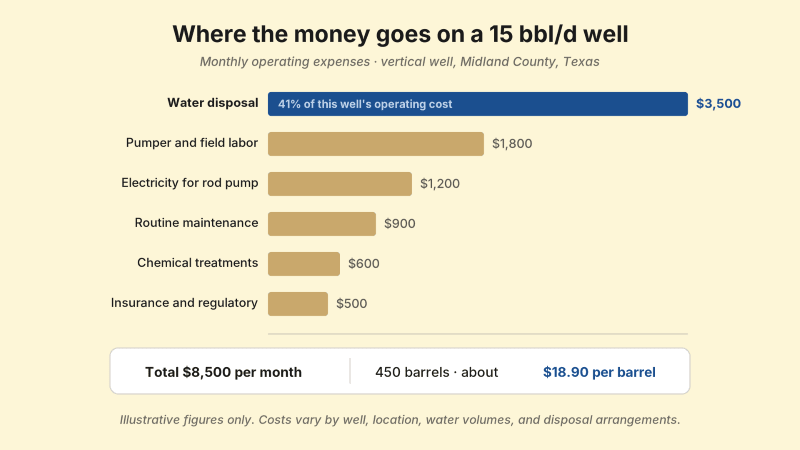
Suppose a vertical well in Midland County, Texas, produces 15 barrels of oil per day. At a commodity price of $70 per barrel, the well generates roughly $31,500 in gross revenue per month. The monthly operating expenses might look like this:
| Cost category | Monthly |
|---|---|
| Pumper and field labor | $1,800 |
| Electricity for rod pump | $1,200 |
| Chemical treatments | $600 |
| Water disposal (trucking and injection) | $3,500 |
| Routine equipment maintenance | $900 |
| Insurance and regulatory costs | $500 |
| Total monthly OpEx | $8,500 |
At 450 barrels per month, that works out to roughly $18.90 per barrel. A well's economic viability depends on more than the commodity price and lease operating expense, including production volumes, transportation and other costs, taxes, royalties, capital requirements, and expected future production. If production declines to five barrels per day while costs remain similar, the per-barrel OpEx rises sharply, and the well approaches its economic limit.
Operating Expense vs Capital Expenditure
This is the comparison mineral owners most commonly encounter. The distinction is straightforward but important.
| Operating expense | Capital expenditure | |
|---|---|---|
| Purpose | Run and maintain a well that already exists | Create the asset: drill, complete, equip |
| Timing | Recurring, every month the well produces | Concentrated around development |
| Size | Smaller individually, cumulative over well life | Large, project-based |
| On the JIB | Billed as incurred | Billed during drilling and completion |
Additional capital expenditures may occur later for significant equipment, facilities, recompletions, or other projects. Over a multi-decade well life, total OpEx can sometimes approach or exceed the original CapEx, particularly on wells that require frequent workovers or have high water disposal costs.
For royalty owners, production and capital costs are generally not charged in the same manner as working-interest costs. However, certain post-production costs may be reflected as royalty deductions when permitted by the applicable lease or royalty agreement. If you see unfamiliar deductions on your check stub, the distinction between OpEx and CapEx may help you identify what the operator is charging and whether your lease permits it.
How Operating Expense Affects Your Royalty
Operating expenses influence your royalty income in two important ways.
First, they determine how long your well produces.
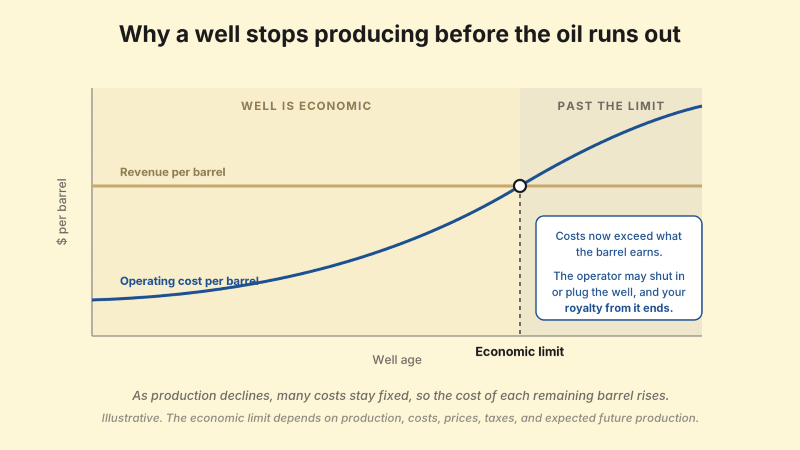
A well may reach its economic limit before the reservoir is physically depleted. This can occur when expected future production and revenue no longer justify the costs of continued operation. When commodity prices drop or operating costs rise due to aging equipment and increasing water production, the operator may determine the well has reached its economic limit and begin the plugging and abandonment process. At that point, your royalty income from that wellbore ends.
Second, some operating costs can be deducted from your royalty.
In leases with post-production cost provisions, certain costs tied to getting your production to a marketable condition can be deducted. The most common deductions are for gathering, compression, transportation, and gas processing. These charges vary widely by operator and by area, and they are not automatically permitted under every lease. Texas courts have addressed post-production cost deductions in several cases, and lease language is the controlling factor.
A Real-World Scenario
David owns mineral rights under 160 acres in Howard County, Texas. He holds a 20 percent royalty interest in two horizontal wells on his lease. Both wells have been producing for six years. Over the past year, David notices that his monthly royalty checks have decreased by about 25 percent even though oil prices have remained stable.
David pulls up the production history for both wells in his Mineral View portfolio and sees that output has declined as expected along a natural depletion curve — the decline alone does not explain a 25 percent drop in his checks. He also notices new deductions on his revenue statements labeled "gathering and compression." After reviewing his lease, David determines that it does contain a post-production cost clause permitting these deductions.
While the charges appear to be within the scope of what the lease allows, David consults an oil and gas attorney to confirm that the amounts being charged are reasonable and that the operator is applying them correctly.
Note: This example is provided for illustrative purposes only and does not represent any specific mineral owner or lease.
What to Check
-
Review your Revenue Statement for Unfamiliar Deductions.
Identify any new line items and compare them against your lease language to verify they are permitted.
-
Monitor Production Trends for Signs of Rising Per-Unit Costs.
As a well ages, production declines while many operating costs remain relatively fixed, so cost per barrel or per MCF increases over time. Tracking production data helps you anticipate when a well may be approaching its economic limit. Monthly production by well is available in your Well Report.
-
Ask the Operator for a Breakdown when Costs Seem High.
If you hold a working interest and your monthly JIB charges seem disproportionate to production, request an itemized breakdown. Compare the per-barrel or per-MCF operating cost to comparable wells in your area. Significant deviations may warrant further inquiry.
Important.
Mineral View can help mineral owners track production data, review well performance, and monitor development activity across their acreage. For questions about post-production cost deductions, JIB charges, or lease cost provisions, consult a qualified landman or Texas oil and gas attorney.
Common Questions
It depends entirely on your lease language. Whether post-production costs can be deducted depends on the royalty provision, including its valuation point and other applicable language. A royalty may be subject to certain post-production costs even when the lease does not contain a clause expressly labeled as a post-production cost provision.
Many modern leases include language allowing the operator to deduct reasonable costs for gathering, compression, transportation, and processing. Review your lease carefully, and if deductions appear that you do not believe are authorized, consult a qualified oil and gas attorney.
It varies widely by well type, location, age, lift method, and water production, so treat any figure as a reference point rather than a target. As a rough guide, a Permian horizontal well in its early years may run roughly $8 to $15 per barrel of lease operating expense, while an older stripper well on rod pump with a high water cut can reach $25 to $40 or more.
The more useful comparison is against nearby wells in the same formation and of similar age.
When a well's operating costs consistently exceed its revenue, the well has reached its economic limit. The operator will typically stop production and begin the plugging and abandonment process. For royalty owners, this means your income from that specific wellbore ends. However, your mineral rights remain intact, and if future conditions change (higher commodity prices, new technology, or a different operator) the formation under your acreage could potentially be developed again.