Capital Expenditure (CapEx)
Capital expenditure, commonly known as CapEx, refers to spending used to acquire, develop, construct, or improve long-term assets used in oil and gas operations, such as wells, production facilities, pipelines, and major equipment. Unlike regular monthly expenses, these are large, upfront investments made with the expectation that they will generate production and revenue over several years.
Understanding this concept helps mineral and royalty owners track the activities executed by an operator on their acreage, interpret expenses on their financial documents, and realize how today's spending decisions can influence tomorrow's royalty earnings.
Owner-First View
What This Means for Mineral Owners
Understanding CapEx helps mineral and royalty owners clarify the financial aspects of their leases. For working interest owners, CapEx typically appears in an Authority for Expenditure (AFE), which outlines estimated costs for a proposed operation, and in Joint Interest Billing (JIB) statements, which charge each owner's share of costs as they are incurred.
If you hold strictly a royalty interest, CapEx is usually not directly deducted from your royalty checks, as royalty owners are generally not responsible for the operator's exploration, drilling, and production costs. However, whether post-production costs (such as gathering, processing, or transportation) can be deducted depends on the specific valuation terms and language in your lease or deed. Conversely, if you hold a working interest, you are responsible for your proportionate share of drilling, completion, operating, and major capital costs, which will be billed directly to you on your JIB statements.
Two Facts to Keep in Mind
- A significant CapEx commitment may indicate that the operator considers the proposed project commercially worthwhile, but the amount alone does not confirm the expected production or profitability of the well.
- Capital expenditures are not the same as the monthly costs you see under operating expenses. CapEx is the upfront investment; operating expenditure (OpEx) is the ongoing cost of keeping a well producing.
Mineral View's Well Report can help mineral owners review drilling and completion activity on their acreage and compare development activity with the production history of nearby wells.
How Capital Expenditure Works
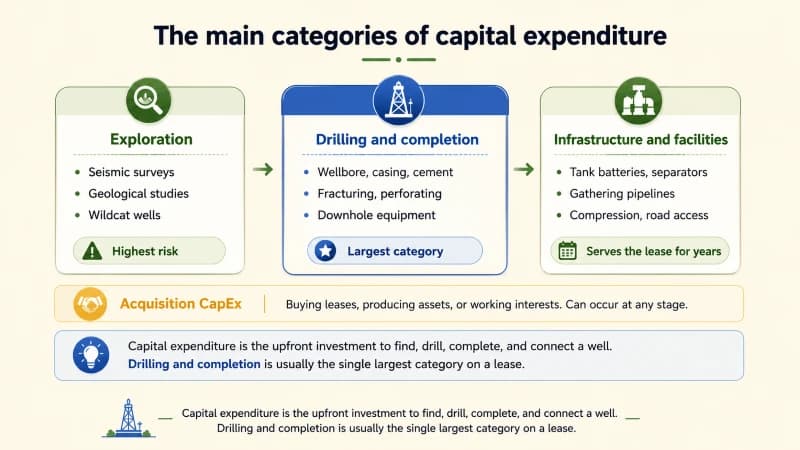
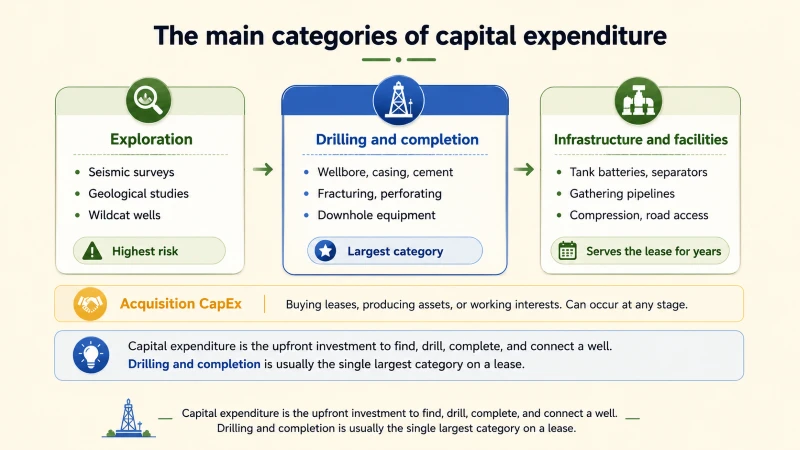
Capital expenditure in oil and gas generally falls into several distinct categories, each tied to a different phase of development.
Exploration CapEx
Exploration capital covers the costs incurred before an operator confirms a commercially viable resource. This typically includes seismic surveys, geological studies, and exploratory (wildcat) wells. These expenditures carry the highest risk because there is no guarantee of finding producible hydrocarbons.
Drilling and Completion CapEx
This is usually the largest single category of capital spending on a lease. It includes the cost of drilling the wellbore, casing and cementing, hydraulic fracturing (if applicable), perforating, and installing downhole equipment. In many Texas shale plays, a single horizontal well can require several million dollars in drilling and completion CapEx.
Infrastructure and Facilities CapEx
Once a well is drilled and completed, the operator may need to build or expand surface infrastructure to move and process production. This includes tank batteries, separation equipment, gathering pipelines, compression stations, and road access. These costs are capitalized because the infrastructure serves the lease for years.
Acquisition CapEx
Acquisition spending can include purchases of mineral properties, leases, producing assets, or working interests. For mineral owners, understanding these transactions can provide broader context about how operators allocate capital across their acreage.
A Worked Example
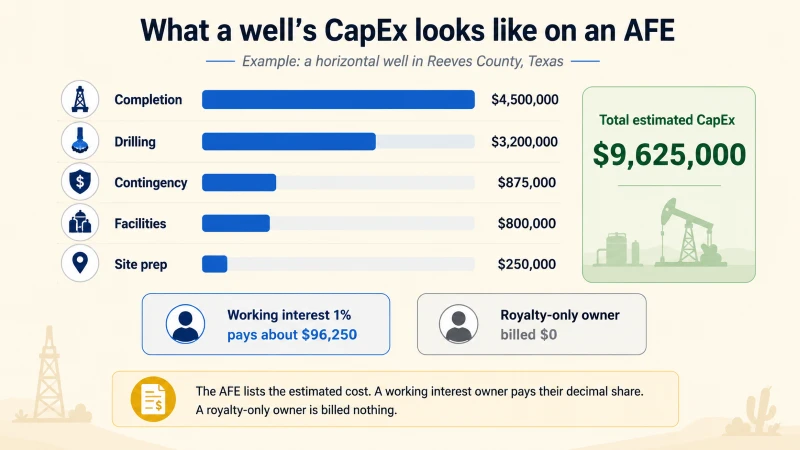
Suppose an operator sends you an AFE for a new horizontal well in Reeves County, Texas. The AFE might break down as follows:
- Drilling costs (rig, fuel, directional services): $3,200,000
- Completion costs (fracturing, perforating, flowback): $4,500,000
- Surface facilities (tank battery, separator, flowlines): $800,000
- Site preparation and access roads: $250,000
- Contingency (typically 10 to 15 percent): $875,000
The listed costs total approximately $9,625,000. If the applicable working-interest decimal for the well is 1%, your share of the estimated costs would be approximately $96,250, subject to the governing agreements and any applicable adjustments. A royalty-only owner on the same lease would not be billed for any of these costs under a standard lease form, though the operator typically evaluates the project by comparing its capital investment and ongoing costs with the expected production and revenue over the life of the well.
Tax Treatment of Capital Expenditure
For working interest owners, how CapEx is classified for tax purposes significantly impacts well economics. The IRS generally divides well development into two categories: intangible drilling costs (IDCs) and tangible equipment costs. IDCs include expenditures with no salvage value (such as labor, fuel, drilling fluids, and site preparation) and typically represent 60 to 80 percent of total well costs.
Under current tax law, qualifying working interest owners can generally deduct most IDCs in the year they are incurred. Tangible costs cover physical equipment with a useful life beyond the current year (such as casing, wellhead equipment, and surface tanks) which are recovered through depreciation over several years.
While royalty owners do not pay drilling costs, they may be eligible for a percentage depletion allowance on their royalty income, which is currently 15 percent for qualifying small producers and royalty owners. Because tax treatment depends on individual circumstances, always consult a qualified tax advisor or CPA experienced in oil and gas taxation before making financial decisions based on these classifications.
Capital Expenditure vs Operating Expenditure
This is the comparison mineral owners most often encounter, and the distinction matters because it affects how costs are categorized on your JIB and how operators report profitability.
Capital expenditure is spent once to create or acquire a long-lived asset. Drilling a well, building a tank battery, or purchasing a lease are all CapEx. These costs are capitalized on the operator's balance sheet and depreciated over the useful life of the asset.
Operating expenditure (OpEx) is the recurring cost of keeping that asset running. Pumper visits, chemical treatments, electricity for artificial lift, water disposal, and routine maintenance are all OpEx. These costs are expensed in the period they occur.
For working interest owners, the practical difference is timing. CapEx hits your JIB in large amounts during drilling and completion, then tapers off. OpEx appears as a smaller, steady monthly charge for as long as the well produces. Royalty owners generally do not see either charge deducted from their checks, though some lease clauses allow limited post-production cost deductions that may include certain infrastructure-related expenses. Review your lease language carefully, and consult a qualified landman or oil and gas attorney if the deductions on your revenue statement seem unusually high.
How Capital Expenditure Affects Your Royalty
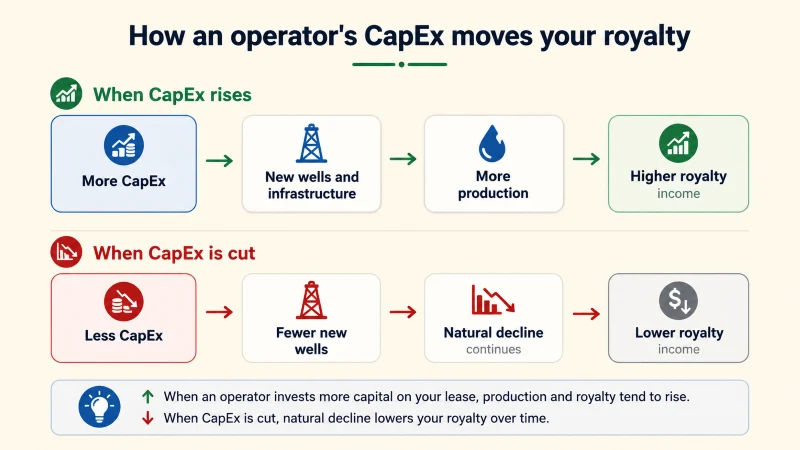
Operator CapEx decisions have a direct, if sometimes indirect, effect on your royalty income.
When an operator increases capital spending on your lease, it usually means new wells, recompletions, or infrastructure improvements are planned. More wells and better infrastructure generally lead to higher production volumes, which in turn increases the royalty revenue flowing to you.
Conversely, when operators cut CapEx (as many did during the 2020 commodity price downturn), drilling activity slows, fewer new wells come online, and production from existing wells naturally declines over time. Even after commodity prices recovered, many operators maintained a more disciplined approach to capital spending, prioritizing free cash flow and returns to investors over aggressive production growth. For mineral owners, this shift can mean slower development on viable acreage even when oil and gas prices are favorable.
It is also worth understanding that operators prioritize CapEx allocation across their entire portfolio. A company with acreage in the Permian Basin, Eagle Ford, and Midland Basin will direct capital toward the leases and formations that offer the best return on investment. If your tract sits in a less competitive area, the operator may defer development even if the underlying resource is viable.
Mineral View's Explore Production tool lets you track production by well and over time, helping you see how production changes as new wells are brought online.
A Real-World Scenario
Maria owns mineral rights under 320 acres in Martin County, Texas. She receives an AFE from her operator proposing a new horizontal well targeting the Wolfcamp A formation, with a total capital expenditure estimate of $8.4 million. Maria holds a 25% royalty interest and no working interest, so she will not owe any portion of the CapEx.
However, she reviews the AFE carefully to understand what the operator plans to do and checks the proposed well spacing to see whether it might affect drainage on her existing producing wells.
Six months after the new well is completed, Maria notices her combined monthly royalty income has increased by roughly 40 percent. The operator's capital investment created a new producing asset on her acreage, and because she holds a royalty interest, she benefits from the added production without having shared in any of the upfront costs.
Note: This example is provided for illustrative purposes only and does not represent any specific mineral owner or lease.
What to Check
Review the AFE Before the Operator Spends
If you receive an AFE, compare the proposed CapEx to similar wells in your area. A significantly higher or lower estimate may reflect differences in well design, location, depth, infrastructure requirements, service costs, or other project-specific factors worth reviewing.
Track How CapEx Translates to Production
After a new well is drilled on your lease, monitor production data in the months that follow. Sustained output that aligns with the operator's projections suggest the capital was well spent. A sharp decline may indicate completion issues or overly optimistic estimates.
Watch for CapEx-Related Deductions on Your Revenue Statement
If you notice new or increased deductions tied to infrastructure, gathering, or processing, verify whether your lease permits those charges. Some operators attempt to pass through capital-related costs that may not be authorized under your lease terms.
Important
Mineral View can help mineral owners monitor well activity, review production data, and better understand development across their acreage. For questions about AFE charges, JIB deductions, or lease cost provisions, consult a qualified landman or Texas oil and gas attorney.
Common Questions
Under most standard oil and gas leases, royalty owners are not responsible for capital expenditures. CapEx is typically borne by the operator and working interest owners. However, some leases contain post-production cost clauses that may allow limited deductions related to gathering or processing infrastructure. Review your lease language to confirm what deductions, if any, apply to your royalty payments.
The most practical indicator is production performance. After a well is completed, comparing its actual production with available forecasts and nearby wells in the same formation provides useful context for evaluating operator performance. Declining production (coupled with a lack of plans for workovers, recompletions, or new drilling) may suggest the operator is directing CapEx to other areas of their portfolio.
When operators reduce CapEx, fewer new wells are drilled and existing wells continue their natural production decline without offsets from new development. This typically leads to a gradual decrease in royalty income over time. Industry-wide CapEx reductions, such as those seen during periods of low commodity prices, can affect production volumes across an entire basin.