Workover
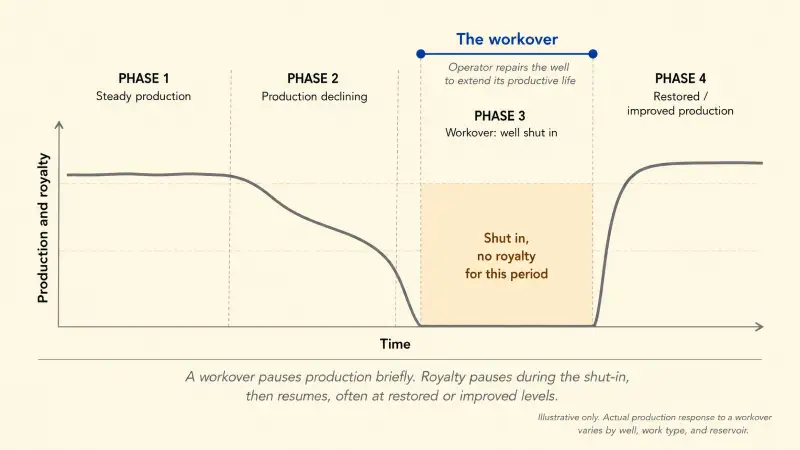
A workover is maintenance or remedial work performed on an existing producing well to restore, maintain, or improve production. It is not a new well, it is the operator investing in a well that is already on the property.
For a mineral owner, a workover usually means a temporary stop in production followed by a period of improved or restored output. Understanding what a workover involves and why operators perform them helps when interpreting royalty statements and evaluating operator activity on a lease.
Owner-First View
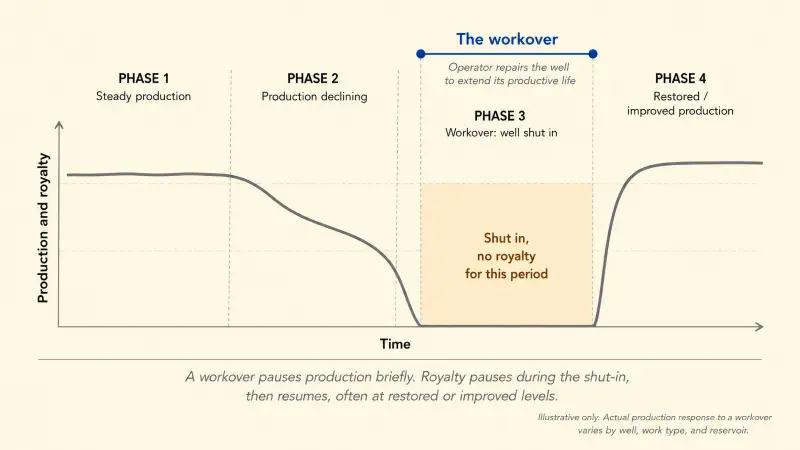
A workover is generally a positive signal. It means the operator believes the well has more productive life and is spending money to extend it. A temporary gap in royalty payments during the workover period is normal. Once the work is complete, production and royalty income typically returns at higher or restored levels.
How a Workover Works
When a well declines in production or develops a mechanical problem, the operator may schedule a workover to address it. A workover rig, smaller than a drilling rig, is brought to the well site to perform the repair or improvement work.
During the workover, the well is typically shut in. Production stops. This means no royalty income is generated for that period.
When the work finishes and the well moves from shut-in back to producing, that status change, along with the operator's completion filing with the Texas Railroad Commission, shows up in Mineral View's Lease Activity, so you can confirm the well is running again without waiting for your next royalty statement.
Example
Tom owns mineral rights in Karnes County, Texas. His Eagle Ford well had been producing steadily for four years when production began declining noticeably in late 2023.
In March 2024, the operator sent notice of a scheduled workover. The well was shut in for 18 days while the crew replaced the downhole pump and performed a sand cleanout.
Tom received no royalty payment for that production period. The following month, production came back significantly higher than it had been in the preceding six months.
Though the operator spent money on the workover, Tom only missed one royalty payment. For Tom, it meant missing one royalty payment, but then seeing better performance from the well, leading to higher future royalty income.
Common Types of Workover Work
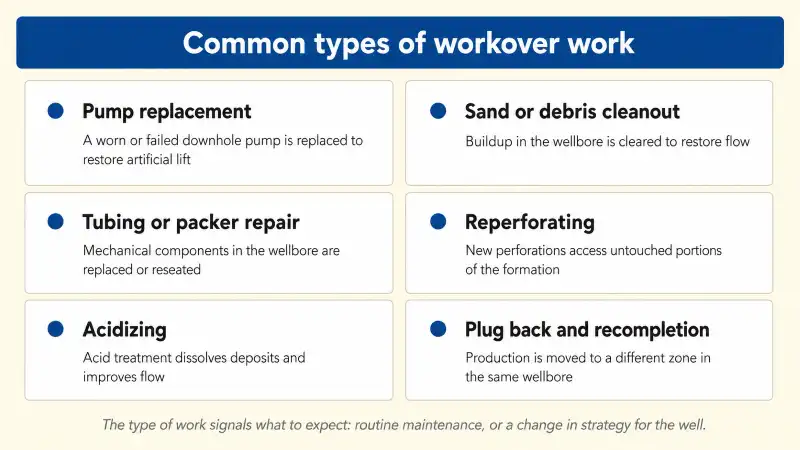
Operators perform workovers for different reasons. The type of work determines how long the well is shut in and what to expect afterward.
- Pump replacement: Downhole pump fails or wears out; replaced to restore artificial lift
- Sand or debris cleanout: Buildup in the wellbore restricts flow; cleared to restore production
- Tubing or packer repair: Mechanical components in the wellbore are replaced or reseated
- Reperforating: New perforations added to access untouched portions of the formation
- Acidizing: Acid treatment to dissolve deposits and improve flow from the formation
- Plug back and recompletion: Production is moved to a different zone within the same wellbore
Each type signals something different about well condition and expected outcome.
Workover vs New Well Completion
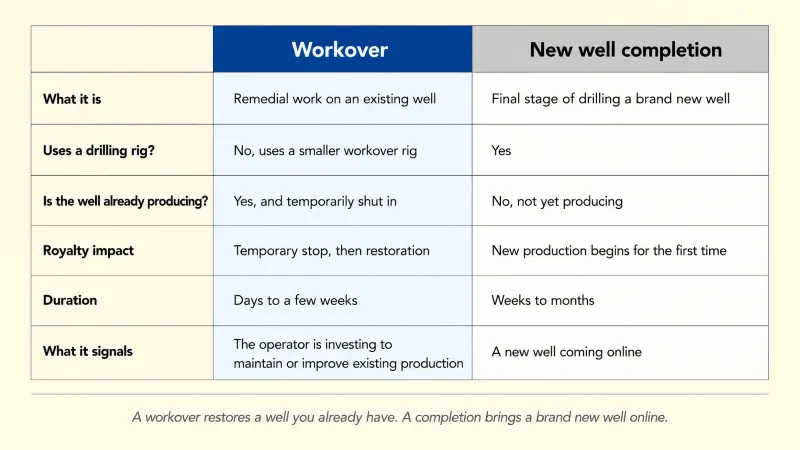
These two operations are often confused when mineral owners receive operator notices.
| Question | Workover | New Well Completion |
|---|---|---|
| What it is | Remedial work on an existing well | Final stage of drilling a brand new well |
| Uses a drilling rig? | No — uses a smaller workover rig | Yes |
| Is the well already producing? | Yes — and temporarily shut in | No — not yet producing |
| Royalty impact | Temporary stop then restoration | New production begins for the first time |
| Duration | Days to a few weeks | Weeks to months |
| What it signals | Operator investing to maintain or improve existing production | New well coming online |
What to Check if a Workover Is Happening
-
Confirm the well is shut-in temporarily, not abandoned.
A workover means the well is expected to return to production. If no notice was received and royalty payments have stopped, contact the operator to confirm status.
-
Review the royalty statement for the workover period.
A month with zero or reduced production is normal during a workover. Compare the statement date against any operator notice received to confirm the timing aligns.
-
Check production after the workover completes.
RRC production records for Texas wells are publicly available and updated regularly. Comparing pre- and post-workover production volumes shows whether the operation was successful.
-
Note the type of work performed.
A simple pump replacement suggests routine maintenance. A plug back and recompletion suggests the operator is changing strategy on the well — which may affect long-term production expectations.
Mineral View's Well Report compiles each Texas well's production history from those Railroad Commission records, so you can see the before-and-after volumes for your wellbore in one place.
Common Questions
A workover is remedial or maintenance work performed on an existing oil or gas well to restore or improve production. It involves bringing a workover rig to the well site, temporarily shutting in the well, and performing mechanical repairs, cleanouts, or production enhancement work.
It is not a new well, it is work on a well that is already producing or has previously produced.
Yes, temporarily. When a well is shut in for a workover, production stops and no revenue is generated. Royalty payments for that production period will be zero or significantly reduced. Once the workover is complete and production resumes, payments return.
The gap in payments is normal and expected, it reflects the actual production record for that period.
Workovers typically take a few days to a few weeks, depending on the work being done. A simple pump replacement may take three to five days. A recompletion or zone change can take several weeks.
The operator's notice or completion report filed with the Railroad Commission of Texas typically shows the work performed and duration.
Generally good news. It means the operator believes the well has remaining productive value and is willing to invest capital in it. A workover extends the productive life of the well, which means more royalty income over time.
The alternative — no workover on a declining well — typically means lower production continuing to decline until the well is eventually plugged and abandoned.