MMBtu (Million British Thermal Units)
MMBtu stands for one million British Thermal Units. It is the unit of energy used to measure and price natural gas, focusing on the heat energy it contains rather than its volume.
If your mineral rights include a gas-producing well, your royalty statement may report gas volume in MCF, while the price or value may be influenced by MMBtu, because buyers often value natural gas based on its heat content, not just its volume. Understanding the difference between the two is the key to reading your gas royalty accurately.
What This Means for Mineral Owners
Gas royalties are not calculated based on volume alone. The energy content of the gas, measured in MMBtu, determines its price and your royalty payment. Two wells producing the same volume of gas can generate different royalty income if their gas has different energy content. Knowing how MMBtu works tells you whether your gas royalty statement is correct.
What Is a BTU, and Why Does It Matter for Gas?
A BTU (British Thermal Unit) is a unit of heat energy. One BTU is roughly the energy released by burning a single wooden matchstick. It is a small unit, which is why gas is priced in MMBtu, one million BTUs, to make the numbers practical.
Think of it like your home heating bill. When your gas company charges you for heating your house, they do not bill you per cubic foot of gas. They bill you per unit of energy delivered, because what you are actually paying for is the heat, not the volume.
The same principle applies to the natural gas your minerals produce. Buyers purchase the energy content, which is measured in BTUs.
One MMBtu is roughly the energy equivalent of:
- Burning approximately 8 gallons of motor oil
- The energy in about 293 kilowatt-hours of electricity
- The heat output of roughly 1,000 cubic feet of dry natural gas (though this varies, more on that below)
None of those conversions need to be memorised. The practical point is simple: MMBtu measures how much usable energy is packed into the gas, not how much space that gas takes up.
MMBtu vs MCF: Energy Content vs Volume
This is the distinction that matters most for mineral owners reading a royalty statement.
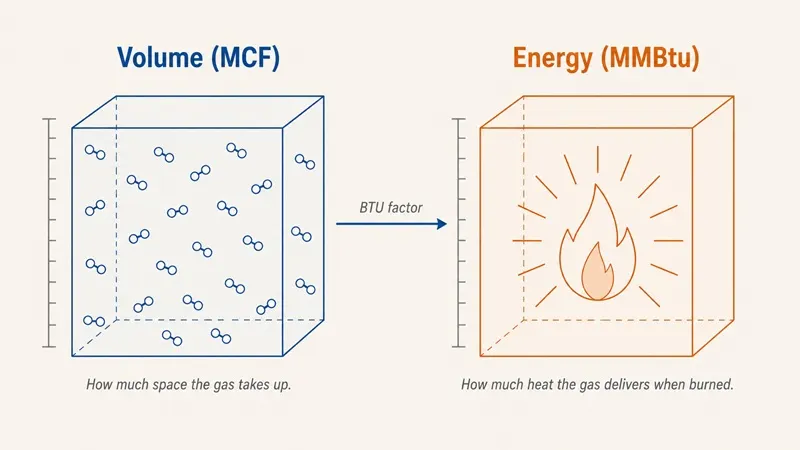
MCF stands for one thousand cubic feet of natural gas. It is a volume measurement, like a gallon of water, describing the amount of space the gas occupies, not its energy content.
MMBtu is an energy measurement, similar to a calorie, describing how much heat the gas delivers when burned.
The two are related but not equal. According to the US Energy Information Administration 2023 data, the average heat content of natural gas delivered to end-users is approximately 1,038 Btu per cubic foot, meaning one MCF of natural gas contains about 1.038 MMBtu on average.
But not all natural gas is average. Gas that contains natural gas liquids (NGLs) such as ethane, propane, and butane has higher energy content. One MCF of such gas might contain 1.1, 1.2, or more MMBtu, depending on its richness.
In some dry gas fields, the BTU content per cubic foot may be lower than the national average. Heat content varies by location, formation, and gathering system.
| MCF | MMBtu | |
|---|---|---|
| What it measures | Volume: how much space the gas takes up | Energy: how much heat the gas delivers |
| Unit equivalent | 1,000 cubic feet of gas | 1,000,000 British Thermal Units |
| Fixed relationship to each other? | No: depends on the gas's BTU content | No: 1 MCF of rich gas contains more MMBtu than 1 MCF of dry gas |
| Where it appears | Production reports, RRC filings, lease reports | Royalty statements, gas purchase contracts, pricing benchmarks |
| Gas price quoted in this unit? | No: gas is not priced per MCF | Yes: gas markets price in $/MMBtu |
The BTU Factor: Why the Same Volume Can Have Different Value
The BTU factor, also called heat content or heating value, converts MCF into MMBtu for a specific well or gathering system. It reflects the actual energy content of the gas being produced.
For dry gas formations, like much of the Haynesville Shale in East Texas, the BTU factor is typically close to 1.0, meaning 1 MCF ≈ 1 MMBtu.
For wet gas formations, like parts of the Eagle Ford or Permian Basin, where the gas carries NGLs alongside methane, the BTU factor can be significantly higher.
Here is what that means in practice:
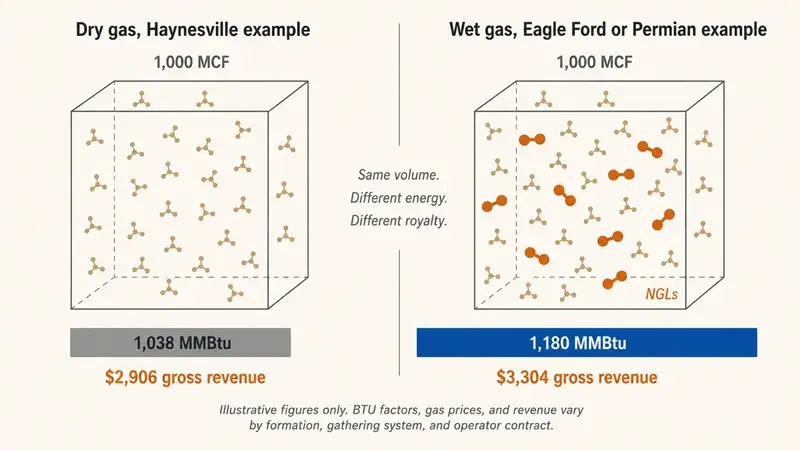
Two wells on different leases each produce 1,000 MCF of gas in the same month. The gas price is $2.80 per MMBtu for both wells.
- Well A (dry gas, BTU factor 1.038, US average): 1,000 MCF × 1.038 = 1,038 MMBtu × $2.80 = $2,906 gross revenue.
- Well B (wet gas, BTU factor 1.18): 1,000 MCF × 1.18 = 1,180 MMBtu × $2.80 = $3,304 gross revenue.
Same volume. Same gas price. A $398 difference in gross revenue, just from the BTU factor. That difference flows through your royalty decimal to your monthly check.
How MMBtu Appears on Your Royalty Statement
When a gas royalty is calculated, it follows a specific chain of steps. MMBtu is in the middle of that chain, the step that connects the volume your well produced to the revenue your royalty is based on.
The Gas Royalty Calculation Chain
- Volume reported: The operator records how much gas was produced (MCF)
- BTU factor applied: MCF × BTU factor = MMBtu
- Gas price applied: MMBtu × gas price ($/MMBtu) = gross gas revenue
- Royalty decimal applied: Gross gas revenue × your decimal = your gas royalty
A Worked Example
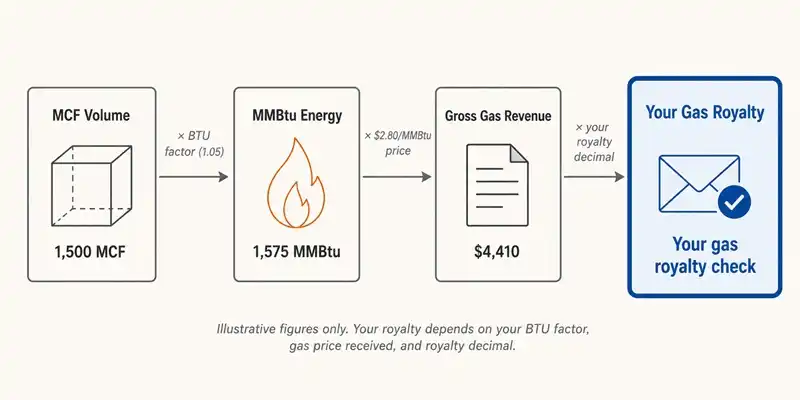
Your lease produces 1,500 MCF of gas in a month. The BTU factor for your gathering system is 1.05. The gas price received is $2.80/MMBtu. For this example, your royalty decimal is 0.02.
- Step 1: 1,500 MCF produced
- Step 2: 1,500 × 1.05 = 1,575 MMBtu
- Step 3: 1,575 × $2.80 = $4,410 gross gas revenue
- Step 4: $4,410 × 0.02 = $88.20 gas royalty
Your royalty decimal will be different. It depends on your mineral ownership percentage, your lease royalty rate, and your tract's share of any pooled unit. Most mineral owner decimals on Texas leases fall between 0.001 and 0.05. Substitute your own decimal into Step 4 to see your share.
Your royalty statement should show each of these figures, typically in the detail section. If your statement shows MCF volume but the revenue does not match what the calculation above produces, the BTU factor or the gas price, or both, are worth reviewing.
The Gas Price You See Is Already in $/MMBtu
The natural gas price displayed at the top of the Mineral View dashboard, reflecting the current Henry Hub spot price, is quoted in dollars per MMBtu. That is how gas markets work. Henry Hub, the primary natural gas pricing benchmark in the United States, prices in $/MMBtu. When the dashboard shows Natural Gas at $2.823, that means one MMBtu of natural gas is worth $2.823 at the Henry Hub benchmark.
The price your operator actually receives for your gas may differ from the Henry Hub spot price. Operators sell gas under purchase contracts at prices that can be above or below the benchmark depending on the gathering system, the market, and the contract terms. The price paid and reflected in your royalty statement will be the contract price, not necessarily Henry Hub. Henry Hub is the benchmark, not the price paid in every contract.
Why Mineral Owners Should Care
Gas royalties may be calculated using MMBtu even when volume is reported in MCF.
Many royalty statements report both the MCF volume and the MMBtu figure used to calculate revenue. If your statement only shows MCF and a revenue amount, the BTU factor and gas price used to arrive at that revenue are worth requesting from the operator. Those two inputs (BTU factor and $/MMBtu) are how the MCF volume you see becomes the dollar amount you receive.
A higher BTU factor means more royalty from the same production volume.
If your well is producing wet gas (gas with high NGL content) your BTU factor will be above 1.0, potentially significantly so. That means your gas revenue is higher than a simple MCF count would suggest. Understanding this helps you verify that your royalty statement is reflecting the full energy value of your gas, not an understated BTU factor.
Gas price movements in $/MMBtu directly affect your royalty payments.
Natural gas prices can fluctuate significantly over time, meaning even small changes in pricing can have a major impact on royalty income for the same production volume. Monitoring benchmark natural gas prices, such as Henry Hub, can provide a useful indicator of how future royalty payments may trend.
Your Lease Report shows gas production in MCF, MMBtu explains how those volumes convert to revenue.
Mineral View's Lease Report shows gas production in MCF for your claimed lease, the same unit the RRC uses in its production records. MMBtu is the conversion step between those MCF volumes and the gas revenue figure. When you see gas production on your Lease Report and want to understand what that production is worth in revenue terms, the BTU factor and $/MMBtu price are the two inputs that complete the picture.
Gas revenue is a component of your six-year royalty income forecast.
For leases that produce both oil and gas, Mineral View's MVestimate projects total royalty income across six years. Gas revenue in that forecast depends on both production volumes and the $/MMBtu pricing assumption. Understanding MMBtu helps you interpret the gas component of your MVestimate, particularly in periods when gas prices move significantly.
What to Check
Find the BTU factor on your royalty statement.
Your monthly royalty statement from the operator should include a line item showing the BTU factor, sometimes labelled as heat content, Btu/CF, or heating value, used to convert MCF to MMBtu. If it is not shown, ask your operator for the detailed breakdown. A BTU factor significantly below 1.0 on a wet gas well is worth questioning.
Verify the gas price used in your statement.
The $/MMBtu price on your royalty statement reflects what the operator received for your gas under their purchase contract. Compare it to the Henry Hub benchmark price for the same production period as a rough sanity check. Significant and unexplained discrepancies from the benchmark are worth investigating.
If your royalty statement shows a gas price in dollars per Mcf rather than dollars per MMBtu, you can convert between them using the heat content factor. Using the EIA's US average heat content as a reference point: price per Mcf ÷ 1.038 = approximate price per MMBtu.
For your specific gas, use the actual BTU factor from your statement rather than the national average, since heat content varies by location and formation.
Run the calculation yourself.
MCF volume × BTU factor = MMBtu. MMBtu × $/MMBtu received = gross gas revenue. Gross gas revenue × your decimal = your gas royalty.
If your statement's final royalty figure does not match your calculation, one of the three inputs (BTU factor, gas price, or decimal) may need to be reviewed.
Important
Mineral View can help you understand production volumes, gas revenue context, and operator activity for your minerals. For questions about BTU factor disputes, royalty statement accuracy, or gas purchase contract terms, consult a qualified landman or Texas oil and gas attorney.
Common Questions
The BTU factor specific to your well or gathering system should appear on your monthly royalty statement, typically in the detail section alongside the MCF volume and gas price. If it is not itemised, you can request it from your operator's owner relations department.
The BTU factor is set by the gas gathering or processing agreement for the system your well is connected to, and it can change if the gas composition changes or if the well connects to a different system.
A dekatherm (Dth) equals one MMBtu, they represent the same amount of energy. One therm equals 100,000 Btu. Ten therms (one dekatherm) therefore equals 1,000,000 Btu, which is exactly one MMBtu.
The two terms are used interchangeably in gas contracts and royalty statements. If your statement uses "Dth" where you expected to see "MMBtu," they are the same unit by a different name, no conversion is needed.
If your MMBtu figure is higher than MCF × 1.0, it means your gas has a BTU factor above 1.0, it is richer in energy content than dry methane. This is normal and expected for wet gas wells producing in formations like the Eagle Ford or Permian Basin.
A BTU factor of 1.1 to 1.3 is common in wet gas plays and reflects the presence of NGLs in your gas stream.
Higher BTU factor = more MMBtu from the same MCF volume = higher gas revenue.