MCF (One Thousand Cubic Feet)
MCF stands for one thousand cubic feet of natural gas. At standard conditions, gas volume is measured at 14.65 psi (pounds per square inch) and 60°F. It is a unit of volume that measures how much space gas occupies, not how much energy it contains.
If your mineral rights include a gas-producing well, MCF is the unit used on your royalty statement, lease reports, and in Railroad Commission of Texas (RRC) production records. It is the standard volume unit used to measure and report natural gas production across the United States.
What This Means for Mineral Owners
MCF is the starting point for calculating your gas royalty. Before any royalty value can be calculated, the operator measures and reports the gas produced during the month in MCF. That volume figure drives everything that follows: the energy conversion, the price applied, and ultimately the royalty check you receive. Reading MCF accurately means you can follow the math behind your statement from the first line.
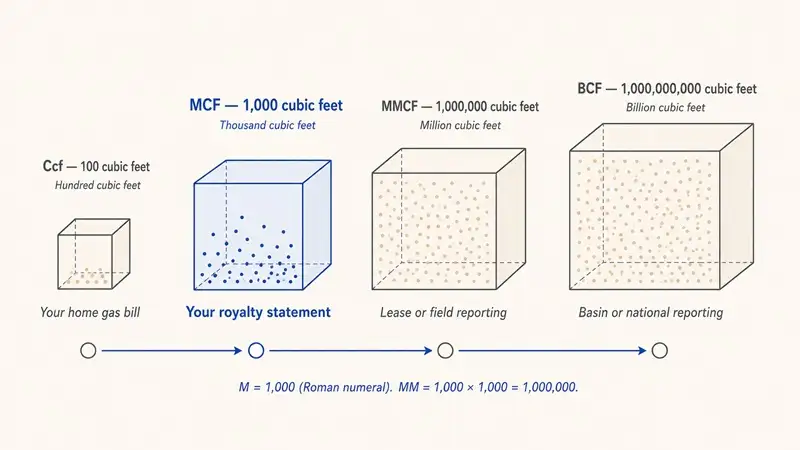
What MCF Measures, and Why "M" Does Not Mean Million
This is one of the most common points of confusion in oil and gas terminology.
The "M" in MCF does not stand for mega or million. It comes from the Latin and Roman numeral system, where M historically represents one thousand. So MCF literally means 1,000 cubic feet of gas.
This trips up many mineral owners because in everyday usage, megabytes, megawatts, and megapixels use the metric system where "mega" means one million. In oil and gas measurement, the convention is different, and it carries through the entire unit system.
Common Natural Gas Volume Units
Natural gas production is measured at different scales depending on the size of the well, lease, or field. The unit system builds on multiples of MCF:
| Unit | What It Means | Scale |
|---|---|---|
| Ccf | 100 cubic feet | The smallest common unit, used on some home gas bills |
| MCF | 1,000 cubic feet | Standard production unit for individual wells and royalty statements |
| MMCF | 1,000,000 cubic feet (1,000 MCF) | Used for larger lease or field-level reporting |
| BCF | 1,000,000,000 cubic feet (1,000 MMCF) | Used for basin-level or national-scale reporting |
A typical producing US gas well might produce anywhere from a few MCF per day on a mature conventional well to hundreds or thousands of MCF per day on a newly completed horizontal well.
Your royalty statement will typically show production in MCF. Field-level and basin reports shift to MMCF and BCF.
How MCF Appears on Your Royalty Statement
Your monthly royalty statement from the operator shows gas production in MCF for the reporting period. It typically appears as a line item alongside the price and the calculated revenue.
A Simplified Royalty Statement Line
| Period | Gas Volume | BTU Factor | MMBtu | Price ($/MMBtu) | Gross Revenue |
|---|---|---|---|---|---|
| Jan 2025 | 1,500 MCF | 1.05 | 1,575 | $2.80 | $4,410 |
The MCF figure is the starting point of the gas revenue calculation. It is multiplied by the BTU factor to convert volume to energy content (in MMBtu), and then multiplied by the gas price to arrive at gross revenue.
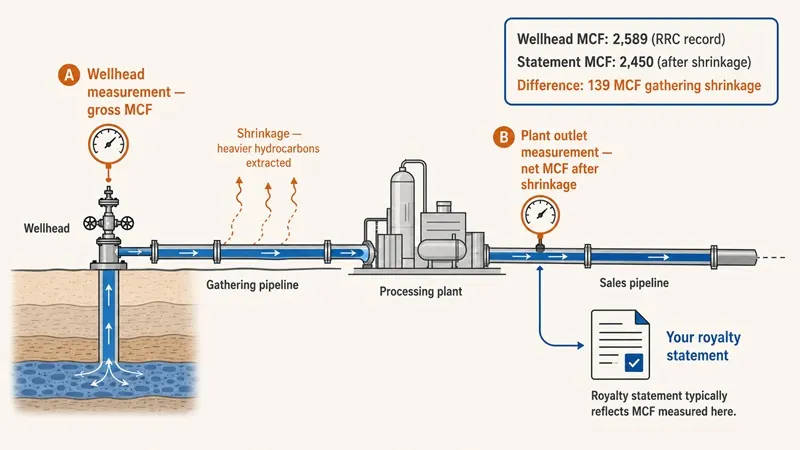
If the MCF volume on your statement looks significantly lower than you expected, there are a few common explanations: the well produced less than forecast, production was interrupted, gas was measured downstream after gathering and processing shrinkage, or the operator is reporting on a different time lag. Each is worth investigating separately.
MCF vs MMBtu: Volume and Energy Are Not the Same
MCF and MMBtu are closely related but measure fundamentally different things.
MCF tells you how much gas was produced, the physical volume, measured in cubic feet.
MMBtu tells you how much energy that gas contains, the heat value, measured in British Thermal Units.
The conversion between them depends on the BTU factor of the specific gas. For average US pipeline-quality natural gas, one MCF equals roughly 1.02 to 1.05 MMBtu. But gas that carries heavier hydrocarbons, like wet gas from the Eagle Ford or Permian Basin, has higher energy content, meaning one MCF can convert to 1.10, 1.20, or more MMBtu depending on the gas richness.
The practical result: two wells can show identical MCF volumes on a production report, but generate different gas revenue if their gas has different energy content.
For the full explanation of how MCF converts to MMBtu and how that conversion flows through to your royalty check, see the MMBtu glossary page.
Where MCF Appears on the Mineral View Platform
MCF is the primary gas production unit displayed across the Mineral View platform.
Lease reports on the Mineral View platform show total gas production for your claimed lease in MCF, both historical production and projected future output. The EUR (Estimated Ultimate Recovery) gas figure on the Lease Report is expressed in MCF, giving you the full estimated gas volume the lease is expected to produce over its life.
For owners with multiple gas-producing leases, Mineral View's Portfolio shows Gas Produced in MCF for each claimed lease and in aggregate across all leases, making it straightforward to compare gas production across your mineral estate at a glance.
Why Mineral Owners Should Care
MCF is the starting point for every gas royalty calculation.
Every gas royalty payment begins with the MCF volume recorded for the month. If the volume is understated due to measurement, reporting, or allocation issues, the royalty calculated from it will be understated as well. Knowing how to read and verify the MCF figure on your statement is the foundation of royalty verification.
MCF volumes decline naturally over time.
Like oil, gas production from a well follows a natural decline curve after reaching its peak. The MCF volumes on your statement will typically be highest in the first months after a well is completed and will decrease over time. Comparing your MCF volumes month to month lets you track whether the decline is in line with expectations or whether something else may be affecting production.
Different wells produce different MCF volumes, and that is normal.
Two wells on the same lease producing from the same formation can show very different MCF figures depending on their completion design, lateral length, and the interval they were perforated in. One well showing 800 MCF per month and another showing 200 MCF per month from the same lease is not unusual. What matters is whether each well's production is consistent with its design and history.
MCF volumes reported to the RRC become part of the public production record.
Every month, operators report gas production to the Railroad Commission of Texas. Those reported MCF volumes are public records. The figures that appear on your royalty statement and on Mineral View should ultimately trace back to those same RRC filings. If there is a significant, unexplained difference between what the RRC shows and what your statement reports, that is worth investigating with the operator.
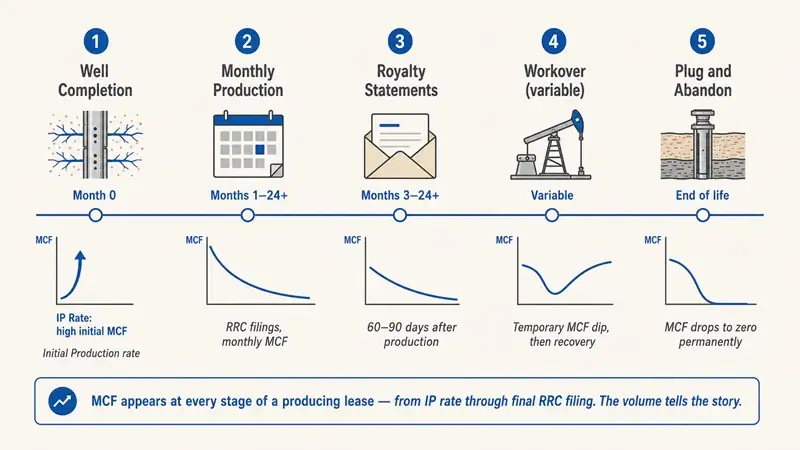
Where MCF Appears in the Lease Lifecycle
Well Completion
When a gas well is completed and begins producing for the first time, the initial MCF volumes, called IP (initial production) rates, are among the most closely watched numbers on a new well. IP rates indicate how the well is performing relative to offset wells in the same formation. See the well completion glossary page for the full process from drilling to first production.
Monthly Production
After first production, the operator reports gas production in MCF to the Railroad Commission each month. These volumes feed royalty calculations and build the production history that underpins reserve estimates and lease valuations.
Royalty Statements
The MCF volume for each production month typically appears on the royalty statement sent to mineral owners, typically 60 to 90 days after the production month ends.
Workover and Recompletion
If a well undergoes a workover, MCF production may drop temporarily during the workover period and recover afterward. Tracking MCF volumes before and after a workover gives mineral owners a way to assess whether the work improved production as intended.
Plug and Abandon
When a well reaches the end of its economic life and is plugged and abandoned, MCF production drops to zero and does not resume. The cumulative MCF produced over the well's life becomes part of its permanent production record at the RRC.
A Real-World Scenario
David owns mineral rights in Karnes County, Texas. His lease has three producing gas wells. Each month, his royalty statement shows gas production in MCF for each well separately.
In January, the three wells produced 1,200 MCF, 800 MCF, and 450 MCF respectively, a total of 2,450 MCF for the lease. His Mineral View Lease Report showed 2,589 MCF for the same period.
The small difference prompted David to ask the operator about the discrepancy. The operator confirmed that the Lease Report reflected gross production at the wellhead, while his royalty statement reflected production after pipeline shrinkage was deducted, a standard practice that reduces the MCF figure used for royalty calculation.
Understanding what MCF measures helped David ask the right question and get a clear answer.
What to Check
Compare MCF on your royalty statement to RRC production records.
In Texas, gas production reported by operators to the Railroad Commission is publicly available. The MCF volume for your lease for a given month should be consistent with what is filed at the RRC. Mineral View's Lease Report pulls from those same RRC records, giving you a direct reference point alongside your royalty statement.
Watch for declining MCF volumes and understand why.
If gas MCF volumes on your statement are falling month over month, it is worth checking whether the decline matches the typical decline curve for wells in your formation, or whether there is a more specific cause such as a mechanical problem, a shut-in period, or an allocation change. Unexpected or abrupt declines are worth following up with the operator.
Check whether MCF or MMBtu is used for pricing on your statement.
Some operators report royalties using MCF-based pricing rather than MMBtu-based pricing, depending on the gas purchase contract. Knowing which unit is being used for price application, and whether a BTU factor is being applied, helps you verify that the revenue line is calculated correctly.
Important
Mineral View can help you understand gas production volumes, lease-level reporting, and operator activity for your minerals. For questions about royalty calculation disputes, MCF measurement discrepancies, or gas purchase contract terms, consult a qualified landman or Texas oil and gas attorney.
Common Questions
MCF is one thousand cubic feet of gas. MMCF is one million cubic feet, exactly 1,000 MCF. The double "M" follows the same Roman numeral convention: M = 1,000, so MM = 1,000 × 1,000 = 1,000,000.
Individual well production is typically reported in MCF. Larger field or basin-level production data shifts to MMCF and BCF (one billion cubic feet). Your royalty statement will typically show MCF.
The difference is usually the measurement point. RRC production records typically capture gas volume at or near the wellhead, the gross volume that comes out of the ground. Royalty statements often use gas volume measured downstream, after the gas has passed through a gathering system and processing plant.
Gas loses some volume during gathering and processing as heavier hydrocarbons are extracted. This is called pipeline or gathering shrinkage, and it is a legitimate reduction, but it should be accounted for clearly in your lease and royalty statement.
Yes, in some cases. A negative MCF volume on a royalty statement typically reflects a production adjustment, a correction to a previously reported volume for an earlier month. Operators sometimes revise production figures when measurement data from the gathering system is reconciled against earlier estimates.
A negative volume reduces the royalty for that statement period and is not an error in itself, but it is worth verifying that the adjustment is tied to a specific prior month and that the revised volumes are consistent with the RRC record.