Barrel of Oil Equivalent (BOE)
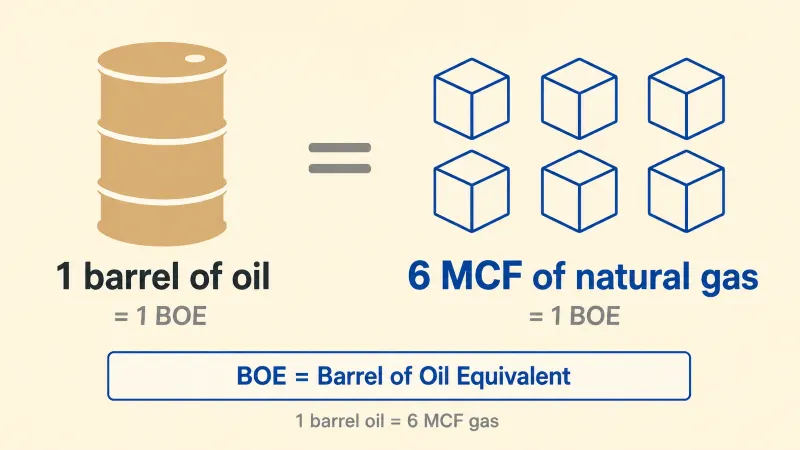
BOE stands for Barrel of Oil Equivalent. It is a standard unit that combines oil and natural gas production into a single figure based on energy content. As oil is measured in barrels and gas is measured in cubic feet, BOE provides a common scale that lets a mineral owner, an operator, or an investor see the total production of a well, lease, or company in a single number.
What This Means for Mineral Owners
If your leases produce only oil or only gas, BOE may not appear often on your statements. But if your leases produce both oil and gas - common in the Permian Basin and Eagle Ford regions - BOE is one of the most useful numbers for understanding the total production on your land.
Two Facts to Keep in Mind
First, BOE combines oil and gas volume by energy content, not by price. Oil and gas are priced differently, so two leases producing the same BOE can generate very different royalty income.
Second, BOE is widely used by operators and production analytics dashboards to summarize production across multiple streams. Recognizing what BOE represents helps you read those summaries accurately and avoid mistaking energy volume for revenue.
Looking for a clearer understanding of your BOE? Use the Explore Production feature to analyze oil and gas production data and gain deeper insight into total production across your assets.
How BOE Works
The BOE figure is built on a simple conversion rooted in energy content.
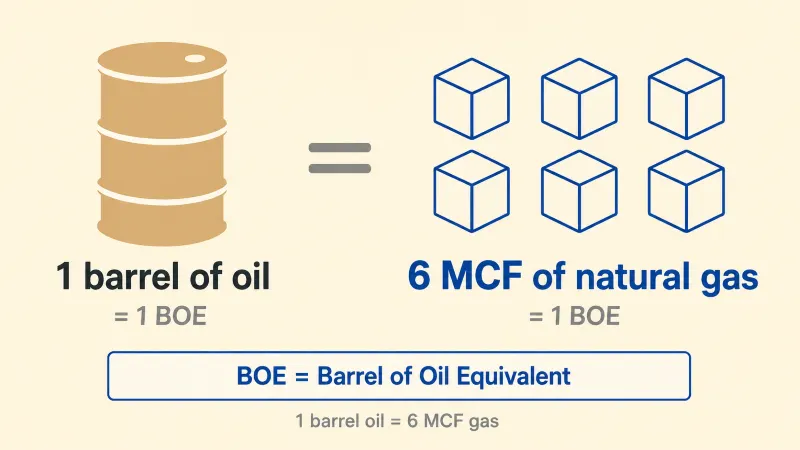
The US Energy Information Administration's standard is that one barrel of crude oil contains roughly the same energy as 6,000 cubic feet of natural gas. This conversion is based on the BTU (British Thermal Unit) heating values of the two fuels. One barrel of oil delivers about 5.8 million BTU, and 6,000 cubic feet of natural gas (6 MCF) delivers a similar amount.
From that standard, the math works as follows:
- 1 barrel of oil = 1 BOE
- 6 MCF of natural gas = 1 BOE
So if a well produces both oil and gas, you can calculate its total BOE by adding the oil barrels directly and dividing the gas MCF by six.
A worked example
A lease produces 500 barrels of oil and 3,000 MCF of gas in a month.
- Oil: 500 barrels = 500 BOE
- Gas: 3,000 MCF ÷ 6 = 500 BOE
- Total: 1,000 BOE for the month
This single number summarizes a lease that would otherwise require two separate figures to describe. It is also why you may see operators describe their daily output as "X BOE per day" or "BOE/d" — it captures total production in one figure.
MCF vs MMBtu vs BOE: What Each One Measures
These three units appear together often on gas-producing leases, and the distinctions matter.
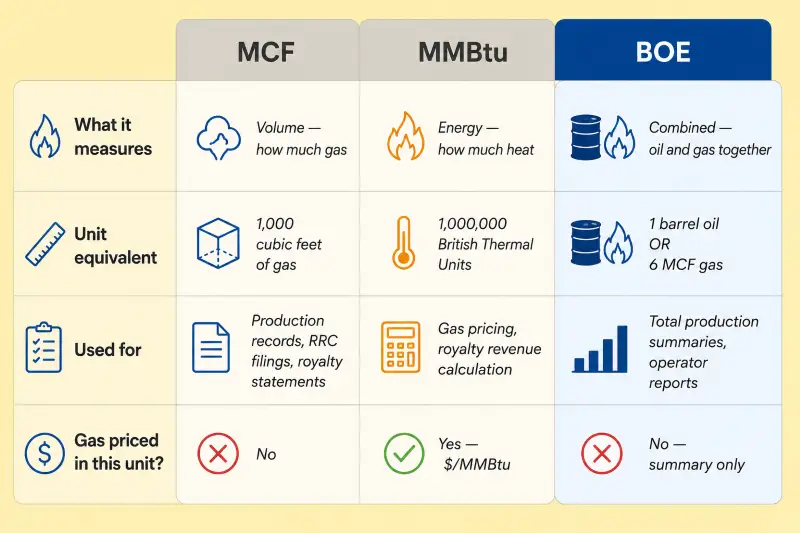
- MCF measures the volume of natural gas (one thousand cubic feet). It is the raw production figure for gas, before any energy conversion.
- MMBtu measures the energy content of natural gas (one million British Thermal Units). It is what gas markets use to price natural gas. The BTU factor of your specific gas converts MCF into MMBtu.
- BOE combines oil and gas into a single unit using the 1 barrel = 6 MCF energy equivalence. It is a summary figure for combined output, not a pricing unit.
The practical relationship: MCF is for measuring gas volume. MMBtu is for pricing that gas. BOE is for combining gas and oil into a single total production figure. Each has its own job, and they often appear together on royalty statements and operator reports.
Why BOE Is Useful and Where It Can Mislead
BOE is the easiest way to summarize multi-stream production. A statement that says "your lease produced 1,000 BOE this month" is more digestible than "your lease produced 500 barrels of oil and 3,000 MCF of gas."
But BOE has one important limitation a mineral owner should understand.
BOE measures energy, not revenue
A barrel of oil and 6 MCF of gas may contain the same energy, but they do not sell for the same price. Through most of the past decade, oil has been priced significantly higher than gas on an energy-equivalent basis. This means a lease producing 1,000 BOE that is 90 percent oil will generate substantially more royalty revenue than a lease producing 1,000 BOE that is 90 percent gas.
This is why operators and investors look at BOE alongside the production mix — the percentage that is oil versus gas — when evaluating revenue. A lease's BOE total tells you the volume. The mix tells you what it is likely worth.
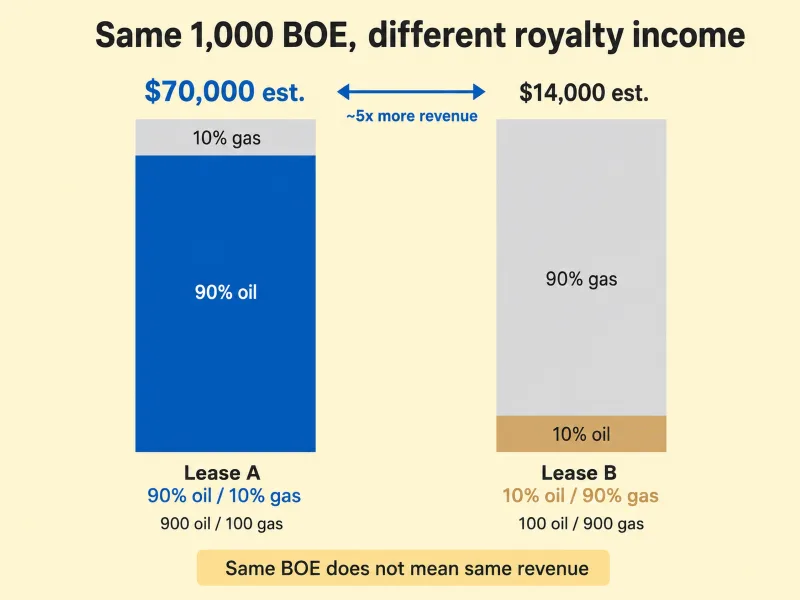
For mineral owners, the practical takeaway is to understand both your total BOE and the underlying split. Mineral View's Lease Report shows oil and gas production separately for each claimed lease, while MVestimate models projected royalty income using both production volumes and price assumptions for each commodity.
A Real-World Scenario
Example: Linda's Permian Basin lease in Midland County
Linda owns mineral rights on a 160-acre tract in Midland County, Texas, in the Permian Basin. Her lease produces both oil and gas from a horizontal well completed in 2022.
Each month, Linda's royalty statement listed oil production in barrels and gas production in MCF on separate lines. The numbers were large — 8,400 barrels of oil and 12,600 MCF of gas in a typical month during the well's first year — and Linda had trouble keeping a sense of the total production at a glance.
When Linda logged into her Mineral View account, she saw the same lease summarized as approximately 10,500 BOE per month: the 8,400 barrels of oil, plus 12,600 MCF of gas divided by six (which equals 2,100 BOE of gas). The BOE figure gave her one number to track month over month.
Linda also noticed something important. Her royalty income was heavily weighted toward oil, because oil was selling for far more per BOE than gas during that period. The 10,500 BOE monthly summary told her the total energy volume, but the dollars on her statement reflected the much higher value of the oil portion. Understanding both BOE and the production mix gave Linda a clearer picture of her royalty income than either number could have provided alone.
Note: This example is provided for illustrative purposes only and does not represent any specific mineral owner or lease.
What to Check
Understand both your BOE total and your production mix
On leases that produce both oil and gas, the BOE figure is a useful summary but does not by itself tell you what the lease is worth. Knowing how much of your production is oil versus gas helps you understand your royalty income, because oil and gas are priced differently.
Verify the conversion if BOE appears on your statement
If your royalty statement shows BOE, you can verify the figure by adding your oil barrels to your gas MCF divided by six. The two should match. If there is a meaningful gap, it may be worth asking the operator how they calculated their BOE figure, since some operators use slightly different conversion factors.
Use BOE for long-term tracking, not short-term price decisions
BOE smooths over the difference between oil and gas. It is a good metric for tracking how a lease's total production is changing over time. For evaluating the economic performance of a lease, separating oil and gas production and applying current commodity prices is more useful than relying on BOE alone.
Important
Mineral View can help you understand combined production, BOE summaries, and operator activity for your minerals. For questions about specific royalty calculations, lease terms, or operator BOE methodologies, consult a qualified landman or Texas oil and gas attorney.
Common Questions
The conversion is based on the BTU energy content of the two fuels. One barrel of oil contains approximately 5.8 million BTU; 6,000 cubic feet (6 MCF) of natural gas contains a similar amount. The US Energy Information Administration uses this 6-to-1 ratio as the standard, and most operators report BOE using this convention. Some companies use slightly different ratios based on their specific gas's energy content, but 6 MCF to 1 BOE is the industry default.
Not necessarily. BOE measures energy, not revenue. Oil and gas sell for different prices, and oil is typically priced significantly higher per BOE than gas. A 1,000-BOE lease that is 90 percent oil will usually generate far more royalty income than a 1,000-BOE lease that is 90 percent gas, even at the same gross BOE total. Your production mix matters as much as your total BOE.
Most royalty statements report oil in barrels and gas in MCF on separate lines, with revenue calculated for each. BOE itself may not appear on every statement, but it is widely used in operator presentations, Mineral View summaries, and investor reports. If your statement does include BOE, it is a summary figure derived from your underlying oil and gas production, not a separate measurement.