Net Profits Interest (NPI)
A Net Profits Interest, or NPI, is a contractual right to receive a percentage of the net profits from an oil, gas, or mineral property after the costs allowed by the agreement are deducted.
For a mineral owner, the key difference from a royalty is simple: a royalty is generally tied to gross production revenue, while a net profits interest pays only after costs allowed by the NPI agreement are subtracted and only if the property shows a profit.
The NPI holder usually does not pay operating costs out of pocket, but payments may be reduced, delayed, or not made when costs are high or the property is not profitable under the agreement.
What This Means for Mineral Owners
The whole story of a net profit interest is in the word net. Most of the interests an owner is familiar with, including a standard royalty interest, pay on gross. You get your share of the revenue from what is sold, and you get it whether or not the operator is making money. A net profits interest is different in a way that matters a great deal: it pays on what is left after costs, so if the property is not profitable, there may be nothing to pay you.
That single distinction changes the risk. A royalty is generally more predictable than an NPI because it is not usually conditioned on the property showing net profit, but royalty income is still not guaranteed. A net profits interest, by contrast, depends both on the property turning a profit and on how that profit is calculated. Two things that are usually settled and simple in a royalty become open and consequential in an NPI.
Two Things to Keep in Mind
- You are paid on net profit, not gross revenue. If the property does not show a profit in a given period, a net profits interest can pay you nothing. A royalty on the same production is generally not dependent on property-level profit, although payments can still be affected by title issues, deductions, taxes, minimum-payment thresholds, or payor timing.
- What counts as net profit is defined by the agreement, and it is negotiable. Which costs can be deducted, whether deficits carry forward, how capital costs are recovered, and when payments begin are all controlled by the contract. Those definitions decide whether, when, and how much you actually receive.
How a Net Profits Interest Works
A net profits interest is usually created by contract and is often carved out of the working interest in a property. The operator or working-interest owner keeps running the property and bearing its costs, and the NPI holder receives an agreed percentage of the net profit it generates.
Net profit vs. gross
This is the heart of it. A gross interest, like a royalty, takes its share off the top of revenue. A net interest takes its share only after costs are subtracted. So with a royalty, drilling and operating costs are generally not your responsibility, and payment is generally not conditioned on whether the operator made a profit. With a net profits interest, the costs come first, and you are paid from whatever profit remains. The higher the costs, or the lower the revenue, the smaller your payment, down to zero in a period with no profit.
The net profits account
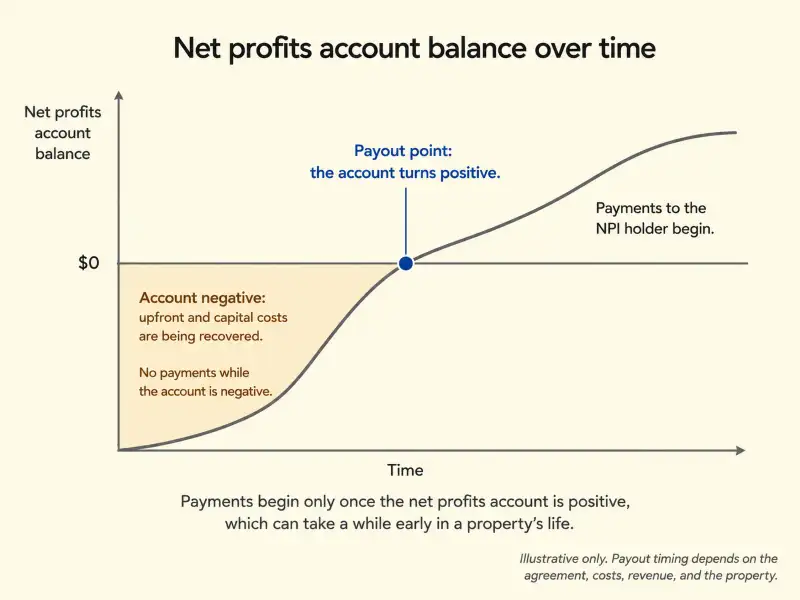
In practice, an NPI is often tracked through a net profits account. Revenue goes in, deductible costs come out, and you are paid your percentage only when the account is positive. Early in a property's life, large upfront and capital costs can keep that account negative for a while, which means payments can be delayed, sometimes for a long time, until the property has earned back enough to show a profit.
A worked example
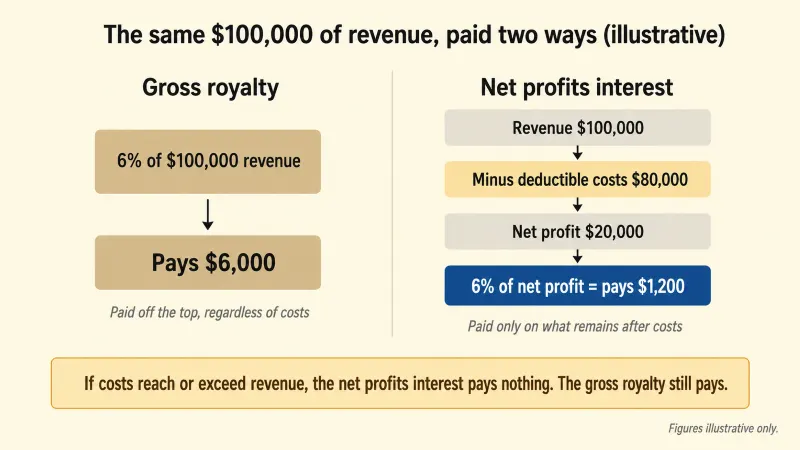
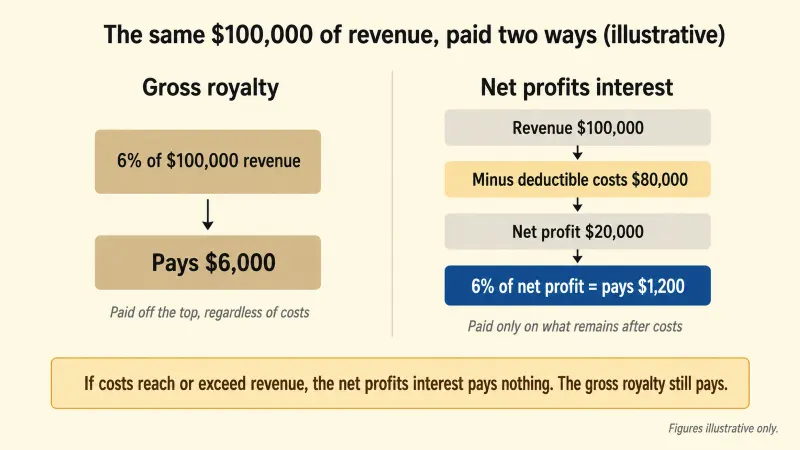
Suppose a property brings in $100,000 of revenue in a period, and $80,000 of costs are deductible under the agreement. The net profit is $20,000, so a 6% net profits interest would pay $1,200.
Compare that to a gross interest at the same 6%, which would pay 6% of the full $100,000, or $6,000, regardless of costs. And if costs had instead reached or exceeded the revenue that period, the net profits interest would have paid nothing, while a gross royalty would still have paid its $6,000.
The figures are illustrative, and NPI and royalty percentages are not usually comparable on the same scale in real deals. The practical point is that a net interest usually pays less than a gross interest at the same stated percentage when deductible costs apply, and it can pay nothing if there is no positive net profit.
Net Profits Interest vs. Royalty Interest
The clearest way to place an NPI is against the gross interests an owner already knows.
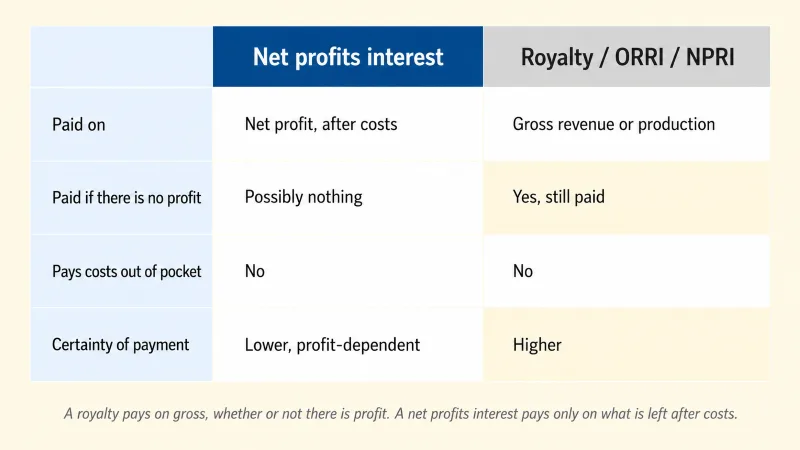
The gross-paying relatives are worth knowing by name. An overriding royalty interest is a gross royalty carved from the working interest and tied to a lease. A non-participating royalty interest is a gross royalty carved from the mineral estate.
Both pay on gross, like a royalty. The working interest is the operating interest that bears the costs directly; a net profits interest holder does not pay those costs but only collects after they are recovered. One name to keep separate is net revenue interest, or NRI: despite the similar wording, an NRI is a working interest's share of revenue after royalty burdens, not a profit-based payment, while a net profits interest pays only after operating costs and only when there is a profit.
When You Might Encounter a Net Profits Interest
A net profits interest is less common for owners than a royalty, but there are a few ways one can land in front of you.
- It can be reserved under a lease or created by a separate agreement, but this is less common for ordinary mineral owners than a standard royalty. Instead of, or alongside, a royalty, an owner might reserve a net profits interest when leasing. This is unusual for many mineral owners and should be approached carefully because it trades the relative predictability of a gross royalty for a profit-dependent payment.
- It can be offered in a deal. A buyer or a partner may propose structuring part of a transaction as a net profits interest, where part of what you receive depends on the property's future profitability rather than being paid in full up front. That can be reasonable or not, depending entirely on the terms.
- It can be inherited or assigned. Interests structured as NPIs get passed down and transferred like other interests, so you might simply find that you hold one.
In every case, the value of the interest depends less on the headline percentage than on the cost definitions behind it. To understand what a comparable gross royalty on the same production might look like as a baseline for comparison, Mineral View's MVestimate models royalty income from production and prices, which gives you a gross-side reference point to weigh an NPI against.
A Real-World Scenario
Example: Daniel weighing a net profits interest in Reeves County
When Daniel was negotiating to sell part of his mineral position in Reeves County, Texas, the buyer proposed paying him partly through a net profit interest in the property rather than entirely in cash. The percentage offered looked attractive on its own.
Before agreeing, Daniel looked past the percentage and asked how net profit would be calculated. The answer mattered more than the headline number. The agreement allowed a broad set of costs to be deducted before any profit was counted, which meant that in higher-cost periods, or early on while capital costs were being recovered, his payments could be small or absent.
Understanding that he would be paid on net rather than gross, and that the cost definitions controlled the outcome, let Daniel weigh the offer realistically and bring specific questions to his attorney rather than being won over by the percentage alone.
Note: This example is provided for illustrative purposes only and does not represent any specific mineral owner or lease.
What to Check
Understand exactly which costs are deductible
The cost definitions are the agreement. Before relying on a net profits interest, you need to know precisely which costs can be subtracted before profit is calculated, including whether capital and other large upfront costs are included. Broad deductions can sharply reduce or delay what you receive. Because your payment depends entirely on the operator's accounting of those costs, it is also worth confirming that the agreement gives you audit and reporting rights, so you can verify how the net profits account is calculated.
Find out whether and when the property is expected to be profitable
Because payment depends on profit, the timing of profitability matters. If a property is early in its life or carries heavy costs, the net profits account may stay negative for a while, meaning no payments until it turns positive. Knowing where the property stands tells you what to realistically expect.
Compare the NPI against a gross royalty
Hold the net profits interest up against what an ordinary gross royalty would pay on the same production. That comparison reveals what you are giving up in certainty for whatever the NPI offers, and it is the right basis for judging the deal.
Important
Mineral View can help you understand the gross production and projected royalty income behind a property. Because a net profits interest is defined by its contract terms, including deductible costs, carry-forward deficits, payout timing, audit rights, reporting obligations, and how profit is calculated, have any NPI reviewed by a qualified Texas oil and gas attorney before you rely on it or agree to one.
Common Questions
A royalty generally pays a share of production revenue without drilling or operating costs, and it is not usually conditioned on whether the property is profitable. A net profits interest pays you a share of net profit, meaning only what is left after specified costs, and only when there is a profit. So a royalty is more certain, while a net profits interest depends on profitability and on how the costs are defined.
No, not out of pocket. Unlike a working interest, a net profits interest does not make you pay the property's costs directly. The difference is that you are only paid after those costs have been covered, so while you do not write checks for costs, you can receive nothing in a period when costs absorb the revenue.
Generally yes. Because payment depends both on the property turning a profit and on how net profit is calculated, an NPI carries more uncertainty than a gross royalty on the same production. It can pay well when a property is profitable and the cost terms are fair, but it can also pay little or nothing, which a royalty would not.
It depends entirely on the agreement, which is why this is the most important thing to confirm. The agreement defines which costs are subtracted before profit is calculated, and these can include operating costs and, in many deals, capital costs and other large upfront charges. Broad cost definitions can sharply reduce or delay what you receive, while narrower ones protect more of your share. Because the cost definitions, not the headline percentage, decide what you actually receive, review them carefully and consider having a qualified Texas oil and gas attorney examine the agreement before you rely on it.
No, despite the similar names. A net profits interest pays a share of net profit, meaning only what is left after specified costs, and only when there is a profit. A net revenue interest, or NRI, is a working interest owner's share of production revenue after royalty burdens are paid, not a profit-based payment. One depends on profitability and on how costs are defined; the other is a revenue decimal on the working interest side. Confusing the two can lead to very different expectations about when, and how much, you are paid.