If you own land in Texas, you may have heard the saying that the real wealth lies beneath your feet. For many families, that value isn’t visible on the surface; it exists deep underground in shale and limestone formations.
You might receive an offer to buy your minerals or inherit a small share in a producing well and wonder whether your monthly royalty check truly reflects its real worth. This is where a mineral rights appraisal becomes important.
It’s not just paperwork; it’s a financial guide that helps you understand what your minerals are actually worth. In regions like the Permian Basin, Eagle Ford, or Haynesville Shale, an accurate mineral rights appraisal is crucial, as it can reveal the full value of your assets and prevent potential financial losses. Whether you are planning to sell, settle an estate, or simply want clarity about your assets, understanding how mineral value is determined helps protect your long-term legacy.
In this blog, we will explain how mineral rights are appraised and what factors truly determine their value.

What Is a Mineral Rights Appraisal?
While every appraisal is a valuation, not every valuation is an appraisal. Think of a mineral rights appraisal as a professional forensic deep dive into the earning potential of your subsurface property. Unlike a typical real estate appraisal for a house, which looks at bedrooms, square footage, and neighborhood curb appeal, a mineral appraisal looks at "invisible" variables.
1) A mineral rights appraisal is a formal assessment of value, based on a specific 'effective date,' and conducted by a certified professional, such as a certified mineral appraiser, geologist, or petroleum engineer.
2) In Texas, this process is governed by strict standards, specifically the Uniform Standards of Professional Appraisal Practice (USPAP). The goal is to find the "Fair Market Value."
3) It simply means the price a property would likely sell for when both the buyer and seller understand all the important details and neither is being forced into the deal.
4) For a Texas mineral owner, those details could include the quality of the underground resources, how much production is possible, and current oil market prices.
To better understand this distinction, think of it like a diamond ring:

The Market Value: You take the ring to a pawn shop. They look at it and offer you $5,000 cash on the spot. This is the "transactional value"-what someone is willing to pay you right now.
The Appraisal: You take the ring to a certified gemologist. They measure the cut, clarity, and carat under a microscope and provide a signed legal document stating it is worth $6,500 for insurance purposes.
Your mineral rights work the exact same way.
The Market Value (The "Pawn Shop"): This is a quick estimate of what a mineral buyer might pay you per acre today based on current oil prices. It is useful for selling, but it isn't official.
The Appraisal (The "Gemologist"): This is a formal, engineering-based report. A certified professional analyzes geological decline curves and future oil prices to create a defensible value for the IRS, estate planning, or legal disputes.
When you look at it this way, it becomes clear why there’s an important difference between what your mineral rights may be worth and the formal appraisal process used to determine that value.
Key Difference Between Mineral Rights Value and Mineral Rights Appraisal
To better understand the distinction, the table below breaks down the main differences between mineral rights value and appraisal.
| Basis | Mineral Rights Value | Mineral Rights Appraisal |
|---|---|---|
| Meaning | What your minerals are likely worth in today’s market. | A formal process used to determine and document mineral worth. |
| Who Determines It | Can be estimated by owners, buyers, brokers, or based on offers received. | Prepared by a certified mineral appraiser, geologist, or petroleum engineer. |
| Legal & Professional Standards (Texas) | Not required to follow any formal standards. | Must comply with the Uniform Standards of Professional Appraisal Practice (USPAP) and accepted Texas valuation methods. |
| Basis of Calculation | Often influenced by market demand, lease activity, production levels, and oil & gas prices. | Based on detailed analysis such as reserve estimates, decline curves, pricing forecasts, and Discounted Cash Flow (DCF) models. |
| Purpose & Use | Helps you decide whether to sell, lease, or hold your minerals. | Used for estate planning, IRS reporting, litigation, divorce settlements, gifting, and financing where a defensible Fair Market Value (FMV) is required. |
Did You Know?
A mineral rights appraisal doesn't require a drill bit to find value.
In major basins like the Permian, geology acts like a giant layer cake. If your neighbors are pumping oil from a specific rock layer (like the Wolfcamp Shale), geologists can scientifically prove that same layer runs right under your feet—even if your land is untouched.
A certified mineral rights appraisal uses this "offset data" to calculate the value of your undrilled rock, turning geological potential into a defensible dollar amount.
Why Texas Mineral Rights Appraisal Is Unique

In Texas, figuring out what your minerals are worth is a bit different than anywhere else. As Texas has such a long history of private ownership and unique energy laws, a mineral rights appraisal requires a specialized approach.
Here is why the Texas process is so unique:
Private Ownership Culture:
Texas is one of the few places on earth where individuals, not the government, own the resources deep underground. This creates a massive, private market that requires expert valuation.
The "Severed Estate" Rule:
In Texas, the "dirt" on top and the "minerals" below can be owned by two different people. An appraiser must carefully track these separate legal rights to ensure they are valuing the correct slice of the property.
The "Rule of Capture" History:
Our state’s legal history means that if a neighbor drills a well and it drains oil from under your land, they generally own that oil. Appraisers have to look at "offset production" (how nearby wells are doing) to see if your assets are being affected.
RRC Data Mining:
An appraiser spends a lot of time on the Railroad Commission of Texas (RRC) website. They look for "Permit to Drill" filings on your land or nearby sections, which can signal a huge jump in your property's value before a rig even arrives.
Cutting Through the "Noise":
Because Texas is so active, there is a mountain of data available from the RRC and the EIA. However, that data is often messy or confusing. A professional acts as a filter, clearing out the "junk" data to give you a realistic price for your net mineral acres.
The Two Pillars of Valuation: How the Math Happens
When determining the value of your interests, experts generally lean on two primary methods. While the "Cost Approach" exists in the textbook, it’s virtually useless for minerals because you can’t "build" more oil. Instead, we focus on the Sales Comparison and Income approaches.
1. The Sales Comparison Approach
This is the "What is the neighbor's house selling for?" method. The appraiser looks at recent, verified sales of similar mineral interests in your specific county or geological play. However, in the oil patch, no two acres are truly identical.
For example, one property may have a 20% royalty rate, while a neighboring property might have a 25% royalty. Additionally, some properties may be located in active drilling zones, while others are years away from development. The appraiser makes "adjustments" to these sales to find a baseline value for your specific acreage.
2. The Income Approach (Discounted Cash Flow)
This is the gold standard for mineral rights appraisal, especially for producing properties. The appraiser builds a "decline curve." Since oil and gas wells naturally lose pressure and produce less over time, the appraiser forecasts exactly how much oil and gas will be extracted over the next 10 to 20 years.
They then apply a "discount rate"-usually between 10% and 20%-to account for the risk that prices might drop or the well might break. This math tells you what those future royalty checks are worth in a single lump sum today. It’s the difference between "potential money" and "present value."
Can You Appraise Land With No Wells? (Non-Producing Minerals)
A common question is, "Can I get an appraisal if a drill bit has never touched my land?"

The answer is yes. Even without active royalty checks, your land can hold massive value based on what is happening around it. Since there is no production to measure yet, appraisers switch from forecasting income to analyzing potential.
They calculate this using two main factors:
- Offset Well Activity: If your neighbors have productive wells, geologists assume that same oil formation likely extends under your land.
- Sales Comparison: They look at what buyers are currently paying for similar undeveloped acreage in your county.
A Note on Technology: This is where the right tool matters. Digital tools like MVestimate are designed to forecast active decline curves for producing wells. For non-producing land where no data exists yet, a human-certified appraiser is currently your best route to determine that speculative value.

The Crucial Role of Geology and Technology
When an expert sits down to perform a mineral rights appraisal, they aren't just looking at spreadsheets; they are looking at the earth itself. Technology has changed the math on Texas minerals more than almost any other factor.
Here is how the rocks and the rigs dictate the value of your property:
The "Dead" Acreage Myth:
A few decades ago, many vertical wells in West Texas were considered "tapped out." With advancements in horizontal drilling and fracking, previously underperforming acres have become highly valuable, as we can now access previously unreachable oil reserves.
Stacked Pay Potential:
Think of your land like a multi-story office building. In many Texas "plays," there isn't just one layer of oil; there are several stacked on top of each other (like the North Spraberry, Lower Clearfork, and Wolfcamp). Each layer is a new source of income, adding a "floor" of value to your appraisal.

Sweet Spots vs. Edges:
Geology isn't uniform. If your minerals are in a "sweet spot", where the rock is thick and the underground pressure is high, your property commands a premium price. If you are on the "edge of the play" where the formation thins out, the value drops because it’s harder and more expensive to get the oil out.
Technology as a Value Multiplier:
An appraiser looks at how efficiently operators in your area are drilling. If companies are using newer, faster completion methods nearby, it makes your minerals more attractive to buyers because they can see a faster return on their investment.
Proximity to Infrastructure:
The best geology in the world doesn't matter if there isn't a pipeline nearby to move the product. An appraiser checks for local "gathering lines" and roads; the easier it is to get the oil to market, the more your minerals are worth.
Lease Terms: The Paperwork That Changes the Price
It is a common mistake to think that 100 acres of minerals always equals a specific price. In reality, the "lease" sitting on top of those minerals is often more important than the land itself.
If your minerals are 'held by production' (HBP) under an old lease with a 12.5% royalty, their value is likely lower than a neighboring property with a modern lease at 25% royalty. The appraiser carefully reviews your Lease Agreement to look for:
Royalty Percentages:
A 25% royalty is worth exactly double a 12.5% royalty in the Income Approach.
Post-Production Deductions:
Does the oil company subtract "transportation and marketing" fees from your check? If so, your net value drops.
Pugh Clauses:
These protect you from having your entire acreage tied up by one small well, allowing for future leasing of deep or undeveloped zones.
Moving Beyond the "Guesswork" with Better Data
For many years, mineral owners were at a disadvantage. Oil companies had access to detailed data, while owners often relied only on a mailbox and a royalty check. To get an accurate mineral rights appraisal, you need more than just reviewing monthly check stubs; you need access to reliable data.
Modern tools have changed this. A clear view of regional activity helps you stay informed about what is happening around your property. Mineral View’s Texas oil and gas maps can show where rigs are currently operating. If drilling is happening near your land, it can increase the perceived potential and value of your minerals.
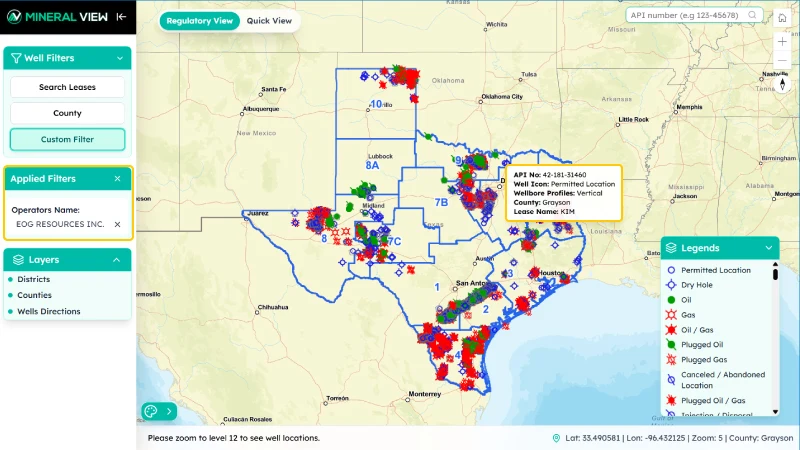
Access to operator information is also significant. Not all oil companies operate the same way. Some actively drill and invest heavily, while others lease acreage but delay development. Knowing who operates your lease and understanding their activity level and financial strength can directly influence how your minerals are valued.
The Value of Timing and Future Potential
Market volatility is the only constant in the Texas energy sector. This is why a mineral rights appraisal is a snapshot in time. If you had an appraisal done in 2020 during the pandemic lows, it would look drastically different than one done in 2026.
An expert appraiser doesn't just look at today’s price; they look at the "strip price" (future projections) from the US Energy Information Administration (EIA). They also look at "Lease Reports" to see what the going rate for "bonus money" is in your county.
If lease bonuses are jumping from $500 to $5,000 an acre, it signals a massive shift in market demand that should be captured in your valuation.
For many owners, the most valuable tool in their arsenal is a reliable data-driven valuation tool that helps estimate future cash flows and overall mineral value. While a formal appraisal is a legal document, having the latest estimate of value based on current production data and market trends allows you to monitor your wealth month-to-month. It helps you decide: "Is now the right time to sell, or should I hold for another five years of royalties?"
Common Pitfalls: What to Avoid
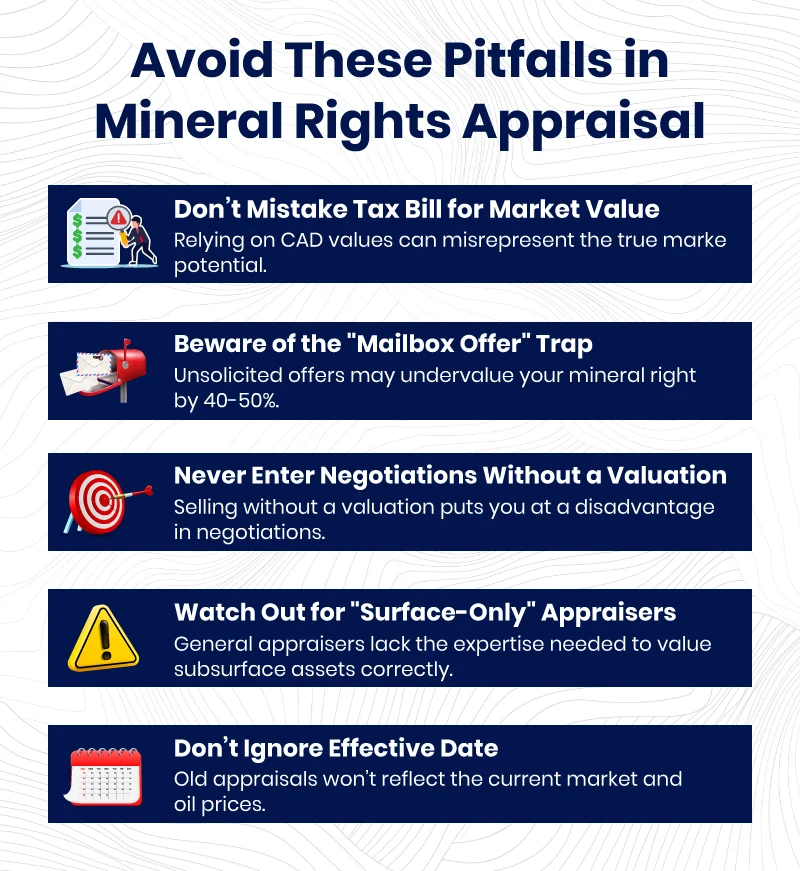
Many mineral owners in Texas make the same few mistakes when it comes to valuing their interests. Here are the most common pitfalls to avoid so you can better execute your mineral rights appraisal and protect your investment:
Don't Mistake Your Tax Bill for a Market Valuation:
County appraisal district (CAD) values are usually outdated or based on tax formulas that don't reflect what a buyer would actually pay you today.
These values are primarily created for property taxation purposes, not for open-market transactions. As a result, relying on a CAD value can significantly misrepresent the true market potential of your mineral rights.
Beware of the "Mailbox Offer" Trap:
Unsolicited letters in the mail often offer only 50% to 60% of the true value, banking on the fact that you haven't had a professional mineral rights appraisal done.
These offers are typically designed to secure quick sales at discounted prices. Without understanding your mineral rights value, you may unknowingly leave substantial money on the table.
Never Fly Blind in a Negotiation:
Selling your minerals without a formal valuation is like playing a high-stakes poker game without looking at your cards.
Buyers often have detailed data and financial models guiding their offers. Entering negotiations without comparable information puts you at a clear disadvantage.
Watch out for "Surface-Only" Appraisers:
Hiring a general real estate appraiser instead of a mineral specialist can lead to a massive undervaluation of your subsurface assets. A proper mineral appraisal requires specialized valuation knowledge, including production data analysis, decline curves, pricing assumptions, and industry-specific risks.
A specialist understands how to properly evaluate royalty streams and long-term development potential.
Don't Ignore the Effective Date:
Market conditions in the oil patch move fast; an appraisal from two years ago likely won't protect your interests in today’s economy. Oil and gas prices, drilling activity, and infrastructure capacity can shift rapidly. An outdated valuation may no longer reflect current production trends or market demand.
Making the Most of Your Mineral Estate
Ultimately, owning minerals is like owning a business. You wouldn't sell a business without looking at the profit and loss statements, and you shouldn't manage your minerals without a clear understanding of their appraised value.
The goal of a professional appraisal is to give you "Decision Clarity." Whether you are navigating a divorce settlement, planning your will, or negotiating a new lease with a landman, the appraisal is your shield and your sword. It ensures that the "Texas tea" beneath your land is working for you, not just the oil company.
Final Words: Securing Your Legacy
A mineral rights appraisal is more than just calculating oil production; it’s a clear financial picture of what your assets are truly worth in a changing market. In Texas, what lies beneath your land can hold significant value, and understanding that value gives you confidence before signing any lease or sale agreement.
As technology and market conditions constantly evolve, staying informed with independent valuations helps protect your family’s long-term financial future. Mineral View helps you access this crucial information with interactive maps and data-driven tools-sign up today to start gaining actionable insights into your mineral assets.
Key Mineral View features, including the Operator Hub and Lease Report, help you understand who manages your minerals and under what terms, making Texas mineral management more informed and efficient.