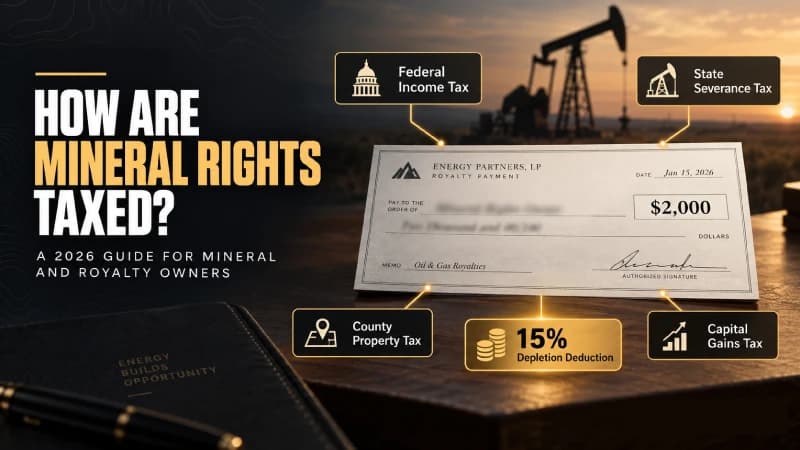
Mineral rights refer to who actually owns the valuable resources like oil, gas, and other minerals hidden beneath a property's surface. For mineral owners, understanding the value of these rights is essential, as it can significantly impact both the overall property value and the potential income from resource extraction.
The value of these rights is influenced by various factors, such as current commodity prices, how much of the property has been produced to date, and the demand for resources in the area. In this blog, we will explore how to value mineral rights effectively.
To get a brief idea of what your mineral rights are worth, mineral owners can utilize a mineral rights value calculator. Yet, for an accurate valuation, it's better to get advice from industry experts or professional appraisers. Understanding the actual value of your mineral rights is essential while making decisions about selling those rights, negotiating lease deals, or planning for future income.
Since the value of mineral rights can fluctuate frequently, it's crucial to stay updated to earn more from your property. Let’s first understand the key point to keep in mind while doing mineral rights valuation.
Key Points to Keep in Mind When Valuing Mineral Rights
The value of mineral rights can go in all sorts of directions, depending on whether the rights are actually producing or not. Typically, producing rights will trade for 3-6 years' worth of average royalty income, along with any potential upside.
Mineral rights owners must understand that the average price per acre can vary and highly depends on location, recent production history and current market conditions.
The discounted cash flow method—where you crunch the numbers to figure out what all the future cash flows from the rights are worth right now—is widely considered the most reliable way to value mineral rights, especially if you factor in the risks.
If you have less time on your hands or you just want to get a rough idea of what your mineral rights are worth, you can try using some quick valuation rules like valuing leased non-producing rights at two to three times the lease bonus paid or unleased non-producing rights at $25 to $250 an acre in certain markets.
Many mineral rights owners also use a mineral rights calculator, an online tool that can give you a rough estimate of what your rights are worth. But these calculators are just a starting point—they can provide you with an approximate estimate depending on the inputs and market conditions.
Where your mineral rights are located has a huge impact on their value, as the location will determine the potential for production, access to infrastructure, and the regulatory environment.
Getting multiple offers from different qualified buyers is often the way to figure out what the market is willing to pay for your mineral rights.
The Main Valuation Methods for Mineral Rights
When it comes to valuing mineral rights, professionals use a few main approaches: the income method using discounted cash flow analysis, the comparable sales method, and the cost approach.
Mineral rights valuation can get pretty complicated, and mineral rights value rules are often applied to give you a rough estimate based on the status of the rights.
The income method is the go-to for valuing producing mineral rights, because it links the value of those rights to the cash they're expected to bring in.
The comparable sales method is used by looking at recent transactions of similar properties, but this approach can be a bit of a challenge due to the lack of data. The income approach estimates future royalties, while the market approach relies on recent sales data.
The income approach, also known as discounted cash flow analysis, is one of the most commonly used and rigorous valuation methods for mineral rights. The cost approach is generally less applicable for mineral rights, because the intangible nature of the rights makes it tough to put a value on them.
Discounted Cash Flow (DCF) Analysis
When using DCF analysis, you're figuring out the present value of all the future cash flows you expect to get from the mineral rights.
This requires forecasting production decline and commodity prices and picking a discount rate that takes into account any risks associated with the rights, like price volatility and regulatory changes. The cash flow value of mineral rights is based on current cash flow from royalty income, which is a key factor in determining overall value.
For example, if you're raking in $2,000 a month in royalties and you expect a 15% annual decline in production, then using a 10% discount rate (keep in mind actual rates will vary based on risk), you might arrive at a present value of around $95,000 over 10 years.
As a rough guide, the cash flow value can also be approximated by taking the average of your last three months of royalty income and multiplying it by a factor of 36 to 72 months (three to six years). Estimating future cash flows requires a detailed forecast of the annual production and cash flows of the wells and leases. The DCF method is really useful for accurately valuing producing properties.
The Comparable Sales Method
The comparable sales method for figuring out the value of your mineral rights works by looking at recent sales of similar properties in the very same area and using that info to come up with a rough idea of what your property might be worth.
Just keep in mind that the average price per acre for mineral rights can vary a lot depending on where you are, how productive that area has been in the past, and the state of the market at the moment.
You might find that the average price per acre can range from as little as $50 per acre to upwards of $20,000 per acre in areas that are super productive. Because there's so much variation in this number, the average price isn't a very reliable indicator on its own—actual value is best figured out by looking at what people are actually willing to pay in the marketplace and what multiple offers are looking like.
Still, this method has its limitations, like the fact that a lot of transactions are private deals that don't get made public. Lease bonus payments that are filed with the county can give you an idea of market prices for non-producing properties, but you'll need to adjust for any changes in the market and commodity prices.
What Makes Mineral Right Value Go Up or Down
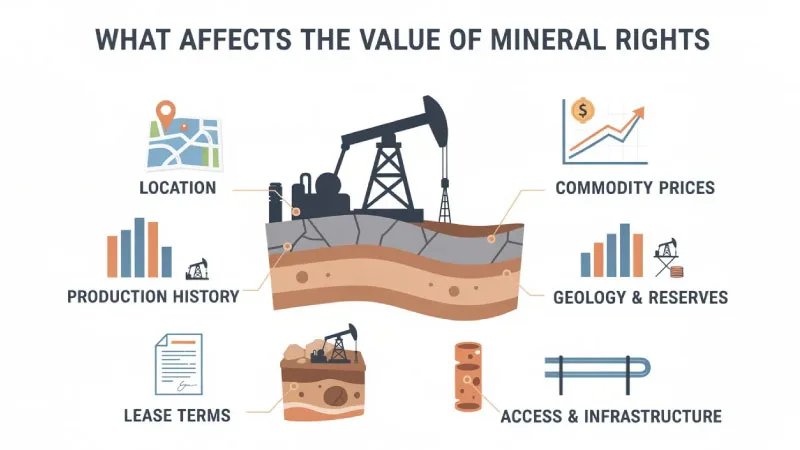
There are a bunch of key factors that can have an impact on the value of your mineral rights. Regional production levels, local government regulations and environmental laws all play a role. As do current market trends and fluctuations in the price of commodities—changes in global market conditions can cause commodity prices to swing unpredictably.
For non-producing mineral rights, the value can range anywhere from a few bucks an acre to around $1000 an acre, depending on all sorts of factors.
Does Production Matter? And How Does Cash Flow Figure In?
If your mineral rights are producing, then they're going to be worth way more than if they're not producing. Getting royalty income means your mineral rights are actually producing oil or gas, which is a big plus for your property.
A fairly standard rule of thumb is to multiply the average monthly royalty income by 36 to 72 months, adjusted for how fast the wells are declining. To smooth out short-term fluctuations, a lot of mineral owners will use the average of their last three months of royalty income when applying this range.
It's also super important to think about future royalty income when valuing your mineral rights—potential future earnings can have a huge impact on their overall value. The number of net mineral acres you own will also affect the amount of royalties you get.
Non-producing leased rights are worth a bit more than unleased rights, usually around two or three times the lease bonus paid. And unleased mineral rights are as speculative as it gets—they can be worth anywhere from $25 to $1000 an acre depending on the location and potential.
What's the Deal with Commodity Prices and Market Trends?
The price of oil, gas, and other commodities can have a huge impact on the value of your mineral rights because higher prices mean higher royalties and lower prices mean lower value.
Fluctuations in commodity prices, driven by changes in global market conditions, can mean the value of your mineral rights goes up and down unpredictably over time. Gas prices, in particular, can affect gas mineral rights in areas like the Marcellus shale.
Some expert individuals will use long-term price forecasts to smooth out fluctuations in commodity prices.
Staying on top of current market trends is super important to get a sense of potential fluctuations and economic influences that might affect the future value of your mineral rights. Other factors like market demand and infrastructure access can also have an impact on the value of your mineral rights.
How Do Lease Terms and Royalty Rates Affect the Value?
The royalty rate, which is usually between 12.5% and 25%, can have a huge impact on the value of your mineral rights. The royalty percentage is what gets used to calculate royalty payments, which are the share of revenue paid to mineral rights owners when leasing oil and gas resources.
A higher royalty rate will bump up the value of the rights, but deductions for post-production costs can cut into the net royalties you get.
Mineral and royalty interests can be bought, sold, or transferred, and these transactions can have a significant impact on the overall value of your mineral rights. Leased mineral rights are typically valued differently from unleased rights, with lease bonuses and the current leasing status serving as key indicators of value.
Lease bonuses can provide a useful benchmark for non-producing rights and the primary lease term length can also affect the value of the rights.
Where You Are and What's Under Your Feet
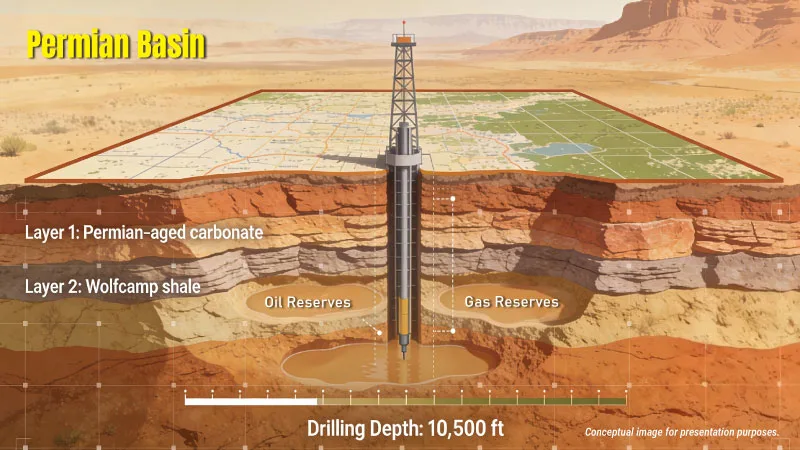
Where your property is and what's going on underneath it are two of the most important factors in figuring out the value of your mineral rights. Mineral owners with property in areas known for being super rich in oil and gas reserves, like the Permian Basin, often see higher values for their mineral rights.
The presence of proven oil and gas reserves, as well as the quality and depth of those reserves, can make a huge difference in the value of mineral rights.
When you're considering the value of mineral rights, it's most crucial to understand the details; it's just as much about the surface as it is about taking into account the underlying geology.
Properties with substantial oil and gas or gas reserves are generally more attractive to mineral buyers and can have better values in the market. By knowing these things, mineral owners can negotiate better lease agreements and make smart decisions associated with their mineral assets.
Digging Deeper into Subsurface Area Considerations
A thorough evaluation of the subsurface area is a must for mineral owners who require an appropriate mineral rights valuation. You'll want to factor in the depth and quality of the mineral deposits, as well as any geological obstacles like water tables or fault lines that could make extraction a whole lot harder.
The viability and expense of extracting oil, gas, or other minerals can be greatly impacted by these kinds of factors, which also have an impact on the total value of mineral rights. Mineral owners can determine the true value of their mineral rights and make well-informed decisions about leasing or selling by gaining a deeper understanding of the subsurface area.
Regional Differences
Mineral rights values can vary wildly from one region to another, largely due to infrastructure, market conditions, and the current activity in oil and gas leases. For example, mineral owners in places like Texas and New Mexico tend to benefit from higher mineral rights values thanks to the presence of big oil and gas companies, active leases and pretty solid infrastructure.
These regions tend to attract a lot more interest from mineral buyers, which can drive prices up. The best way to get a clear picture of the value of their mineral rights is for mineral owners to do some digging on local market trends, recent lease activity and the demand for resources in their area.
Quick Valuation Rules of Thumb

If you're short on time or just want a rough estimate of the value of your mineral rights, then you might want to give the quick valuation rules a whirl. These are also known as mineral rights valuation rules of thumb—simplified guidelines that help estimate mineral rights value based on the status of your rights.
You can also use a mineral rights calculator to get an estimate, but remember these are just a rough guide and don't take into account future upside potential. Just keep in mind that all these methods are only a rough guide and should be backed up with some proper research and analysis.
The Cash Flow Multiple Method
This involves estimating the cash flow value by multiplying the average monthly royalty income by something like 36 to 72 months—but you'll need to adjust that calculation for the rate of decline of the wells. The average monthly income from royalties is what's used in this calculation.
The cash flow value is based on your royalty income and can be estimated by averaging the last three months of royalty income and multiplying by something like three to six years. Mature wells might need greater multiples, like 70–80x, but new wells might need lower multiples, like 40–50x.
The Lease Bonus Multiple
Leased mineral rights that aren't producing any oil can be valued at two to three times the lease bonus, especially if there's an active lease in place. That's because the presence of an active lease increases the value of mineral rights, because it shows there are ongoing contractual rights and potential royalty income.
For non-producing mineral rights, the value can range from pretty much nothing to $1,000 an acre, depending on whether they're leased or not and other factors like geological potential and market activity. Unleased non-producing rights are a different story altogether, and their value can vary wildly depending on these factors.
Valuation by Production Status
Producing Mineral Rights
Producing mineral rights are the most valuable because they're generating current cash flow from existing royalty income. Upside value is an extra layer of value that can increase the worth of mineral rights even more, because it shows the potential for future drilling and production.
The potential upside value of mineral rights is kind of subjective and can vary a lot between buyers. Upside potential from future drilling can also increase the value of producing properties beyond just the initial cash flow multiples.
Non-Producing Mineral Rights
These include leased and unleased non-producing mineral rights that are waiting to be developed. Leased mineral rights are generally more valuable than unleased ones, because the leasing status can indicate immediate interest from operators and potential for future production.
For non-producing mineral rights, values can range from pretty much nothing to around $1,000 an acre, depending on whether the rights are leased or not.
As they carry a lot more risk and uncertainty, non-producing mineral rights are harder to value than producing rights. Their value is based more on potential than proven production.
Geographic & Location Factors
Location is a huge factor in determining the value of mineral rights. If you have got property in a high-production region like the Permian Basin, you can expect to get a premium price, as the geology is proven, there's existing infrastructure, and there's already drilling going on in the area.
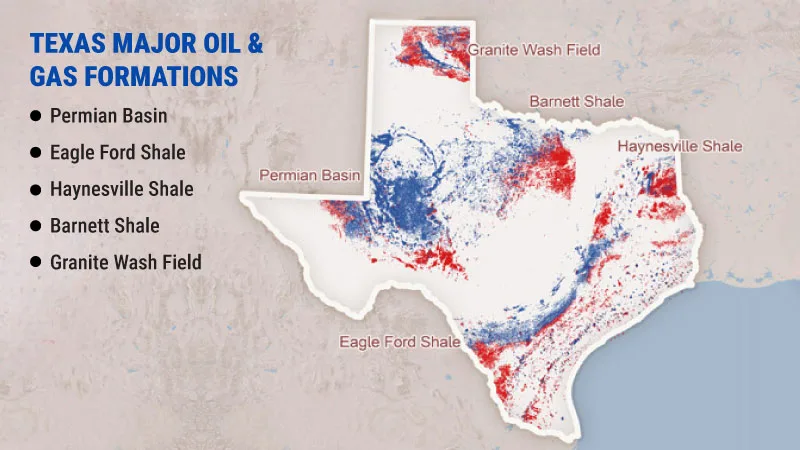
Having access to pipelines and markets also really boosts the value. And don't even get started on the regulatory environment—that can make or break the potential for development and how much your mineral rights are worth.
Estimating Future Production (MVestimate)
Estimating future production is a critical step in valuing mineral rights, especially for those considering selling mineral rights or negotiating new lease agreements. Mineral owners can use methods like decline curve analysis and estimated ultimate recovery (EUR) to project future production rates and potential income from resource extraction.
But here's the thing—arriving at a reliable estimate is a complex process that needs access to a mountain of historical production data and a good handle on geology, data science and market dynamics. And that's where Mineral View's MVestimate tool can be a real game changer.
Using Production Forecasts to Get a Handle on Future Income
When it comes to valuations, the pros use super detailed discounted cash flow analysis - but many mineral owners just want a practical way to get their head around what their leases might realistically earn over time.
MVestimate is a feature Mineral View offers that helps fill that gap by estimating how much oil and gas leases might earn over the next six years, based on verified Texas Railroad Commission production data and industry-standard decline curve forecasting methods. It then uses that to project future production and potential cash flow for each lease and well.
This is a forward-looking estimate, so please don't go thinking it's a cast-iron guarantee of a sale price or a formal appraisal—but it can help mineral owners get a better sense of the income potential of their leases, compare different scenarios and prepare for lease negotiations or sale discussions with a bit more confidence.
Getting the Best Deal on Mineral Rights
To get the best price for your mineral rights, here are some things to keep in mind:
- Don't get stuck with just one bidder—try to get multiple bidders in the mix so you know you're getting a fair deal and market value.
- Work with some experts to get a really solid valuation done, using the income approach to make sure the value is up to date and reflects current market conditions.
- Try negotiating a better lease royalty rate to boost long-term income.
- Create a bit of competition among the interested buyers so you can figure out what your mineral rights are really worth in the current market.
- On top of that, selling mineral rights can have some tax benefits, making it a pretty attractive option for some owners.
Don't be tempted to just take the first offer that comes along, either—there's probably a better deal to be had if you just shop around a bit. A lot of mineral owners end up leaving money on the table because they don't take the time to compare offers.
The Bottom Line
Knowing how to value mineral rights is crucial if you're a mineral owner looking to make informed decisions about selling or leasing. The value depends on all sorts of factors, from whether the land is producing or not to royalty income, commodity prices, and lease terms.
Producing rights are usually more valuable, while non-producing rights rely on lease bonuses and market comparisons.
Now tools like mineral rights calculators and rough valuation rules can give you a rough idea, but to get a reliable estimate, you need to do a detailed analysis, like discounted cash flow methods, and get some competitive offers from qualified buyers.
Negotiating a good lease royalty rate and staying on top of market trends can also make a big difference to how much you get from your mineral interests.
By using Mineral View features designed to support mineral owners, you can get a lot more insight and support throughout the valuation process and make decisions that really suit your goals.