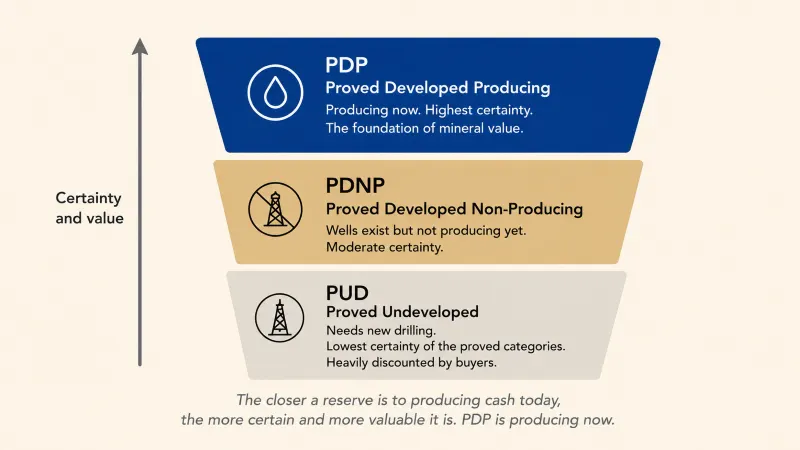
Proved Developed Producing (PDP)
Proved Developed Producing, or PDP, is a category of oil and gas reserves from existing wells that are already drilled, completed, and producing. These reserves are usually lower-risk than undeveloped reserves because the well is already producing, and the remaining oil or gas estimate is based on real production data.
For a mineral owner, PDP matters because producing wells are usually valued more confidently than undrilled potential.
How Reserves Are Classified
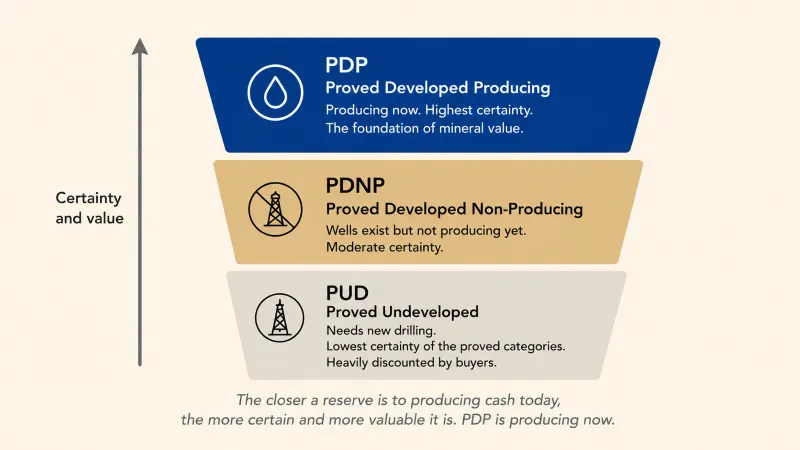
Reserves are grouped by two things at once: how certain they are, and whether the wells to produce them already exist. The proved categories, from most certain to least, break down like this.
Proved Developed Producing (PDP)
These reserves are being produced right now from existing wells. The wells are drilled, the equipment is in place, and production is being measured. Because nothing about PDP depends on future drilling or future decisions, it is the most certain category and the foundation of mineral value.
Proved Developed Non-Producing (PDNP)
These reserves are tied to wells that already exist but are not currently producing. Common examples are zones that have been drilled through but not yet perforated (sometimes called behind-pipe reserves), or wells that are temporarily shut in awaiting a pipeline connection or a workover. PDNP reserves can usually be produced without major new drilling, but because they are not flowing yet, they carry more uncertainty than PDP.
Proved Undeveloped (PUD)
These reserves are considered reasonably certain to exist, but producing them requires drilling new wells or making major capital investments that have not happened yet. PUD represents future drilling locations that an operator could develop, but whether and when that happens depends on the operator's decisions, budget, and prices. PUD is the least certain of the proved categories, because it depends on drilling that may or may not occur.
Beyond the proved categories, reserves can also be classified as probable or possible, which are progressively less certain still. For most owner purposes, the proved categories above are what drive value.
PDP vs. PDNP vs. PUD
Seeing the three side by side makes the value differences clear.
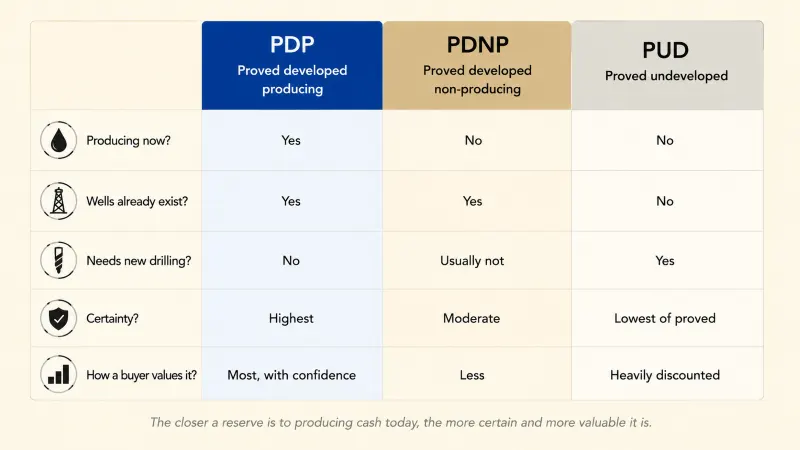
The pattern is simple: the closer a reserve is to producing cash today, the more certain and more valuable it is.
Why PDP Is the Most Valuable Reserve Category
Lower risk, higher confidence
PDP is the most valuable reserve category because it represents wells that are already producing and generating measurable revenue. Buyers can value PDP with much greater confidence since its performance is based on actual production data.
Why PUD is discounted
Undrilled reserves (PUD) carry significant uncertainty as there is no guarantee the well will ever be drilled and even if drilled, production may not meet expectations. Buyers heavily discount PUD to account for both the uncertainty and the delay before any future income is realized.
Understand what an offer is really worth
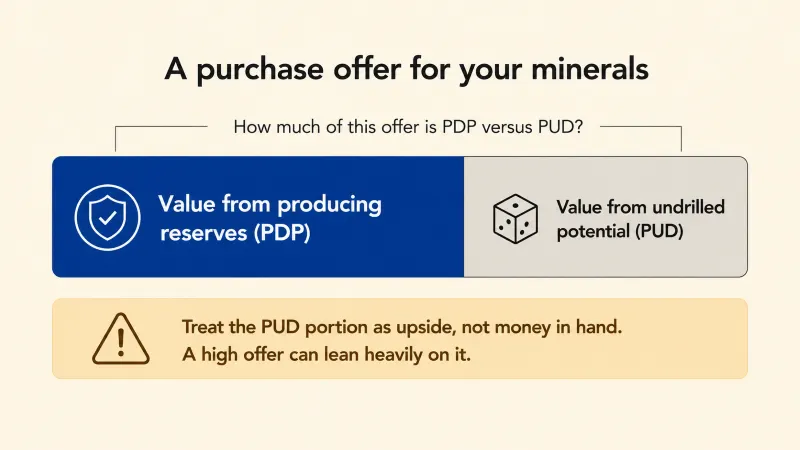
A high purchase offer may derive much of its value from PUD rather than producing reserves. PDP represents value that is already proven and measurable, while PUD reflects expectations about future development. Knowing the proportion of PDP versus PUD helps determine how much of an offer is based on current value versus future potential.
PDP vs. EUR
Estimated Ultimate Recovery (EUR) represents the total volume a well is expected to produce over its entire lifetime. PDP is the producing, proven portion of that total that is already generating revenue. In simple terms, EUR is the lifetime projection, while PDP is the producing portion already in motion.
Estimate income from producing reserves
Mineral View's MVestimate models projected royalty income using production data and commodity prices. Because it is based on active production, MVestimate reflects the value of the PDP portion of your mineral assets.
Importance of PDP Assets for Mineral Owners
For everyday mineral owners, Proved Developed Producing (PDP) assets are the single most important part of your property. As PDP means the oil or gas wells are already drilled, completed, and actively producing, they typically provide you immediate, monthly royalty checks. There is no waiting or guessing; the cash is flowing right now. When operators report a substantial increase in their year-over-year PDP reserves, it directly benefits the folks who own the minerals.
A company focusing on its PDP base means they are financially healthy and fully committed to keeping the land active. Even better, the steady money the operator makes from these current PDP wells gives them the cash they need to drill new wells on your acreage, turning your undeveloped land into even more active streams of income. Ultimately, strong PDP activity means your lease stays safely active (Held by Production), your overall mineral property value typically increases, and your financial risk remains minimal. It gives you a reliable, long-term source of passive income without ever requiring you to pay a single cent for drilling costs.
What to Check
Ask how much of an offer is PDP vs PUD
When you receive an offer, find out how much of the value comes from producing reserves and how much from undrilled potential. The PDP portion is the certain part; the PUD portion is a bet on future drilling. That split tells you how solid the offer really is. Mineral View's Lease Report shows production for your leases, which helps you see the producing basis behind your PDP.
Focus on producing reserves for certain value
If you want to understand the part of your minerals' value that is dependable, look to what is producing now. PDP is the value that does not rely on anything new happening, which makes it the firmest ground for any decision.
Treat undrilled potential as upside, not guarantee
Proved undeveloped reserves can add real value if they are developed, but they are not certain. Treat them as potential upside rather than money in hand, and be cautious about an offer that leans heavily on them.
Important
Mineral View can help you see your production and estimate income from your producing minerals. For a proper valuation of your reserves, an assessment of how an offer is built, or a keep-or-sell decision, consult a qualified mineral appraisal professional, Texas oil and gas attorney, or financial advisor, since these involve specific valuations beyond general education.
Common Questions
Because PDP is producing now and PUD is not. PDP reserves come from wells that already exist and are generating measurable revenue, so there is little uncertainty. PUD reserves depend on new wells being drilled in the future, which may or may not happen and may or may not perform. Buyers pay more, and with more confidence, for the certainty of producing reserves.
Not necessarily. A large offer can include significant value assigned to undrilled potential rather than current production. That is why it helps to ask how much of an offer is based on producing reserves versus undeveloped potential. The headline number alone does not tell you how much of the value is certain.
PDP is the most certain, producing-now portion of your reserves, while estimated ultimate recovery is the total a well is expected to produce over its entire life. In other words, PDP is part of the picture that EUR describes in full. PDP is what is flowing today; EUR is the lifetime total, including production still to come and, in some uses, undeveloped potential.