Estimated Ultimate Recovery (EUR)
Estimated ultimate recovery, or EUR, is the estimated total amount of oil, gas, and sometimes liquids that a well, lease, or project is expected to recover over its productive or economic life.
It combines what the well has already produced with an estimate of how much may still be recovered under current technical, economic, and operating assumptions.
- The first part comes from actual production records, while the remaining part is estimated, often through decline curve analysis and other engineering assumptions.
- For a mineral owner, EUR helps estimate the upper range of lifetime production from a well under current assumptions, which makes it useful in valuations, reserve reports, and purchase offers.
The word to keep in mind is the first one: estimated. EUR can change over time, and it generally becomes more reliable as a well builds a longer and steadier production history.
What This Means for Mineral Owners
If a daily rate like BOPD tells you how fast a well is producing today, EUR tells you the big-picture lifetime total. It answers the question owners care about most over the long run: across the whole life of this well, how much is likely to come out of the ground.
Because your royalty is tied to production, the well's EUR helps frame the possible lifetime production volume behind your royalty, but the actual royalty value depends on prices, product mix, timing, deductions, taxes, and your decimal interest.
You are most likely to see EUR in reserve reports, valuation summaries, and the materials behind a purchase offer. It is a useful number, but it is a projection, not a guaranteed outcome. The part that matters most to your future income is the remaining-production estimate, not the production that has already occurred.
EUR helps estimate lifetime recoverable volume from a well, but it measures production volume, not money or royalty value. What that volume is worth depends on product mix, commodity prices, production timing, deductions, taxes, lease terms, and your decimal interest.
EUR is an estimate that changes over time. A brand-new well usually has a less reliable EUR than a well with years of production history, because much of the estimate depends on projecting a decline pattern that has only just begun.
How EUR Is Calculated
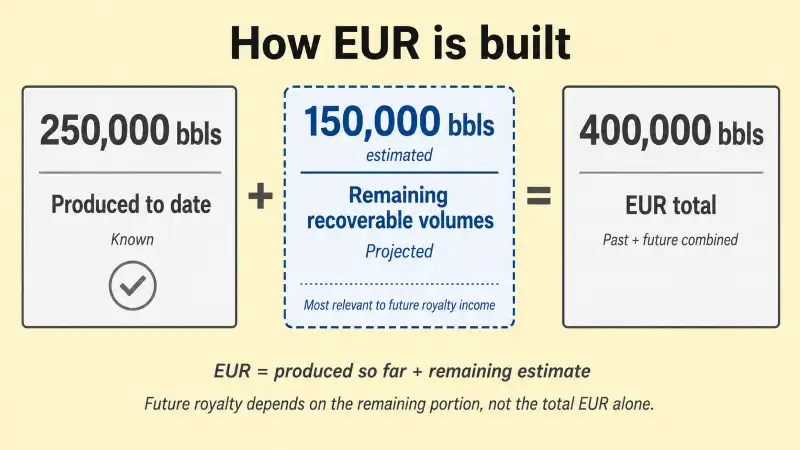
At its simplest, EUR is the sum of two parts:
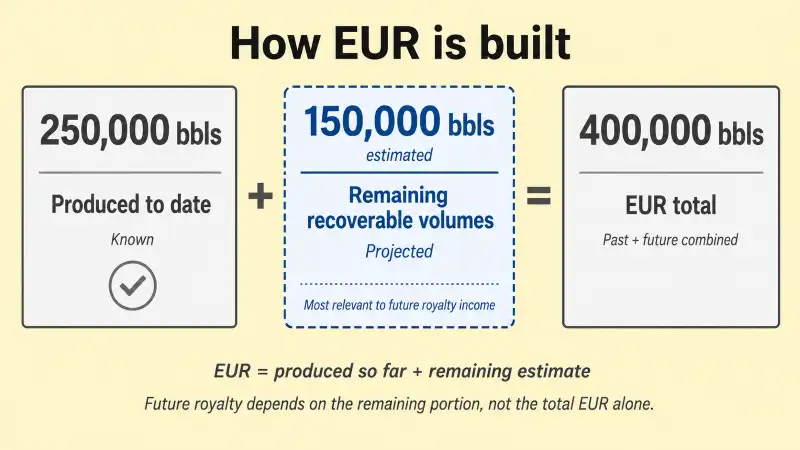
EUR = Cumulative Production to Date + Estimated Remaining Recoverable Volumes
The two halves are very different
The first part, cumulative production to date, is based on actual production records. In Texas, production is reported to the Railroad Commission of Texas, although figures can still vary by source, product, allocation method, lease, unit, or later correction.
The second part, estimated remaining recoverable volume, is where most of the uncertainty sits. Analysts study how the well's production has declined so far and project that decline forward to estimate how much more the well may produce before reaching its economic limit.
This is decline curve analysis. The longer and steadier the production history, the more confident that projection can be. Early in a well's life, when only a few months of data exist, the remaining-production estimate is much less certain and depends heavily on engineering judgment and assumptions.
A worked example
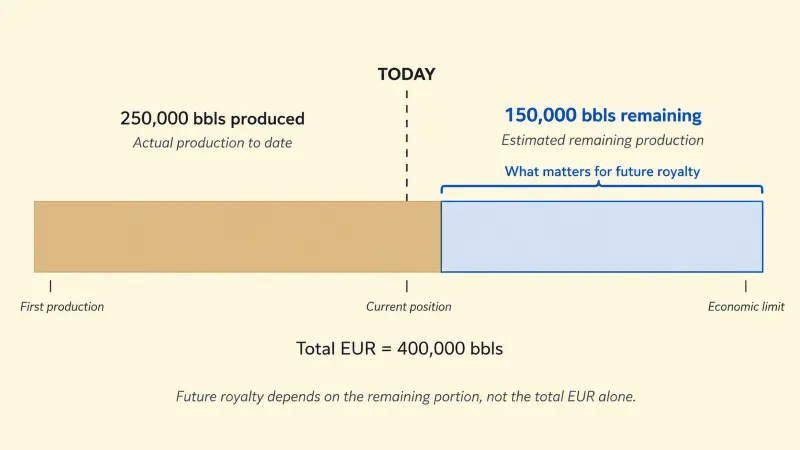
Suppose a well has already produced 250,000 barrels of oil, and decline curve analysis estimates it may produce another 150,000 barrels before reaching its economic limit. Under that estimate, its EUR would be about 400,000 barrels.
The 250,000 already produced is essentially fixed. The 150,000 barrels remaining is the estimated portion, and it can change as the well ages, prices change, operating costs shift, downtime occurs, or the operator performs workovers, recompletions, refracs, or other operational changes. When an EUR is revised up or down, it is usually the estimated remaining-production portion that changes, although cumulative production records can also be corrected or reallocated in some cases.
EUR vs Reserves vs PDP
These three describe production volume at different points and with different levels of certainty.
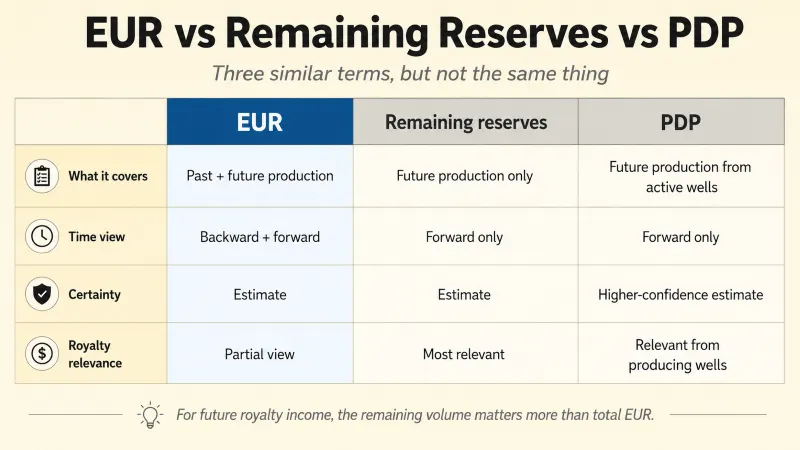
- EUR is the total expected over the well's entire life, looking backward and forward at once.
- Remaining reserves, or remaining recoverable volumes, refer to the part still expected to be produced under the assumptions used in the report. It is generally EUR minus cumulative production to date, and it is the portion most relevant to your future royalty income.
- PDP, or proved developed producing reserves, is a proved-reserve category tied to wells that are already drilled, completed, and producing under existing economic and operating conditions. It is generally considered one of the more certain reserve categories, but it still depends on engineering estimates, economic assumptions, prices, costs, and operating conditions.
Put simply, PDP is a more conservative reserve category, remaining reserves are the volumes still expected to be produced, and EUR is the broader lifetime recovery estimate that includes both past and expected future production.
Why EUR Matters to Mineral Owners
EUR matters because it underpins how minerals are valued. When someone makes you an offer or prepares a reserve report, an EUR figure is usually sitting behind it, since the total expected production is what gives the asset its long-term worth. A higher EUR may point to more lifetime production potential, but remaining royalty value depends on how much has already been produced, what product mix remains, and when future production is expected to occur.
There are two cautions that keep EUR honest. First, it is volume, not value. The same EUR can be worth very different amounts depending on whether it is mostly oil, gas, or liquids, what prices do, what deductions apply, and how soon the production arrives, since future income is generally discounted compared with income received today. Second, reliability depends on history. An EUR quoted for a young well leans heavily on projected decline behavior that has not fully played out, so it deserves more caution than an EUR for a well with a long, stable production history.
For owners who want to see how expected production may translate into income over time rather than as a single lifetime volume, Mineral View's MVestimate models royalty income using production data, decline behavior, product mix, and price assumptions.
A Real-World Scenario
Example: Karen reviewing a purchase offer in Midland County
Karen received an offer to buy her mineral interest in Midland County, Texas. The offer materials cited a large EUR for the wells on her acreage, and the size of that number made the offer feel strong.
Before responding, Karen asked two questions: how much of that EUR had already been produced, and how old the wells were. The answers reframed the offer. A large portion of the EUR had already been produced over prior years, which meant the remaining recoverable volume, the part most relevant to her future royalty income, was smaller than the headline EUR suggested.
Knowing that, Karen could weigh the offer against the future income she could reasonably expect, rather than against a lifetime production figure that partly reflected past production. Understanding that EUR looks both backward and forward kept her from overreading the number.
Note: This example is provided for illustrative purposes only and does not represent any specific mineral owner or lease.
What to Check
Ask how much of the EUR has already been produced
EUR includes past production, but only the remaining reserves will pay you from here forward. When you see an EUR figure, find out how much has already been produced, because the leftover or remaining recoverable volume is what matters most to your future royalty.
Mineral View's Lease Report shows production history and estimated remaining volumes at the lease level, which helps separate what has already happened from what may still be ahead.
Consider the well's age when judging an EUR
An EUR for a well with years of steady production history is usually more dependable than one for a well that came online only a few months ago. The younger the well, the more of its EUR rests on projection assumptions, so treat early-life estimates with appropriate caution.
Remember EUR is volume, not value
A large EUR does not automatically mean large future income. The value depends on product mix, prices, production timing, deductions, taxes, lease terms, and your decimal interest. Use EUR to understand scale, and look to a value-based estimate to understand worth.
Important
Mineral View can help you see production history, estimated remaining volumes, and projected income for your minerals. For questions about how an EUR figure was derived or how it should affect the value of your interest, consult a qualified landman, Texas oil and gas attorney, or mineral appraisal professional.
Common Questions
Because the estimated remaining-production portion of EUR gets refined as new production data comes in. As a well produces and its decline trend becomes clearer, analysts may update how much they expect it to recover over its economic life.
Prices, operating costs, workovers, recompletions, downtime, technology, and operator decisions can also shift the estimate. The part that changes is usually the estimate of what is still to come, although production records can sometimes be corrected, reallocated, or updated.
Often, but not always. A higher EUR points to more total expected production, which can support more value if the remaining volume, product mix, timing, prices, and deductions are favorable. But EUR measures production volume rather than money, and value also depends on whether the production is oil, gas, or liquids, what prices do, what deductions apply, how much has already been produced, and how soon the remaining production is expected to arrive. Two interests with the same EUR can be worth quite different amounts.
No. EUR is an estimate, not a promise, guarantee, or operator commitment. The portion already produced is known, but the remaining portion is a projection that can prove high or low depending on how the well actually performs, what prices do, and how long it stays economical to operate. It is a technical forecast based on available data and assumptions, and it should be read as one.