Net Mineral Acres
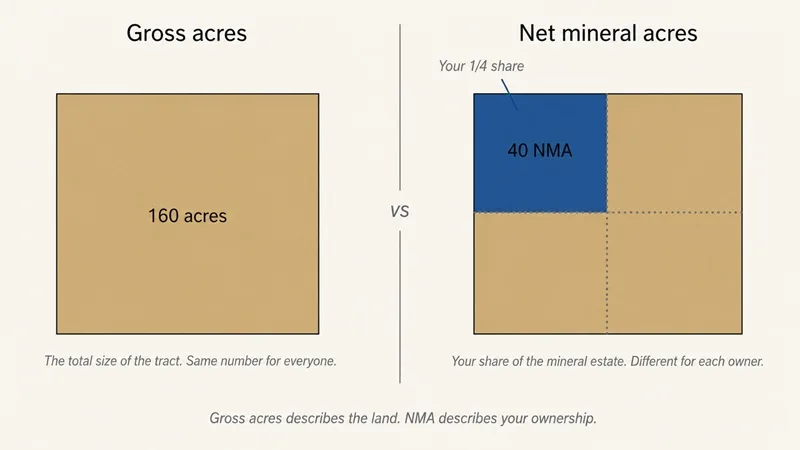
Net mineral acres (NMA) is the number of acres of mineral rights you actually own. If a 160-acre family tract is shared equally among four siblings, the tract is still 160 acres, but each sibling's NMA is 40.
NMA is the figure that drives your royalty payments and the price any buyer will pay for your minerals. Knowing it precisely matters more than knowing the size of the original tract.
What This Means for Mineral Owners
Three things in your mineral ownership trace back to your NMA: the royalty check you receive each month, the decimal interest on your division order, and the price anyone will offer to buy your minerals. If your NMA is wrong by even a small fraction, all three are wrong by the same fraction. Knowing your NMA precisely is the most direct way to confirm you are being paid correctly and to evaluate any offer fairly.
Gross Acres vs Net Mineral Acres
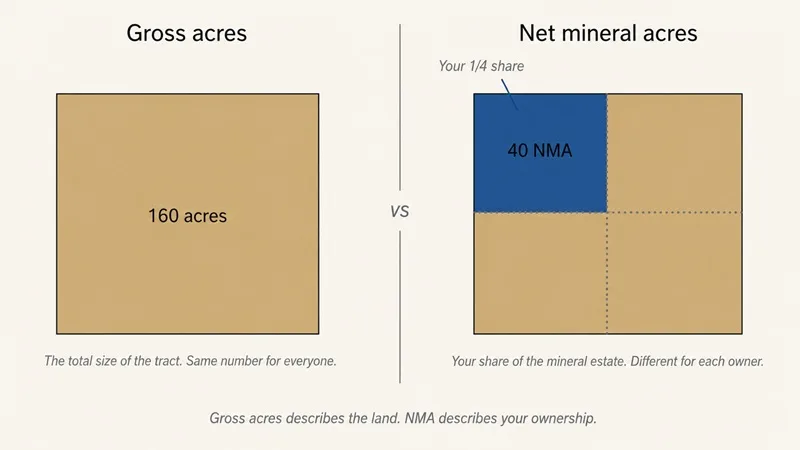
These two numbers describe the same piece of land but mean very different things.
Gross acres is the total size of the tract, the physical area of the property, regardless of ownership or fractional interest. A 160-acre tract is 160 gross acres whether one person owns all the minerals or ten people share them.
Net mineral acres (NMA) is your share of the tract's mineral estate, based on your ownership fraction. If you own one quarter of the minerals beneath a 160-acre tract, you have 40 net mineral acres, not 160.
The difference between gross and net mineral acres is where most confusion arises. An heir told they own minerals in a 320-acre tract may assume they own 320 acres of minerals, but they may own only 20 acres of minerals, depending on their inherited share. Gross acreage describes the land. NMA describes your ownership.
Other Acreage Terms You May Encounter
When working with mineral interests, you may see references to "acreage" or "undeveloped acreage" alongside NMA. These are related but distinct concepts.
- "Acreage" is a general term for the size of a tract, used interchangeably with gross acres in lease and ownership discussions.
- "Undeveloped acreage" refers to mineral acres where no well has been drilled and no production has begun, important for valuation, since undeveloped NMA may carry different value than NMA tied to producing wells.
Both terms ultimately resolve back to NMA when calculating your actual ownership stake.
How to Calculate Net Mineral Acres
Calculating your net mineral acres is straightforward when you have two pieces of information from your deed: the gross acreage of the tract and your mineral ownership fraction.
Net Mineral Acres (NMA) = Gross Acres × Mineral Ownership Fraction
The mineral ownership fraction is the share of the mineral estate you own, expressed as a decimal or a fraction. This number comes from your deed or chain of title.
Example 1: Simple Ownership
You own one-quarter (1/4) of the mineral rights beneath a 160-acre tract.
- Gross acres: 160
- Mineral ownership fraction: 1/4
- Net mineral acres: 160 × 1/4 = 40 NMA
Example 2: Inherited Split (Fraction of a Fraction)
This is the most common scenario for heirs and often causes surprises.
Your parent owned one-half (1/2) of the minerals beneath a 160-acre tract, or 80 NMA. When they passed, their interest was divided equally among four children. You inherited one quarter of your parent's interest.
- Your mineral fraction: 1/4 × 1/2 = 1/8
- Gross acres: 160
- Net mineral acres: 160 × 1/8 = 20 NMA
The tract is still 160 acres. Your parent held 80 NMA. You hold 20. Each sibling holds 20. The four of you together hold what your parent held.
Example 3: Multiple Tracts
You own mineral interests across two separate tracts in different counties.
- Tract A: Own 1/4 of 320 acres → 80 NMA
- Tract B: Own 1/2 of 80 acres → 40 NMA
- Total net mineral acres = 80 + 40 = 120 NMA
Each tract is calculated independently. NMA is additive across tracts, but only when comparing like interests. Tracts in different formations, counties, or lease situations are distinct assets even when the NMA is combined.
| Gross Acres | Net Mineral Acres | |
|---|---|---|
| What it describes | Total physical size of the tract | Your actual ownership of the mineral estate |
| Ownership fraction applied? | No | Yes |
| Changes when minerals are split? | No | Yes, each heir's NMA decreases |
| Used to calculate royalty decimal? | No | Yes |
| Used in purchase offers? | Sometimes, for context | Yes, offers are priced per NMA |
Undivided Interest and How Minerals Get Divided
Mineral ownership in Texas is usually an undivided fractional interest. You do not own a specific corner of the land, you own a fraction of the entire mineral estate beneath the whole tract. Every co-owner has the same undivided claim across the entire property.
This matters because it means mineral interests can be divided almost indefinitely. A 160-acre tract with one mineral owner starts at 160 NMA. That owner passes away and leaves the minerals to four children, each now holds 40 NMA. Each of those children passes their interest to two heirs, each grandchild now holds 20 NMA. By the third generation, interests can become small enough that annual royalty checks are measured in dollars, not thousands.
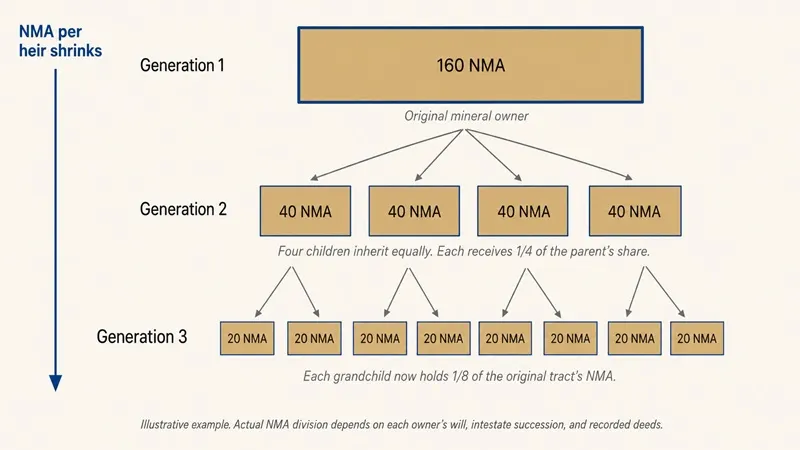
This division across generations is the most common reason mineral owners discover their NMA is far smaller than the gross acreage of the original family tract.
How NMA Appears in Documents and Offers
Deeds and conveyances.
Your NMA is established in the deed that conveyed your mineral interest. It may be expressed as a fraction ("an undivided 1/4 interest in and to all the oil, gas and other minerals") or as a decimal ("0.25000 interest"). The gross acreage of the tract is stated separately. Multiplying the two gives your NMA.
Division orders.
When a well begins producing, the operator prepares a division order, a document that establishes each owner's decimal interest for royalty payment purposes. Your decimal interest on a division order is derived from your NMA, the lease royalty rate, and the tract participation factor. If you know your NMA and your royalty rate, you can verify your division order decimal independently.
Purchase offers.
When a mineral buyer or operator makes an offer to purchase your minerals, they typically price it per net mineral acre, for example, $3,000 per NMA. If you own 40 NMA and the offer is $3,000 per NMA, the total offer is $120,000. Without knowing your NMA precisely, you cannot evaluate whether the offer is reasonable or compare it against market benchmarks for your area.
NMA vs Net Royalty Acres
Net mineral acres (NMA) and net royalty acres (NRA) are related but measure different things. Understanding the distinction is important when you encounter both terms in documents or offers.
Net mineral acres (NMA) measures your ownership of the mineral estate itself, before any lease royalty rate is applied. It is the size of what you own in the ground.
Net royalty acres (NRA) takes your NMA and applies the lease royalty rate to express your effective royalty interest as an acreage figure. The formula is:
Net Royalty Acres = Net Mineral Acres × Lease Royalty Rate
Example: 40 NMA on a lease with a 1/4 (25%) royalty rate = 10 net royalty acres (NRA).
NRA is most commonly used when comparing mineral interests across leases with different royalty rates, it allows apples-to-apples comparison. NMA is the more fundamental measure and the one that applies before any lease exists.
Why Mineral Owners Should Care
Every royalty payment traces back to your NMA.
Your monthly royalty check is calculated from your decimal interest on the division order, and that decimal is derived from your NMA and royalty rate. If your NMA is wrong in the title records or misapplied by the operator, every royalty payment you receive will be wrong. Knowing your NMA and verifying your division order decimal are the two most direct ways to confirm you are being paid correctly.
Offers are priced per NMA, and the difference matters.
A $2,000/NMA offer on a property you thought was 160 NMA but is actually 40 NMA is worth $80,000, not $320,000. NMA precision matters in every financial decision involving your minerals. For owners evaluating whether to hold or sell, Mineral View's MVestimate shows a six-year royalty income forecast based on your lease's production data, giving you a data-backed benchmark to compare against any offer you receive.
NMA is what the Portfolio tracks.
When you claim leases in Mineral View and enter your decimal interest, the platform uses that information to calculate your personal share of production and reserves, not the lease total. Mineral View's Portfolio aggregates this across all claimed leases, showing your combined production, personal reserves, and revenue forecasts at the ownership level that actually applies to you.
Heirship reduces NMA, and most heirs don't know by how much.
Inherited mineral interests are typically smaller than the original family tract suggests. Tracing the full chain of title from the original deed to your current ownership is the only reliable way to confirm your NMA. County deed records are the source.
Where NMA Appears in the Lease Lifecycle
1. Before Leasing
NMA establishes what you own before any lease is signed. An operator approaching you for a lease offer will calculate your NMA from title research. Knowing it yourself before negotiations begin means you can verify their calculation and evaluate the bonus offer on a per-NMA basis.
2. Lease Signing
The lease is signed covering your interest in the tract. Your NMA and the royalty rate you negotiate become the inputs to your decimal interest. A higher royalty rate on the same NMA produces a higher decimal and higher royalty payments.
3. Division Order
When production begins, the operator sends a division order establishing your decimal interest. This decimal is calculated from your NMA, the royalty rate, and any tract participation factors for pooled units. Reviewing the division order against your known NMA is how you verify the operator has applied your ownership correctly.
4. Royalty Payments
Monthly royalty = gross production revenue × your decimal interest. Your decimal traces directly to your NMA. Every payment for the life of the well reflects the NMA established at the title level.
5. Purchase Offers
If you receive an offer to buy your minerals, the per-NMA price is the key metric. Market rates vary significantly by county, formation, and production activity. Knowing your NMA precisely is the first step in evaluating any offer.
6. Estate Planning and Transfer
If you pass your minerals to heirs, your NMA is divided according to your will or intestate succession rules. Each heir's NMA decreases proportionally. Documenting NMA clearly in estate planning prevents the ambiguity that causes title disputes in later generations.
A Real-World Scenario
Three siblings inherited mineral rights from their mother in Karnes County, Texas. Their mother's deed showed she owned an undivided 1/2 interest in a 240-acre tract, 120 NMA.
When she passed, her interest was divided equally among the three children. Each inherited 1/3 of their mother's 1/2 interest, a mineral fraction of 1/6 of the full tract.
Each sibling's NMA: 240 × 1/6 = 40 NMA.
When an operator approached one sibling with a lease offer at $1,800 per NMA, that sibling knew the offer was worth $72,000, not the $216,000 they would have assumed if they thought they owned 120 NMA.
The other two siblings owned identical interests and received identical offers. Knowing their NMA made the difference between evaluating the offer accurately and making a misinformed decision.
What to Check
Find your mineral fraction in the original deed.
Your NMA starts with your deed. Look for language describing your share of the mineral estate, "an undivided 1/4 interest," "0.12500 interest," or similar. The gross acreage of the tract is usually stated in the property description. Multiply the two to get your NMA. If the deed is unclear or involves multiple conveyances, tracing the full chain of title at the county clerk's office will establish your current fraction.
Verify your division order decimal independently.
Once you know your NMA and lease royalty rate, you can calculate what your division order decimal should be. If the decimal the operator assigned does not match your calculation, that discrepancy is worth investigating before you sign the division order.
Track your NMA across all leases in one place.
If you own mineral interests across multiple tracts, managing each individually is difficult. Mineral View's Portfolio allows you to enter your decimal interest for each claimed lease and tracks your combined production, personal reserves, and revenue estimates across your entire mineral estate, at your ownership level, not the lease total.
Important
Mineral View can help you understand production data, royalty context, and operator activity for your minerals. For questions about confirming your mineral ownership fraction, reviewing deed language, or resolving title disputes, consult a qualified landman or Texas oil and gas attorney.
Common Questions
Your mineral ownership fraction is established in your deed or chain of title, the recorded documents at the county clerk's office where the land is located. The deed that conveyed your interest to you will describe your fractional share of the mineral estate.
If your minerals came through inheritance, you may need to trace multiple generations of deeds and estate records to determine the current fraction. A landman or title attorney can perform a title runsheet to establish your current NMA precisely.
Your NMA can change through voluntary transfers, if you sell or give a portion of your interest, your NMA decreases. It can also change through estate distribution if you inherit additional interests.
NMA does not change simply because a lease expires, a well is drilled, or production volumes change. The physical ownership of the mineral estate is separate from the lease or production activity on it.
Pricing per NMA is the standard because it creates a comparable unit across different tracts, counties, and ownership fractions. A buyer evaluating mineral interests across multiple counties can compare $2,500/NMA in Midland County against $1,800/NMA in Karnes County on the same basis.
The per-NMA price captures both the value of the land and the production activity in the area, condensed into a single metric that works regardless of tract size or ownership fraction.