Natural Gas Liquids (NGL)
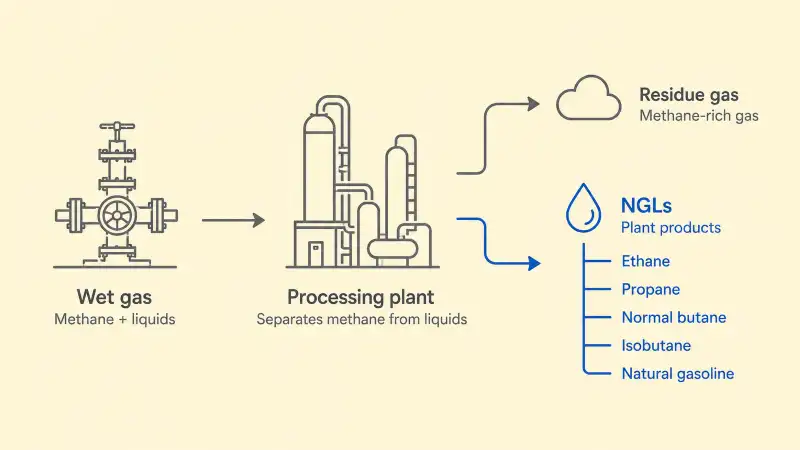
Natural gas liquids, or NGLs, are the heavier hydrocarbons separated from wet natural gas at a processing plant and sold as distinct liquid products: ethane, propane, butane, isobutane, and natural gasoline.
For a mineral owner, NGLs matter because they appear as a separate revenue line on your royalty statement and can add meaningful income on a wet gas lease — though that revenue often carries larger deductions than your oil or gas lines.
What This Means for Mineral Owners
NGLs are most relevant to you if your minerals sit in a wet gas area, where the produced gas is rich in heavier hydrocarbons. The wet gas windows of the Permian Basin and the Eagle Ford produce gas rich in NGLs, while Haynesville areas commonly produce dry-gas-focused revenue with limited NGL value. Both the Permian and the Eagle Ford also contain drier windows, so the specific location of your minerals, not just the basin name, determines whether NGLs apply to you.
When NGLs do apply to your lease, they typically appear on your statement under a line labeled something like "Plant Products," "NGL," "Products," or occasionally broken out by individual components. Many owners see this line, do not recognize it, and wonder whether it is an extra payment or an error. It is neither. It is the revenue from the liquids that were pulled out of your gas at the plant.
NGL revenue can carry significant post-production deductions because the gas may need to be gathered, compressed, processed, and the liquids fractionated and transported before products are sold. Depending on your lease language, some of those costs may be passed through to you.
NGL is not the same thing as condensate. The two are both liquids and are easy to confuse, but they are separated at different points in the process and can appear differently on your statement.
How NGLs Work
Gas does not always come out of the ground as the clean, dry methane that gets sold to homes and power plants. In many Texas formations the gas is "wet," meaning it carries heavier hydrocarbon molecules along with the methane.
That mixed stream is sent to a gas processing plant. The plant does two jobs. First, it separates the methane-rich residue gas, which may be reported in MCF and priced or adjusted based on MMBtu heat content. Second, it captures the heavier components and turns them into liquids. Those liquids are the NGLs. They are then usually fractionated - split into their individual products - each of which is sold into its own market.
The five NGL products
A barrel of NGLs is a blend of distinct products, and each one is priced separately:
- Ethane - the lightest, used mainly as a petrochemical feedstock. When ethane prices are low, operators sometimes leave it in the gas stream instead of extracting it, a practice called ethane rejection.
- Propane - widely used for heating and fuel. Its price often tracks closer to oil than to natural gas.
- Normal butane - used in fuel blending and as a refining and petrochemical input.
- Isobutane - used mainly in refining, including alkylation to make higher-octane gasoline.
- Natural gasoline (pentanes plus) - one of the heavier NGL product groups, commonly used as a blendstock.
Because each product has its own market, the value of your NGL revenue depends on the specific mix your gas produces, not just the total volume.
A worked example
The numbers below are illustrative, but they show the shape of what happens.
Suppose a lease produces 10,000 MCF of wet gas in a month. After processing, that might separate into roughly 7,500 MCF of residue gas and about 150 barrels of NGLs, although actual shrinkage and NGL yield vary by gas composition, plant recovery, ethane rejection, processing contracts, pressure, and measurement method. On the royalty statement, the owner would then see two related lines: one for the residue gas priced per MCF, and one for the NGL barrels priced separately. The NGL line may also show its own deductions for processing, fractionation, transportation, or related post-production costs, depending on the lease, operator, processor, payor, and statement format. The two production streams came from the same gas, but they are measured, priced, and deducted separately.
NGL vs Condensate vs Residue Gas: What Each One Is
These three terms travel together on wet gas leases and are easy to mix up.
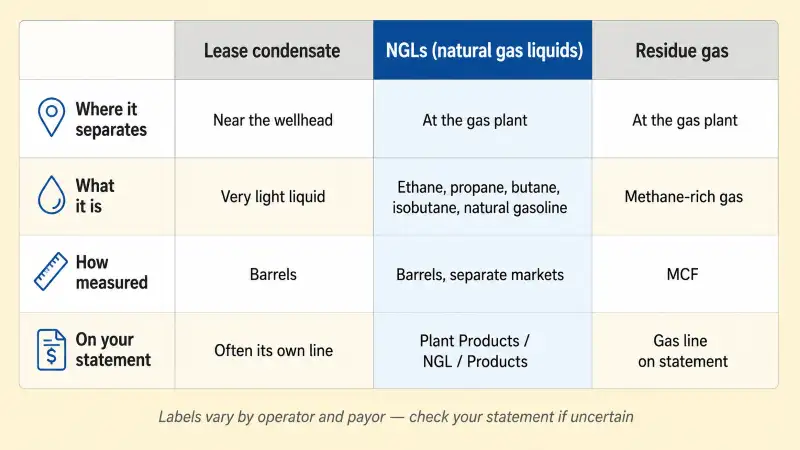
- NGLs are separated out at a processing plant, downstream from your well. They start as part of the gas stream and become liquid through processing.
- Lease condensate is a very light liquid that can drop out of the gas at the wellhead or lease separator because of changes in pressure and temperature as the gas comes to the surface. It is often sold much like oil and may appear on its own statement line. It is different from plant-separated NGLs, although product labels can vary by payor and should be checked against the statement code or explanation.
- Residue gas is the methane-rich gas that remains after NGLs and certain other components are removed. It is commonly sold as natural gas, and the gas volume on your statement after processing may look lower than the raw produced-gas volume because liquids and shrinkage have been removed.
Lease condensate generally separates at or near the lease, NGLs are commonly separated at the processing plant, and residue gas is the methane-rich gas left to sell as natural gas.
How NGLs Affect Your Royalty Income
On a wet gas lease, NGLs can be a real part of your income rather than a rounding line. Ignoring the NGL line can cause you to understate what your minerals actually generate.
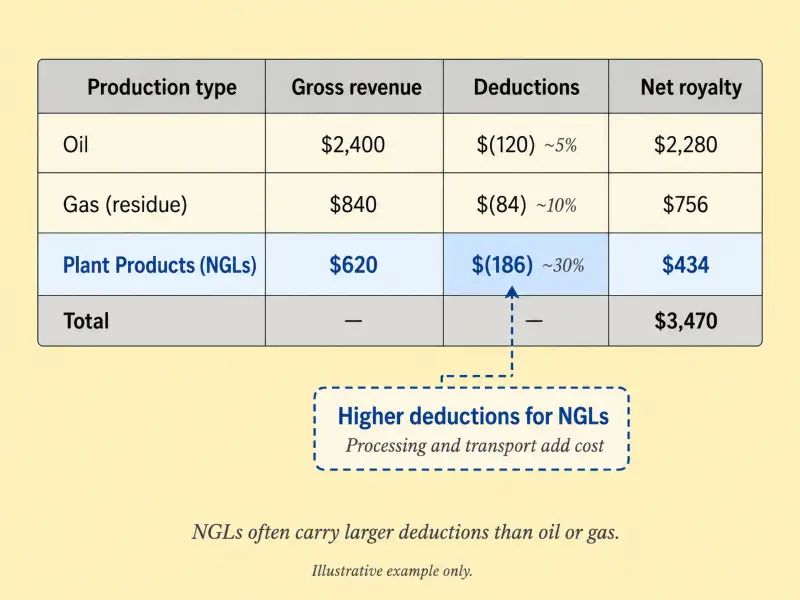
At the same time, NGL revenue can show proportionally large deductions. Getting liquids to market may involve gathering, compression, processing, fractionation, and transport. Depending on your lease language and applicable Texas law, some of those post-production costs may be charged against your share. Two leases producing identical NGL volumes can pay their owners differently based entirely on whether and how those costs can be deducted.
A few other things move your NGL revenue. The type of gas processing arrangement matters because it sets how much of the liquid's value reaches you. Under a percentage-of-proceeds arrangement, you and the processor share the liquids revenue on a set split. Under a keep-whole arrangement, the processor returns value tied to the gas it used to extract the liquids. The same NGL volume can produce different net revenue depending on which arrangement governs your gas.
NGLs are measured in barrels and are often priced as a percentage of the crude oil benchmark (WTI) rather than tracking natural gas. Because each product also trades in its own market, your NGL income can swing month to month even when your production volume holds steady. Ethane rejection, mentioned earlier, can also change the reported NGL volume from one period to the next.
For owners who want to see how production volumes translate into projected income over time, Mineral View's MVestimate models royalty income using production data and price assumptions, which is one way to put the NGL portion of a wet gas lease into context against the oil and gas streams.
A Real-World Scenario
Example: Marcus's Eagle Ford lease in Karnes County
Marcus inherited mineral rights on a tract in Karnes County, Texas, in the wet gas window of the Eagle Ford. His lease produces gas along with a healthy volume of liquids.
When his royalty statements began arriving, Marcus understood the oil and the gas lines, but a third line labeled "Plant Products" confused him. He assumed at first that it might be a mistake. After looking into it, he learned that the line was his share of the NGL revenue from propane, butane, and other liquids separated from his gas at the processing plant. In some months that line represented a noticeable share of his total royalty income.
Marcus also noticed that the deductions against the Plant Products line were larger, in percentage terms, than the deductions against his other lines. That reflected the extra steps required to process and move the liquids to market. His cousin, who owns dry gas minerals in the Haynesville Shale area, had no such line on her statements because her gas produced little or no meaningful liquids value. Understanding the difference helped Marcus read his own statement with more confidence and ask better questions when a number looked off.
Note: This example is provided for illustrative purposes only and does not represent any specific mineral owner or lease.
What to Check
Track your NGL revenue and deductions over time
If your minerals produce wet gas, the NGL line is worth watching alongside your oil and gas lines, both for the revenue it adds and for the deductions it carries. A long-term view makes it easier to spot when something changes. Mineral View's Monthly Report summarizes production and revenue trends across your minerals over a rolling window, which helps you see how the NGL portion behaves month to month rather than statement by statement.
Review your lease's post-production cost language
Whether NGL processing and transport costs can be deducted from your share depends heavily on the wording of your lease and how Texas courts interpret it.
Royalty valued "at the well" generally allows post-production costs such as processing and transport to be subtracted before your share is calculated, while language that values royalty "in the pipeline," "at the point of sale," or as "cost-free" may limit or prevent those deductions.
This is one of the more contested areas of royalty accounting in Texas, so if your NGL deductions look large or have changed, the exact royalty-valuation wording in your lease is the place to start.
Know whether your area produces NGLs at all
Wet gas areas commonly produce meaningful NGL value, while dry gas areas generally produce little or no separate NGL value. Knowing which side your minerals fall on tells you whether an NGL line should appear on your statement in the first place, and whether its absence is normal or worth a question.
Important
Mineral View can help you understand combined production, revenue trends, and operator activity for your minerals. For questions about post-production deductions, your specific lease language, or whether your NGL revenue is being calculated correctly, consult a qualified landman or Texas oil and gas attorney.
Common Questions
Because the liquids in your gas are separated out at a processing plant and sold as their own products, distinct from the residue gas. Your statement reports the residue gas and the NGLs separately because they are measured and priced separately. The Plant Products or NGL line is your share of the revenue from those liquids. It is not an extra or duplicate payment.
NGLs require more steps to reach the market than raw gas does, including gathering, processing, fractionation, and transport. Those steps cost money, and depending on your lease language some of that cost may be charged against your share as a post-production deduction. This is why the NGL line may show proportionally larger deductions than the oil line. How much of that cost actually reaches you depends on your lease's royalty-valuation language and on the processing arrangement (such as percentage-of-proceeds or keep-whole) that governs your gas. Whether those deductions are proper under your lease is a question for a qualified professional to review.
Not necessarily. If your minerals are in a dry gas area, the gas usually produces little or no meaningful liquids value, so there may be no separate NGL line to report. The absence of NGLs is normal for dry gas. If you believe your area produces wet gas and you still see no NGL line, that would be a reasonable thing to ask your operator about.