Dry Natural Gas
Dry natural gas is natural gas that is almost entirely methane, with very few natural gas liquids such as ethane, propane, or butane mixed in. Because it contains very few recoverable liquids, dry gas usually needs less liquids processing than wet gas before it can be treated, conditioned, and moved through pipelines.
If your minerals sit over a dry gas formation, your royalty income comes almost entirely from the methane your wells produce, measured in MCF and valued by its heat content. There are few or no natural gas liquids to add separate value to your check, which often makes dry gas royalty income simpler to read and sometimes lower per MCF than wet gas income, depending on volume, gas price, heat content, deductions, and lease terms.
What This Means for Mineral Owners
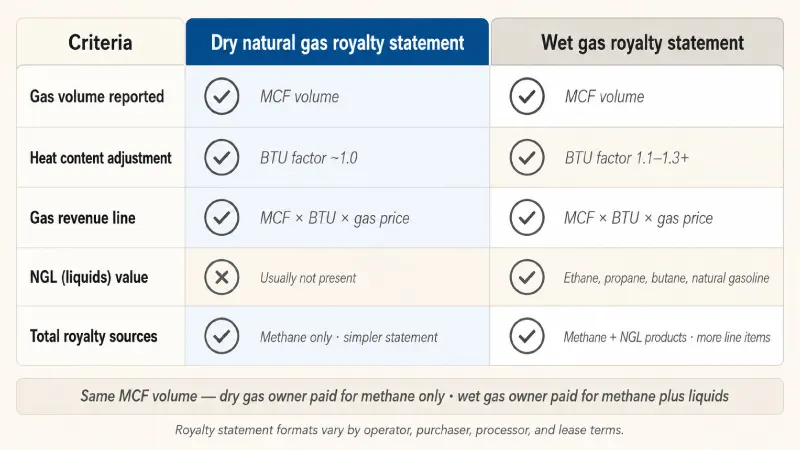
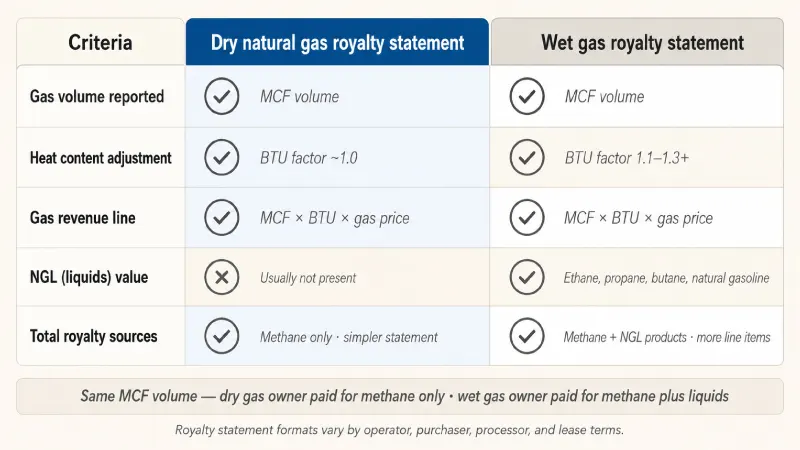
Whether your gas is dry or wet shapes what your royalty check looks like. If your minerals produce dry gas, your statement will be relatively simple: volume in MCF, a heat-content adjustment, a gas price, and your royalty share. Dry gas statements generally do not show separate natural gas liquids line items because there are few liquids to sell, although royalty-statement formats can vary by operator, purchaser, processor, and lease terms.
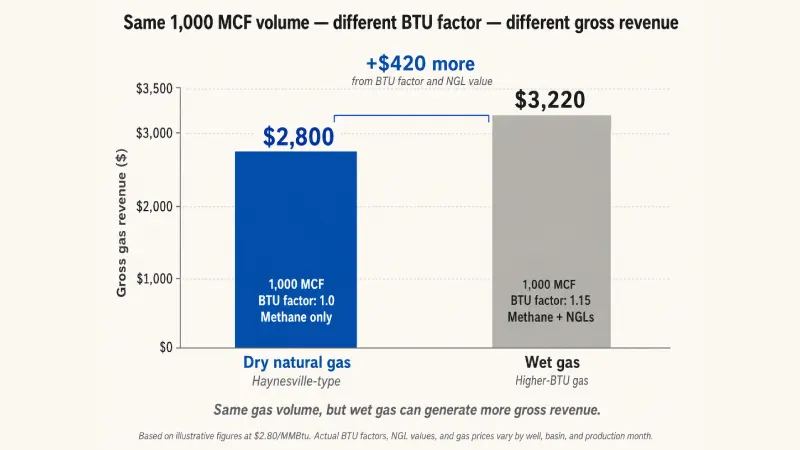
If your minerals produce wet gas, your statement may include additional value from natural gas liquids, which can meaningfully increase your total royalty. This is why two mineral owners producing the same MCF volume can receive very different checks: the wet gas owner gets paid for the methane plus the liquids, while the dry gas owner gets paid for the methane alone.
Key point for mineral owners
Knowing which type of gas your wells produce helps you understand your check, verify you are being paid for everything your gas contains, and set realistic expectations for your royalty income.
What Makes Gas "Dry"
Natural gas comes out of the ground as a mixture. The mixture is mostly methane, the lightest and most abundant hydrocarbon, but it can also contain heavier hydrocarbons called natural gas liquids (NGLs), such as ethane, propane, butane, and natural gasoline.
The industry often describes gas by how much recoverable liquid content it contains. A common practical measure is how many gallons of liquids can be recovered per thousand cubic feet, or MCF, of gas.
- Dry gas contains very few recoverable liquids. It is sometimes called "lean" gas because it is lean in heavier hydrocarbons and usually does not create meaningful separate NGL values.
- Wet gas contains more recoverable liquids. It is often called "rich" or "wet" gas because it includes heavier hydrocarbons that may be extracted and sold as natural gas liquids.
The dividing line is not a single fixed number; it varies by region, gathering system, and how the gas is processed. After treating and conditioning, dry gas is typically sold as pipeline-quality natural gas. The practical point for a mineral owner is whether your gas carries enough liquids to generate separate NGL value on your royalty statement.
Dry Gas vs Wet Gas: What It Means for Your Check
The difference between dry and wet gas shows up directly in royalty income.
Dry gas income
Dry gas income comes from one source: the methane-rich gas stream, sold by volume and adjusted for heat content. A dry gas royalty statement is usually simpler to read than a wet gas statement, although statement formats vary.
Wet gas income
Wet gas income comes from two sources: the methane-rich gas stream plus the natural gas liquids extracted during processing, which may be sold as products such as ethane, propane, butane, and natural gasoline. A wet gas statement may show separate value for these products, depending on the lease, purchaser, processor, and statement format.
This is why gas richness matters to your bottom line. The same volume of wet gas can often be worth more than the same volume of dry gas because wet gas may carry additional saleable products, although the final royalty value also depends on market prices, processing costs, deductions, and lease terms. MMBtu covers how heat content affects gas pricing, and the difference in heat content between dry and wet gas is one reason wet gas can command a higher value per MCF.
To understand the full picture
For a complete explanation of how your gas volume converts to royalty dollars, see the MMBtu and MCF glossary pages, which explain how volume and energy content combine to determine your gas royalty.
Dry Gas Plays in Texas and Beyond
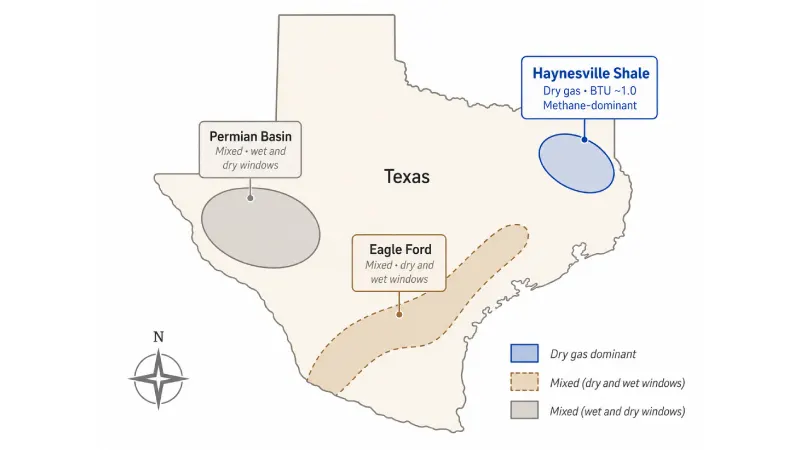
Texas is home to one of the largest dry gas plays in the country, alongside several wet gas and mixed plays.
Haynesville Shale (East Texas and Louisiana)
The Haynesville is a premier dry gas play. Wells in the Haynesville produce gas that is overwhelmingly methane, with a BTU factor close to 1.0, meaning one MCF of Haynesville gas contains roughly one MMBtu of energy. Mineral owners in the Haynesville typically see dry gas royalty statements: methane volume, heat-content adjustment, price, and royalty share, with little or no NGL value.
Eagle Ford and Permian Basin (South and West Texas)
These plays contain both wet gas and dry gas windows depending on depth and location. In the wetter windows, gas carries significant NGLs, and mineral owners may see separate liquids value on their statements. In the drier windows, the gas behaves more like Haynesville dry gas.
Other US dry gas regions
The Marcellus Shale in Appalachia is another major US dry gas region, although it is less directly relevant to most Texas mineral owners.
Key takeaway for Texas mineral owners
The play your minerals sit in tells you a great deal about whether to expect dry or wet gas royalty income. If your minerals are in the Haynesville, expect a dry gas statement. If they are in parts of the Eagle Ford or Permian Basin, you may see NGL value depending on the specific window. Mineral View's Lease Report shows the producing formation for claimed leases, helping you identify which gas type to expect.
A Real-World Scenario
Example: Carol's Haynesville minerals in Harrison County
Carol owns mineral rights on a 120-acre tract in Harrison County, Texas, in the heart of the Haynesville Shale. Her grandfather acquired the minerals decades ago, and the family began receiving royalty income after a horizontal well was completed on the lease in 2021.
When Carol first reviewed her royalty statement, she was confused. A friend in the Eagle Ford had told her about the natural gas liquids value on his statement, but Carol's statement had no such line items. She wondered whether she was being underpaid.
After reviewing the statement and the formation her minerals produced from, Carol learned that her gas was dry Haynesville gas, almost pure methane, with a BTU factor near 1.0. There were no significant natural gas liquids to extract and sell, so she would not normally expect separate NGL value on her royalty statement. Her statement was correct; it simply reflected dry gas production.
Understanding the difference between dry and wet gas turned Carol's confusion into confidence. She knew her statement was complete, and she set her royalty expectations based on methane volume and gas prices rather than expecting liquids value her gas did not contain.
What to Check
Identify which formation your minerals produce from
The producing formation and the specific location within the play are strong indicators of whether your gas is dry or wet. If you do not know your producing formation, your royalty statement, your lease, or Mineral View's Lease Report can help identify it. Knowing the formation sets your expectations for what your statement should show.
Check whether your statement includes natural gas liquids value
- If you produce wet gas, your statement may show separate value for NGLs.
- If you produce dry gas, your statement generally will not show separate NGL value, although royalty-statement formats can vary.
- If you believe your gas is wet but see no NGL value on your statement, that is worth asking your operator about.
- If your gas is dry, the absence of NGL value is normal and expected.
Understand your gas's heat content (BTU factor)
Dry gas often has a BTU factor close to 1.0, while wet gas can have a higher BTU factor because it contains heavier hydrocarbons. Your royalty statement should show the BTU factor used to convert your MCF volume into MMBtu for pricing. The MMBtu glossary page explains how to read and verify this figure.
Important
Mineral View can help you understand gas production, formation data, and royalty context for your minerals. For questions about whether your royalty statement correctly reflects your gas type, or about natural gas liquids you believe should be valued separately, consult a qualified landman or Texas oil and gas attorney.
Common Questions
The producing formation is the best indicator. Dry gas plays like the Haynesville generally produce methane-rich gas with limited liquids, while wetter plays and windows produce gas with more natural gas liquids. Your royalty statement offers another clue: if it shows separate value for natural gas liquids, your gas is likely wet; if it shows only gas volume, heat-content adjustment, and gas value, your gas may be dry or lean. Your operator or a landman can confirm the gas type for your specific well.
Per unit of volume, dry gas often generates less royalty income than wet gas because wet gas may carry additional saleable natural gas liquids. However, dry gas is cheaper to process and easier to transport, and dry gas plays like the Haynesville can produce very high volumes. The total value depends on volume, gas prices, and the specific economics of your well, not just the gas type.
If your minerals produce dry gas, there are usually few or no natural gas liquids to extract and sell separately, so your statement may not show separate NGL value. Statement formats can vary by operator, purchaser, processor, and lease terms. This is normal for dry gas production. If you believe your gas should contain liquids based on your formation, it is worth confirming the gas type with your operator.