MCFE (Thousand Cubic Feet Equivalent)
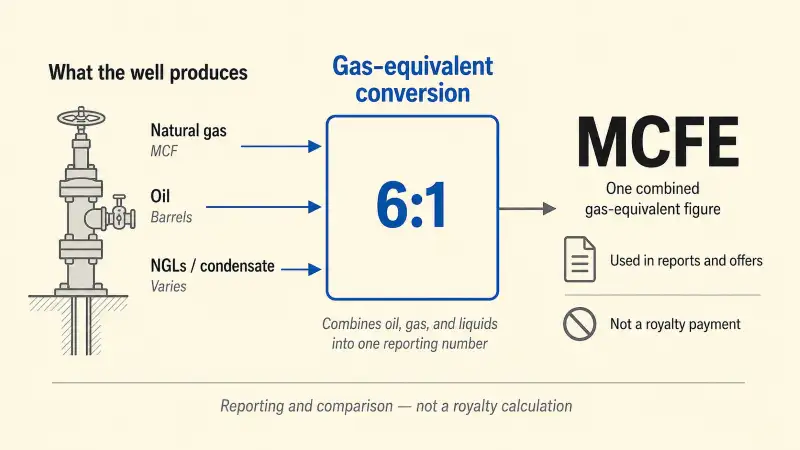
MCFE is a gas-equivalent reporting unit used by exploration and production companies, analysts, and reserve evaluators to summarize combined oil, gas, and sometimes liquids production in a single natural-gas-based measure.
It stands for thousand cubic feet equivalent, meaning production is expressed as the energy equivalent of one thousand cubic feet of natural gas.
For a mineral owner, MCFE may appear in:
- Production summaries
- Reserve reports
- Valuation documents
- Investor-style reports
- Mineral purchase offer materials
It is a reporting unit, not a cash-payment figure. Your royalty is still based on the actual products sold, such as oil, gas, and NGLs.
What This Means for Mineral Owners
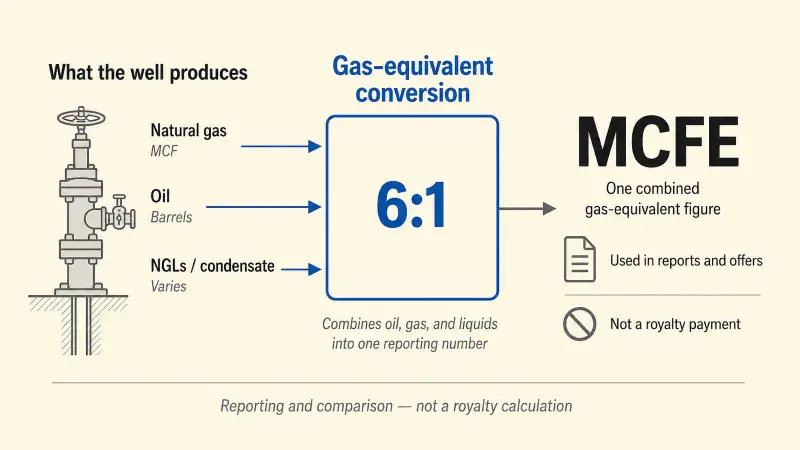
MCFE is a reporting and comparison tool, not a royalty-payment method. Operators, analysts, and reserve evaluators use it to convert a well's, lease's, or portfolio's production into one gas-equivalent number, which makes it easier to compare assets that produce different mixes of oil, gas, and liquids. You are most likely to encounter MCFE if your minerals are in a gas-weighted area, or if you are reading a reserve report, an investor-style summary, or an offer document.
It helps to know up front that MCFE is the gas-equivalent counterpart to BOE. BOE expresses combined production in barrels of oil equivalent, while MCFE expresses combined production in thousand cubic feet of natural gas equivalent. When the same products and conversion assumptions are used, they describe the same production in different equivalent units, and they can usually be converted using the common 6 MCF to 1 barrel energy-equivalence ratio.
MCFE measures energy-equivalent production, not money, revenue, or royalty value. The six-to-one ratio is about energy content, not price: six MCF of gas and one barrel of oil hold similar energy, but the barrel has often sold for several times more in dollars. That is why the oil, gas, and liquids mix behind an MCFE figure can matter as much as the total, and often more when estimating value.
You are generally not paid directly based on MCFE. Your royalty check is generally calculated from the actual products sold, such as barrels of oil, MCF or MMBtu-adjusted gas, and NGL or condensate volumes, each with its own price, deductions, taxes, and lease terms. MCFE is a summary figure layered on top of those product lines, used mainly for reporting, comparison, reserves, and valuation rather than direct royalty payment.
How MCFE Works
Many wells produce more than one product, such as oil, natural gas, NGLs, or condensate. Because oil is measured in barrels and gas is measured in MCF or MMBtu, it can be difficult to summarize total production across products in one number. MCFE solves that by converting everything into a common gas unit.
The six-to-one conversion
MCFE uses the same common energy-equivalence convention as BOE, applied in the opposite direction: one barrel of oil is commonly treated as roughly equal to six MCF of natural gas on an energy basis. For why the ratio is six-to-one and how it derives from BTU heating values, see the BOE page. Applied to MCFE, the mechanic is:
- One MCF of natural gas equals one MCFE before any heat-content or reporting adjustments.
- One barrel of oil is commonly converted to about six MCFE under the standard 6:1 energy-equivalence convention.
- NGL and condensate volumes may also be included in equivalent production, but the conversion method can vary by operator, report, reserve evaluator, product mix, and disclosure method.
Total MCFE is commonly calculated as gas volume in MCF, plus oil barrels multiplied by six, plus any included liquids converted according to the report's stated methodology.
A worked example
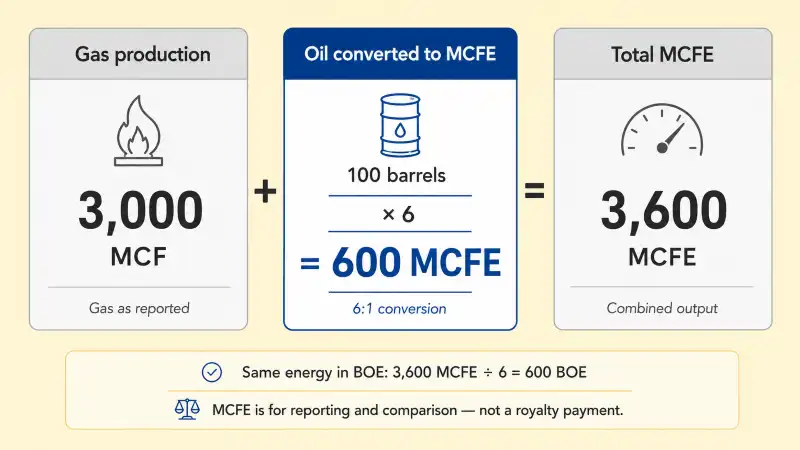
Suppose a well produces 3,000 MCF of natural gas and 100 barrels of oil in a month, and the report uses the common 6:1 conversion. Converting the oil to a gas-equivalent basis gives 100 barrels times 6, or 600 MCFE. Adding that to the 3,000 MCF of gas gives a total of 3,600 MCFE.
Using the same 6:1 conversion, the same production expressed as BOE would be 600 BOE, because 3,600 MCFE divided by 6 equals 600 BOE. BOE and MCFE can represent the same total energy-equivalent production shown in different units, as long as the same products and conversion assumptions are used.
MCFE vs BOE vs MCF
These three look alike and are easy to mix up, but they answer different questions.
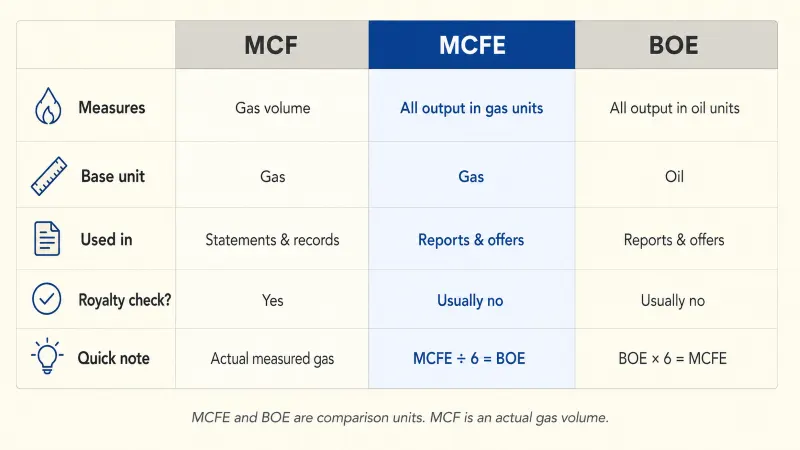
- MCF is a measured volume of natural gas only. It does not include oil or liquids. It may be one of the quantities used in payment, but actual gas revenue can also depend on MMBtu heat content, realized price, deductions, taxes, and lease terms.
- MCFE combines production into a single gas-equivalent figure, commonly converting oil at six MCFE per barrel and converting included liquids according to the report's methodology. It is a summary number, not a raw measured volume of gas.
- BOE combines production into a single oil-equivalent figure, using the same energy-equivalence concept in the opposite direction. BOE equals MCFE divided by six.
In short, MCF is a measured gas-volume unit, while MCFE and BOE are equivalent-production units used to summarize total energy across products.
Why MCFE Is Useful and Where It Can Mislead
The usefulness of MCFE is that it gives one number to compare wells or leases with different product mixes. A gas-weighted operator may report in MCFE because it expresses gas-heavy production in a natural scale, while an oil-weighted operator may prefer BOE for the same reason. Both can describe the same production from different equivalent-unit perspectives, so the unit an operator chooses may give a clue about whether the asset is gas-heavy or oil-heavy.
Like BOE, MCFE measures energy-equivalent production, not money, so the oil, gas, and liquids mix behind the figure is essential when estimating value. The MCFE-specific risk is that, in a reserve report or purchase offer, a large gas-weighted MCFE figure can look impressive even when the revenue value behind it is lower than the headline number suggests.
To understand what production may be worth rather than only how much energy it represents, Mineral View's MVestimate models royalty income using production volumes and product-specific price assumptions.
A Real-World Scenario
Example: Robert reviewing a purchase offer in Reeves County
Robert was reviewing a purchase offer for his mineral interest in Reeves County, Texas. The offer materials described the reserves behind his minerals as a figure in MCFE, and the number looked large, which made the offer feel generous.
Before responding, Robert looked more closely and asked what share of that MCFE total was oil and what share was gas. It turned out the production was more gas-weighted than he had assumed.
Because oil has often carried a higher value per energy-equivalent unit than natural gas, the gas-heavy mix meant the estimated revenue behind that large MCFE number could be lower than the headline figure suggested. Understanding that MCFE measured energy-equivalent production rather than money helped Robert evaluate the offer on the right basis and ask better questions before deciding.
Note: This example is provided for illustrative purposes only and does not represent any specific mineral owner or lease.
What to Check
Find the oil and gas split behind the MCFE number
Whenever MCFE appears in a report or offer, the product mix matters as much as the total, and sometimes more when estimating value. Ask two things: how much of the figure comes from oil, gas, NGLs, or condensate, and what conversion basis was used to build it, since a figure based on something other than the standard 6:1 energy ratio can change the headline number. Both the product mix and the conversion method strongly affect what the figure is worth. Mineral View's Lease Report shows production broken down by product for a lease, which is one way to see the actual oil, gas, and liquids behind a single equivalent figure.
Treat MCFE as energy, not revenue
A larger MCFE figure means more energy-equivalent production, not necessarily more royalty value. Keep that distinction in mind when a sales pitch or summary leads with an MCFE total, especially for gas-weighted production.
Do not expect MCFE on your royalty check
Your monthly royalty statement generally pays you on the actual products sold, not on a combined MCFE figure. If you are trying to reconcile your check, work from the actual oil, gas, NGL, and condensate lines rather than an equivalent total.
Important
Mineral View can help you see production by product, revenue trends, and projected income for your minerals. For questions about how a reserve figure or an offer expressed in MCFE translates into value, consult a qualified landman, Texas oil and gas attorney, or a mineral appraisal professional.
Common Questions
No. MCF is an actual measured volume of natural gas. MCFE is a combined figure that converts oil and liquids into gas-equivalent units and adds them to the gas. On a pure gas well with no oil, NGLs, or condensate, the two numbers may be the same or very close. On a well that also produces oil or liquids, the MCFE figure will usually be larger than the MCF figure because those products have been converted and added in.
Not necessarily. A larger MCFE total means more energy-equivalent production, not automatically more money, and a gas-weighted total can be worth less than a smaller oil-weighted one depending on prices, deductions, product mix, and lease terms. The practical step is to ask what share of the figure comes from oil, gas, NGLs, or condensate, and what conversion basis was used, before treating a big number as a big payday.
No. Your royalty is calculated on the actual products sold, such as oil by the barrel, gas by MCF or MMBtu-adjusted value, and NGLs or condensate by their own volumes, each with its own price, deductions, taxes, and lease terms. MCFE sits on top of those product lines as a reporting and comparison figure, common in reserve estimates, valuation documents, investor summaries, and offer materials. If you are reconciling a royalty check, work from the actual product lines rather than any MCFE total.