Lease Bonus
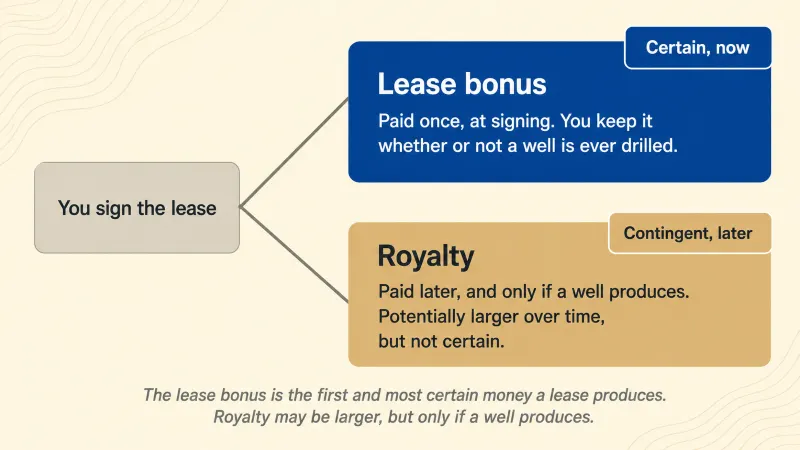
A lease bonus is a one-time upfront payment a mineral owner receives for signing an oil and gas lease. It is usually paid per net mineral acre.
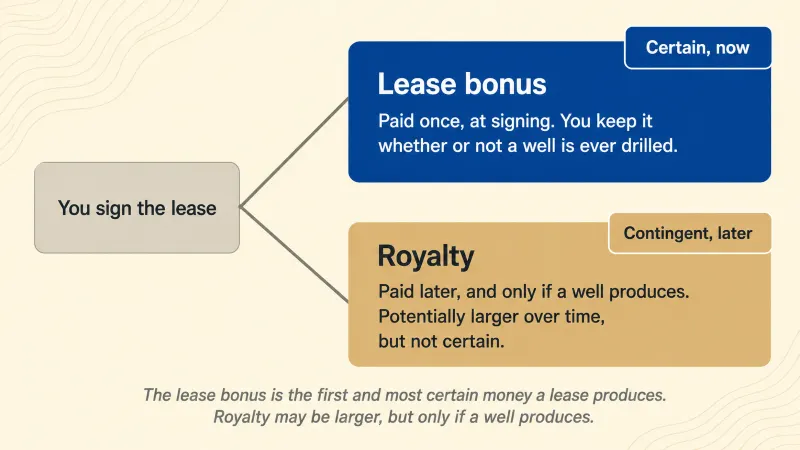
Once it is properly paid, you generally keep it whether or not a well is ever drilled, which is what sets it apart from royalty income that only arrives if a well produces.
What This Means for Mineral Owners
The lease bonus is usually the first money you see from a lease, and once it is actually paid, it is more certain than future royalty income. You receive it for signing, and once properly paid, you generally keep it regardless of whether the operator ever drills. If no well is ever completed and no other lease payments apply, the bonus may turn out to be the only income the lease ever produces.
That certainty is a key reason the bonus and the royalty are usually in tension. An operator often has a set budget for a lease, so pushing the bonus higher can put pressure on the royalty rate or other lease terms. The real decision is rarely just "how big is the bonus," but "how should I balance money now against potentially larger royalty income later, along with the rest of the lease terms."
Once the bonus is properly paid, you generally keep it whether or not a well is drilled. Because it is generally not contingent on production, it may be your only income if nothing is ever produced and no other lease payments apply. The bonus and royalty are also often traded off, and other lease terms can matter just as much: a higher bonus may come with a lower royalty rate, and a higher royalty with a lower bonus, so you generally cannot push both to the highest level at the same time.
How a Lease Bonus Works
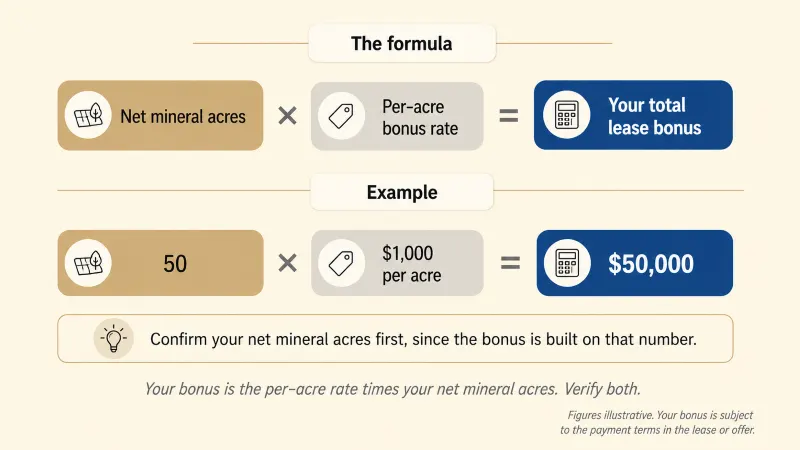
A lease bonus is almost always quoted as a dollar amount per net mineral acre. Your total bonus is that per-acre rate multiplied by your net mineral acres.
How the bonus is calculated
If an operator offers $1,000 per net mineral acre and you own 50 net mineral acres, your bonus would be $50,000, subject to the payment terms in the lease or offer documents. The more net acres you own and the higher the per-acre rate, the larger the bonus. Because the bonus scales directly with your net mineral acres, confirming how many net mineral acres you actually own is the first step to knowing whether an offer is calculated correctly.
Paid whether or not there is production
This is what sets the bonus apart from the royalty. A royalty only pays you if and when a well produces. The bonus pays you for signing. If the operator never drills, or drills a dry hole, you generally keep the paid bonus, while the royalty may never produce income. Because the bonus is your certain money, owners should make sure the payment terms are clear before releasing a signed lease.
How the bonus fits the lease structure
In many modern Texas leases, the bonus is paid upfront as part of a paid-up lease, meaning the single bonus payment covers the entire primary term unless the lease says otherwise. Older leases sometimes used annual delay rentals instead, paying smaller amounts each year to keep the lease alive before drilling. Knowing which structure your lease uses tells you whether the bonus is the whole upfront story or just part of it.
In most modern paid-up leases the bonus is simply yours to keep, though a few leases may structure a payment as advance or recoverable against future royalty, which is one more reason to confirm what the lease actually says.
The Bonus vs. Royalty Tradeoff
This is the central decision in most lease negotiations, so it is worth seeing the two side by side.
| Lease Bonus | Royalty | |
|---|---|---|
| When paid | Once, at signing | Ongoing, only when producing |
| Depends on production? | No | Yes |
| Certain? | Yes, once properly paid | No, contingent on a producing well |
| Size potential | Fixed and known | Potentially much larger over time |
The tradeoff is real money in both directions. A larger bonus is certain cash in hand now, which matters more if drilling is uncertain or far off. A higher royalty can be worth far more over the life of a producing well, which matters more if development looks likely.
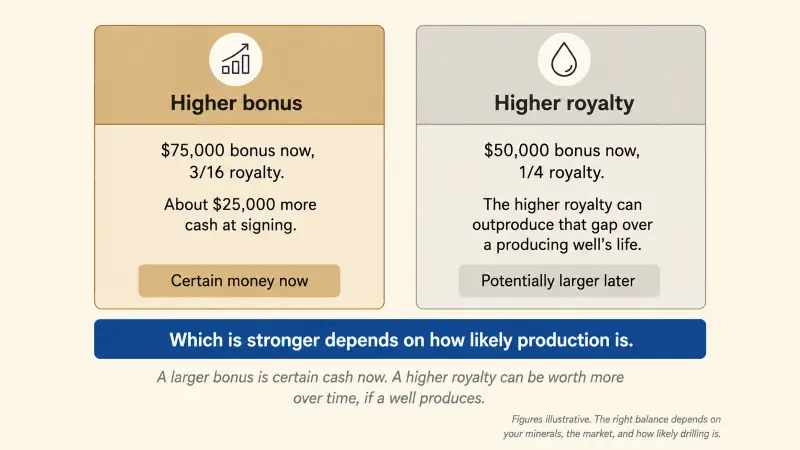
Suppose you own 50 net mineral acres and weigh two offers.
- Offer A is a higher bonus of $1,500 per acre ($75,000) with a 3/16 royalty.
- Offer B is a lower bonus of $1,000 per acre ($50,000) with a 1/4 royalty.
Offer A puts $25,000 more in your pocket at signing. But if a strong well is drilled, the higher royalty in Offer B can outproduce that $25,000 difference over the life of the well, and keep paying for years.
If drilling looks unlikely, Offer A's certain money may be the better bet. Which is stronger depends entirely on how likely production is, which is the judgment the next sections help you make.
To weigh the royalty side of that tradeoff, Mineral View's MVestimate models projected royalty income from production and prices, which gives you a sense of what a higher royalty might be worth over time to set against the certainty of a larger bonus.
Texas Per-Acre Bonus Rates
The most common question owners ask is simply, "Is my per-acre bonus fair?" There is no single answer, because the per-acre rate is market-driven and varies widely by location, how active the play is, competition for leases, and commodity prices. A rate that is normal in one area or year can be well off in another.
The ranges below reflect typical private lease offers by region. For a public reference point, the Texas General Land Office (GLO) holds oil and gas lease sales on state land and publishes bonus-per-acre results. Those public figures generally run lower than private offers, but both show how sharply bonuses vary by region and market cycle.
| Texas Region | Typical Lease Bonus Per Net Mineral Acre |
|---|---|
| Permian Basin (core) | $2,500 – $7,500+ |
| Eagle Ford | ~$500/ac (single data point) |
| Haynesville (East Texas) | $750 – $3,500 |
| Non-core / quieter areas | $150 – $1,000 |
Note: These are approximate market ranges as of 2026 and vary by location, activity, operator demand, and oil and gas prices. Public GLO auction rates run lower than private lease offers, so a fair offer near you may sit above the public benchmark. Always compare against recent activity near your own tract.
Because the rate is market-driven and negotiable, and because your total bonus depends on your net mineral acres, the per-acre number alone does not tell you whether the overall lease offer is strong. What a fair rate looks like for your specific minerals is something a local landman or attorney can help you gauge against current activity in your area.
How to Check Your Bonus Offer
You can sanity-check a bonus offer in three steps, the same way you would verify any figure on a statement.
Step 1: Confirm your net mineral acres
Your bonus is built on this number, so an error here changes everything. Confirm how many net mineral acres you actually own in the tract being leased.
Step 2: Do the math
Multiply your net mineral acres by the offered per-acre rate. That is your gross bonus, subject to the payment terms in the offer. (Example: 50 net mineral acres × $1,000 = $50,000.)
Step 3: Compare the per-acre rate to the market
Weigh the offered per-acre rate against recent activity and public benchmarks like the GLO lease-sale results for your region. A rate far below current market for an active area is worth questioning; a rate in line with the market, paired with strong royalty and lease terms, is a better signal than a high bonus alone.
If the math or the per-acre rate does not look right, that is a reason to ask questions, and often to bring the offer to a landman or attorney, before you sign.
Tax Treatment of a Lease Bonus
A lease bonus is generally treated as ordinary income rather than capital gain, though the treatment should be confirmed with a tax professional. For tax purposes it is often described as advance royalty, and for individual owners it is commonly reported on Schedule E, where royalty income is reported.
Because it is generally ordinary income, the bonus can increase your taxable income in the year you receive it, which is worth planning for since it usually arrives as a single lump sum. The IRS treats oil and gas lease bonuses as ordinary income for the year received, but the right handling depends on your overall situation, so this is an area to confirm with a tax professional rather than rely on a general description.
What to Check
Confirm the per-acre rate and your net mineral acres
Your bonus is the per-acre rate times your net mineral acres, so both numbers need to be right. Confirming how many net mineral acres you own is the foundation for checking whether a bonus offer is calculated correctly. Mineral View's Portfolio lets you keep your minerals and leases organized in one place, which helps when you are comparing offers across tracts.
Weigh the bonus against the royalty and other lease terms
Treat the bonus and royalty as part of the same lease negotiation, along with deductions, pooling, depth, shut-in, Pugh, surface-use, and term provisions. Decide how much you value certain money now versus potentially larger money later, given how likely drilling seems in your area, and negotiate the balance accordingly.
Plan for the tax bill
Because a bonus is generally ordinary income received in one lump sum, it can create a meaningful tax bill in the year you receive it. Planning for that with a tax professional before you sign avoids surprises at filing time.
Important
Mineral View can help you organize your minerals and estimate the royalty side of a lease. For help negotiating the bonus and royalty terms, confirming a fair per-acre rate for your area, or handling the tax treatment of a bonus, consult a qualified Texas landman or oil and gas attorney and a tax professional.
Common Questions
Yes. The lease bonus is paid for signing the lease and is not contingent on production. If the operator never drills, or drills a well that does not produce, you still keep the bonus once it is properly paid. In that situation, the bonus may end up being the only income the lease ever generates.
It depends heavily on where your minerals are and on market conditions. In a highly competitive play during strong prices, per-acre bonuses can be substantial, while in a quiet area they may be modest. Public Texas General Land Office lease-sale results are one way to see how widely rates vary by region and over time, though state-land sales can run lower than active private-market offers, especially where the state owns little land in a play such as the core Eagle Ford. Because private offers depend on your specific location, acreage, lease terms, and current activity, the per-acre number alone does not tell you whether an offer is strong.
It depends on your situation, and you usually cannot maximize both. A higher bonus is certain money now, which is attractive if drilling is uncertain. A higher royalty can be worth much more over time, but only if a well is drilled and produces. Weigh certainty against potential upside, and consider getting professional guidance before deciding, since the right balance is specific to you.
A lease bonus is generally treated as ordinary income, often described as advance royalty, and for individuals it is commonly reported on Schedule E. Because it usually arrives as a lump sum, it can increase your tax for that year. Tax treatment depends on your specific circumstances, so confirm the details with a tax professional rather than relying on a general rule.
Be careful. A lease bonus is not truly in hand until the payment is actually received and cleared, or until the payment terms are safely handled in writing. Some offers use drafts, orders of payment, or title-check periods, so timing can matter. Before releasing a signed lease, make sure you understand when payment is due, whether the company can delay or reject payment, and what happens if title is disputed.
Lease bonus offers can vary even within the same county or area. The amount may depend on net mineral acres, exact location, depth rights, lease terms, operator interest, nearby drilling, title clarity, competition, and timing. A neighbor's bonus can be useful context, but it does not automatically prove that your offer is too low or too high.
No. A high bonus can look attractive, but the full lease matters. A lower bonus with a stronger royalty rate, better deduction language, a Pugh clause, depth limits, surface protections, or better pooling terms may be worth more over time. Compare the whole lease, not just the upfront check.