Paid-Up Lease
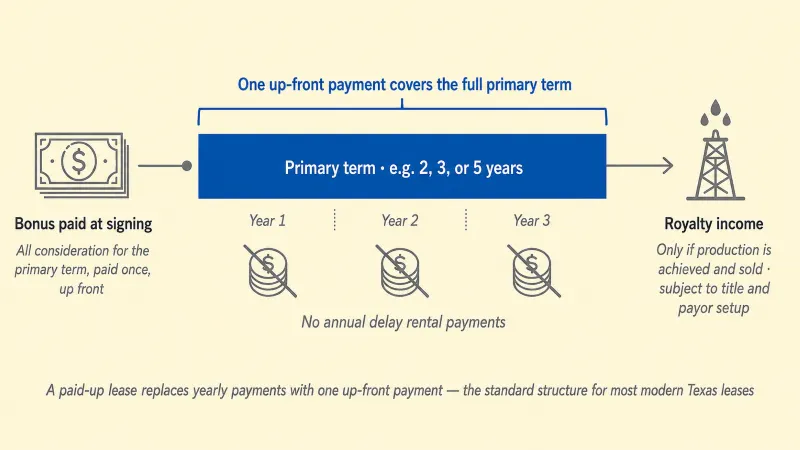
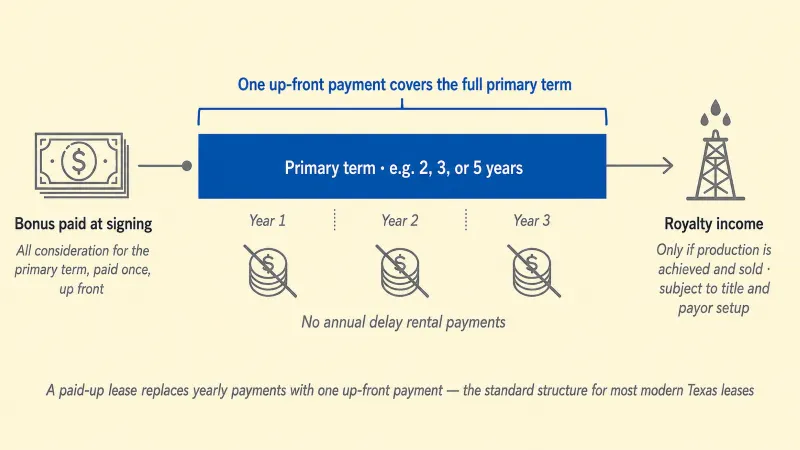
A paid-up lease is an oil and gas lease in which the lessee pays everything owed for the primary term up front at signing, so no annual delay rental payments are due before drilling or production. For a mineral owner, that means your bonus covers the primary term and the next payment you are likely to see is royalty income once production is sold, so a quiet stretch after the bonus is normal rather than a sign that something is wrong. It is the standard structure for most modern Texas leases.
What This Means for Mineral Owners
The phrase "paid-up" generally means delay rentals are handled up front or eliminated, rather than paid year by year during the primary term. Under an older-style delay rental lease, the lessee had to send the mineral owner a payment during the primary term to keep the lease alive without drilling or production.
A paid-up lease folds that delay-rental structure into the deal at signing, so annual delay rental payments are generally not required during the primary term. You get your bonus, and the next major payment is usually royalty income if production is achieved and sold, subject to title review, division-order or payor setup, payment thresholds, and applicable payment timing.
This is why many owners are confused when, after receiving a bonus, the payments stop. On a paid-up lease, that silence is normal. It does not mean anything is wrong. It usually means the lessee has already paid the consideration required to keep the lease in force during the primary term and is deciding whether to drill, assign the lease, extend it if allowed, or let it expire.
On a paid-up lease, do not expect annual delay rental payments during the primary term. Your bonus is the main compensation for that period. Royalty payments generally begin only after production is sold and payor setup, title review, and payment processing are completed.
A paid-up lease may still end at the close of the primary term if the lessee has not established production in paying quantities or otherwise maintained the lease through operations, shut-in provisions, pooling, continuous operations, extension options, or other lease-saving clauses. The "paid-up" feature affects how the lease is maintained during the primary term, not whether it can expire.
How a Paid-Up Lease Works
Paid-up lease vs delay rental lease
The clearest way to understand a paid-up lease is to compare it with the delay rental lease it largely replaced.
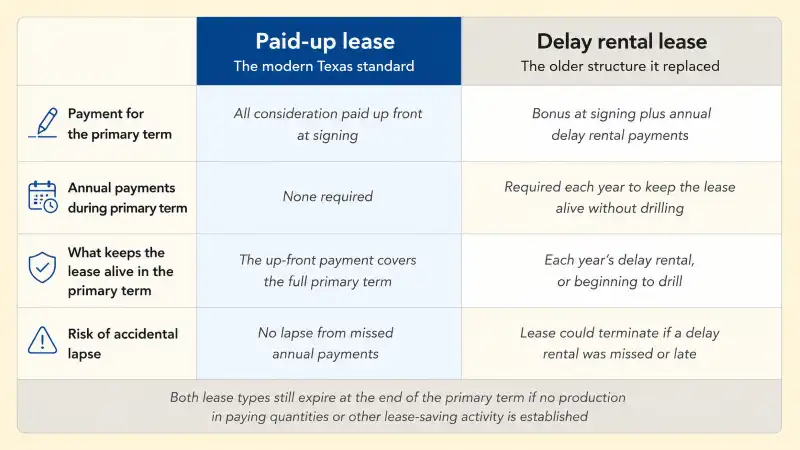
Under a delay rental lease, the lessee typically had to begin drilling or pay a delay rental by the required date to keep the lease alive during the primary term. If the lessee failed to drill and failed to pay the required delay rental on time, the lease could terminate, depending on the lease language, and the mineral owner could regain the ability to lease the minerals again. Those annual payments were small, but they were real checkpoints.
Under a paid-up lease, the lessee pays the agreed consideration for the primary term at signing. There are no annual rentals and no annual checkpoints. The lease generally stays in force for the full primary term without annual delay rental payments, whether or not the lessee drills, unless the lease contains a specific provision that changes that result.
The primary term still has an end
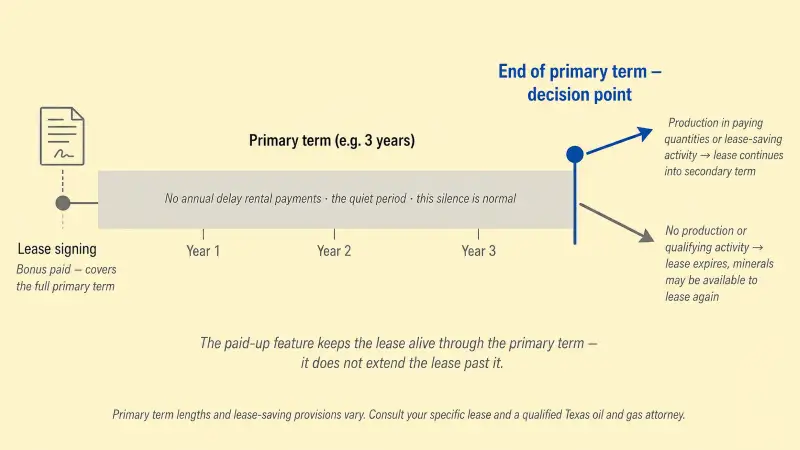
A paid-up lease is not permanent. It runs for a fixed primary term, often two, three, or five years, set in the lease itself. If the lessee establishes production in paying quantities, or satisfies another lease-saving condition before the primary term ends, the lease may continue into the secondary term and can be held as long as the lease conditions are met.
If the primary term ends with no production in paying quantities and no qualifying lease-saving activity, the lease typically expires and the minerals may become available to lease again, subject to lease language, title review, pooling, and any savings clauses.
A simple example
An owner signs a paid-up lease with a three-year primary term and receives a lease bonus at signing. For three years, the owner hears nothing further, which is expected on a paid-up lease. If the lessee drills and production in paying quantities is established before the three years are up, the lease may continue into its secondary term, and royalty payments may begin after production is sold and payment setup is completed.
If the three years pass with no production, qualifying operations, extension, pooling effect, or other lease-saving activity, the lease may expire and the owner may be free to negotiate a new lease after confirming the lease status.
Why a Paid-Up Lease Matters to You
A paid-up lease changes where your attention should go. Because there are generally no annual delay rental payments to track, the bonus you negotiate, the length of the primary term, extension options, royalty rate, deductions, Pugh clause, and lease-saving clauses become especially important.
The bonus is usually your main upfront compensation for tying up your minerals during the primary term, so it carries more weight in a paid-up lease than in an older delay rental structure. The primary term length sets how long the operator can hold your minerals without producing.
A shorter primary term often works in the mineral owner's favor because it requires the lessee to act sooner or risk lease expiration, while a longer term can keep your minerals committed for more years before that decision point arrives. Many paid-up leases also include an extension option that lets the lessee add time to the primary term for an additional payment, so it is worth checking whether your lease gives the operator that right and on what terms.
It is also worth knowing that a paid-up lease gives you fewer chances for the lease to lapse because of a missed-delay rental payment during the primary term, since those annual payments are generally not required. The lease generally runs to the end of its primary term unless production, operations, extension rights, pooling, shut-in provisions, continuous operations, or other lease terms affect its status.
For owners who want to keep track of whether a lease is producing and when a primary term may be approaching its end, Mineral View's Lease Activity tracks regulatory filings and status changes on claimed leases, which can help you see whether an operator has begun activity before a term expires.
A Real-World Scenario
Example: Karen's paid-up lease in Wise County
Karen signed a paid-up oil and gas lease on her minerals in Wise County, Texas, with a three-year primary term, and received her bonus at closing. The first year passed with no further checks, and by the second year she had begun to worry that something had gone wrong or that she was owed payments she was not receiving.
When she looked into it, Karen learned that her lease was a paid-up lease, which meant no annual rental payments were ever due. The operator had paid everything owed for the primary term at signing and simply had not yet drilled.
The lessee still had until the end of the third year to establish production in paying quantities or otherwise maintain the lease under its terms. If it failed to do so, the lease could expire and Karen may be able to lease again after confirming the lease status. Understanding this turned her worry into a clear question with a clear answer: nothing was wrong, and she now knew the date by which the operator had to act.
Note: This example is provided for illustrative purposes only and does not represent any specific mineral owner or lease.
What to Check
Confirm whether your lease is paid-up
Most modern Texas leases are paid-up, but the only way to be sure is to read the lease. Look for language stating that the lease is paid up for the primary term or that no delay rentals are due. Knowing which structure you have tells you whether to expect any payments before production. Mineral View's Lease Report helps you keep your lease details and status organized in one place.
Know your primary term length and expiration date
As the primary term is the clock that governs a paid-up lease, knowing its length and end date is essential. That date is when the lessee generally must have established production in paying quantities or satisfied another lease-saving provision. If not, the lease may expire and your minerals may become available to lease again.
Do not expect annual payments during the primary term
If you have a paid-up lease, the absence of payments after the bonus is normal, not a sign of a problem. Royalty payments generally begin after production is sold and the payor completes title review, division-order or payment setup, and applicable payment processing. Knowing this avoids a common and unnecessary worry.
Important
Mineral View can help you organize your lease details and track operator activity for your minerals. For questions about your specific lease terms, your primary term, or whether a lease has expired, consult a qualified landman or Texas oil and gas attorney before acting.
Common Questions
On a paid-up lease, yes, that is usually normal. The lessee paid the agreed consideration for the primary term at signing, so annual delay rental payments are generally not due during that term. The next major payment you may see is royalty income, which generally begins after production is sold and payor processing, title review, and any required payment setup are completed. The pause after your bonus is expected, not a sign that something is wrong.
Neither by itself. It is simply the standard modern structure, and what matters is the terms inside it. Because there are generally no annual delay rentals, your bonus, primary term length, royalty rate, extension options, deductions, Pugh clause, and lease-saving clauses carry significant weight. A strong bonus and a reasonably short primary term generally work in your favor, while a long primary term can keep your minerals committed longer before the lessee has to act or risk lease expiration.
If the primary term ends with no production in paying quantities and no qualifying operations, extension, shut-in provision, pooling effect, or other lease-saving activity, the lease may expire and your minerals may become available to lease again. The paid-up feature by itself does not extend the lease past its primary term. Whether a lease has truly expired can depend on the exact lease language, title facts, operations near the deadline, shut-in clauses, pooling, continuous operations, extension options, and other savings provisions, so it is worth confirming with a qualified professional.