Decimal Interest
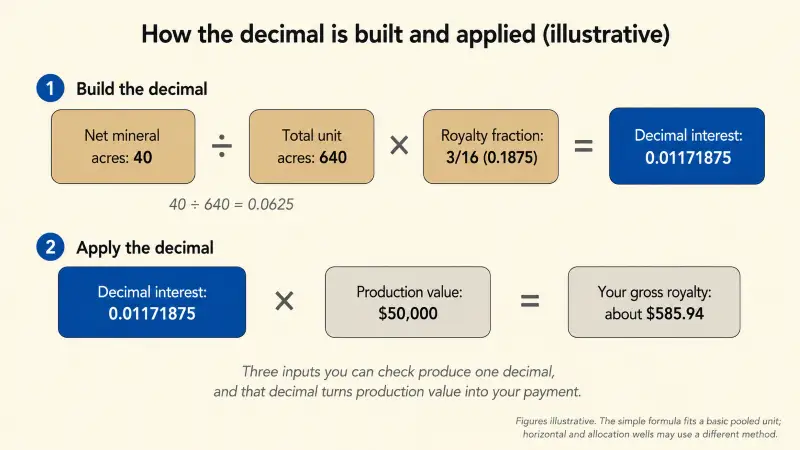
A decimal interest is the decimal number used to calculate a mineral owner's share of production revenue from a well, lease, or unit. In a simple pooled-unit royalty example, it is commonly based on the owner's net mineral acres, the unit acres, and the royalty fraction. The decimal often appears on a division order and royalty statement, and even a small error can affect every royalty check tied to that well.
What This Means for Mineral Owners
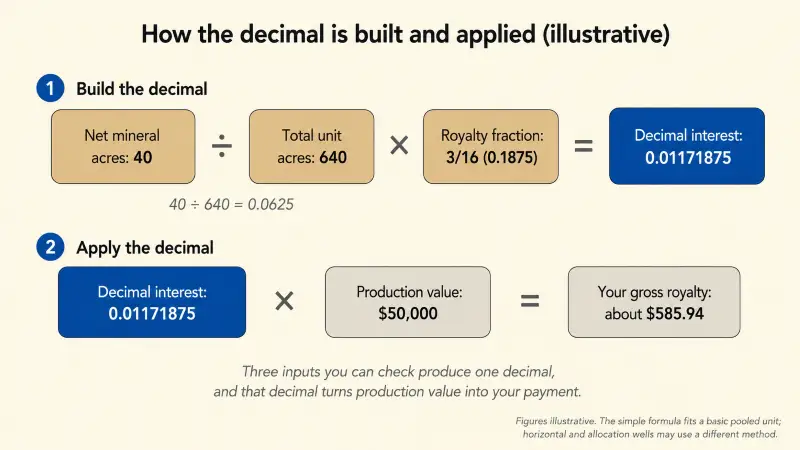
If you want to understand your royalty check, the decimal interest is where to start. It is the main ownership multiplier applied to production value to help calculate your payment. Everything else, the prices, the volumes, the deductions, flows through this one number to determine what you receive.
That is why it deserves attention. Because the same decimal is often applied month after month, an error in it does not happen just once. It repeats in every check until someone catches and corrects it. The good news is that the decimal is not a mystery figure. It is calculated from inputs you can identify and check.
Your decimal interest affects every check tied to that well, lease, unit, or payment deck. If it is wrong, your payments may be wrong until it is corrected, so it is worth verifying rather than assuming.
In a simple pooled-unit example, it is commonly calculated from your net mineral acres, the size of the unit, and your royalty fraction. Because those inputs are knowable, you can check whether the decimal makes sense.
How a Decimal Interest Is Calculated
For a royalty owner, the decimal interest generally comes from a simple relationship:
Simple royalty decimal example = (Your net mineral acres ÷ Total unit acres) × Your royalty fraction
The three inputs
Each piece is something you can look up or confirm:
- Your net mineral acres: how much of the minerals you actually own in the area being produced.
- The total unit acres: the size of the pooled unit, allocation area, or tract basis used for the well, depending on the well and lease structure.
- Your royalty fraction: the royalty rate set in your lease, such as one-eighth or three-sixteenths.
A mistake in any one of these flows straight through into a wrong decimal, which is why understanding the inputs is the key to checking the result. This simple formula fits a basic pooled unit. Horizontal and allocation wells that cross several tracts often use a different allocation method, so your decimal on those wells may not match the simple calculation, which is common in areas like the Permian Basin.
A worked example
Suppose, in a simple pooled-unit example, you own 40 net mineral acres in a 640-acre unit, and your lease reserves a three-sixteenths royalty. Your share of the unit is 40 divided by 640, or 0.0625. Multiplying by the royalty fraction of 0.1875 gives a decimal interest of 0.01171875.
To see what that means on a check, if production attributable to the unit sold for $50,000 in a month, your gross royalty would be about $50,000 times 0.01171875, or roughly $585.94 before deductions, taxes, and other adjustments. The figures are illustrative, but they show how the decimal turns production value into your payment.
Why it has so many decimal places
Decimals are carried out to many places because ownership shares are often small and need to be precise. When a unit is divided among many owners and tracts, rounding too early would distort payments, so the decimal is taken to six, seven, or eight places to keep each owner's share exact. A royalty statement may display the decimal rounded to fewer places than the division order shows, so a shorter number on a statement is not necessarily a mismatch.
Decimal Interest vs. Royalty Fraction
Owners frequently confuse these two, and the difference is worth being clear about.
- The royalty fraction is the rate in your lease, such as one-eighth. It is the same regardless of how much of the unit you own.
- The decimal interest is your actual share of the unit's revenue. It takes the royalty fraction and scales it down by how much of the unit you actually own.
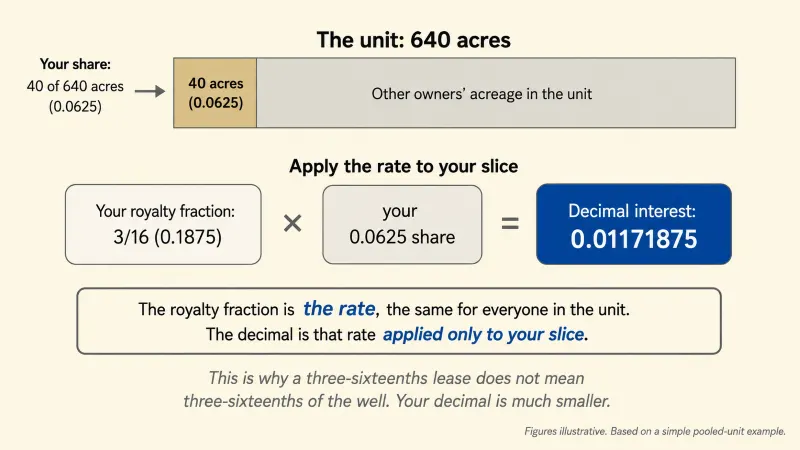
This is why owners are sometimes surprised that their decimal looks so small. Holding a one-eighth lease does not mean you receive one-eighth of the well's revenue. You receive one-eighth of the share attributable to the acreage you own within the unit or payment allocation, which is usually a much smaller number. The fraction is the rate; the decimal is the rate applied to your slice.
Why Your Decimal Interest Matters
The decimal interest matters because it is the lever on your entire royalty income. A small error has an outsized effect, since it is applied to every payment going forward. And because the decimal appears on the Division order you are asked to sign, reviewing it is part of confirming whether the payment decimal appears correct from the start.
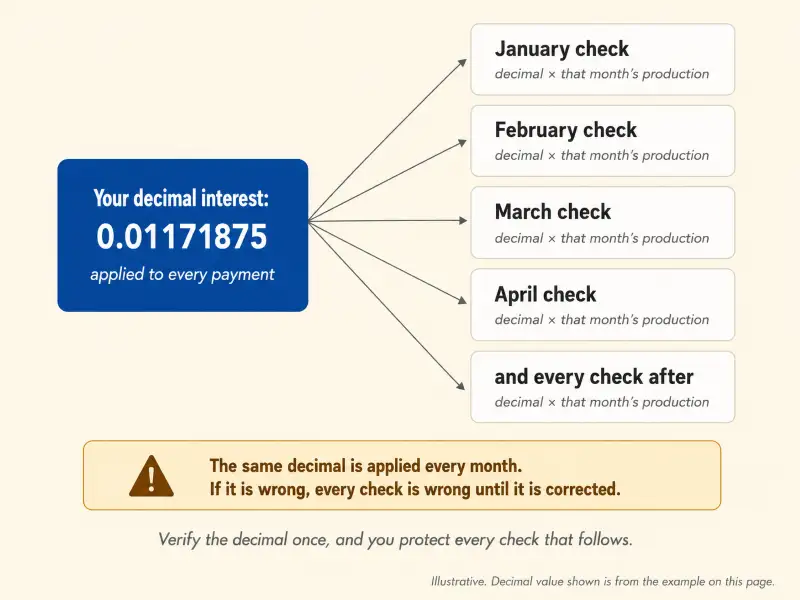
Verifying the decimal protects your income at the source. Checking that the net acres, unit size, and royalty fraction behind it are right is far easier than trying to untangle months of underpayment later.
For owners who want to understand how their decimal and production translate into expected income, Mineral View's MVestimate models royalty income using production and price assumptions, which puts the effect of your decimal into a forward-looking picture.
A Real-World Scenario
Example: Diane tracing an inherited interest in Reeves County
When Diane began receiving royalty checks on an inherited interest in Reeves County, Texas, the amounts seemed lower than she expected for the well's reported production. Rather than assume the checks were simply small, she looked at the decimal interest on her division order and worked back through the inputs.
She found that the net mineral acres used in her decimal were lower than what she actually owned, based on how the inherited interest had been recorded. Because the decimal was built on an understated acreage figure, every check had been calculated on too small a share.
Diane raised the discrepancy with the operator or payor and brought the supporting ownership records to a professional to confirm. Once the decimal was corrected, her payments were adjusted to reflect what she actually owned. Checking the number behind the check, rather than just the check, was what surfaced the issue.
Note: This example is provided for illustrative purposes only and does not represent any specific mineral owner or lease.
What to Check
Verify the inputs behind your decimal
Confirm the three pieces that build your decimal: your net mineral acres, the size of the unit, and your royalty fraction. If each input is right and the math holds, your decimal is likely correct. If one is off, the decimal will be too.
Check the decimal on your division order before signing
The division order states the decimal the payor intends to use for distributing proceeds to you. Reviewing it against what you believe you own before you sign is the natural moment to catch an error, since a division order directs payment but generally should not change your lease terms. If the decimal does not look right, it is reasonable to ask questions before agreeing.
Watch for decimal changes on your statements
Decimals can change when units are revised, interests are transferred, or corrections are made. Tracking your payments over time helps you notice an unexpected change. Mineral View's Monthly Report summarizes your revenue across minerals over time, which makes a shift in your payments easier to spot than reading one statement at a time.
Important
Mineral View can help you see your production and revenue trends over time. For questions about whether your decimal interest is correct, whether to sign a division order, or how an inheritance or transfer affects your share, consult a qualified landman or Texas oil and gas attorney, since these involve title and ownership records.
Common Questions
For a royalty owner, it generally equals your net mineral acres divided by the total unit acres, multiplied by your royalty fraction. That produces the precise share of the unit's revenue you are paid. Each input can be checked, so if your decimal looks wrong, the place to start is confirming those three numbers.
Because the royalty fraction is the rate, not your share of the whole well. You receive your fraction of only the portion of the unit attributable to the acreage you own, not of the entire unit's production. Since most owners own a slice of a unit rather than all of it, the resulting decimal is much smaller than the headline fraction.
Start by checking the inputs behind it: your net mineral acres, the unit size, and your royalty fraction. If one appears incorrect, raise it with the operator and gather your ownership records. Because a decimal dispute turns on title and ownership, it is worth reviewing with a qualified landman or attorney rather than assuming either that it is fine or that it is wrong.
Yes. Your decimal interest can change if ownership is transferred, title is corrected, a unit is revised, a well is added to a different unit, an allocation method changes, or the payor corrects its records. A change is not automatically wrong, but it is worth checking against your ownership, lease, unit information, and division order.
Not always. The decimal on a division order is usually based on title review, ownership records, unit size, and lease terms, but mistakes can happen. Before signing, compare the decimal against your net mineral acres, royalty fraction, and the unit or allocation basis used for the well. If it does not look right, ask the operator or payor for the calculation behind it.
Different wells can have different decimal interests because they may be in different units, cover different acreage, use different allocation methods, or be tied to different leases or ownership tracts. Even if the wells are operated by the same company, your share can change from well to well depending on the land and title records behind each well.