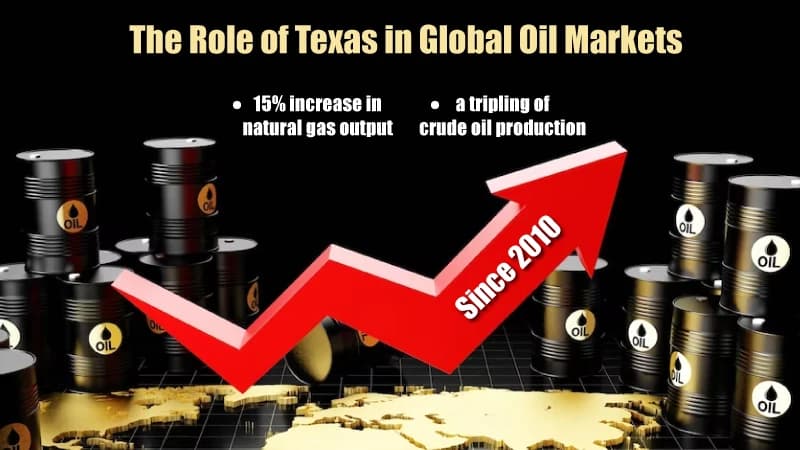
An essential change in the production landscape is about to occur in the global oil market, with Texas emerging as a significant player. Nearly all the recent increase in the world's oil production has come from this region, comprising six counties. Natural gas and oil are the foundation of the "Texas Miracle". Texas has seen a 15% increase in natural gas output and a tripling of crude oil production since 2010, driven primarily by advancements in horizontal drilling and hydraulic fracturing techniques ( or "fracking") in the shale resource plays. This article will examine Texas's role in the world's oil markets and the state's increasing prominence in the renewable energy industry.
The Historical Evolution of Oil Markets
Contrary to the conventional calendar, for Texans, the dawn of the 20th century wasn't marked on January 1, 1901. It started on January 10th, nine days later, when the Lucas No. 1 well at Spindletop, close to Beaumont, blew in, spitting drilling pipe, mud, gas, and oil.
The Origin and Importance of Spindletop
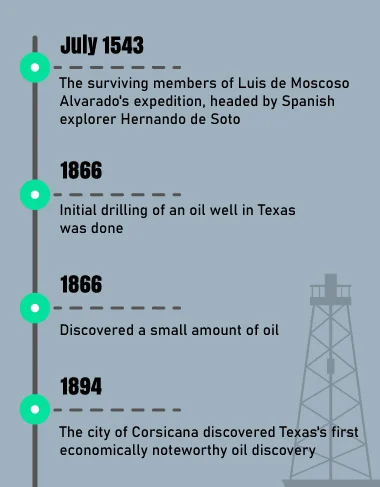
Before European settlers arrived in Texas, the state's natural oil seeps were well known for hundreds of years. The surviving members of Luis de Moscoso Alvarado's expedition, headed by Spanish explorer Hernando de Soto, were driven ashore in July 1543 between Sabine Pass and High Island in Texas. Moscoso stated that the gang utilized the oil they discovered floating on the water's surface to caulk their boats.
The initial drilling of an oil well in Texas for oil production was done by Lyne T. Barret in 1866 at Melrose, located in Nacogdoches County. The operation was followed by Amory Reily Starr and Peyton F. Edwards, who successfully drilled an oil well near Oil Springs the following year.
Nacogdoches County became the location of Texas's first commercial oil field, pipeline, and crude refinement endeavor after the companies drilled additional wells there. Although thousands of barrels of oil were produced, the price generally stayed the same to the point where further development efforts could be justified. Bexar County rancher George Dullnig discovered a small amount of oil in 1886 while drilling for water; he did not try to produce it commercially.
The city of Corsicana discovered Texas's first economically noteworthy oil discovery in 1894, and they were also drilling for water. The drillers needed water, not oil, so they abandoned that well.
Spindletop
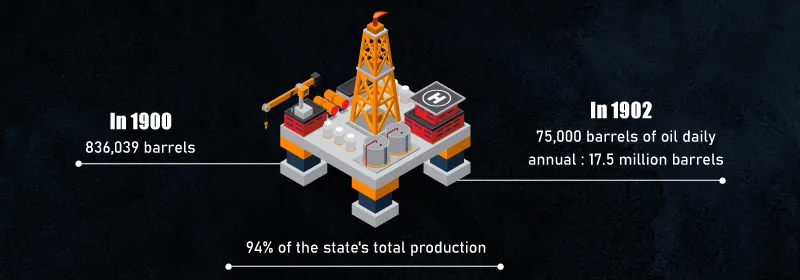
Spindletop was the oil discovery that gave Texas the impetus to become a significant petroleum producer and industrial power. In 1901, exploration had started in the upper Gulf Coast region close to Beaumont. Capt. Anthony F. Lucas, an oil prospector and mining engineer from Louisiana, drilled the Spindletop field's discovery well following several dry holes. At first, the Lucas No. 1 was estimated to produce over 75,000 barrels of oil daily. In 1902, the area reached a peak annual production of approximately 17.5 million barrels, confirming its status as a highly prolific oil field. This event marked the beginning of the Texas oil boom and profoundly impacted the oil industry in the United States and worldwide.
In addition to being the first salt dome oil discovery, Spindletop set off a wave of conjecture that led to numerous other significant discoveries in the region. Amidst the boom, hundreds of enthusiastic wildcatters arrived.
A massive wave of associated manufacturing, supply, and service companies, including producers and dealers of oil-field equipment, pipelines, and refineries, followed closely behind them.
In 1900, Texas's oil production stood at 836,039 barrels. By 1902, Spindletop alone contributed over 17 million barrels, representing 94% of the state's total production. The glut caused oil prices to fall to a record low of 3 cents per barrel, while in some boomtowns, a cup of water could be purchased for 5 cents.
The Rise of Texas as a Major Oil-Producing
The early exploration and production turmoil created an unbalanced oil supply, often leading to overproduction. A few significant discoveries in the early years made them widely available. It caused a considerable price decrease but was followed by slight exploration and a sudden price increase as production decreased.
Oil production and exploration grew and steadied in the late 1910s and early 1920s. North Texas, Central Texas, the Panhandle, and the Permian Basin in western Texas became recognized oil production centers. The Ranger Oil Boom strike west of Dallas-Fort Worth in 1917 marked the beginning of North Texas's discoveries. These were particularly significant because they accelerated the region's industrialization and supported the war effort during World War I. Texas became the nation's leading oil producer very fast. In 1940, Texas led the US in oil production, with California in second place.
Texas Oil had Several Effects on World Events, Including:
-
First World War
The 1917 Ranger Oil Boom in North Texas aided the war effort by bringing industrialization to the region. Texas served as a central area and a source for the Mexican Revolution smuggling, which was later included in political efforts during World War I.
-
Second World War
Texas played a significant role in increasing oil production during World War II by around 80% because of its prime location, such as Texas’s land, coastline oil, and reserves.
-
Economic Expansions
Texas's extensive oil production transformed the state's primary industry, made people and businesses wealthier, and unbolted the state's economy to the rest of the world. The oil and gas sector employs 1.4 million people in Texas.
Texas Railroad Commission (TRC)
The state organization that oversees the liquefied petroleum gas industry, pipeline safety, uranium, and surface coal mining, the oil and gas sector, and gas utilities is the Railroad Commission of Texas. The Texas Railroad Commission overcame most of the sharp price swings common in the early years of the boom and stabilized oil production in the United States after assuming regulatory authority over the Texas oil industry in the 1940s. In 2005, however, it ceased to oversee railroads because the Texas Department of Transportation took control of the remaining rail responsibilities.
The Contributions of the Oil Industry to Texas' Economy
Texas's growing oil and gas industries generate billions of dollars in tax revenue that the state's citizens rely on for infrastructure projects, public instruction, higher education, and other necessities. The oil and gas sector is a cornerstone of Texas's economic growth, highlighting the need for laws promoting judicious use of natural resources.
Furthermore, according to data on tax collections recently released by Texas Comptroller Glenn Hegar, Texas oil and natural gas producers are paying the State of Texas record amounts of production taxes. Recently, data from Texas Comptroller Glenn Hegar reported an increase in tax revenue generated by the state's oil and natural gas operators. In April 2022, oil operators paid $666 million in taxes from oil production, followed by tax payments of $595 million in May. Oil & gas operators also set a record in May, contributing $413 million from natural gas production. In the fiscal landscape of the Texas oil and gas sector, these figures not only eclipse revenues from previous years but also underscore the enduring economic impact of Texas's oil and gas industry. This is particularly notable amidst the global shift towards renewable energy sources like wind and solar.
The sector's contribution to Texas's Gross Domestic Product (GDP) is substantial in terms of financial input and employment generation. The oil and gas industry is a significant employer in the state, providing a multitude of job opportunities for many of the local communities. The energy sector is also essential in state budget allocation for critical areas such as K-12 public education.
Growth of the Renewable Energy Sector in Texas
In the realm of renewable energy, Texas has traditionally been a leader in the oil and gas industry. Still, it has been making great strides towards a diversified energy portfolio. Over the past decade, the state has significantly embraced renewable energy sources, integrating wind and solar power into its energy mix. A report by the American Clean Power Association recognized Texas as a leader in deploying new renewable energy projects, marking a significant transition for a state historically reliant on fossil fuels.
In 2021, Texas achieved a milestone in renewable energy development, installing 7,352 megawatts across wind, solar, and other renewable projects, surpassing California's output of 2,697 megawatts. Furthermore, Texas is advancing in energy storage development, with nearly 20,000 megawatts in progress, outpacing California’s 14,000 megawatts. These achievements position Texas as a key player in the nation’s transition to renewable energy.
Texas has maintained its leadership in solar and wind electricity generation since 2006. In 2021, it produced more than double the renewable energy output of its nearest competitor while also leading the nation in natural gas (25%), oil (43%), and wind power (26%) production.
Innovations and Future Trends in Texas Oil Production
2023 is shaping to be a critical year for the energy sector, particularly in light of the geopolitical tensions impacting global energy resources. With Texas at the forefront, the US is emerging as a potential major supplier of liquefied natural gas (LNG), providing a stable alternative to Russian gas supplies.
The Texas oil and gas industry is adapting to these global dynamics by prioritizing enhanced safety, intelligence, and efficiency. Advances in technology, including automation, digitization, and artificial intelligence, are revolutionizing the sector. These innovations are addressing complex subsurface engineering challenges more efficiently, significantly improving well and oilfield productivity and setting new benchmarks in the industry.
Adopting sophisticated robotics and advanced data management systems is also streamlining previously onerous & costly processes, reducing reliance on manual labor and thus increasing operation efficiencies. Natural gas is still the primary and fastest-growing energy source in Texas. Technological advancements in drilling, especially hydraulic fracturing, have unlocked vast reserves in the state's shale formations. This surge in production capacity allows Texas to meet domestic and international energy demands more effectively.
As Texas continues to pursue a sustainable and balanced energy portfolio, its ongoing exploration and utilization of natural gas resources are crucial. This approach aims for economic profitability and underscores a commitment to an environmentally responsible energy future in the state.
Summary
Texas substantially influences the global oil markets, producing significant economic returns for the state and its citizens. The landmark discovery at Spindletop back in 1901 marked a historical and monumental shift in the global energy landscape, profoundly impacting the oil and gas industry for well over a century. Building on its legacy in fossil fuels, Texas is now diversifying into renewable energy, reaching previously untapped resources of wind and solar power. This strategic shift underscores Texas's commitment to addressing the current and future energy demands of not just this country but also the world. With Texas’ vast energy resources, we can provide a more stable and secure future in the world of tomorrow.
Texas's role in shaping the oil markets is undeniable in the global context. Supporting this influence is Mineral View, an analytical tool equipped with features like Cash Flow Analysis and Value Analysis. MineralView is an essential tool for effectively navigating the constantly changing landscape of the oil and gas industry. It provides critical insights for strategic decision-making, allowing stakeholders to navigate the industry's dynamic terrain effectively and make informed choices.