Explore "A Timeline of the History of Oil and Gas in Texas". From the 1901 Spindletop discovery to the contemporary energy behemoth, Texas' oil and gas industry has changed the world. Explore Texas's economic, cultural, and educational transformations with us. This article will share the captivating narrative of how oil and gas shaped Texas' identity and economic growth.
Significance of Oil and Gas in Texas
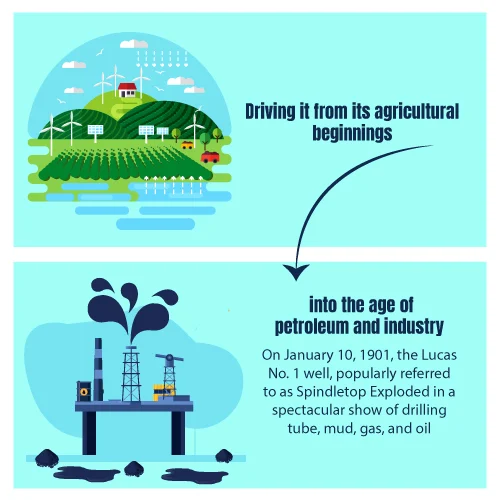
The twentieth century in Texas past events started on a distinct path that distinguished it from the rest of the globe. On January 10, 1901, the Lucas No. 1 well, popularly referred to as Spindletop, exploded in a spectacular show of drilling tube, mud, gas, and oil, forever changing Texas' fate. This discovery signified the beginning of Texas' contemporary period, driving it from its agricultural beginnings into the age of petroleum and industry.
While the late 19th century saw the transformative impact of railroads, bringing newfound opportunities and prosperity, the discovery of oil reshaped the Texan landscape. Petroleum began to replace agriculture as the driving force of the Texan economy, leaving an indelible mark on the lives of its people. Oil's influence extended beyond corporate development and wealth; it touched the lives of those who owned the land where oil was extracted and those directly involved in the industry.
Oil fields gave rise to new Texan towns and global conglomerates, accumulating immense fortunes. However, the depletion of oil fields led to the decline of once-thriving communities. High-stakes drilling ventures resulted in bankruptcies. Yet, the impact of Texas oil extended further, reshaping the state's culture and influencing millions of Texans not directly tied to the petroleum industry.
Oil's significance in Texas history goes back centuries. Spanish explorer Hernando de Soto's expedition in 1543 noted oil seeps along the Texas coast, recognizing its medicinal properties. The modern oil and gas investment and processing journey began in 1866 with Texas's first producing well in Nacogdoches County.
The true turning point was the 1901 Spindletop discovery, triggering a modern gold rush. Within a short span, significant fields emerged within a 150-mile radius of Spindletop. Major oil and gas investment companies like Exxon and Gulf Oil formed, and industrial regions sprang up around Port Arthur and Beaumont.
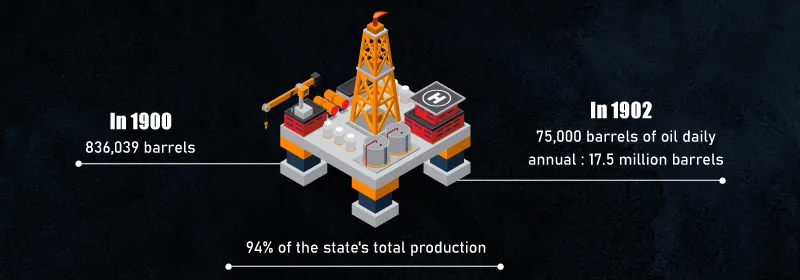
The Spindletop discovery revolutionized American transportation and industry. Texas went from producing 836,039 barrels of oil in 1900 to Spindletop, contributing over 17 million barrels in 1902.
Oil discoveries in North Central Texas, like Brownwood and Wichita Falls, and fields near Electra and Ranger further fueled the frenzy. The boom-town phenomenon strained small farming communities near discoveries, leading to urbanization.
The impact wasn't just economic; it enriched the state treasury. The legislature authorized an oil production tax in 1905, significantly benefiting higher education in Texas.
The discovery of oil on university lands, such as the Santa Rita No. 1 well in 1923, transformed Texas higher education. The University of Texas benefited immensely from oil income, changing the educational landscape.
In summary
investing in oil and gas and its related operations in Texas isn't merely an economic story. It's a tale of transformation from a rural, agrarian society to an industrial powerhouse, shaping the state's culture, economy, and education.
The legacy of Spindletop and subsequent oil discoveries continues to influence Texas today. One such innovation by 'Mineral View' that will revolutionize the landscape of mineral ownership and investment is the "Mapping & Research" feature. A tool that helps users make educated choices, traverse the complex world of mineral interests, and remain ahead in an ever-changing market using stunning visual features.
Spindletop Boom
Early 20th-century Texas relied on timber, agriculture, and livestock. Oil drilling in the late 1890s and early 1900s had little economic impact on the state. Oil from Spindletop on January 10, 1901, altered everything. Let's dive deeper:
The Spindletop Discovery
Spindletop atop a salt dome in the Beaumont, Texas, forestry industry. On that memorable day, the Spindletop gusher spewed 100,000 barrels of oil for nine days. Chevron Corporation was formed from Texaco and Gulf Oil, starting the oil and gas investment age.
Spindletop's Role in the US Oil Boom
Pulitzer Prize-winning energy expert Daniel Yergin claims Spindletop launched the US oil boom. Oil was used for lighting and lubrication before this discovery by the people. Oil made Spindletop widely accessible.
Historical Use of Oil
Spanish invaders used crude oil for ship caulking and boot waterproofing from 1543. Native Americans used crude oil medicine. Oil leaks oiled pre-1800 dwellings. Sour Lake, Texas, produced oil in 1847. Texas' Corsicana discovered oil in 1896. Until Spindletop in 1893–1896, wildcatters discovered little oil.
Early Efforts to Discover Oil
Sulfur springs and gas seepages indicated Spindletop Hill oil. George W. Carroll, George W. O'Brien, and Patillo Higgins founded Gladys City Oil, Gas, and Manufacturing Company in 1892 for Spindletop Hill exploration. Independent geologist and one-armed machinist Patillo Higgins predicted the country would move from coal to oil despite investor skepticism and dry holes. He believed salt dome drilling would provide oil against conventional thinking. Local geologists disagreed.
Collaboration and Discovery
In 1899, Higgins joined salt dome expert Captain Anthony F. Lucas. Contracts and leases were made. Pittsburgh bankers James M. Guffey and John H. Galey supported Lucas after he ran out of money at 575 feet. Lucas' stake fell, leaving Higgins at 0%. Guffey and Galey introduced Corsicana drilling mud specialists Al and Curt Hamill.
The Historic Oil Strike
Finally, Lucas found oil at 1,139 feet on January 10, 1901. Over 100 feet, the "Lucas Geyser" and "Lucas Gusher" released 100,000 barrels of oil every day. The gusher stopped after 9 days.
Spindletop's Economic Impact
According to Lamar University, Spindletop produced 836,000 barrels of oil in nine days, surpassing Texas in 1900. Spindletop supplied 40% of 1901 US oil.
Rise of Texas Oil Towns
Texas has a remarkable oil-producing history with highs and lows. Texas oil output peaked in 1972. This prosperity was followed by a sustained fall in the early 2000s. In January 1999, output increased to 39 million barrels, revitalizing the Texan oil sector.
Texas produced 1.85 billion barrels of oil in 2019, a United States benchmark. This spike in Texas oil contributed to the US' 12.23 million barrels per day oil output, according to the EIA. Texas' enormous oil reserves helped enhance our country's oil production.
Houston, Austin, Dallas, San Antonio, and Midland are oil and gas investment hubs. Houston, the biggest Texan metropolis, is the energy hub and home to BP, ConocoPhillips, and Shell. Oil extraction has spurred economic expansion in other places, creating jobs, revenue, and real estate.
The COVID-19 outbreak affected the Texas oil sector, but analysts are optimistic. Texas' oil towns may revive due to the Permian Basin's production potential. This long oil history in Texas has reshaped its cities and contributed to the nation's energy environment, making Texas a significant oil and gas powerhouse.
Oil Crisis and Economic Challenges
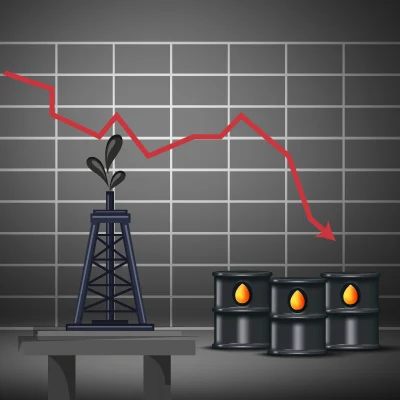
The US and the West faced a significant energy crisis in 1973. Arab OPEC countries tripled oil prices and banned shipments to the US, Japan, and Europe's west in retaliation to Western backing for Israel following the Yom Kippur War and fears over the weakening US currency. This greatly affected the US oil and gas sector.
1. 1973 Oil Crisis
The US and the West faced a significant energy crisis in 1973. Arab OPEC countries tripled oil prices and banned shipments to the US, Japan, and Europe's west in retaliation to Western backing for Israel following the Yom Kippur War and fears over the weakening US currency. This greatly affected the US oil and gas sector.
Important US oil and gas sector factors around this crisis:
Oil Supply Disruption: The oil-exporting restriction caused bottlenecks and higher costs in the US. It was hard for the domestic energy sector to fulfill consumption.
Economic Effect: The oil crisis caused a deep recession and soaring prices. The oil-dependent US economy suffered. These difficulties required government and business adaptation.
Economic Restructuring: The US began economic reform to minimize its oil dependence, which comprised conserving energy, renewable energy sources, and home oil production.
Geopolitical Concerns: Worries about military action to safeguard supplies of energy underlined the US oil and gas sector's strategic role in world politics.
2. 1979 Oil Crisis
The Iranian Revolution caused major disruption to the oil sector, resulting in a substantial loss of production. This crisis also affected US oil and gas supply:
Important US oil and gas sector factors with this crisis:
Supply Disruption: The US suffered logistical difficulties with curtailed Iranian oil shipments. The trouble, coupled with the Iran-Iraq War, increasing regional instability. The loss of Iranian oil output raised oil prices, hurting the US economy and the oil and gas sector.
Long-term Effects: The 1970s crisis forced the US to improve output and lessen its dependence on foreign oil, even if oil prices stabilized by 1981. This caused a 1980s oil surplus and a change in global oil market dynamics.
Both oil crises showed how vulnerable the US oil and gas supply business was to global geopolitical events and supply disruptions. They also influenced US energy policy to minimize oil reliance and boost energy security. This boosted Texas' overall oil extraction and production.
Fracking and the Shale Revolution
-
From 2009–2019
U.S. petroleum and different liquid production altered the global oil landscape, leaving other nations that produce oil behind. According to the EIA, U.S. petroleum and other liquids output doubled from 9.1 million barrels per day in 2009 to 19.5 million bpd in 2019. This yielded an annual growth rate of +7.9%, five times greater than the world petroleum consumption growth rate of +1.6%.
-
In November 2022
The CEO of the eponymous oil company told an investment conference in Miami that OPEC had reclaimed authority over the oil markets. This oblique acknowledgment confirms that the oil and gas industry's game-changer, the U.S. shale revolution, has reached its height.
The rest of the globe only grew production by 0.5%. The worldwide demand growth of +14.8 million bpd between 2009 and 2019 was absorbed almost entirely by U.S. marginal production, which was +14.5 million bpd. U.S. manufacturers captured two-thirds of global consumption growth in six of those ten years (2011-2014 and 2018-2019). In 2019, U.S. manufacturers accounted for nearly 19% of worldwide output and consumption, up from 11% in 2009.
Despite actual oil prices rising above the long-term average, U.S. output was predicted to rise by 0.7 million bpd in 2022 compared to 2019. Despite not meeting expectations, US oil output increased to 17.8 million barrels per day, the second highest level in a row.
| Year | U.S. Oil Production (Million Barrels per Day) | U.S. Share of Global Production |
| 2009 | 9.1 | 11% |
| 2019 | 19.5 | 19% |
| 2022 | 17.8 | - |
The shale revolution is the broad adoption of horizontal drilling and hydraulic fracturing to increase shale and tight rock production. Horizontal drilling was launched in the 1980s, and hydraulic fracturing has been used on a lesser scale since the 1950s, but its combined use to boost output began with gas-rich strata in 2005-2006 and oil-rich formations in 2008-2009.
Both approaches have improved through learning curves, allowing deeper drilling, quicker processes, longer lateral sections, and more accurate pressure pumping to fracture rocks. The oil and gas sector has entered a new age as the shale revolution, once unstoppable, has soared.
Future of Oil and Gas in Texas
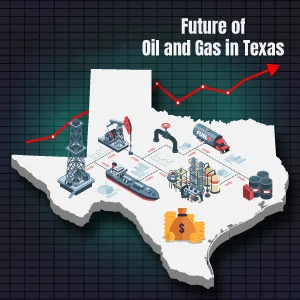
Future of Oil and Gas in Texas
Texas state government finances have long been tied to the oil and gas sector. The breakthrough of oil at Spindletop in 1901 started this seemingly endless boom.
Since Texas Comptroller of Public Accounts Glenn Heger's biennial state budget was released, Texas's oil and gas supply sector has a bright future. The state announced an all-time high $32.7 billion surplus for the 2024-25 biennium, up 54% from the 2019 record of $16 billion. Heger credits the oil and gas industry for its rapid rise.
On January 9, 2023, the EPA declared that it would not label the Permian Basin as in breach of air quality requirements, giving the industry optimism. In the upcoming regulatory plan, it focuses on non-discretionary acts. Governor Abort's designation of the Permian Basin as Texas's "crown jewel" of oil and gas was influenced by recent research showing a 76% decrease in methane emissions. The state protects regional oil and natural gas production, creating high-paying employment.
A Permian non-attainment classification would reduce oil output and tax income. The government is planning a production rise for the next fiscal year.
Texas' oil and natural gas sectors drive economic development. The Texas Rainy Day Fund is funded by oil and gas breakup taxes, which have increased state tax receipts. Texas is ready to support future goals with a $13 billion balance and a $32.7 billion surplus.
Industry generated a record $24.7 billion in state royalties and local taxes for the year, or $60 million each day. This money finances colleges, highways, public schools, and other facilities, as well as infrastructure and transport initiatives.
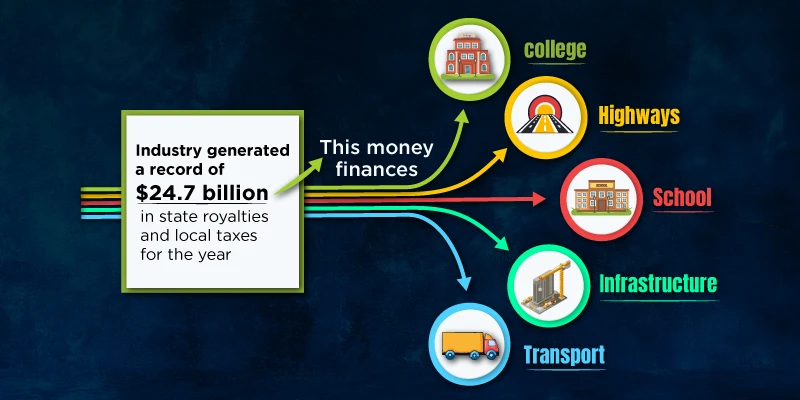
In the fourth quarter of fiscal year 2021, production taxes rose 116% to $5.8 billion, while gas royalties rose 102% to $2.2 billion, topping $10 billion.
Todd Staples, TXOGA president, highlights that the U.S. is taking steps to safeguard ecology, with the oil and natural gas sector leading the way via innovations. The Environmental Partnership and Texas Methane and Flaring Coalition encourage cooperation to fulfill energy and sustainability objectives.
Texas is improving its future as energy independence becomes global. Its economic relationship with the EU and supply of the U.S. Strategic Petroleum Reserve show its energy security commitment. Texas needs a forward-thinking regulatory framework to address cold weather-related production decreases, oil price increases, carbon footprint problems, and environmental difficulties.
Conclusion
The history of oil and gas in Texas is a tale of transformation from an agrarian society to an industrial powerhouse. The discovery of Spindletop in 1901 marked a turning point, propelling Texas into the modern petroleum age. This industry has enriched major companies, created new towns, and significantly impacted higher education.
Despite challenges, such as the oil crises of the 1970s, Texas has thrived, becoming a major player in the global oil market. The future looks promising, with a thriving industry contributing to the state's finances, employment, and infrastructure. Texas' legacy in the oil and gas sector endures, shaping not only the state but also the nation's energy landscape.