Over the past few decades, there have been significant advancements in the technology and operations of oil rigs in Texas. The E&P industries are being recognized for their contribution to sustainable economic growth, largely due to Texas drilling rigs. With the current dependance of this sector, investors are interested about the sustainability of Texas drilling rigs. This article explores the future of oil rigs in Texas and provides insights for enhanced analysis and foresight.
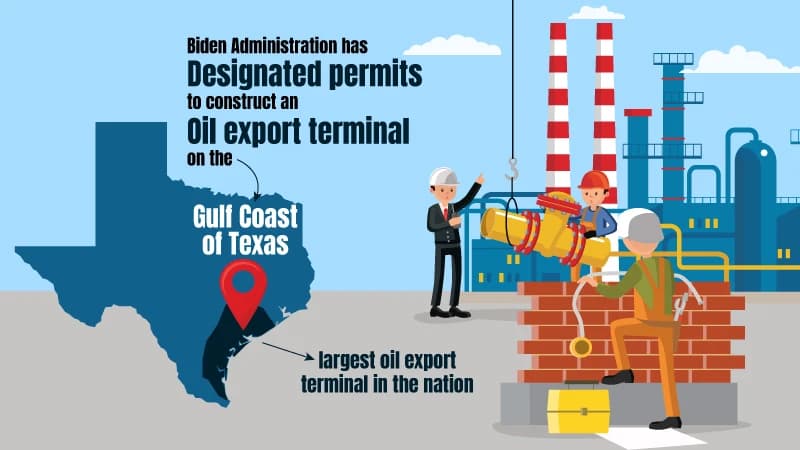
Recently, Oilman Magazine published an article that the oil and gas sector is positioned to encounter strong growth throughout this decade. Moreover, in 2022, the Biden Administration has designated permits to construct an oil export terminal on the Gulf Coast of Texas, which will become the largest terminal in the nation. This terminal will be capable of handling an additional 2 million barrels of oil per day. The oil rigs have developed new innovations in oil drilling techniques. Let’s see what they are.
Innovations in Oil Drilling Technology
The demand for energy keeps increasing every day. Texas oil rigs incorporate many of the latest drilling technologies, paving the way for more ethical production methods. Let's inspect the latest innovations in oil drilling technology:
Horizontal Drilling
The oil and gas industries are producing more hydrocarbons through the use of horizontal drilling. This technology enables drilling to a certain limit vertically inside the lease and then drilling horizontally to a specified limit to produce the oil from the reservoir. This technique in drilling brings more oil production to fulfill the nation’s energy demand. This technology significantly enhances our ability to access and utilize mineral resources. It effectively lowers water tables, ensuring more efficient drilling operations. Additionally, it plays a crucial role in maximizing the extraction of oil and gas from challenging reservoirs, including those with complex fracture networks.
Directional Drilling
Texas oil rigs have adopted directional drilling techniques for more effective oil production. Directional drilling is also known as directional boring. It uses a non-vertical angle to drill a well instead of drilling straight down. The drilling is done at a particular angle to intersect the reservoir in the most optimum position to effectively produce the most hydrocarbons.
By using this drilling technique, a number of wells can be drilled from a single location. As the drilling is done at a particular angle, the surface footprint is reduced, which simultaneously minimizes the requirement of additional well pads. It additionally contributes to preserving terrestrial and marine habitats as well as the ecosystem.
Though this type of drilling has been used for about 100 years, it has led to technical breakthroughs that allow for incredible feats of engineering, drilling at extremely long distances and changing directions.
Involving Robotics and Automation in Oil Rigs in Texas
Robotics and automation have maximized mineral exploration in Texas using oil rigs. The participation of robots to carry out the drilling activity enhances productivity and accuracy. It subsequently generates safety for humans, increases efficiency, as well as minimizes the initial cost.
Today, several oil rigs have implemented automatic drilling systems. It monitors and commands the drilling tasks to be performed completely automatically. This automation helps extract more oil, generating more profit.
Big Data Analytics and Machine Learning Algorithms
Oil rigs in Texas use a big data analysis system to analyze the data for more accurate drilling activities. Big data analytics enables personnel to make educated decisions regarding drilling activities and production. With the help of machine learning algorithms, the failure of the device can be better predicted. It analyzes the data with high accuracy in order to achieve the maximum amount of production. Additionally, it can inform the geologists about the parameters of the reservoir, which can aid in improving well efficiency as well as safety.
Latest Monitoring and Sensing Technology:
The latest sensing and monitoring technology uses artificial intelligence software such as SCADA that enhances the drilling operation. This technology provides real-time data and allows the monitoring of the equipment. These systems include sensors that detect and monitor pressure, temperature, and various drilling activities to enhance the efficiency of oil rig operations. It enables the operator to understand any failure activity to avoid accidents and provide safety.
Additionally, modern monitoring includes seismic imaging technology, which provides images of surface layers of wells in 3D and 4D format. By observing such images, the geoscientist and operators can understand the condition of the well properly.
Involvement of Enhanced Oil Recovery (EOR) Techniques
EOR techniques are introduced to extract the remaining oil from the reservoir following the primary and secondary stages of oil recovery. These techniques involve injecting various materials inside the reservoir, such as chemicals, gasses, and steam. It helps to increase the flow and production of oil in the reservoir. These techniques enhance the operation of oil rigs and help to produce more oil.
Integrating Energy Mix in the Texas Oil Industry:
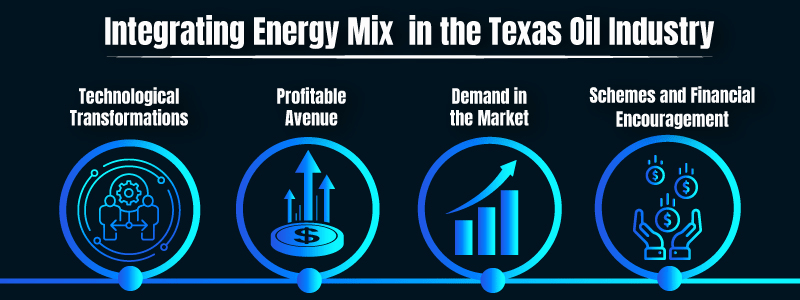
The Texas oil industry has integrated an energy mix to contribute more to energy generation. The combination of renewable energy with natural gas and oil provides sustainable, environmentally friendly, and efficient energy. The purpose of incorporating a suitable energy mix is to meet the sustainable yet profitable energy needs of consumers. Here are some key advantages of involving energy mix:
Technological Transformations
Along with modern oil exploration tactics, re-enables like solar and wind have brought technological transformation to the oil industry. Solar and wind power plants can generate electricity that will provide energy to oil rigs in Texas to perform their operation effectively. Involving energy mix in oil rigs utilizes all the latest technologies that transform the overall drilling activities, reducing some environmental concerns.
Profitable Avenue
Integrating the energy mix has brought a profitable avenue. Texas has incorporated numerous wind and solar power plants into oil rigs, effectively generating more energy, improving several employment chances.
Demand in the Market
The Texas oil industry has high energy demand, being the US's top crude oil and natural gas producer. The industrial and transportation sectors are the largest consumers of petroleum. Energy diversification is crucial for economic growth and independence.
Schemes and Financial Encouragement
The Texas government has introduced various initiatives and financial incentives to support the integration of the energy mix. It is done at state as well as federal levels. Recently, Texas has established a $10 billion energy fund, most of which will be used to construct gas-fired power facilities. The Public Utility Commission of Texas will manage the fund. Furthermore, the state has pushed proposals to protect oil and gas from climate efforts, and legislators have enacted measures to stimulate the development of gas-powered power plants and offer subsidies to the energy sector. The Texas oil and gas sector significantly contributes to the state's economic growth, generating billions of dollars in tax revenues for public schools, colleges, highways, and other vital services.
Implementing an energy mix in Texas's oil and gas industry has enormous benefits. Here are the key benefits:
Combining re-enables and oil rigs satisfies all energy-efficient revenues, boosting energy production stability.
Renewable and oil rigs provide cost-effective, safe, and accessible solutions. Oil companies employ high-tech equipment, AI, and ML to produce energy with minimal human work, lowering prices. Thus, it reduces initial costs and becomes economical.
Economic and Employment Trends in the Texas Oil Industry
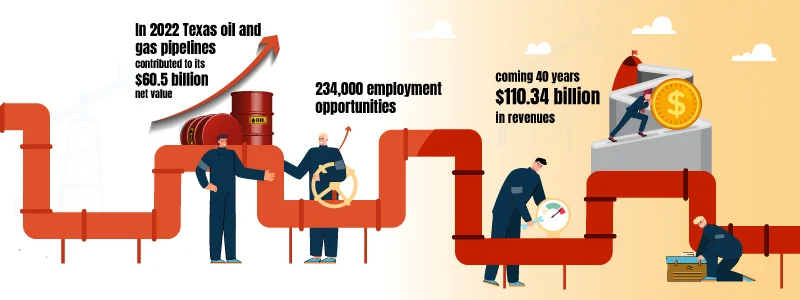
Energy generation from the oil sector has helped the state prosper economically. Recently, the Texas Pipeline Association has published a report. According to the data, the state's construction and Texas oil and gas pipelines contributed to its $60.5 billion net value in 2022.
This achievement resulted in generating up to 234,000 employment opportunities and was also responsible for producing $34.0 billion with an extra gross product of the state. The report also estimates that Texas' oil sector will be valued at $1.86 trillion, with an additional $1.05 trillion in gross state product. It will grant up to $110.34 billion in revenues for creating local and state governments. These predictions in the report will appear in practice in the coming 40 years.
Let’s look at the Texas oil industry's latest economic and employment trends.
Employment Trends in the Texas Oil Industry
Direct employment in Texas' oil and gas companies increased by 8.1% in the first quarter of 2023, hitting a record total pay expenditure of $19.5 billion. Upstream employment, especially in exploration and production, has increased by 20,000, or 11.2%, from the industry's lowest point during COVID-19 in September 2020, with a monthly growth rate of 1,390 jobs. In December 2023, the Texas oil and gas industry added more than 31,000 jobs. Despite a slowing rig count, the industry's healthy growth, with a standard wage of about $115,000 in 2022, suggests ongoing demand and provides reason for confidence.
Economic Trends in the Texas Oil Industry
The Texas oil and gas industries contributed significantly to the state's finances, generating $24.7 billion in taxes and royalties in fiscal year 2022. Its development into downstream energy fields, such as petroleum products and refining, has helped to diversify Texas' economy. The industry's high average wage of roughly $115,000 in 2022 reflects its enormous economic effect, demonstrating its continued relevance and durability in Texas.
Oil Rigs Companies and Community Relations:
Talking about the relationship between communities and oil rig companies in Texas has been a topic of discussion. The people with the mineral rights claim the profit but don’t want their mineral land to be distracted. Sometimes, an argument gets raised between both parties; one of them asks for mineral exploration with oil rigs to earn a profit, whereas the other gets disturbed due to excessive drilling noise, spreading hazardous gasses, and many other things.
Therefore, residents assume that the relationship between oil rig companies and communities is often less beneficial. There’s no question that oil rigs are responsible for some kind of destruction. By considering such effects, the authorities introduced community engagement guidelines that are advantageous to improve the relationship between oil rig companies and the local communities. Let’s know about these activities.
Arranging informative seminars that will help the community understand more about oil rigs.
Exploring ways to enhance the functioning of oil rigs in Texas while minimizing their impact on the community.
Providing detailed information on safe and secured drilling tasks to the community to receive their positive opinions over oil rig companies.
Integrating environmental safety and protection projects to reduce the worse effects of oil rigs on the ecosystem and nearby human societies.
Recommending the latest employment vacancies in the oil rig industry to get closer attention of the community on oil rig companies.
Above all, activities play an important role in forming good relations between oil rig companies and the communities. Oil rig companies should make concerted efforts to garner positive feedback from the community to help the oil sector grow. For that, companies should have an interactive and effective talk on the concerns of the community regarding oil rigs, understand their expectations, provide the necessary information, and generate solutions to fulfill their needs.
Conclusion:
Texas refineries have involved multiple technological advancement techniques. The latest techniques help to enhance the operation and efficiency of the refinery plant. The Texas refineries have grown with modern-day digitalization and automation techniques. It has involved automation systems like SCADA, IIoT, and many more. Also, it makes use of robotics for accuracy and to achieve better efficiency as well as productivity.
Many oil companies and authorities have suggested community engagement activities to develop good relations between the community and oil rigs. The Texas Pipeline Association has published an article that includes the net profit achieved by the oil industry. According to experts, the oil industry will generate many job opportunities due to enormous economic growth over the next 40 years, ensuring a bright future for oil rigs in Texas.
FAQ’s
Where are the most oil rigs located in Texas?
Texas itself is the state with the highest number of oil rigs in the country. But cities like Austin, Houston, San Antonio, Midland, and Dallas are headquarters to most companies that operate oil rigs throughout all of Texas.
How many Oil Rigs are there in Texas? Industry?
The number of oil rigs fluctuates. Recent data shows about 309 active oil rigs in Texas as of Dec 29, 2023.