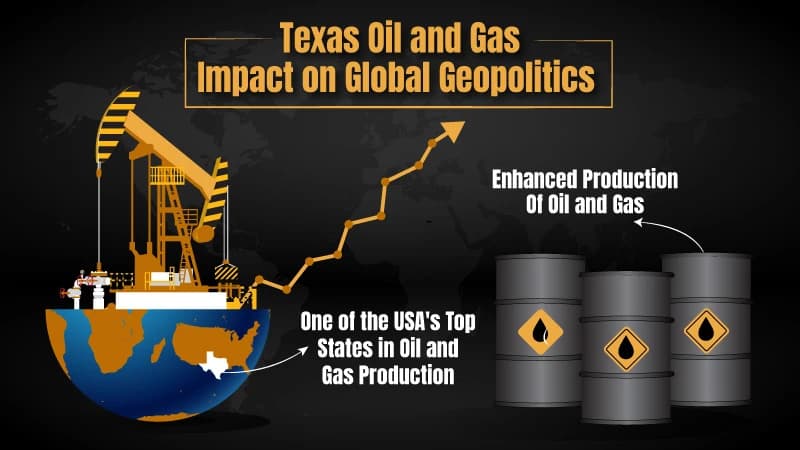
The economic growth of any state is primarily driven by its industrial development. The Texas oil and gas sector plays a pivotal role in shaping global geopolitics. This is due to the sector's increased oil and gas production and its ability to meet market energy demands. So, is Texas making significant contributions to forming the global energy dynamics? The answer is yes in many ways! It is one of the USA's top states in oil and gas production. The overall Texas oil and gas industry's price swings affect the US economy and the worldwide oil market to some extent. As a result, it has a significant impact on geopolitical relations and the economic durability of oil-dependent nations.
This post will get you through the impact of Texas oil and gas on global geopolitics. Additionally, we will focus on the United States' geopolitics with OPEC countries. Let's plunge into the depths!
Fossil fuels remain pivotal for achieving the nation's energy independence. It also permits the nation to participate in establishing international relations, along with better strategic elasticity. The geopolitical significance of Texas encompasses a range of factors, including numerous energy policies, oil and gas pricing events, and global economic factors. Have a closer look at how Texas oil and gas production began earlier and contributed to the US energy sector.
Historical Legacy: Texas and the Birth of the Oil and Gas Era
Texas was not always the first to contribute to energy fulfillment with the oil and gas industry. But it is undoubtedly one of the top states in energy fulfillment today. Below are some crucial stages that will help you explore the historical legacy of the Texas oil and gas industry.
-
The oil boom at Spindletop near Beaumont marked the beginning of oil exploration in Texas in 1901.
-
The oil boom impacted major oil production, helping the Texas Railroad Commission regulate the oil industry.
-
The Texas Railroad Commission's authority expanded beyond oil and gas production in 1917.
-
The East Texas oil field was identified in 1930, which added more value to oil and gas production.
-
Continual advancements in technology and innovation have perpetually increased oil and gas production to date.
Even before OPEC was formed, the United States had a significant effect on world oil prices. When the oil and gas sector was evolving after the formation of OPEC in the 1960s, it used to decide oil and gas prices. Yet, due to maximum oil and gas extraction and production, Texas continues to maintain its independence from OPEC.
OPEC and Texas: Current Oil and Gas Pricing Scenario
The US and the Organization of the Petroleum Exporting Countries (OPEC) always stay on trend for their fluctuating prices and impact on the global oil market. Texas, being a leading state in oil and gas production, disagrees with the policies and decisions on the pricing of oil and gas taken by OPEC. The OPEC includes 14 countries, so whatever the pricing considerations are discussed must be accepted by other countries unanimously. The primary objective of OPEC, along with other member countries, is to unify and integrate all petroleum policies in order to secure reasonable and stable prices for petroleum producers.
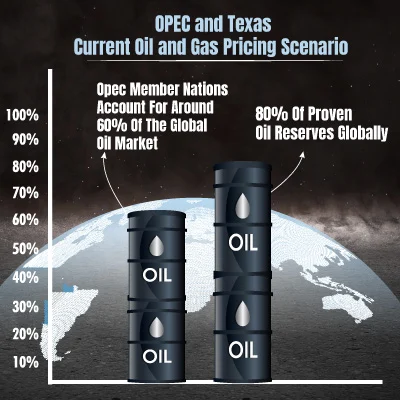
OPEC's price adjustment strategies often respond to global oil demand fluctuations. Whereas it concludes that the oil price falls at the time of less oil demand. The petroleum exports of OPEC member nations account for around 60% of the global oil market. OPEC evaluated that the member nations have contributed 80% of proven oil reserves globally.
Prior to OPEC's establishment, dominant American oil companies were the primary setters of global oil prices. Import quotas capped foreign oil at 9% of domestic use by 1959. In the 1970s, the US faced an energy crisis amid OPEC's rising influence, highlighted by the 1973-1974 oil embargo. Recent years saw a resurgence in US production, prompting competition with OPEC, particularly highlighted by Saudi Arabia's output increase in 2014 to counter the production from the US shale gains. Efforts to subject OPEC to US antitrust laws have been proposed but not enacted.
When determining global oil prices, a variety of factors are considered, including supply and demand chains, geopolitical events, government frameworks and policies, the global economic situation, and many others.
As we are aware, oil prices are decided in the oil futures market. For future oil pricing, there comes an oil future contract. The contract indicates the person has the authority to buy oil in barrels. The individual can purchase it at a cost on a predestined date in the future. As per the contract, sellers and buyers can be legally involved to optimize their transaction activities on a designated date. Sentiment is another key factor included in oil pricing determination. Most investors speculate that oil demand may increase in the future, which results in increased oil prices in the current situation. Moreover, hedgers and speculators influence the enhanced oil prices.
The recent report from Reuters as of 15th Jan 2024 states that Brent crude futures became stable at about 0.2%, i.e., 14 cents, and around $78.15 a barrel. On the holiday of King Martin Luther, the US West Texas Intermediate crude has seen no settlement. Yet, the benchmark was settled at 0.3%, which is 18 cents and about $72.50 at 15:13 EST. At the start of the session, both benchmarks decreased by more than $1 per barrel.
The Shale Revolution: Texas at the Forefront
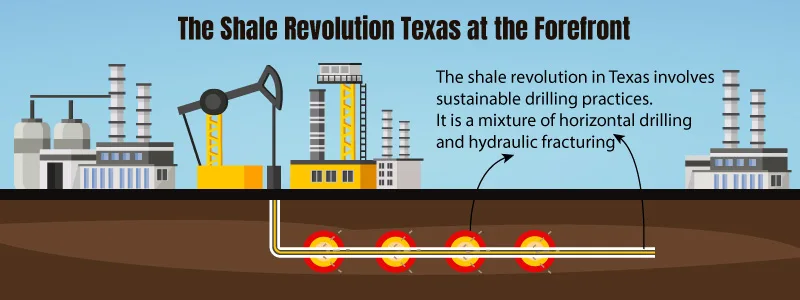
The shale revolution in Texas highlights significant advancements in sustainable drilling technologies. It is a mixture of horizontal drilling and hydraulic fracturing. It has evolved the remarkable growth of the oil and gas industry in the US, especially from tight oil formations. Tight oil contributes 36% of total crude oil production in the country. This production minimizes the attenuation of US imports from overseas and develops an economic rise.
As per the report in 2011, the oil and gas sector comprises 1.6% of total US GDP and is still increasing. The oil and gas industry employed around 169,000 people from 2010 to 2012. The shale revolution has had significant benefits in the evolution of oil and gas extraction, which has also contributed to shale formation. The US is now taking the credit for generating 20% of the total global supply of dry natural gas, of which 40% is extracted from shale.
For the first time since 1949, the US exported petroleum in 2020 (Texas has a major role), although growing home consumption is likely to reverse this trend. The shale revolution has transformed the nation's energy landscape, resulting in a new energy atlas reflecting changes for the United States.
Here are three major shale plays that put their efforts into supplementing more oil and gas in Texas. The reported figures are based on recent data. There may be fluctuations.
| Name of the Shale Play | Associated Minerals | Approximate Production Per Day |
|---|---|---|
| Permian Basin | --- | --- |
| --- | Oil | 3.5 million barrels |
| --- | Gas | 10.2 billion cubic feet |
| Eagle Ford Shale | --- | --- |
| --- | Oil | 1,096.1 Barrels |
| --- | Gas | 2,580 million cubic feet equivalent
|
| Barnett | Gas | 4 million cubic feet
|
Pipelines and Politics: The Geopolitical Significance of Texas Infrastructure
It is said that oil and gas pipelines and politics have always been a trend in the US. A few experts suggest the pipeline installation may cause some environmental concerns. The University of Virginia School of Law recently published a report on pipelines and politics. That report describes a significant transformation in the natural gas pipeline permission procedure in the US.
The Federal Energy Regulatory Commission (FERC) examines community interest by considering multiple factors. However, in the previous 20 years, FERC has changed its perspective towards pipelines. Over the last two decades, experts have observed the undertakings of FERC. They concluded that the legal allowance for pipeline installation now depends on the shipping contract of the applicant. They should pay more attention to the environmental impacts and public concerns.
Such an approach contributed to the modifications in the political dynamics of distinctive pipeline undertakings. FERC has previously absorbed the resistance of certain factors, such as labor interests, coal, and railroads. It resulted in a detailed investigation of public interest. However, such resistive factors have reduced and permitted FERC to flourish the pipeline interests.
With the prospective contravention of the Natural Gas Act, eccentric political swings generate rigorous observations for the courts or the state. Understanding the modulation of natural gas infrastructure in the US spreads ahead of official rules. It includes an inclusive view of considerations like official rules, political dynamics, and institutional landscape. It also focuses on the political economy of natural gas to understand the pipeline regulations.
Oil and gas infrastructure in Texas supports hundreds of thousands of jobs, boosts the state's economy, and influences the world's energy future.
Texas Oil: The Power of Energy Diplomacy

Texas is recognized for its primary mineral resources and extensive oil and gas energy production sector. At the same time, it prompts the consequence of the oil and gas sector at the global level with the emergence of the power of energy diplomacy. Energy diplomacy includes the diplomatic undertakings that are considered to advance ingress to commodities as well as energy resources. The main objective for involving energy diplomacy is to intensify international energy transitions.
The Lone Star State is a leader in the oil and gas industry. Texas dominates both oil pricing and foreign ties of the United States globally. The enormous energy production due to the Texas oil and gas industry has achieved a significant economic height for itself. Moreover, the state has participated in energy geopolitics globally, leading its energy-generating position.
Strategic application of energy diplomacy has fueled substantial growth. Texas is frequently hailed as the global capital of the oil and gas industry. It has emerged as a prominent element in energy diplomacy, capable of bolstering cooperation, shaping geopolitical decisions, and facilitating commercial deals.
Conclusion
Over recent decades, Texas's oil and gas sector has played a significant role in the geopolitics between the USA and OPEC. Due to its extensive energy generation and production, it has opted not to align closely with OPEC. The enhanced production sparked the shale revolution, which additionally introduced shale plays like the Permian Basin, Eagle Ford Shale, etc.
The updated approach of FERC is transforming the pipeline infrastructure and reducing political interference. With the growing oil and gas production, Texas is leading energy diplomacy as a means to attain economic success. For shaping international relations and negotiating business contracts, energy diplomacy has added its positive attempts. The Texas oil and gas sector's measures and policies will continue to influence global geopolitics for years to come.
FAQs:
What is the "Geopolitics of Oil and Gas"?
The geopolitics of oil and gas refers to the interaction between world politics and the extraction, distribution, and utilization of these resources. The oil and gas industry covers a vast geographical area of Texas. The detailed understanding of how oil and gas influence political and international relations is the geopolitics of oil and gas.
How does oil cause Geopolitical Issues?
Price fluctuation, sudden rise, or decrement in oil prices results in a geopolitical issue.
How did the oil and gas industry affect the government of Texas?
The Texas oil and gas sector is the primary funding medium for the state's economic stability. With its impact on Texas' economy, job opportunities, and tax revenues, the oil and gas industry has shaped the dynamics of politics and legislation. It has contributed around $28.1 billion since 1987.