If you own land in Texas, you’ve likely heard that you own a "bundle of sticks." It’s a classic legal metaphor used to explain that property ownership isn't just one single right; it’s a collection of many. In the world of Texas oil and gas, the two most important sticks in that bundle are the power to make deals and the right to get paid.
When a family inherits a ranch in the Permian Basin or a developer buys acreage in the Eagle Ford Shale, a crucial question arises: Who actually has the authority to sign a lease? This is where the distinction of Executive Rights vs Non-Executive Rights comes into play. One person might hold the "power" (the Executive), while several others hold the "paycheck" (the Non-Executives).
Understanding this dynamic is essential for every Texas mineral owner. Whether you are negotiating a life-changing bonus or simply waiting for your first royalty check, knowing where you stand in this hierarchy determines your financial future and your legal protections. This guide will break down everything you need to know about navigating the complex waters of Texas mineral interests.

What is the Mineral Estate?
In Texas, the land beneath your feet can be legally “severed” from the surface. This means one person can own the grass, the trees, and the dirt, while another person owns the oil, gas, and minerals deep underground.
The mineral estate is considered the dominant estate. This is a powerful legal concept. It means the mineral owner (or the person they lease to) has the right to use the surface as much as is "reasonably necessary" to extract the minerals. However, the mineral estate itself is further subdivided into five specific rights:
- The Development Right: The right to physically enter the land and drill.
- The Executive Right: The power to negotiate and sign oil and gas leases.
- The Bonus Right: The right to receive the upfront cash payment when a lease is signed.
- The Delay Rental Right: Payments made to "delay" drilling (less common in modern leases).
- The Royalty Right: The right to a share of the revenue once production begins.
- Difference between Executive and Non-Executive Mineral Rights in Texas:
In Texas, an Executive Mineral Right gives the owner the exclusive legal authority to negotiate and sign oil and gas leases.
A Non-Executive Mineral Right, such as a Non-Participating Royalty Interest (NPRI), provides no control over leasing but guarantees the owner a right to receive royalty payments from actual production.
What are Executive Rights?

The holder of the executive right is essentially the “quarterback” of the mineral estate. They are the only ones an oil and gas company needs to talk to. If an operator wants to drill on a 500-acre tract, they don’t need signatures from every cousin and sibling who owns a tiny fraction of the minerals. They only need the signature of the person holding the executive rights.
The Scope of the Executive’s Authority
When you hold executive rights, you have the unilateral power to decide:
- The Bonus Amount: Whether to accept $500 or $5,000 per acre.
- The Royalty Percentage: Whether to lock everyone into a 15% royalty or push for 25%.
- The Primary Term: How long the company has to start drilling (usually 3 to 5 years).
- Pooling Provisions: How your land can be combined with neighboring tracts to form a "unit."
- Surface and Water Protections: What rules the oil company must follow regarding fences, roads, and water use. Critically for 2026, this includes negotiating "anti-recycling" clauses or compensation for produced water recycling pits, which were deregulated by the RRC’s July 1, 2025, Chapter 4 rule overhaul.
As this power is so concentrated, the executive rights holder holds the keys to the kingdom. They can bind everyone else, the non-executive owners, to a contract that could last for the next fifty years.
What are Non-Executive Rights?
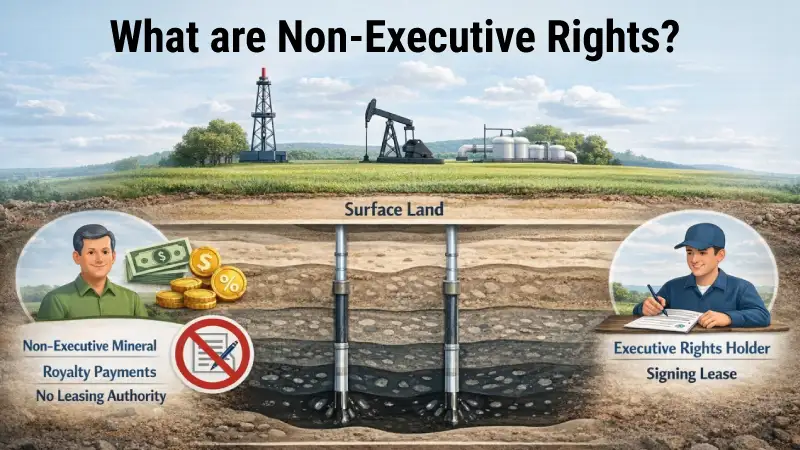
If you own minerals but lack the power to sign a lease, you are a "non-executive" owner. This sounds like a disadvantage, and in terms of control, it is, but it also means you get the benefits of production without the headache of negotiation.
-
Non-Executive Mineral Interests (NEMI)
-
Non-Participating Royalty Interests (NPRI)
A Non-Executive Mineral Interests owner owns a share of the actual minerals. They are entitled to their portion of the bonus and their portion of the royalties. However, they are "silent partners." They have to accept whatever deal the executive rights holder negotiates. If the executive signs a bad deal, the NEMI owner is stuck with it.
The NPRI is one of the most common interests in Texas. This person doesn't own the "minerals" in the traditional sense; they only own a right to a share of production. Usually, an NPRI owner does not get a share of the bonus money, only the royalty checks once the oil starts flowing.
In the debate of Executive Rights vs Non-Executive Rights, the NPRI owner is the most vulnerable because they have zero say in when (or if) the land is ever leased.
Why the Distinction Matters: The "Duty"
Because the executive rights holder can essentially spend the non-executive’s money by signing a low-royalty lease, Texas law has stepped in to create some guardrails.
For decades, there was a debate in Texas courts: Does the executive owe the non-executive a "fiduciary duty" (like a lawyer owes a client) or just a "contractual duty"?
The Duty of Utmost Good Faith and Fair Dealing
The Texas Supreme Court settled this in the landmark case Lesley v. Veterans Land Board. The court ruled that the executive owes a duty of utmost good faith and fair dealing.
What does this mean exactly?
-
The executive cannot purposely sign a deal that hurts the non-executive to benefit themselves.
-
Example of a Breach: An executive owns the surface and the executive rights but no royalties. A company offers a lease with a 25% royalty. The executive says, "No, give me a 10% royalty but pay me a massive 'surface damage fee' instead." Because the non-executive only shares in the royalty, the executive has essentially stolen the non-executive's value. This is a breach of duty.
However, the executive is not required to be a perfect negotiator. As long as they act with “utmost good faith” and obtain market terms, the non-executive cannot sue just because they thought they could have gotten a slightly better deal.
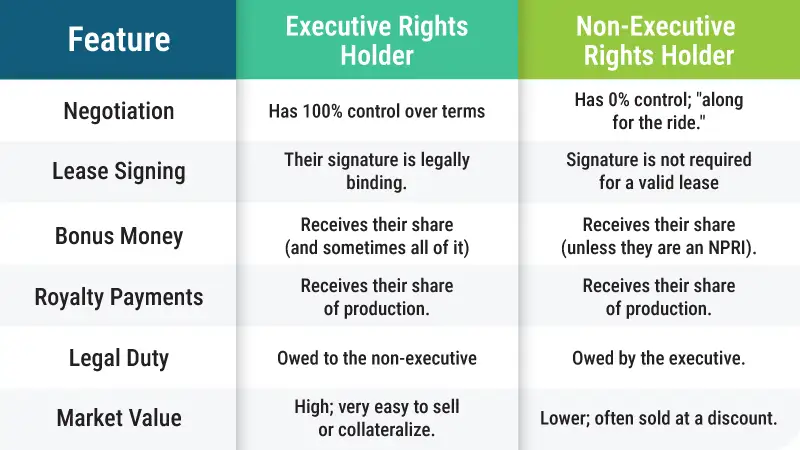
Comparing Executive Rights vs Non-Executive Rights
How to Identify What You Own
You cannot simply look at a royalty check to know if you have executive rights. You must look at the Chain of Title.
In Texas, everything comes down to the "Granting Clause" or the "Reservation Clause" in a deed. You might see language like
-
"Grantor reserves unto himself all executive rights, including the right to lease..." (This means the seller kept the power).
-
"Grantee shall have no right to participate in the making of any oil and gas lease..." (This means the buyer is non-executive).
The "Duhig Rule" and Other Complications
Texas deed interpretation is notoriously difficult. Sometimes a deed says someone is "reserving 1/2 of the minerals," but it doesn't specify who gets the executive rights. Under Texas law, if the deed is silent, the executive rights usually follow the mineral ownership.
However, if the minerals are split and the deed doesn't specify, you might end up with "co-executives," where everyone has to sign. This can lead to a "gridlock" where no leasing happens because the owners can't agree.
For Example: If you own 50% of the minerals but sign a deed "reserving 1/2" for yourself without mentioning the other 50% already owned by someone else, the law gives your 1/2 to the buyer to make them "whole." You intended to keep everything, but because of the Duhig Rule, you walk away with nothing.
The 5-Minute Deed Self-Audit
Unsure if you hold the "Quarterback" stick? Scan your deed right now for these specific "Red Flag" phrases that determine your financial future:
- "Sole and Exclusive": If the deed gives one party "sole" power to lease, the other party is usually Non-Executive.
- "Non-Participating": If you are listed as an NPRI, you generally have no voting power and often receive zero signing bonus money.
- "Reservation" vs. "Exception": Pay close attention to these headers—a "Reservation" keeps a new right for the seller, while an "Exception" protects an existing right.
- The "Silence" Check: If executive rights aren’t mentioned at all, they generally travel with the mineral ownership (meaning you likely have them).
Real-World Example: The "Permian Split"
Let’s imagine a family in Midland, Texas. In 1960, the grandfather sold the family ranch but kept "all oil, gas, and other minerals." Over time, he passed away and left the minerals to his three children: Ann, Bob, and Charlie.
-
Ann is a landman and knows the industry.
-
Bob and Charlie live out of state and don't want to deal with paperwork.
The family signs a deed giving Ann the "sole and exclusive executive rights."
Fast forward to 2026. A major oil company wants to lease the land.
- The company only talks to Ann.
- Ann negotiates a top-tier 2026 market rate of a $7,500 per-acre bonus and a 25% royalty.
- Ann signs the lease.
- The oil company pays the $10,000 per acre, which is split equally between Ann,Bob, and Charlie.
- When the well is drilled, all three receive their 1/3 share of the 25% royalty.
In this scenario, the balance of Executive Rights vs Non-Executive Rights worked perfectly. Ann did the work, and everyone got paid. Conflicts only arise when "Ann" decides to stop answering the phone or tries to cut a side deal with the oil company.
Valuation: What is Your Interest Worth?
If you are looking to sell your minerals, the distinction of Executive Rights vs Non-Executive Rights is the first thing a buyer will look at. Here are the factors you need to understand while valuing your rights:
- Control Premium: Executive rights are worth more. Why? Because a buyer who owns the executive rights can control the timing of their income. They can choose to lease when prices are high.
- Non-Exec Discount: Non-executive interests (especially NPRIs) often sell for less. A buyer is taking a risk; if the executive rights holder is a stubborn landowner who refuses to ever sign a lease, the non-executive owner might never see a penny.
- Proximity Matters: If your non-executive interest is in a "hot" area like Loving County or Reeves County, the discount is smaller. Buyers know that the pressure to drill is so high that a lease is almost inevitable.
The "Dominant Estate" and the Surface Owner
We cannot discuss Executive Rights vs Non-Executive Rights without mentioning the person standing on top of the minerals: the surface owner.
Often, the surface owner is the one who holds the executive rights. They have a vested interest in making sure the oil company doesn't ruin their land. They will negotiate for:
- Specific locations for well pads.
- The use of "closed-loop" systems to protect soil.
- High-quality fencing and cattle guards.
If you are a non-executive owner and the executive is also the surface owner, you should be vigilant. Sometimes, a surface owner will "trade" a higher royalty (which you would share in) for better surface protections, such as banning newly permitted commercial waste pits (which only benefits them). This is a common area for legal disputes regarding the “duty of utmost good faith.”
Practical Tips for the Texas Mineral Owner
If You Are the Executive:
- Document Everything: Keep a folder of every offer you receive. If you reject a high offer, write down why (e.g., "The company had a bad reputation" or "The lease form was too aggressive").
- Stay Informed: Know the going rates for bonuses and royalties in your county. The Railroad Commission of Texas (RRC) website is a goldmine of data.
- Consult an Attorney: Oil and gas leases are "perpetual" contracts if production is established. Spending a few thousand dollars on a legal review can save you millions over the life of a well.
If You Are Non-Executive:
- Map Your Interest: Know exactly where your minerals are located. Don’t struggle with clunky government websites. Click over to our Mineral View Interactive Map to instantly see if rigs are moving toward your land and verify active permits near your tract.
- Audit Your Checks: Once production starts, ensure the royalty decimal on your division order matches the lease the executive signed.
- Communication is Key: Keep a polite line of communication open with the executive rights holder. If they know you are watching, they are more likely to be diligent in their negotiations.
Common Misconceptions
- "I didn't sign the lease, so it's not valid." False. If the executive rights holder signed, your interest is bound.
- "The executive can keep all the bonus money." Usually False. Unless the deed specifically says the executive keeps 100% of the bonus, it is generally shared among the mineral owners.
- "I can force the executive to lease." Difficult. You cannot usually "force" a lease unless you can prove the executive is acting in bad faith or "self-sabotaging" the minerals to hurt you.
Conclusion: Navigating the Texas Oil Patch
The world of Texas oil and gas is built on these historical divisions of power. The interplay of Executive Rights vs Non-Executive Rights is what allows the industry to move quickly while still protecting the underlying property owners.
For the executive, it is a position of great responsibility, one that requires a balance between personal gain and the legal duty to others. For the non-executive, it is a position of passive investment, requiring trust and a watchful eye on the local "play."
Whether you own a fraction of an acre or a massive West Texas ranch, understanding this "bundle of sticks" is the key to protecting your legacy. If you are ever in doubt about which sticks you hold, remember that in Texas, the "paper trail" is king. Review your deeds, stay informed about local drilling, and never hesitate to seek professional advice. After all, in the Texas oil patch, knowledge isn't just power; it's profit.