When you are thinking about purchasing rural property or land in the Lone Star State or elsewhere in the U.S., one of the most important questions you will face is, “What exactly am I buying?”
Most individuals concentrate on the surface, such as the acreage, the quality of the soil, the availability of water and the view but fail to look at the one beneath the ground. It is here that buying land without mineral rights becomes an important issue.
To a lot of Texans, the knowledge of how mineral rights work can secure your investment, avoid any possible surprises, and optimize your landholding experience.
In this guide, we will take you through all you need to know about buying land without mineral rights, why it is popular, what the risks and opportunities are, and how you can use tools like Mineral View to aid in your decision-making.
What Are Mineral Rights? A Simple Breakdown
Before we go deeper into the idea of buying land without mineral rights, let’s start by defining mineral rights in plain language.
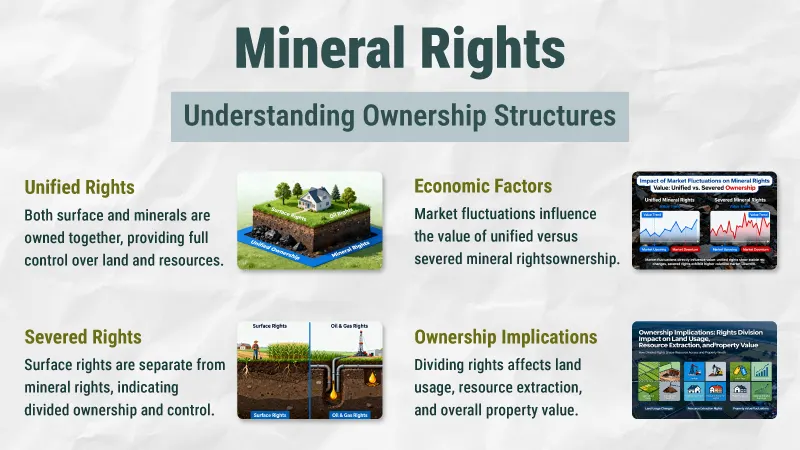
When you own property, there are actually two main parts:
- Surface Rights: The right to use the surface of the land. This includes building a home, farming, grazing livestock, or planting trees.
- Mineral Rights: are the legal ownership of subsurface resources like oil, natural gas, and metals. In Texas, these rights are a "dominant estate," meaning the mineral owner can legally access the surface to extract resources, often taking precedence over the surface owner's rights unless a waiver is signed. But according to recent decisions by the Texas Supreme Court, the surface owner (not the mineral owner) typically owns the pore space, or the voids in the rock itself. If you intend to lease your land for carbon capture storage, this is essential.
In some cases, the same person owns both surface and mineral rights; this is called a unified estate. But often, especially in states like Texas, the mineral rights have been sold or “severed” from the surface rights. In a split estate, one person owns the surface land while someone else owns what’s beneath.
Why Buying Land Without Mineral Rights Is Common, Especially in Texas
In Texas, buying land without mineral rights is not unusual; it’s actually the norm in many areas. Since Texas has a long history of oil and gas production, previous landowners often sold the surface but kept the mineral rights, either because they believed the land might contain valuable resources or because they wanted to keep the potential to lease or sell mineral interests later.
Here’s why this matters:
- Oil and gas were discovered long ago in many counties, and early settlers or landowners reserved their mineral rights.
- Land developers and speculators may sell off the surface only, keeping minerals for future revenue.
- Land parcels change hands many times over decades, but once minerals are separated from surface rights, that division often stays forever.
According to some real estate professionals, a significant portion of rural land in Texas is sold without conveying the mineral rights. Many buyers are not even aware of this until closing or until companies show up to drill nearby.
This makes buying land without mineral rights a real possibility for many buyers, and not necessarily a bad one if you know what you are dealing with.
Why People Still Buy Land Without Mineral Rights
If you’re buying land for personal use, building a home, ranching, farming, recreational use, or conservation, owning mineral rights isn’t always essential. In fact:
- You still have full use of the surface of the property.
- You can build structures, fences, roads, ponds, barns, or anything surface rights allow.
- You can enjoy the land exactly as you intended without mineral ownership.
In most areas of the U.S., such as in Texas, customers regularly acquire land without mineral rights since in most cases owning both is infrequent and prohibitively costly. With that said, it is essential to know the difference and control expectations.
You can negotiate for executive rights even if you can't pay for the entire mineral rights. This gives you control over who drills on your property by enabling the surface owner to execute leases even if they do not actually own the minerals.
Mineral View is one of the most efficient tools that would allow you to estimate the situation: it is a platform that allows searching mineral activity, history of ownership, and drilling data of land parcels.
Being informed on who owns mineral rights under your land and whether there are high chances of drilling activity under your land can help you make a definite decision on whether to purchase the land.
What You Need to Know About the Risks
While buying land without mineral rights is common, it comes with certain considerations, especially if your land is in an area with active or potential resource development.
Here are the main risks:
1. You Don’t Benefit from Resource Income
If oil, gas, or other valuable minerals are found under your land, you won’t receive royalty income or lease payments. The owner of the mineral rights (not you) is entitled to those financial benefits.
2. Drilling or Extraction Can Still Affect Your Surface
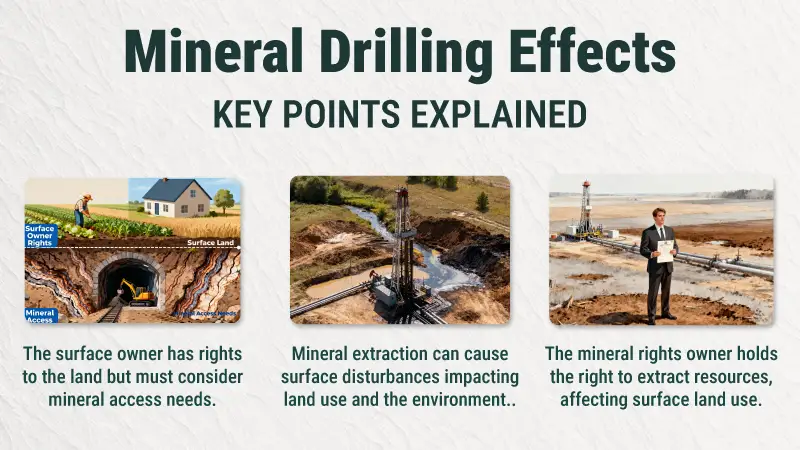
The owner of the mineral rights will have a dominant estate in certain states. This implies that they will be able to get to the surface and touch the minerals underneath, potentially messing up your land. Although a Surface Use Agreement (SUA) is not strictly required in Texas, you are protected by the Accommodation Doctrine. If the mineral owner has a fair, less impactful way to collect their minerals, they must allow your current surface usage (such as a pre-existing barn or home site).
This is a big consideration when you are going to build a dream home or run a ranch or farm.
3. Property Value Dynamics
Land that includes mineral rights may be valued higher than land that does not, especially in areas with active drilling or significant reserves. So, owning only the surface may have implications for resale value or investment potential.
4. Uncertainty About Future Resource Development
The future isn’t always predictable. A property with no current drilling activity could be close to new discoveries or technological shifts that make extraction profitable years later. If you don’t own the mineral rights, you miss out on that upside.
How to Know If You’re Buying Land Without Mineral Rights
It is among the most significant aspects of the purchasing activity. You do not want to think you own what you believe to be the case, particularly underground.
Here’s how to check:
1. Read the Deed Carefully
With the property deed, the inclusion or exclusion of mineral rights should be explicitly mentioned or it may be evident that the mineral rights have been specifically reserved by a past owner. When the deed does not state that there are minerals, it does not mean that you own them; it merely means that the seller did not own them in the first place.
2. Title Search
A title search by a professional may reveal the severance of mineral rights in the past. This can even involve the examination of past records and actions. This is done by many real estate buyers by employing a landman or a titling company.
3. Use Mineral Mapping Tools
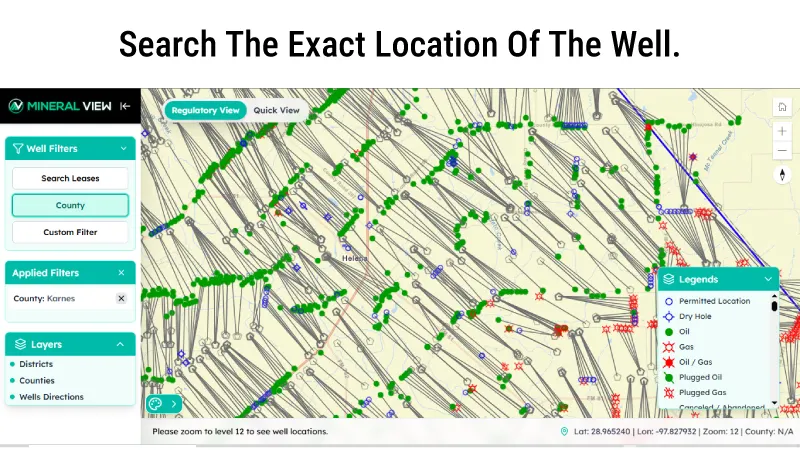
This is where sites such as Mineral View would come in. The mapping feature of it enables you to:
- Search the exact location of the well.
- Understand well status (producing or non-producing).
- Existing wells and drilling permits in a specific area.
- Get historical information on the trends in production and ownership.
Such an understanding can save you the inconvenience of getting into some unpleasant surprises and guide the negotiation strategy.
Should You Be Worried? When Buying Land Without Mineral Rights Might Be Fine
Most buyers should not panic if they find out they are buying land without mineral rights, especially if:
- Their primary interest is the surface (homesite, ranch, farm, or leisure property).
- The area has low or no known resource development.
- They have clear documentation that surface rights are fully theirs.
In many cases, landowners live out their lives enjoying their property without even thinking about mineral rights, as they never come into play in everyday use.
Label: The key here is informed decision-making. If you know what you’re buying, and you’re okay with the arrangement, then buying land without mineral rights can be just fine.
Tips for Negotiating and Closing the Deal
Here are some practical steps if you’re considering buying land without mineral rights:
1. Ask for Price Adjustments
If mineral rights are excluded, you may be able to negotiate a lower purchase price, especially if the seller is keeping potentially valuable rights.
2. Get a Waiver or Surface Use Agreement
If the mineral rights owner is someone known (not a distant investor), you might ask for a surface use agreement that limits how or when they can disturb the surface.
3. Work with Knowledgeable Professionals
A real estate agent, landman, or attorney experienced in mineral rights can help you interpret deeds, negotiate contracts, and protect your interests.
4. Use Technology and Data Tools
Platforms like Mineral View can provide you with:
- Historical drilling maps
- Ownership records
- Production reports
- Lease and permit details
This insight gives you leverage and understanding that typical land buyers don’t have.
A Texas-Focused Perspective
Since Texas is a state so rich in oil, it is useful to contextualize the process of buying land without mineral rights in the Texas context.
In Texas:
- Surface rights are often separated from mineral rights as a result of historic oil and gas interests.
- Mineral rights are also prevalent in the state law, meaning that they can take precedence over the surface use where necessary.
- At closing, the deeds are frequently in a typical format in which the mineral rights are not always transferred over except where specifically expressed.
This fact increases all the more the necessity to verify what rights you are purchasing in Texas and account for that in prices and planning and future ambitions.
Although the Eagle Ford shale is still a significant player, market projections for 2026 indicate a significant change towards the direction of the Permian Basin. Expect more "secondary recovery" activity if you are purchasing in West Texas, where businesses use modern technology to go back to old wells.
Understanding Surface and Mineral Rights Before You Purchase
When it comes to purchasing property in Texas or other energy-producing states, understanding how surface and mineral rights work together, and sometimes separately, is critical for long-term clarity and protection.
In many transactions, mineral rights ownership is already divided, meaning the mineral and surface rights may belong to different parties. While the surface owner or property owner controls day-to-day land use, the right to lease mineral rights often remains with someone else, sometimes a distant investor or family trust.
This separation is why reviewing ownership history matters so much before finalizing a deal. Many potential buyers focus only on the surface when purchasing property, without realizing that underground resources such as oil, gas, or other minerals beneath the land may already be committed to future development.
In active regions, this can include nearby oil wells or the possibility of future gas exploration, which may create a potential impact on land use, access roads, or overall enjoyment of the property.
Proper due diligence helps avoid surprises. This process usually involves checking public records, reviewing a detailed title report, and working closely with a qualified title company that understands land rights in the region.
These records often reveal whether mineral rights holders include individuals, families, or even private companies that specialize in energy development.
Because mineral ownership laws are legal matters governed by state and local regulations, buyers should always confirm what rights are included and what rights are excluded before closing.
For anyone evaluating land in Texas, understanding how surface access, mineral development, and existing agreements interact gives you a realistic picture of what ownership truly means.
Tools like Mineral View can further support this process by helping buyers review activity data, ownership patterns, and development trends tied to specific parcels, adding another layer of confidence before making a final decision.
2026 Tax & Tech Incentives
Many mineral owners assume their land has no value if it hasn’t produced in years, but that is changing. In 2026, Texas introduced new tax incentives, such as HB 3159, that encourage oil and gas companies to restart older, plugged, or inactive wells.
These programs, overseen and permitted through the Texas Railroad Commission, reduce taxes when operators re-enter or restimulate existing wells, making it cheaper than drilling new ones.
Because of this, mineral properties that have been dormant for 10 or even 20 years may see renewed interest. Improved drilling and completion methods now allow operators to recover additional oil and natural gas from formations once thought to be exhausted. For mineral owners, this means quiet properties may not stay quiet, and understanding what you own matters more than ever.
Final Thoughts: Buying Land Without Mineral Rights
Buying land without mineral rights is a common practice, particularly in the energy-rich regions such as Texas and other regions in the United States. It is not necessarily bad but it should be considered with special care before committing.
Being able to comprehend precisely what you are purchasing, what rights you are entitled to, and how to deal with any future changes is going to bring you calmness and secure your investment.
You can purchase land without worrying that you do not know what you have and what you do not have because with the aid of research tools, good professionals, and proper communication with sellers, you can purchase land with certainty. And, when you are unsure, websites such as Mineral View can provide you with a helpful dose of information that makes you look at the big picture as your feet step on the ground.
The best land purchase decision can be made by remaining knowledgeable and proactive regardless of whether the mineral rights accompany the purchase.