To keep ahead in the fast-paced oil and gas industry, one must work smarter, not harder. Yes, even the oil and gas industry involved smart working within it. One such smart way of working is oil and gas automation.
The sector is changing as a result of automation, which makes work safer, quicker, and more effective. Companies can save time, lower hazards, and increase production by utilizing cutting-edge technology to monitor machinery, resolve issues, and optimize procedures.
This blog informs how automation is transforming oil and gas operations and how it can lead to safer and more intelligent outcomes.

The Role of Automation in Modern Oil and Gas Operations
The oil and gas industry is one of the essential industries to the movement of the world economy. Although it helps enhance the economy, it also contains some barriers. Energy price volatility, policy uncertainty, resource depletion, climate legislation, geopolitical concerns, and competition from renewable sources are some of the obstacles the industry must overcome.
Although companies are figuring out how to overcome these obstacles, market research indicates that the need for oil and gas will not change for at least the next 25 years, until renewable energy sources take over the market. The industry's sustained importance is demonstrated by the estimate that the global IoT in the oil and gas market would reach an astounding $43.48 billion by 2030 at a compound annual growth rate of 21.86%.
On the other hand, industries are concentrating on using automation and cutting-edge technologies to improve operations and the effectiveness of aging infrastructure. 94% of the oil and gas sector worldwide has at least one IoT or automation project, with 83% of those projects having advanced to the use stage, per Microsoft's 2019 IoT Signals study.
Other industry leaders like DNV GL support this trend, stating in its Technology Outlook 2023 that this decade may combine cloud computing and sophisticated simulation with digital twins, augmented reality, and virtual system testing, resulting in significant shifts in the industry's outlook.
However, the industry will gain greatly from these technologies in many ways, including real-time data monitoring, seismic research, and subsurface geological analysis, which will lead to notable improvements in machine performance, safety, and profitability.
Why Oil and Gas Automation is Trending?
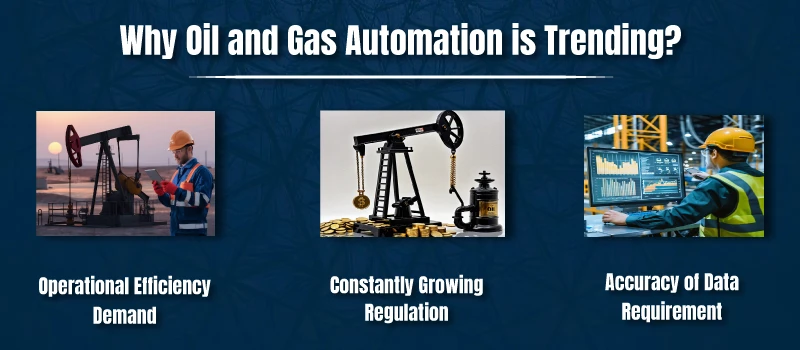
The automation in the oil and gas industry is trending due to the following reasons:
Operational Efficiency Demand
It has been demonstrated that oil and gas automation helps companies automate jobs in order to standardize procedures and evaluate the data gathered. This, in turn, increases productivity by making processes operate much more smoothly and freeing up employees to work on more valuable duties.
Human error is responsible for 60–80% of regular task failures and errors in the oil and gas industry. This number can be significantly decreased by standardizing procedures, confirming the data, and maintaining audit trails.
Accuracy of Data Requirement
In the oil and gas industry, inaccuracy in data can cause safety risks, equipment failure, and economic loss. While accuracy in data helps mineral experts make better decisions, improves efficiency, and reduces errors in drilling, production, and monitoring.
The highest accuracy in data requirements can be achieved by integrating automation in the oil and gas industry.
Constantly Growing Regulation
In the oil and gas sector, growing regulation is a problematic trend that affects almost every aspect of company activities and the supply chain as a whole. The need to mitigate climate change is growing, as is the need from stakeholders to report on sustainability. For oil and gas companies, health and safety reporting and monitoring can be a difficult but crucial responsibility.
The industry has difficulties as a result of these regulatory increases as well as several others in CSR, exploration, etc., but they should also be seen as chances for innovation and gaining a competitive edge.
To reduce such concerns, integrating automation in the oil and gas industry plays a significant role.
These are some major reasons why automation in oil and gas is trending. Along with these, there are several technologies that are now transforming the future of oil and gas automation.
Pivotal Technologies Shaping the Future of Oil and Gas Automation
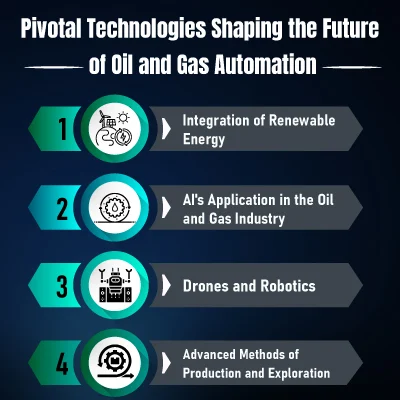
Below are some of the latest technologies that are revolutionizing the future of oil and gas automation.
-
AI's Application in the Oil and Gas Industry
The oil and gas sector is utilizing data science and artificial intelligence (AI) to address complex issues at every level of their operations, including upstream, midstream, and downstream.
In the oil and gas industry, this creative method enables petroleum engineers and managers to find and apply new concepts for exploration and production right in the field, which eventually increases return on investment (ROI).
-
Advanced Methods of Production and Exploration
The oil and gas industry's exploration and production activities have also been significantly impacted by technological improvements. The application of hydraulic fracturing, or "fracking," is another revolutionary development.
In order to recover previously unreachable oil and gas resources, this technique entails pumping fluids at high pressures into rock formations to cause fractures.
Oil and gas output has surged rapidly as a result of fracking, changing the energy landscape and opening up enormous deposits that were previously unprofitable to explore.
-
Drones and Robotics
The oil and gas industry has seen substantial changes in a number of areas due to the use of robotics and drones. Drones, also known as unmanned aerial vehicles (UAVs), are being utilized more and more to check infrastructure from the air, including offshore rigs and pipelines.
Drones with high-resolution cameras and sensors can monitor vegetation growth, find structural flaws, and detect leaks, giving operators visual data in real time.
In dangerous situations, robotic systems are used to lessen the hazards to human operators. They may carry out jobs like pipeline maintenance, repairs, and inspection, reducing the need for human intervention in potentially hazardous circumstances.
-
Integration of Renewable Energy
The incorporation of renewable energy sources is also causing a major upheaval in the oil and gas industry. To lower carbon emissions and increase sustainability, the sector is investing in renewable technologies, including solar, wind, and geothermal energy. In order to lessen dependency on conventional fossil fuel-powered generators, renewable energy systems are being installed in remote oil and gas fields.
Furthermore, offshore platforms no longer require diesel generators to generate electricity because of the widespread usage of renewable energy technology. In the long run, this decreases operating expenses in addition to reducing greenhouse gas emissions. An increasing dedication to a more sustainable energy future is reflected in the oil and gas industry's adoption of renewable energy.
These are the recent technologies that help the oil and gas industry in bringing automation within it. However, to fully implement these automation technologies, there are some potential challenges that need to be addressed.
Navigating the Challenges of Oil and Gas Automation
Below are some challenges in automation in the oil and gas industry.
Expert Employees
According to research, one of the main obstacles to the oil and gas industry's digital transformation is skilled labor, but this doesn't have to be the case. The growing popularity of no-code process automation platforms gives employees, IT teams, or a combination of both the ability to quickly digitize operations.
Resistance to Change
There will be some opposition to the automation of oil and gas, as with any development. Fortunately, this may be avoided with the right strategy for introducing the automation software and providing training and platform access to staff members.
In the oil and gas industry, people may fear job loss, high costs, or system failures. Training, clear benefits, and strong leadership can help overcome this resistance and ensure smooth adoption of automation.
Older Systems
Legacy systems continue to be a problem for many companies, but this need not be an obstacle. By drawing or pushing data to and from legacy systems, automation software has accelerated digitalization for numerous companies. Ready-to-use connectors into ERP, HR, and finance systems are included with oil and gas automation technologies.
These are some potential challenges in integrating automation in oil and gas. To overcome these challenges, training programs should be arranged for existing staff to gain better knowledge in the automation sector. Moreover, the older systems should be replaced with modern systems, considering the automation features. Regardless of these challenges, automation in the oil and gas industry is now putting one step forward in achieving better financial success.
Conclusion
By improving operations' intelligence, safety, and efficiency, automation is transforming the oil and gas sector. Companies may improve data accuracy, streamline operations, minimize human error, and adjust to ever-increasing restrictions by utilizing cutting-edge technology like artificial intelligence (AI), the Internet of Things (IoT), robotics, and digital twins.
These developments ensure long-term relevance in a competitive marketplace by enhancing safety and productivity while also opening the door for sustainable energy integration. Oil and gas automation is the prudent move for a resilient and dynamic future; it is no longer an alternative.