Shut-In Well
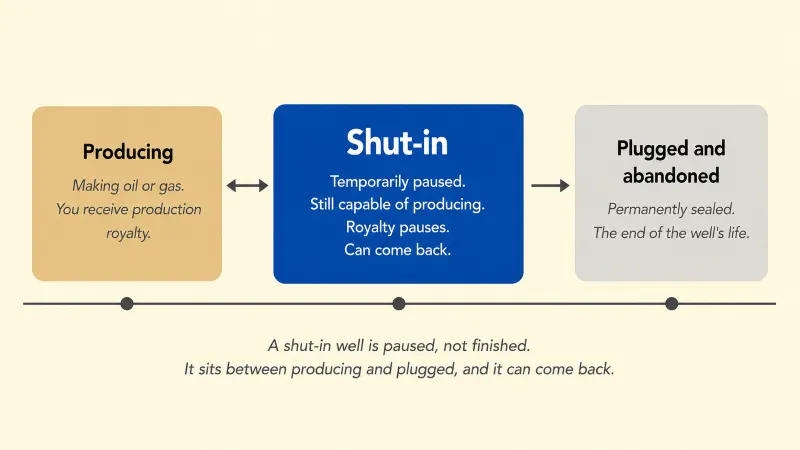
A shut-in well is an oil or gas well that is not currently producing because it has been temporarily closed in, though it may still be capable of producing and is not necessarily abandoned or plugged. A well may be shut in because of low prices, lack of pipeline access, maintenance, market conditions, or other operational reasons.
For mineral owners, a shut-in well usually means normal production royalty from that well pauses. The key lease question is whether a shut-in royalty clause allows the lease to remain active while the well is idle.
What This Means for Mineral Owners
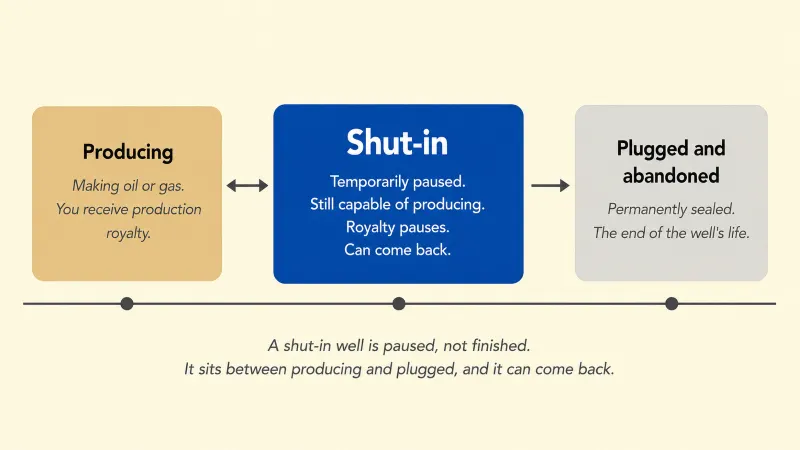
A shut-in well sits in the middle of the well-status spectrum. It is not producing, so normal production royalty from that well usually pauses, but it is also not finished the way a plugged well is. It has simply been paused, and it can come back. For an owner, that creates two practical concerns: your income from the well has stopped for now, and you want to know whether your lease is still safe while the well is idle.
The income side is usually simple. No production from that well generally means no normal production royalty from that well while it remains shut in, although a separate shut-in royalty payment may be owed if the lease requires it. The lease side is where it gets important, because whether your lease survives a shut-in often depends on a specific lease provision and on the operator using it.
Your royalty from a shut-in well generally pauses. With no production, there is usually no production royalty until the well resumes, if it does.
Whether your lease stays alive during the shut-in often depends on the lease's shut-in royalty clause, payment timing, duration limits, and whether the well qualifies under that clause. Without that protection, a prolonged shut-in can put the lease at risk, depending on the habendum clause, cessation clause, savings clauses, and Texas law.
Why a Well Gets Shut In
Wells are shut in for many reasons, and the reason often tells you how long it might last and whether the well is likely to return.
Common causes include low prices that make selling the product temporarily uneconomic, a lack of pipeline or market access (which is especially common for gas wells waiting on a gathering line), mechanical issues or maintenance, and operator decisions tied to timing or infrastructure. A gas well drilled before a pipeline reaches it, for instance, may sit shut in until the connection is built.
Temporary pause or a step toward plugging
Some shut-ins are temporary and the well eventually resumes, while others become long-term inactive wells or move toward plugging, especially if the well is near the end of its useful life. The reason for the shut-in, how long it lasts, and the operator's filings are clues that suggest whether a well is likely to come back or be plugged.
Shut-In Well vs. Shut-In Royalty
These two terms are closely related and constantly confused, so it helps to separate them clearly.
- A shut-in well is a status. It describes a well that is capable of producing but is temporarily closed in.
- A shut-in royalty is a lease payment. It is money paid under a shut-in royalty clause that may help keep the lease alive while a qualifying well is shut in.
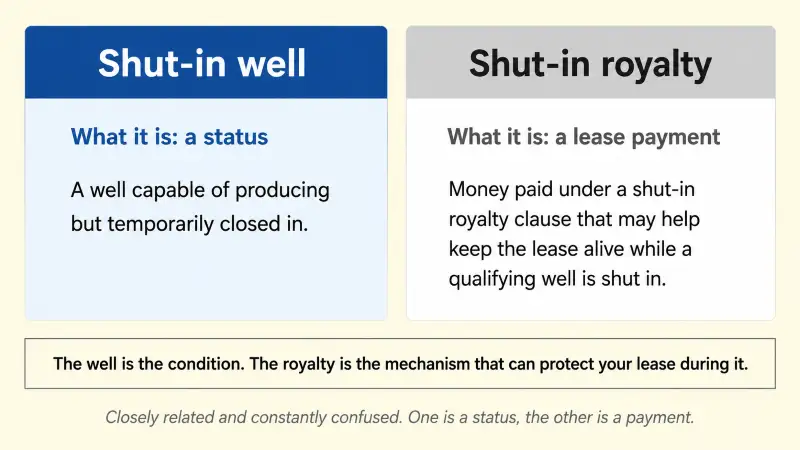
The well is the condition; the royalty is the mechanism that can protect your lease during that condition. A well can be shut in, but lease protection depends on the exact lease language, whether the well qualifies, and whether the lessee or operator satisfies the required payment and timing terms. The shut-in royalty payment itself, including its amount and timing, is governed by the specific shut-in royalty clause in your lease.
Why a Shut-In Well Matters to You
A shut-in well affects you in two ways. The first is income. Because production has stopped, your royalty from that well pauses, which can matter for budgeting if the well was a meaningful part of your income.
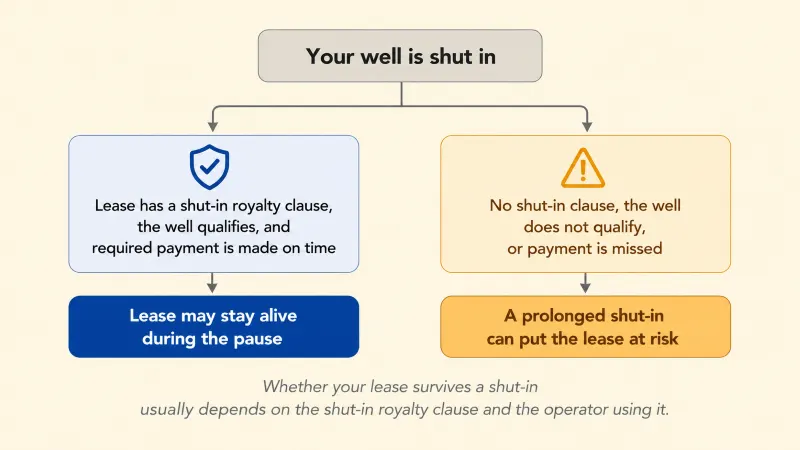
The second is lease protection, and it is the more consequential one. If your lease includes a shut-in royalty clause and the lessee or operator properly pays under it, the lease may remain in effect even while the well is idle. If the lease lacks that protection, or the required payment is not made, a prolonged shut-in can put the lease at risk under the habendum clause or other lease terms.
That outcome cuts two ways: if a lease terminates, the operator's lease rights may end, but your minerals may become available to lease again, subject to title and lease facts.
For owners who want to see a well's current status, Mineral View's Lease Report shows whether a claimed lease is producing or shut in, alongside production and operator information, which is a direct way to confirm what state your well is in.
A Real-World Scenario
Example: George waiting on a pipeline in Reeves County
George owns a royalty interest in a gas well in Reeves County, Texas. The well was drilled and completed, but his expected royalty checks did not begin. When he looked into it, he learned the well had been shut in because the pipeline needed to carry its gas to market had not yet reached the location.
The pause was unsettling until George understood two things. First, the shut-in was about infrastructure, not the well's quality, so the well was expected to produce once the pipeline connection was complete. Second, he confirmed that his lease included a shut-in royalty provision, which meant the operator could potentially keep the lease alive during the wait if the clause requirements were met. Months later, when the gathering line was finished, the well came online and his royalty began. Knowing why the well was shut in and that his lease was protected turned an anxious wait into an understandable one.
Note: This example is provided for illustrative purposes only and does not represent any specific mineral owner or lease.
What to Check
Find out why and how long the well is shut in
The reason for a shut-in tells you a lot. A well awaiting a pipeline is in a different situation than one shut in at the end of its life. Understanding the cause helps you gauge whether and when the well is likely to resume. Mineral View's Lease Activity tracks regulatory filings such as status changes, which is one way to follow when a well shuts in and when it comes back.
Confirm whether your lease is being protected
This is the question that matters most. Check whether your lease has a shut-in royalty clause, whether the well qualifies under that clause, and whether the lessee or operator is making any required payment on time. That is usually what keeps the lease alive while the well is idle, and its absence is what puts a lease at risk during a long shut-in.
Watch for signs the well may be plugged rather than resumed
A shut-in that stretches on, or filings pointing toward plugging, can signal that a well is not coming back. Knowing the difference helps you anticipate whether your minerals might soon be free to lease again.
Important
Mineral View can help you see whether a well is producing or shut in and track activity on your minerals. For questions about whether your lease is still protected during a shut-in, whether shut-in royalties are owed or being paid, or what happens if the well is plugged, consult a qualified landman or Texas oil and gas attorney.
Common Questions
Usually not in the form of a production royalty, because the well is not producing. However, if your lease has a shut-in royalty clause, the operator may make a separate shut-in royalty payment to keep the lease alive during the pause. That payment is generally different from and often smaller than your normal production royalty.
Not necessarily. Many leases allow a qualifying well to be shut in without ending the lease, as long as the shut-in royalty clause applies and the lessee or operator satisfies its requirements. The risk to a lease usually arises when a shut-in is prolonged, the well does not qualify under the clause, required payments are missed, or there is no shut-in protection in place. Whether your lease is at risk depends on its specific terms.
It varies widely depending on the reason and on the lease. A well waiting on a pipeline might be shut in for months, while others resume sooner or, in some cases, never return and are eventually plugged. Many shut-in royalty clauses operate year to year, allowing the lease to be held for successive periods as long as the required payment is made, and some leases cap the total time a shut-in can hold the lease, so the exact limit depends on your lease language.
Start by finding out why the well was shut in, since the reason is the best clue to whether and when it may return. Then confirm whether your lease has a shut-in royalty clause and, if so, whether the well qualifies and any required payment is being made on time, because that is usually what protects the lease during the pause. Watching the operator's status filings over time helps you see whether the well is heading back toward production or toward plugging. Because lease language controls and the facts vary, a prolonged shut-in is worth reviewing with a qualified landman or Texas oil and gas attorney.
There is no guarantee. The reason for the shut-in is the best clue. A well shut in because of pipeline access, temporary market conditions, or maintenance may return to production. A well that has been shut in for a long time, has repeated inactivity filings, or shows plugging-related activity may be closer to being plugged. Mineral owners should watch status records, operator filings, and production history.
No. A shut-in royalty is usually a lease payment made to help preserve the lease while a qualifying well is shut in. It is generally separate from production royalty and is often much smaller. The amount, timing, and effect of the payment depend on the exact shut-in royalty clause in your lease.