BOPD (Barrels of Oil Per Day)
BOPD stands for barrels of oil per day, a measure of how fast a well, lease, or property is producing oil during a specific period. You will usually see it in news, operator announcements, production reports, and purchase offers, often as a headline figure like a well coming online at 1,200 BOPD, rather than on your royalty statement.
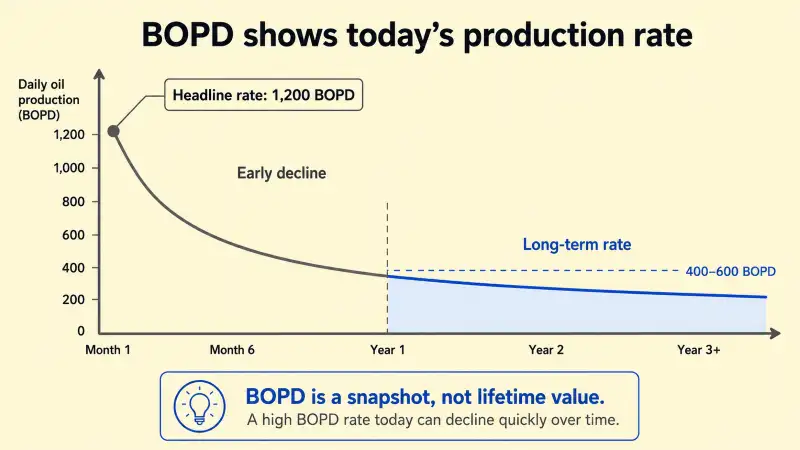
For a mineral owner it is a snapshot of how fast a well is producing during a specific period. It is not a measure of lifetime production, total value, or long-term royalty income, and the rate often declines over time, sometimes sharply.
What This Means for Mineral Owners
BOPD tells you the pace of oil production during a specific period, such as one day, one month, or an average reporting window. You will usually encounter it in news, operator announcements, production reports, and purchase offers rather than on your royalty statement, which typically reports the monthly volumes actually sold rather than a daily rate. A new well's first reported rate, often called its initial production or IP rate, is frequently quoted in BOPD and is often one of the strongest early-life numbers operators report. As an owner, you might hear that "the new well came on at 1,500 BOPD" and reasonably expect large royalty checks to follow.
The catch is that a daily rate is a measurement for a specific period, not a forecast of future production or royalty income. Oil wells, especially many modern horizontal wells, often decline quickly after their early production period, though the exact decline depends on the formation, completion design, pressure, choke management, and operator strategy. A well producing 1,500 BOPD during an early reporting period may be producing far less within a year, in many horizontal wells well under half the opening rate, depending on the decline curve and operating conditions. So a high BOPD is genuine good news, but it describes today, not the years ahead.
A high BOPD figure does not guarantee lasting income. It reflects a production rate for a specific period, and that rate often declines over time. Your royalty income may follow that decline pattern if prices, deductions, uptime, gas and liquids revenue, and your decimal interest remain similar.
BOPD measures oil only. If your well also produces natural gas and liquids, those add to your income but are not captured in a BOPD figure. A gas-heavy well can have a small BOPD and still generate meaningful royalty.
How BOPD Works
A daily rate is calculated by dividing total oil production by the number of days in the measured period. A well that produces 18,000 barrels over 30 days is averaging 600 BOPD for that period.
Average rate vs peak rate
Not every BOPD figure means the same thing. Some report an average over a month or a year, which smooths out the ups and downs. Others report a peak rate, often the best 24-hour or 30-day figure a well achieved, sometimes written as IP24 or IP30. Peak figures are higher than averages by design, so it helps to know which kind of rate you are looking at before drawing conclusions.
Initial production (IP) rates
The IP rate is a headline number for a new well and is often one of the highest early-life rates the well will report, but it may vary depending on the reporting window, flowback, choke settings, and operator reporting method. It can be useful for comparing new wells in the same area and formation, but on its own it says little about how the well will perform a year or five years later.
A worked example
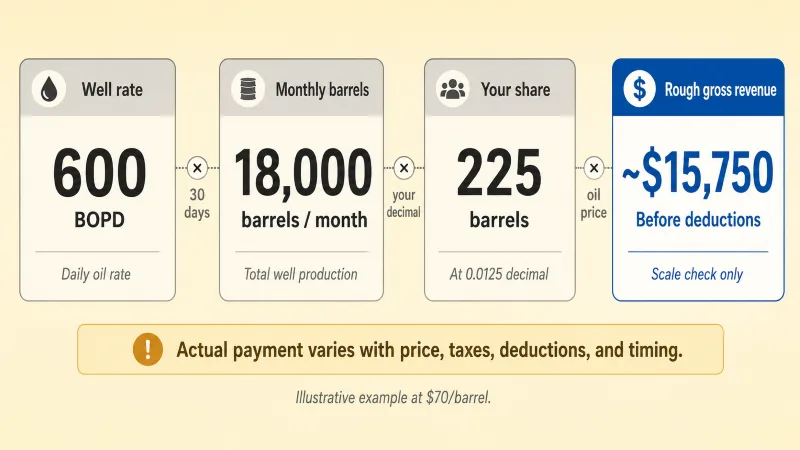
Suppose a well is producing 600 BOPD and your royalty interest works out to a decimal of 0.0125. Your share of the daily oil would be about 600 times 0.0125, or 7.5 barrels per day, which is roughly 225 barrels over a 30-day month. At an oil price of $70 per barrel, that is around $15,750 for the month before severance taxes, post-production deductions, price adjustments, payment thresholds, and other statement-level adjustments.
Treat that only as a rough sense of scale, not a calculation of your check. Actual payments are based on the oil actually sold, the realized sales price, your decimal interest, severance taxes, deductions, payor setup, title review, division orders, minimum-payment thresholds, and applicable Texas payment timing rules. The example shows the basic shape of the math, not a number you should expect to repeat every month.
BOPD vs BOEPD vs MCFD
These rate terms look similar but measure different things.
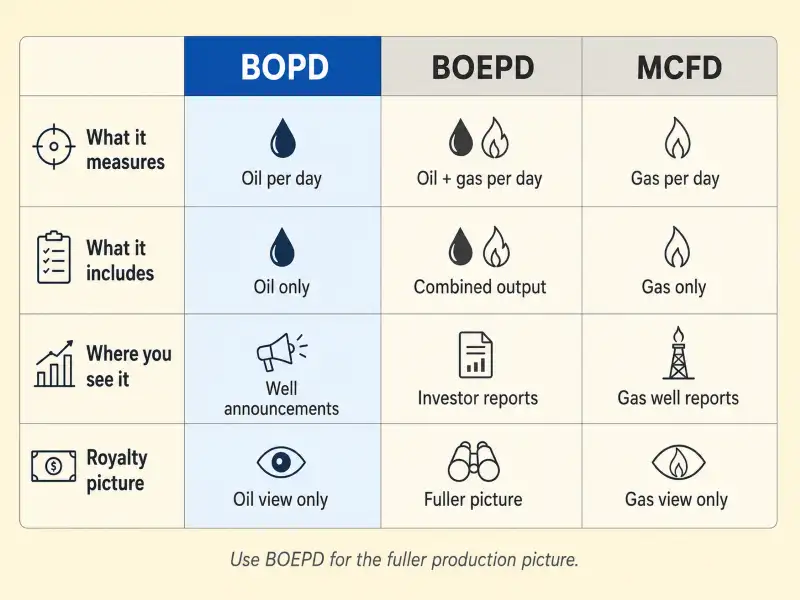
- BOPD measures oil production per day, and nothing else.
- BOEPD measures barrels of oil equivalent per day. It combines oil, gas, and sometimes NGL or condensate volumes into one daily energy-equivalent rate, depending on the operator's reporting method.
- MCFD measures thousand cubic feet of natural gas per day. It is the gas-only rate, the counterpart to BOPD on the gas side. See the MCF glossary page for how gas volume measurement works.
The practical point is that BOPD alone can understate a well's total output if that well also produces gas. To see the full picture, you would look at the oil rate and the gas rate together, or at a combined figure such as BOEPD. The BOE glossary page explains how oil and gas are combined into a single energy-equivalent unit.
Why BOPD Is Useful and Where It Can Mislead
BOPD is useful as a quick measure of how a well is performing and for comparing wells at the same stage of life. A new well's IP rate in BOPD can give a useful first read on how strong the well is relative to nearby wells in the same formation and at a similar stage of life.
Where it misleads is when a single rate is treated as a lasting income level. Three things to remember. First, a rate is not a lifetime total. How much a well ultimately produces over its life is a separate idea, closer to estimated ultimate recovery. Second, rates often decline, and the steeper the early decline, the faster the gap opens between the headline BOPD and what the well actually produces later. Third, BOPD ignores gas, NGLs, and condensate, so it is an incomplete view of income for any well that produces more than oil.
For owners who want to see how a well's rate has changed over time rather than at a single moment, Mineral View's Well Report presents a well-level production history, which shows the decline behind a one-day rate instead of only the peak.
Example Scenario
Example: Linda's horizontal well in Martin County
Linda owns a small royalty interest in a new horizontal well in Martin County, Texas. When the well was completed, the operator announced an early production rate of about 1,800 BOPD, and local news repeated the figure. Linda expected her royalty checks to stay near that early level.
Her first couple of checks were indeed strong. Over the following year, though, the checks shrank steadily, even though oil prices held roughly steady. The well had not done anything wrong. It was following the decline pattern that many new horizontal wells show, dropping from a strong early rate toward a lower, slower-declining level. Once Linda understood that the 1,800 BOPD was a peak starting rate rather than a steady level, the falling checks made sense, and she could plan around a more realistic long-term figure.
Note: This example is provided for illustrative purposes only and does not represent any specific mineral owner or lease.
What to Check
Treat a high BOPD as an early indicator, not a forecast
When you see a strong BOPD figure, especially an IP rate on a new well, read it as an early production indicator rather than the normal long-term rate. The same caution applies to purchase offers: a buyer may lead with a high IP or BOPD because it makes the well, and the offer, look strong, even though that rate reflects early-life performance rather than lasting value. Expect the rate to decline from the early production period, often quickly in the first year. Your royalty income may also decline if prices, deductions, uptime, and other revenue streams remain similar. Mineral View's MVestimate models royalty income across a well's expected life using decline behavior, which gives a fuller picture than a single day's rate.
Check whether the rate is oil only
A BOPD figure leaves out gas and liquids. If your well produces gas as well, your income includes those streams even though they do not appear in a barrels-of-oil rate. Looking at the gas rate or a combined rate alongside the BOPD avoids underestimating the well.
Use the rate to sanity-check, not calculate, your royalty
A daily rate and your decimal interest can give you a rough sense of scale, but they will not reproduce your check. Actual payments depend on volumes sold, realized prices, your decimal interest, severance taxes, deductions, title review, division orders, payor setup, payment thresholds, and applicable Texas payment timing rules. Use the rate to spot when something looks clearly off, not as a substitute for the statement.
Important
Mineral View can help you see production rates, history, and projected income for your minerals. For questions about how a production rate translates into the value of your interest or whether your payments are correct, consult a qualified landman, Texas oil and gas attorney, or mineral appraisal professional.
Common Questions
Usually not. The opening rate is often one of the highest early-life rates a well will report, and production often declines from there, sometimes steeply in the first year for horizontal wells. Your royalty income may follow a similar pattern, often strong early and then settling to a lower, slower-declining level, but the actual dollar amount also depends on prices, deductions, uptime, gas and liquids revenue, and your decimal interest. A high BOPD is good news, but it describes the start, not the long run.
No. BOPD is an oil production rate, not a payment. Your payment depends on the oil actually sold, the realized price, your decimal interest, severance taxes, deductions, and payment timing. It also does not include gas, NGLs, or condensate that a BOPD figure leaves out. The rate can help you understand scale, but it is not your revenue.
It depends entirely on the type of well and where it is in its life. A new horizontal well may come on at hundreds or thousands of BOPD in some areas, while a mature stripper well may produce around 10 BOPD or less and still be worth operating. Because the meaningful comparison is between wells at the same stage, a single BOPD number means little without that context.