Drilling Mud
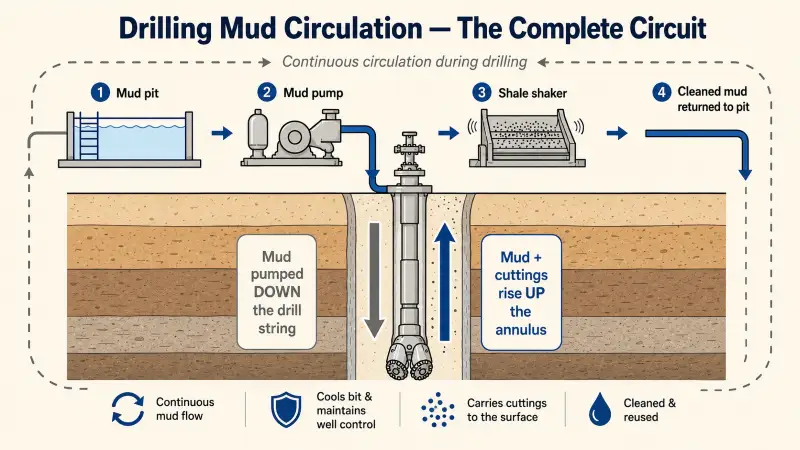
Drilling mud, also called drilling fluid, is the specialized liquid pumped down the wellbore while a well is being drilled. It travels down the drill string, exits through the drill bit, carries rock cuttings back to the surface, and along the way cools the bit, stabilizes the hole, and controls the pressure of the formations being drilled through.
For a mineral owner, drilling mud is part of the drilling phase you usually do not see, but it can affect whether your well is drilled safely, efficiently, and with reduced risk of damaging the rock that holds your oil and gas.
What This Means for Mineral Owners
A well drilled cleanly may avoid costly drilling delays, which can support a smoother path toward completion, first production, and eventual royalty payments. You will not choose your operator's drilling mud, and you usually will not see mud details on standard owner-facing documents or royalty statements. But the way drilling mud is managed can affect two things you do care about: whether drilling stays on schedule and whether the rock holding your oil and gas is protected during drilling.
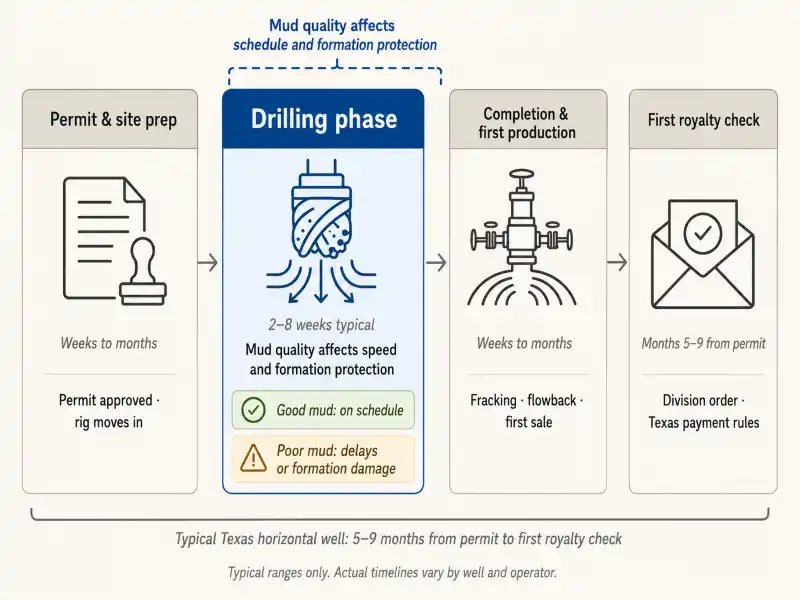
Properly managed drilling mud keeps the drilling phase on schedule by clearing cuttings, stabilizing the hole, and preventing the pressure problems that halt drilling. Poorly managed mud can cause delays, mechanical problems, or "formation damage," which is when the wrong fluid clogs the rock pores that hold your hydrocarbons and reduces how much the well can produce.
Key point for mineral owners
You cannot control any of this. But understanding it helps you read drilling activity, ask informed questions if your well's drilling phase runs unusually long, and appreciate why the gap between spud and first production exists.
What Drilling Mud Does
Drilling mud performs several important jobs during the drilling phase. Four of the most important are cuttings removal, cooling and lubrication, wellbore stability, and pressure control.
Clears rock cuttings
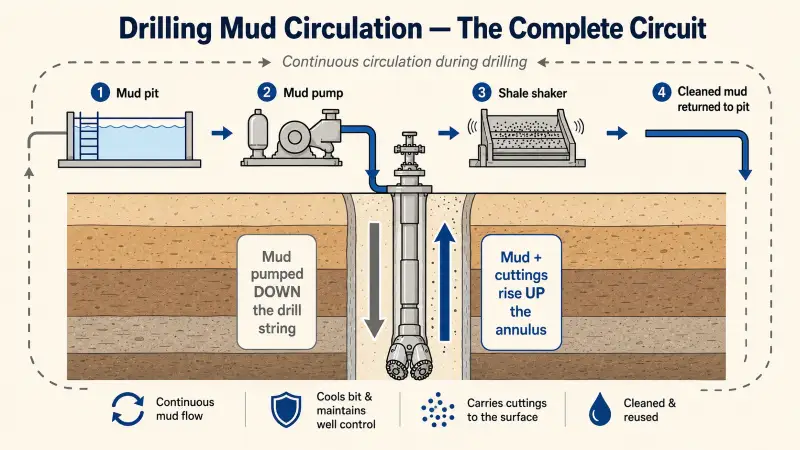
As the drill bit grinds through rock, it produces cuttings that must be removed from the hole. Mud circulates down the drill string and back up the annulus (the space between the drill string and the wellbore wall), carrying cuttings to the surface, where vibrating screens called shale shakers separate the rock from the fluid so the mud can be reused.
Cools and lubricates the bit
A drill bit grinding through rock at depth generates significant heat and friction. Mud flowing through and around the bit cools it and reduces friction, extending the life of the bit and the downhole equipment.
Stabilizes the wellbore
Mud forms a thin layer called a filter cake along the walls of the hole. This filter cake helps hold the wellbore open and prevents drilling fluid from being lost into porous formations, a problem called lost circulation.
Controls formation pressure
This is the safety-critical job. Rock formations at depth hold oil, gas, and water under natural pressure. The weight of the mud column creates downward hydrostatic pressure that counterbalances this formation pressure. If the mud is too light, high-pressure gas can enter the wellbore (a "kick") and, if uncontrolled, lead to a blowout. If the mud is too heavy, it can fracture the formation. Mud engineers monitor and adjust mud weight constantly to keep this balance correct.
Types of Drilling Mud
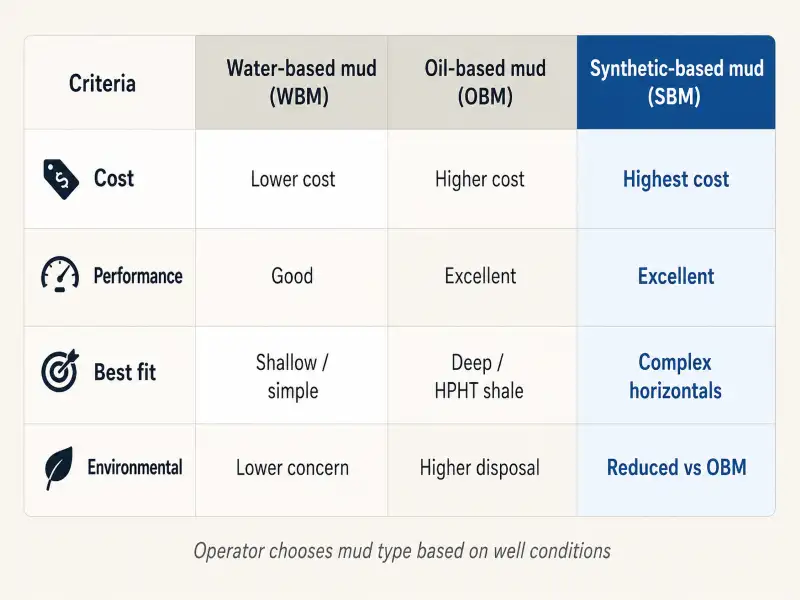
Operators choose among three main drilling mud systems depending on the formation, depth, temperature, and environmental requirements of the well.
Water-based mud (WBM)
The most common and least expensive system, built on a water base with clays and chemicals added. Water-based mud is often used for shallower or less complex sections of a well. It generally carries lower environmental and disposal concerns than oil-based mud, although disposal still depends on additives, salinity, cuttings, and applicable oilfield-waste rules.
Oil-based mud (OBM)
Built on a diesel or mineral oil base. Oil-based mud offers superior stability in shale formations and withstands the high temperatures found at greater depths. It performs well in challenging conditions but carries higher cost and greater environmental and disposal considerations.
Synthetic-based mud (SBM)
Engineered with synthetic fluids that deliver much of the high-temperature, high-stability performance of oil-based mud while reducing environmental risk. Synthetic-based mud may be used in some complex horizontal wells where technical, temperature, stability, or environmental requirements justify it, including certain wells in major Texas plays.
What this means for mineral owners
Mud selection reflects how complex the well is. A modern horizontal well in a deep or high-pressure Texas formation may require a more specialized and expensive mud system than a shallow vertical well, depending on the formation, well design, operator preference, and drilling conditions. The choice is the operator's, made to drill the well safely and efficiently.
How Drilling Mud Affects Your Royalty Timeline
Drilling mud does not appear in your royalty math, but it influences the drilling phase that precedes any royalty income.
On-schedule drilling
When mud is properly weighted and maintained, the drilling phase proceeds without the interruptions that come from kicks, stuck pipe, or lost circulation. A drilling phase that stays on schedule can help the well move more smoothly toward completion and first production, but the first royalty check also depends on first sales, title review, division orders, payor setup, lease terms, and Texas payment rules.
Avoiding formation damage
The right mud chemistry can help protect the rock formation that holds your oil and gas, especially near the wellbore. The wrong mud, or poorly managed mud, can sometimes contribute to formation damage near the wellbore, reducing how freely hydrocarbons flow into the well. This can lower the well's productivity, and a less productive well produces lower royalty income over its life.
Avoiding incidents
A blowout or serious pressure incident can halt a project entirely, trigger regulatory scrutiny, and delay or jeopardize production. Proper mud management is a core part of preventing these incidents.
You cannot usually observe mud management directly, but you can watch broader indicators: a drilling phase that runs within a normal timeline and a well that produces in line with nearby comparable wells may suggest that drilling and completion went reasonably well. Mineral View's Well Report shows drilling depth, operational milestones, and production data, letting you track a well's progress without visiting the site or chasing paper records.
A Real-World Scenario
Example: Robert's Wolfcamp well in Reeves County
Robert owns mineral rights on a 160-acre tract in Reeves County, Texas, in the Delaware Basin portion of the Permian. In 2024, an operator spudded a horizontal well on his lease, targeting a deep, high-pressure section of the Wolfcamp formation.
Robert had no involvement in the drilling and could not see the day-to-day operations. What he could see, through the Well Report on his Mineral View account, was that the well's drilling phase progressed steadily over about eight weeks and reached total depth without extended interruptions.
Behind the scenes, the operator used a mud system selected for the temperature, pressure, and stability challenges of the deep Wolfcamp. The mud engineer maintained the correct mud weight throughout, counterbalancing the formation pressure and preventing the kind of gas kick that can shut down a high-pressure well for days. The hole stayed stable, the bit stayed cool, and the cuttings cleared properly.
The result for Robert: the well reached total depth on a normal timeline, moved into completion, and later began producing after completion, flowback, surface-facility setup, and sales arrangements were completed. His royalty income began after production was sold and the initial payment process was completed, including title review, division-order or payor setup, and applicable payment timing. He never thought about drilling mud, but the careful management of it was one reason his well stayed on schedule.
What to Check
Track the drilling timeline through the Well Report
While you cannot monitor mud management directly, you can track the drilling phase's overall progress. Mineral View's Well Report shows drilling depth and operational milestones. Mineral View's Lease Activity tracks daily Railroad Commission of Texas filings, including drilling progress updates, so you can monitor your well's status in real time. A drilling phase that runs within the normal range for your area can be a positive sign, although it does not prove that every operational detail, including mud management, was handled correctly.
Compare your well's productivity to nearby wells
Once your well produces, compare its output to nearby wells in the same formation. A well that produces well below comparable wells could have many causes, including reservoir quality, completion design, lateral placement, downtime, pressure depletion, parent-child well effects, mechanical issues, or, in some cases, formation damage from drilling. If your well significantly underperforms its neighbors, it is reasonable to ask the operator about it.
Understand that mud selection is the operator's decision
Drilling mud choice is an operational decision the operator makes to drill the well safely and efficiently. Mineral owners do not select or approve mud systems. If you have questions about how a well on your lease was drilled, your operator's owner relations department is the place to ask.
Important
Mineral View can help you track drilling progress, operational milestones, and production data for your minerals. For questions about well performance, suspected formation damage, or operator conduct during drilling, consult a qualified landman or Texas oil and gas attorney.
Common Questions
Not directly. Drilling mud does not appear in your royalty calculation. However, well-managed mud helps the well reach production on schedule and protects the rock formation that holds your oil and gas, both of which affect when your royalty starts and how much the well ultimately produces.
Poorly managed mud can cause "formation damage," where the wrong fluid plugs the pores in the rock near the wellbore and reduces how freely oil and gas can flow into the well. This can lower the well's productivity over its life. A well-chosen and maintained mud system is designed to avoid this. As a mineral owner, you cannot control mud management, but you can compare your well's production to nearby wells to spot a significant underperformance.
Detailed mud system records are usually operator-held operational records and are generally not part of standard public-facing Railroad Commission of Texas production or completion records. If you want to know, you can ask your operator's owner relations department, though they are not required to share operational details. A reasonable starting point is to ask for a brief summary of the mud program used — the type of system, any major adjustments made during drilling, and whether any steps were taken to reduce the risk of formation damage near the wellbore.