Christmas Tree
A Christmas tree is the assembly of valves, gauges, and fittings installed at the top of a completed oil or gas well to control the flow of hydrocarbons out of the well. It takes its name from its tiered, branching shape, which resembles a Christmas tree when viewed from the side. It is usually installed as part of the transition from drilling and completion operations to production, after the well has been prepared for controlled flow.
For a mineral owner, the appearance of a Christmas tree on a well site is a strong visual signal that the well has moved into a late-stage phase, but it does not always mean production or sales have already started.
What This Means for Mineral Owners
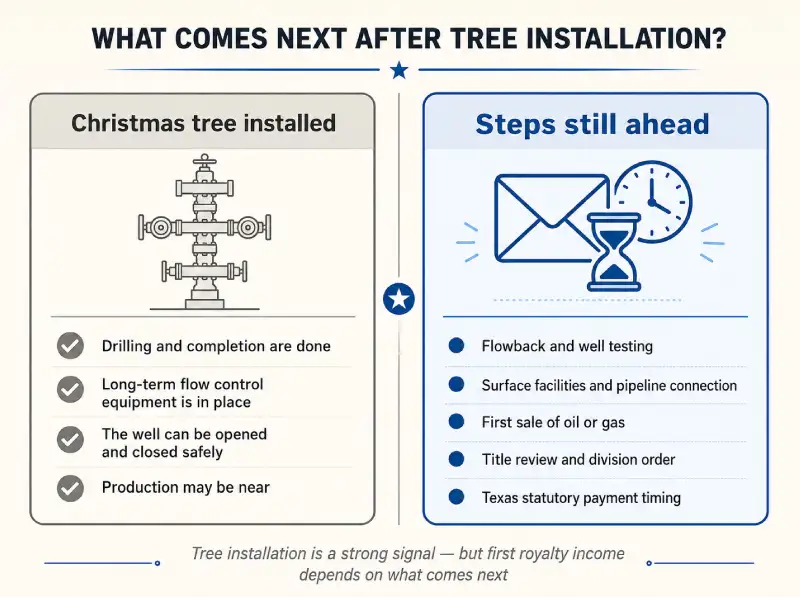
You will not interact with the Christmas tree directly, but its installation is an important milestone showing that the well is being prepared for controlled production. When the drilling rig leaves and the Christmas tree is in place, the well may be moving toward production, but additional steps such as flowback, testing, surface facilities, measurement setup, or pipeline connection may still be needed before royalty income begins.
The tree also serves a safety and control function that protects your royalty income. The valves on the tree let the operator open, close, and adjust the flow of oil or gas from your well. If something goes wrong, the tree provides the shut-off points that prevent uncontrolled releases. A properly maintained tree is part of why a producing well keeps producing reliably, month after month, year after year.
Key point for mineral owners
Understanding what a Christmas tree is helps you read drilling activity reports, recognize a key visual milestone if you visit your land, and appreciate why the gap between completion and first production exists.
Where the Christmas Tree Fits in a Well's Life
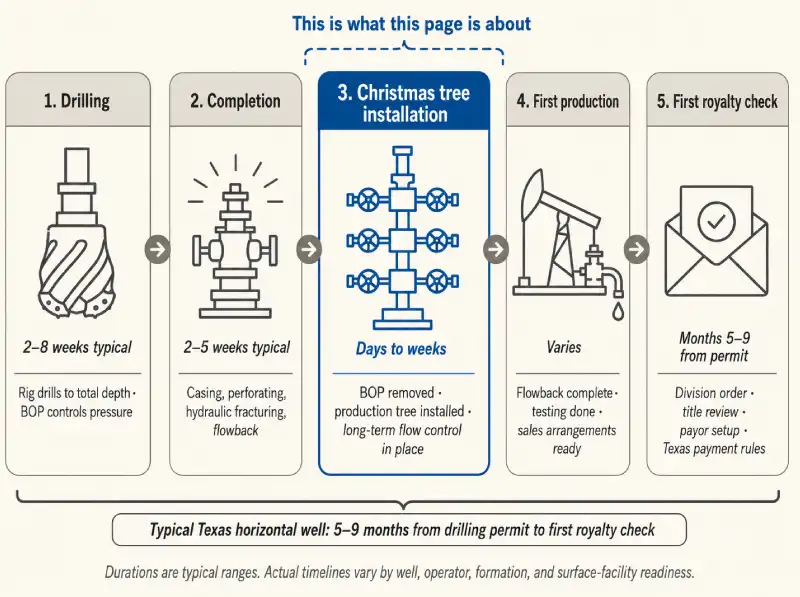
A typical Texas well goes through several phases before producing. The Christmas tree is installed near the end of that sequence, at the handoff from drilling to production.
Drilling phase
The rig drills the well to total depth. During this phase, a different piece of equipment called a blowout preventer (BOP) sits at the top of the well to control pressure if something unexpected happens downhole. The resulting hole is the wellbore the Christmas tree will eventually sit on top of.
Completion phase
After drilling, the well is completed. Casing is typically set and cemented during well construction, and completion may include perforating, hydraulic fracturing for many modern horizontal wells, flowback, and preparing the well for production.
Tree installation
After drilling and completion operations, the blowout preventer or temporary pressure-control equipment is removed, and a production tree may be installed for long-term well control. Tree installation can be relatively quick compared to drilling and completion, but timing varies based on well design, pressure-control requirements, service availability, and surface-facility readiness.
First production
With the tree in place, the operator can control flow from the well, but production may begin only after required testing, flowback, measurement, facility, and sales arrangements are ready. Oil and gas flow from the formation up the wellbore, through the tree, and out into a flowline that carries them to surface facilities for separation and measurement.
For a mineral owner watching the permit-to-payment timeline, Christmas tree installation is one of the late-stage milestones. Once it appears, first production may be near, but delays can still occur because of flowback, surface facilities, pipeline takeaway, testing, weather, operational scheduling, or sales setup.
Main Components of a Christmas Tree
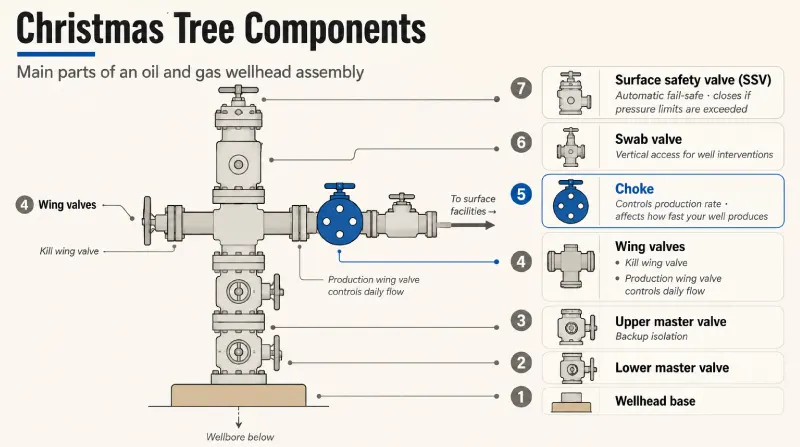
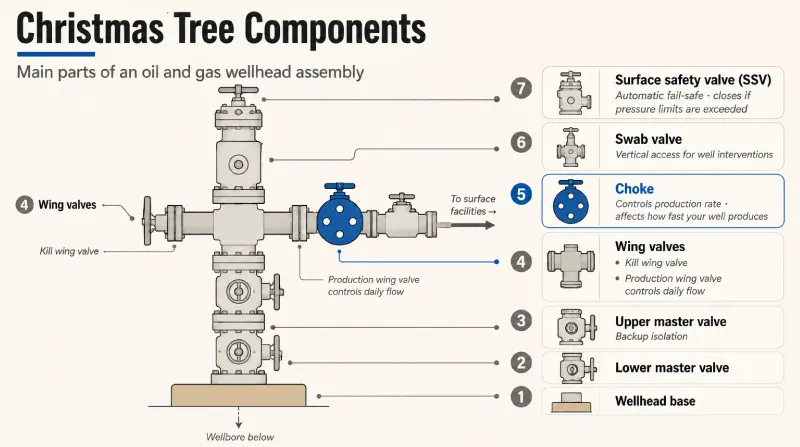
A Christmas tree is a stack of valves and fittings, each with a specific job. You do not need to know every component to understand your well, but a basic familiarity helps when you see references to wellhead work or maintenance.
Master valves
The primary shut-off valves for the entire well. There are typically two master valves stacked on top of each other. The lower master valve is the main isolation point, and the upper master valve provides a backup. Closing a properly functioning master valve can isolate well flow, but actual shut-in procedures depend on the well design, pressure conditions, and operator safety protocols.
Wing valves
Valves on the side of the tree that control the flow into the production line. The production wing valve handles routine daily flow control. The kill wing valve is used during interventions, such as injecting fluids to control pressure for workover operations.
Swab valve
A valve at the very top of the tree that provides vertical access into the well, used during interventions or when running tools downhole.
Choke
An adjustable flow restriction that controls the rate at which the well produces. By opening or closing the choke, the operator can manage the well's production rate.
Safety valves
Many trees include a surface safety valve (SSV) that automatically closes if pressure drops or rises outside safe limits. The SSV is typically held open by hydraulic pressure, so if hydraulic supply is lost, the valve closes automatically, a fail-safe design.
Key point for mineral owners
The tree gives the operator multiple ways to control and shut off the well. This is why operators have multiple control and isolation points, although many wellhead or tree maintenance activities may still require the well to be shut in, depressurized, or secured.
How the Christmas Tree Protects Your Royalty Income
The Christmas tree does not generate royalty income directly, but its proper function protects it.
It controls production rate
The choke and wing valves let the operator manage how fast the well produces. Producing too fast can sometimes reduce long-term performance or create operational issues, while producing too slowly may delay revenue. The operator uses the tree and choke to manage flow based on reservoir, equipment, and safety conditions. The tree gives the operator the tools to find the right rate, which over the life of the well affects how much your minerals ultimately produce.
It enables safe shut-in
When a well needs to be temporarily shut in (for maintenance, infrastructure work, or low gas prices), the tree provides the valves that close the well safely. A well that can be shut in cleanly and reopened later is a well that can outlast short-term operational interruptions.
It reduces the risk of uncontrolled releases
Many trees include safety systems designed to shut in the well under unsafe pressure or operating conditions, helping reduce the risk of uncontrolled releases that could damage the well, the environment, and future production.
It supports maintenance access
When the operator needs to perform a workover or other intervention on the well, the tree's design allows access to the wellbore without having to drill a new well. This extends the productive life of your minerals.
You will not usually see Christmas tree maintenance as a separate royalty-statement item, but proper wellhead control and maintenance can support safe, reliable production over the life of the well.
A Real-World Scenario
Example: Linda's Eagle Ford well in Karnes County
Linda owns mineral rights on a 100-acre tract in Karnes County, Texas, in the Eagle Ford. In 2024, an operator drilled and completed a horizontal well on her lease. Linda followed the activity through her Mineral View Lease Report.
The drilling phase took about six weeks. The completion phase, including hydraulic fracturing, took another three weeks. In late summer, Linda saw the rig leave the site, but the well was not yet producing. She wondered what the gap meant.
The gap was part of the transition from drilling and completion to production: the operator removed temporary pressure-control equipment and installed the production tree and related surface-control equipment. With the tree in place, the operator could begin controlled flow when the well, surface facilities, measurement equipment, and sales arrangements were ready. In this example, first oil flowed within a few days of tree installation.
Linda received her first royalty check after the initial payment process was completed. In Texas, first royalty payments may take longer than ordinary monthly payments because they can depend on first sale timing, title review, division orders, payor setup, and statutory payment rules. Throughout the producing life of the well, the Christmas tree sat at the top of her wellsite, controlling flow and providing the shut-off and safety functions that protected her royalty income, even though Linda herself never touched it or had any reason to.
What to Check
Track production milestones through the Lease Report
Mineral View's Lease Report shows drilling, completion, and production milestones from Railroad Commission of Texas filings. While Christmas tree installation is not always called out as a discrete milestone, the period between completion and first production may include tree installation, flowback, testing, surface-facility work, measurement setup, and bringing the well online. Mineral View's Lease Activity tracks daily regulatory filings — including completion notices and production status changes — so you can see exactly where your well is in the process.
Watch the first-production date closely
First sale of production is the key milestone for royalty payment timing. In Texas, the first royalty payment can take longer than later monthly payments because of statutory timing rules, title review, division orders, payor setup, and minimum-payment thresholds.
Understand that shut-ins are normal
If your well is temporarily shut in for maintenance or operational reasons, the Christmas tree is what makes that safe. A short shut-in is not a sign of failure, and the tree allows the well to be brought back online cleanly. Extended shut-ins are worth asking your operator about.
Important
Mineral View can help you track drilling, completion, and production milestones for your minerals. For questions about a specific well's status, maintenance work, or operational delays, contact your operator's owner relations department or consult a qualified landman or Texas oil and gas attorney.
Common Questions
The production Christmas tree is commonly installed during the transition from completion operations to production, but additional steps may still occur before the well begins regular sales. It replaces drilling or temporary pressure-control equipment and becomes the long-term surface-control equipment for the producing well. Installation may take a short time compared with drilling and completion, but the full transition to production can also depend on flowback, testing, facilities, measurement, and sales connections.
Not directly. The tree does not change your royalty calculation. It does, however, give the operator the tools to manage your well's production rate, perform maintenance safely, and prevent the kind of incidents that could shut down production. In that indirect sense, the tree helps protect your royalty income over the producing life of the well.
Yes. Once a well is in production, the Christmas tree is the most visible piece of equipment at the wellsite: a stack of valves, gauges, and fittings, usually painted in safety colors, rising several feet above ground level. If you visit your land and see a tree in place, the well may be producing, shut in, undergoing testing, or ready for production, depending on its current operating status. The tree typically looks like a vertical assembly of steel pipe bodies and valve handwheels, roughly the size of a large chest freezer in its footprint and three to six feet tall.