There was an era when engineers had to dedicate extensive time to analyzing the data associated with the oil and gas sector. Today, however, these tasks are completed much more quickly. This rapid advancement is thanks to the application of AI in the oil and gas industry.
This represents an incredible achievement in innovation! But what exactly does AI mean for the oil and gas sector?
It is transforming the whole world, and so why will the tide of the AI revolution leave behind these pivotal sectors?
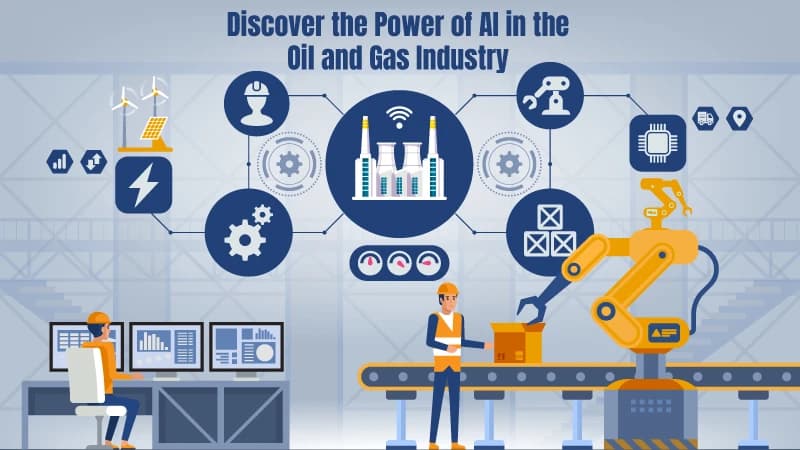
This article will help you discover the power of AI in the oil and gas industry.
Nowadays, artificial intelligence can execute nearly any task almost instantaneously. Recognizing these capabilities, geoscientists and engineers have embraced the integration of AI into the oil and gas industry.
This move is now revolutionizing the entire oil and gas sector. First, let's define what AI is.
Introduction to Artificial Intelligence
All of us have at least once heard about a technology called ‘Artificial Intelligence’. But did you happen to go through every aspect of it? It is the latest technology that is made to perform tasks without human intervention.
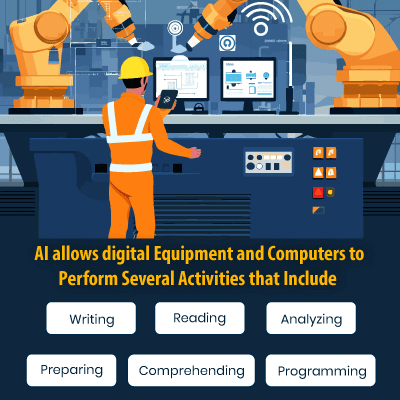
This technology performs tasks autonomously, using its own intelligence. AI allows digital equipment and computers to perform several activities that include popular tasks like writing, reading, comprehending, preparing, programming, analyzing, and so on.
AI is a technology that is closely associated with the field of computer science. Put simply; AI is the field that combines complex data sets and computer science to tackle problem solving. This includes sub-disciplines like Machine Learning and Deep Learning. These sub-fields are often mentioned after AI as the AI-ML algorithm.
AI is transforming every sector rapidly. And so entered in the oil and gas industry! The industry has also adopted AI technology to optimize operations and boost productivity.
When combined with robotics or other technologies, its effectiveness has been demonstrated in drilling, data analytics, environmental monitoring, and more within the oil and gas sector. But how does AI in oil and gas exactly function? Let's get to know about AI in the oil and gas industry.
About AI in the Oil and Gas Industry
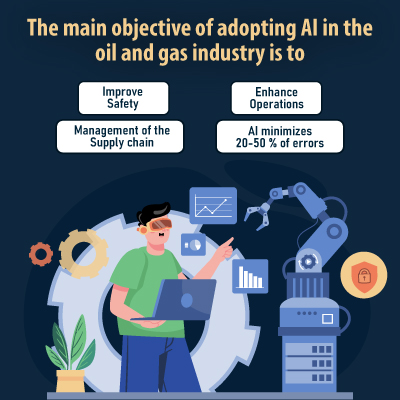
AI has become a popular choice in the oil and gas industry. The oil and gas sector uses AI algorithms and digital innovations to enhance production, and this trend is anticipated to continue in the future. Recently, during the Covid-19 pandemic, there was a significant push to accelerate AI optimization.
AI is a significant player in achieving quick processes, reducing costs, and improving sustainability. The primary goal of integrating AI in the oil and gas industry is to enhance safety, streamline operations, and manage the supply chain more effectively. AI reduces errors by 20-50%.
It also plays a crucial role in elevating safety standards and preventing disasters. This is achieved by closely monitoring infrastructure and platforms for any signs of leaks or spills. Several leading US oil and gas companies are adopting AI to enhance productivity and security.
They are refining automated drilling operations to enable more accurate drilling. They also focus on rapid data interpretation and enhancing worker safety using AI. The implementation of AI is elevating the entire oil and gas sector. Now, let’s delve into the detailed insights on how AI diversifies the oil and gas sector.
Applications of AI in the Oil & Gas Industry:
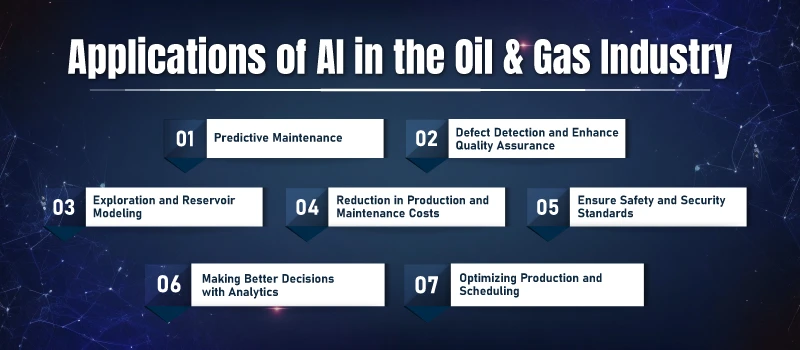
AI is transforming the oil and gas sector rapidly. Here is an exhaustive overview for applications of AI in the oil and gas industry.
Predictive Maintenance:
A key advantage of AI is its ability to analyze vast amounts of data and identify patterns and trends. Human workers may sometimes fail to identify such patterns. Sensors integrated with AI algorithms can detect equipment failures before they occur.
Oil and gas companies now utilize AI specifically to predict equipment failures. To analyze the sensor data from various devices such as turbines, compressors, and pumps the AI algorithm can be put into service. Oil and gas companies can use AI to optimize predictive maintenance and efficiently prepare maintenance schedules. It also helps to minimize the downtime.
Defect Detection and Enhance Quality Assurance
The oil and gas industry may often face issues like defects in error-prone mechanisms or spotting inappropriate threading. Such issues can affect operations. Defects stemming from upstream issues can manifest at the end of the production line. This can result in substantial financial losses and operational disruptions. Using defective equipment or pipelines in production activities can lead to significant damage.
The cost of damage recovery is significantly higher, making AI implementation a preferable alternative. Implementing a Computer Vision-Based System can analyze the production quality and offer detailed defect insights in analytics. These AI-powered defect detection techniques are less costly and offer improved quality assurance. Several oil and gas companies often prioritize this technique for quick detection of defects and enhanced quality assurance.
Exploration and Reservoir Modeling:
Often, analyzing the geological conditions of an area is time-consuming. To facilitate this, an AI algorithm can be employed. AI helps to analyze detailed seismic data and other land data. It reduces excessive time and provides data accuracy. The AI adoption assists engineers and geologists in finding the potential areas for enhanced exploration and evaluating the shape and size of the oil and gas reservoirs. Utilizing AI improves accuracy and performs efficient operations. Ultimately, this results in more secure and enhanced exploration, along with improved reservoir modeling.
Reduction in Production and Maintenance Costs
The extracted oil and gas are stored in a central repository, and later it is distributed across pipelines. Oil and gas components can experience corrosion and degradation from various environmental conditions. The corrosion produces deformation of components that may weaken the pipeline. Disregarding such concerns may generate catastrophic damage, affecting the whole production procedure. Therefore, to overcome this, extra production and maintenance expenditure is required.
Implementing AI can avert such concerns. AI and IoT techniques can identify the signs of corrosion. AI utilizes predictive intelligence and knowledge graphs to determine the possibility of corrosion events and raise alerts to pipeline operators. With this solution, oil and gas companies can effectively minimize corrosion risks. Additionally, based on the analysis of the knowledge graph, the operators can study several machinery downtimes and carry out appropriate maintenance schedules. By this way, oil and gas companies can get rid of additional production and maintenance costs.
Ensure Safety and Security Standards
The oil and gas production plants operate in complex environmental conditions. There is a strong risk of injury occurrence. The workers in oil production plants perform their tasks under various temperature ranges. These ranges may exceed toxic fumes. Also, the workers must acknowledge several moving mechanisms. Therefore, workers need to follow all the safety protocols to avoid any injury or accident and any financial penalties. At times, intense work pressure can lead workers to overlook safety protocols.
During such situations, utilizing AI becomes beneficial. The oil and gas production plant can make use of AI-Powered Computer Vision. This technique can monitor the working site to ensure the workers are following all the safety protocols while working. It is done without any human interference. The AI algorithm holds the Camera Data, which is analyzed to send proactive recommendations and alerts to the management. If any smallest deviations in workers are found, AI detects it and alerts the management.
Making Better Decisions with Analytics
The oil and gas business holds the challenge of handling a large amount of data that comes from manufacturing processes. Sometimes, it becomes complex to capitalize on such excessive data present in data silos due to the unavailability of adequate analytical devices. Oil and gas companies often hire a Data Engineer to analyze a huge amount of data manually. However, hiring an engineer involves an additional expense. However, it is hard for engineers to analyze the massive amount of data in a single day of operations.
In such a scenario, utilizing Big Data-Powered AI applications may analyze accurate data. To receive predictions out of vast data sets, AI can be accessed to collect the information into the segments and uncover the inconsistencies. AI algorithms analyze several streams of data from multiple sensors and machineries or from whole geoscience data. It performs real-time analytics to develop intelligent suggestions as per business requirements, enabling geoscientists to make better decisions with analytics.
Optimizing Production and Scheduling
The recently published report of OnePetro informs that offshore oil undertakings may deal with challenges like cost and schedule overruns. These concerns arise due to scheduling issues, resource limitations, and inappropriate weather conditions. These concerns arose due to complicated activities such as the installation of platforms and offshore drilling.
To overcome such challenges, it is necessary to carry out proper scheduling models and crucial planning that is responsible for such risks and factors. Using AI here would be the better choice. AI tools may help forecast equipment failure and optimize production. The cloud platform associated with AI also delivers advanced analytics to identify any peculiarity in data, signaling some issues with devices. It helps optimize production and scheduling.
The Impact of Artificial Intelligence on the Oil and Gas Industry
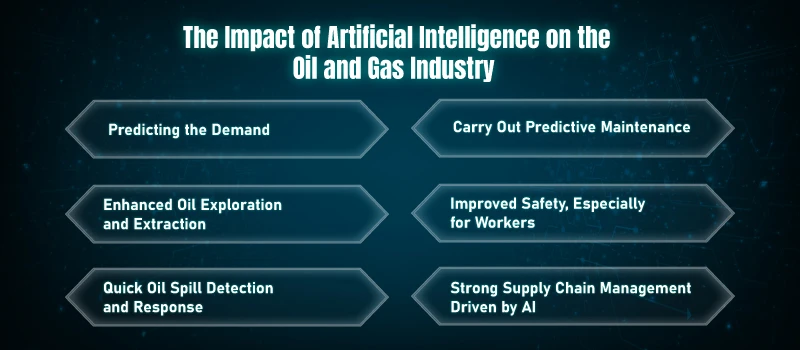
The oil and gas sectors are commonly known for their crucial operational surroundings and complexity. This sector consists of multiple operational activities. Operations such as drilling, extracting, transporting, and so on are included in the overall production process. With modern-day tools and provisions, monitoring and managing all such undertakings effectively may become a tough task.
However, the assimilation of AI in the oil and gas industry has brought a positive impact on almost all attempts belonging to the oil and gas industry. ‘Mordor Intelligence’ carried out market research recently. It states that between 2024 and 2029, AI in oil and gas is anticipated to account for 11.68% of CAGR (Compound Annual Growth Rate).
The huge oil and gas sector is now capable of analyzing all their data of location in a single spot, which is due to AI ensuring monitor and manage all the plants remotely that are associated with the whole sector. With so many benefits, AI helps them work faster and make better judgments. Additionally, with the ability of AI to analyze large data sets and study patterns is reshaping the oil and gas sector the way ahead we thought.
The huge oil and gas sector is now capable of analyzing all their data of location in a single spot, which is due to AI ensuring monitor and manage all the plants remotely that are associated with the whole sector. With so many benefits, AI helps them work faster and make better judgments. Additionally, with the ability of AI to analyze large data sets and study patterns is reshaping the oil and gas sector the way ahead we thought.
Predicting the Demand.
Carry Out Predictive Maintenance.
Enhanced Oil Exploration and Extraction
Improved Safety, Especially for Workers.
Quick Oil Spill Detection and Response.
Strong Supply Chain Management driven by AI.
Conclusion
The integration of AI in the oil and gas industry has given birth to a new era of enhanced productivity and efficiency. With the capability of handling large quantities of data, AI delivers predictive maintenance, improved defect detection, and increased safety standards. Additionally, AI is responsible for improved production, right scheduling, and supply chain management.
AI is taking the whole oil and gas sector towards strong profit margins. It is also beneficial as it saves the overall costs by 10-20%. The market for (artificial intelligence) AI in the oil and gas sector in the United States is expected to reach $4.21 billion by 2028, according to various reports.
With its cutting-edge applications tailored to market needs, the oil and gas sector is poised for economic growth and increased productivity in the coming years. The involvement of AI will surely bring the oil and gas sector to a sustainable future. Stay tuned to MineralView.com for more such extensive articles and information, as well as data tools for the oil and gas industry!.
FAQ’s
What is Artificial Intelligence?
Artificial Intelligence is a modern-day innovation that aims to make machines think on their own. With the integration of AI, machines can perform their task on their own using their self-intelligence without human intervention.
What is the Role of AI in the Oil and Gas Industry?
AI plays several roles in the oil and gas industry. Some of them are to Analyze vast Data Sets, Enhance Production, Carry out Predictive Maintenance, Improve Efficiency, and many more.
How is AI used in Oil Drilling?
With the help of machine learning algorithms, AI is able to analyze excessive geological data to forecast the probability of discovering oil and gas reservoirs. It helps companies to drill in a high potential area only.
Will AI Completely Replace Human Employment in the Oil and Gas Industry?
There’s no wonder that AI is enhancing the oil and gas sector in several ways, but it can’t replace humans totally. Though AI performs all the crucial tasks, human employment is required to monitor and handle them.