Held by Production (HBP)
Held by production, often shortened to HBP, is the status of an oil and gas lease that has moved past its fixed primary term and is being kept in force by qualifying production, usually production in paying quantities. For a mineral owner, that status matters: while a lease is validly held, the existing lease terms generally continue, and you usually cannot re-lease those same minerals or force a renegotiation. A lease can stay held this way for years, even decades, as long as a qualifying well keeps producing.
What This Means for Mineral Owners
The single most important thing to understand about HBP is that it generally keeps your existing lease in place beyond the primary term. The bonus, royalty rate, and lease terms you or a previous owner agreed to may continue for as long as the lease remains validly held, unless the lease is amended, partially released, or affected by a specific lease provision. You generally cannot capture today's higher royalty rates or sign a new lease covering the same held minerals while the existing lease remains validly held by production.
This matters most to owners who inherited minerals under an old lease, or who signed years ago when royalty rates were lower. If nearby owners are signing new leases at better terms and your minerals are validly held by production, you generally cannot lease those same held minerals again unless the existing lease terminates, is released, or no longer holds the relevant acreage or depths.
An HBP lease can persist for a very long time, even decades, if a low-producing well continues to satisfy the lease's production-in-paying-quantities or other lease-saving requirements.
A modest stripper well producing only a few barrels a day may be able to hold a lease in force year after year, but the result depends on production in paying quantities and any Pugh, retained-acreage, depth, pooling, or continuous-development clauses in the lease.
The existing lease terms generally remain in effect while the lease is validly held. You usually cannot re-lease the same held minerals, renegotiate the royalty, or collect a new lease bonus unless the lease terminates, is released, or the parties agree to amend it.
How a Lease Becomes and Stays Held by Production
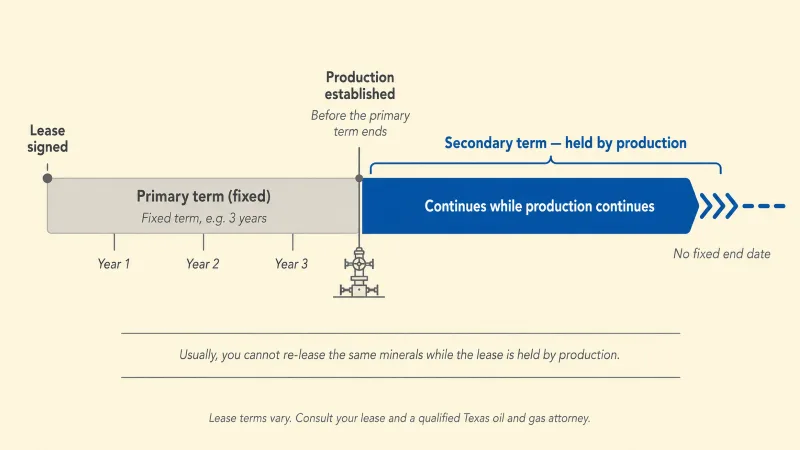
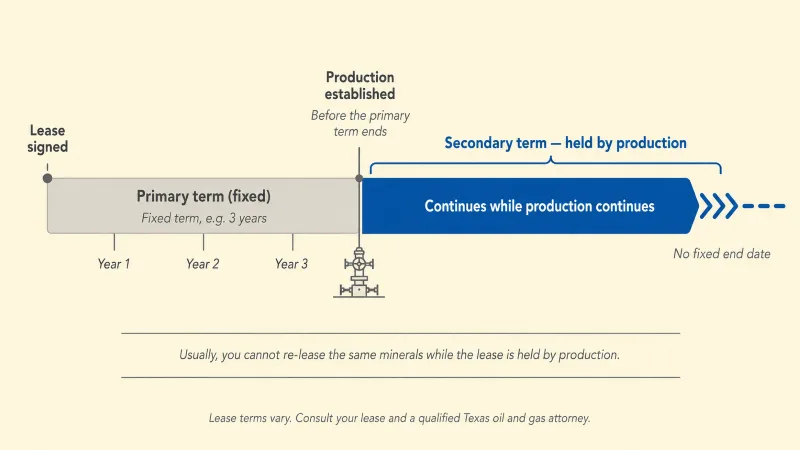
A lease typically becomes held by production when qualifying production is established before the primary term ends, carrying the lease into its secondary term under the lease's habendum clause or related lease-saving provisions. The mechanics of that transition belong to the habendum clause, and the habendum clause page covers the primary and secondary terms in detail. What matters here is the ongoing condition that follows: the lease is now kept alive by qualifying production or another lease-saving provision rather than simply by the fixed primary-term clock.
To keep a lease held, production generally must meet the standard of production in paying quantities, a fact-specific test that considers whether the well produces profit over operating expenses over a reasonable period and, in some cases, whether a reasonably prudent operator would continue operating it.
A well producing at a sustained genuine loss may not satisfy that standard, but the answer depends on the lease language, operating costs, revenue history, temporary conditions, and applicable Texas law.
Production may not have to be physically on your tract
If your minerals are validly pooled into a unit, production from a well within that pooled unit may hold your lease or the pooled portion of your lease, depending on the lease language, pooling clause, unit designation, and applicable law. Owners are sometimes surprised to learn their lease may be held by a well they cannot see from their property.
One well may hold a large lease, depending on the lease
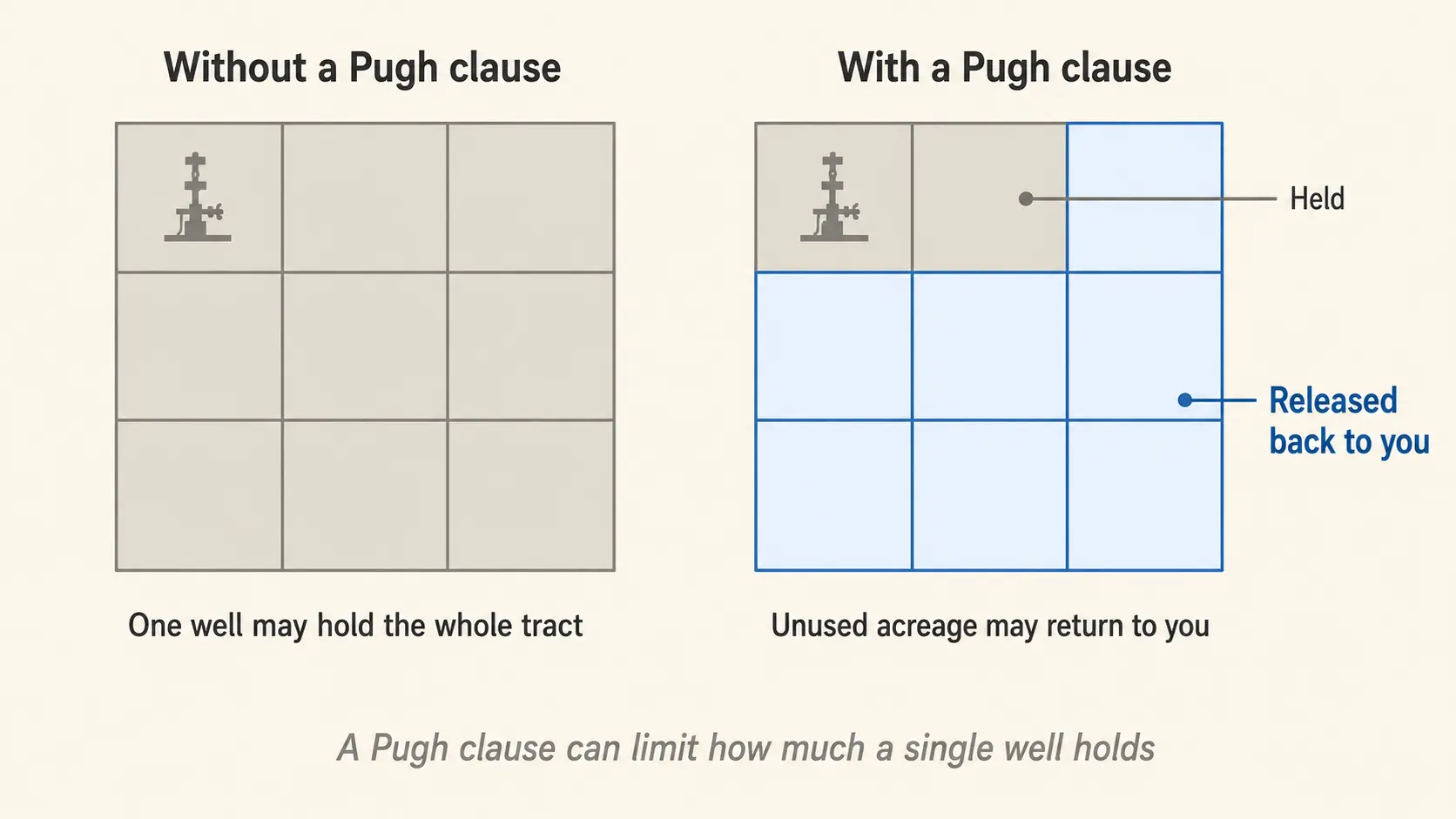
Unless the lease says otherwise, a single producing well may hold all leased acreage and depths, not just the area around the well.
However, Pugh clauses, retained-acre clauses, depth clauses, pooling provisions, and continuous-development clauses can limit how much acreage or depth remains held. This is why a Pugh clause, retained-acreage clause, depth clause, or continuous-development clause can matter so much to owners with larger tracts or multiple producing depths.
Held by Production vs the Habendum Clause
These two are closely related and easy to blur together, so it helps to separate them clearly.
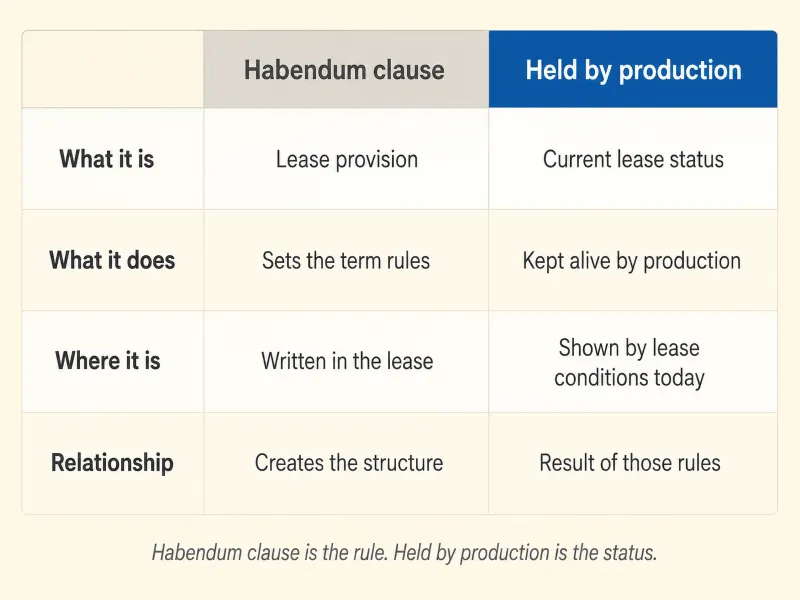
In short, the habendum clause is the rule, and held by production is what you call a lease that the rule is currently keeping alive. In most leases, the habendum clause provides the basic rule for when the lease can continue beyond the primary term, while shut-in, cessation, continuous-operations, pooling, retained-acreage, and other clauses may also affect when held status begins, continues, or ends.
Why Being Held by Production Matters to You
The reason HBP deserves an owner's attention is that it can limit your ability to re-lease, renegotiate, or separately develop the minerals covered by the existing lease while that lease remains validly held. A few practical consequences follow from that.
Your terms are fixed. If your lease carries an older, lower royalty, you generally remain at that rate while the lease is validly held, even if newer leases in the area offer better terms. You also generally will not receive a new lease bonus for the same held minerals because no new lease is being signed.
The hold can outlast your expectations. Because even a small well can sometimes satisfy production in paying quantities, a lease can remain held long after the strongest early production has tapered off. Owners who assume an aging well will automatically free up their minerals soon may be surprised to find that the lease can continue for many more years if the well still satisfies the lease requirements.
One possible path to flexibility is partial release. A Pugh clause, retained-acre clause, depth clause, or continuous-development clause may release acreage or depths that are not included in production or development, returning part of your minerals while the producing portion remains held. Without that type of limiting clause, more of the lease may remain held than the owner expects, depending on the lease language and production facts.
To check whether your lease is currently producing and may still be held, Mineral View's Lease Report shows a claimed lease's status, such as Producing or Shut-In, alongside production and operator information, which is a practical starting point for understanding where your lease stands.
A Real-World Scenario
Example: Ellen's inherited lease in Reagan County
Ellen inherited a mineral interest in Reagan County, Texas, under a lease her grandfather had signed many years earlier at a one-eighth royalty. When several of her neighbors began signing new leases at noticeably better royalty rates, Ellen wanted to do the same.
When she looked into it, she learned her minerals were held by production by an old, low-volume well that was still producing steadily, if modestly.
Because the lease appeared to be validly held, she generally could not sign a new lease covering the same minerals or force a royalty renegotiation. The older terms stayed in force. Ellen also discovered her lease had no Pugh clause, retained-acreage clause, or depth limitation, so the single producing well appeared to hold all of her leased acreage rather than only the portion around the well.
Understanding that her minerals could remain committed while the well continued producing in paying quantities helped her set realistic expectations and plan accordingly rather than expecting a quick new lease.
Note: This example is provided for illustrative purposes only and does not represent any specific mineral owner or lease.
What to Check
Confirm whether your lease is actually still held
A lease is generally held while qualifying production continues, unless another lease-saving provision also applies. If the well has stopped producing in paying quantities and no shut-in, cessation, continuous-operations, pooling, force majeure, or other savings provision applies, the lease may have terminated, which could free some or all of your minerals. Watching production, well status, regulatory filings, and operator activity helps you identify when lease status may need review.
Mineral View's Lease Activity tracks regulatory filings such as production updates and status changes, so you can see when production may have stopped without waiting for a statement.
Check for a Pugh clause that could free unused acreage or depths
If you own a larger tract or your interest covers multiple depths, a Pugh clause, retained-acreage clause, depth clause, or continuous-development clause may release parts of the lease that are not included in production or development. Knowing whether your lease has one helps you understand whether all of your minerals may be held or whether some acreage, depths, or formations may be released.
Set expectations about re-leasing
While a lease is validly held by production, you generally cannot re-lease the same held minerals or force a renegotiation. You can, however, sometimes negotiate directly with the current operator, who may agree to amend the lease, release acreage or depths it is not developing, or modernize certain terms, although the operator is generally not required to do so. If you believe the lease is no longer held because production has stopped or become uneconomic, that is a separate title and lease-interpretation question worth confirming with a qualified professional before signing a new lease or taking action.
Important
Mineral View can help you see whether a lease is producing, shut in, or showing recent activity. For questions about whether a lease is still validly held, whether it may have terminated, or how a Pugh clause applies to your minerals, consult a qualified landman or Texas oil and gas attorney.
Common Questions
Generally no. While an existing lease is validly held by production, the minerals covered by that lease are committed to it, and you usually cannot sign a new lease covering the same held rights with a different operator.
The ability to re-lease usually returns only after the existing lease ends or releases the relevant rights, which may happen when production in paying quantities stops and no lease-saving provision keeps the lease alive.
One thing you may encounter is a top lease, a new lease an operator signs now but that only takes effect if and when your existing lease terminates. Top leases are sometimes offered when minerals are held but an operator wants to secure them ahead of others. Because a top lease turns on timing and title questions that depend on when the old lease ends, it is worth reviewing with a qualified professional before signing one.
There is usually no fixed time limit once a lease is validly held into its secondary term. A lease may remain held for as long as qualifying production in paying quantities continues and the lease requirements are satisfied, which can be many years or even decades. Because even a low-volume well can sometimes satisfy that standard, an aging lease may stay held long after its strongest production years have passed.
The relevant standard is usually production in paying quantities, a fact-specific standard that considers revenue, operating costs, the time period reviewed, and whether a reasonably prudent operator would continue operating the well for profit. A well producing very little may still meet that standard, or it may not, depending on revenue, operating costs, production history, market conditions, and lease language.
As this can be a close and fact-specific question, a well that appears to be barely producing is worth reviewing with a professional rather than assuming the lease is or is not still held.