Accommodation Doctrine
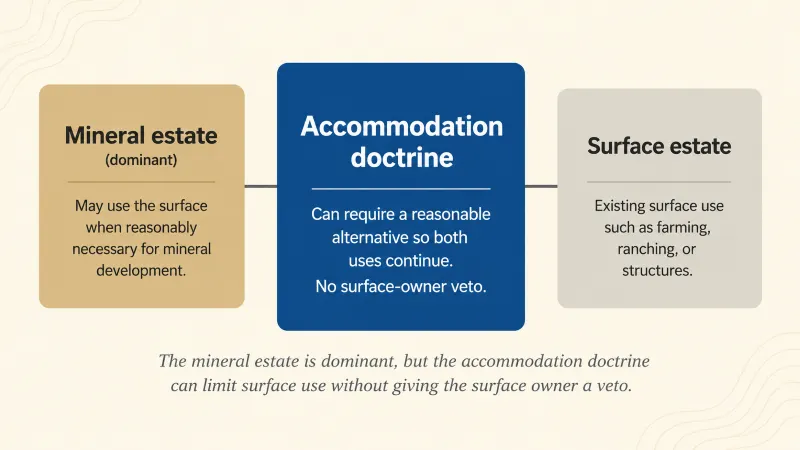
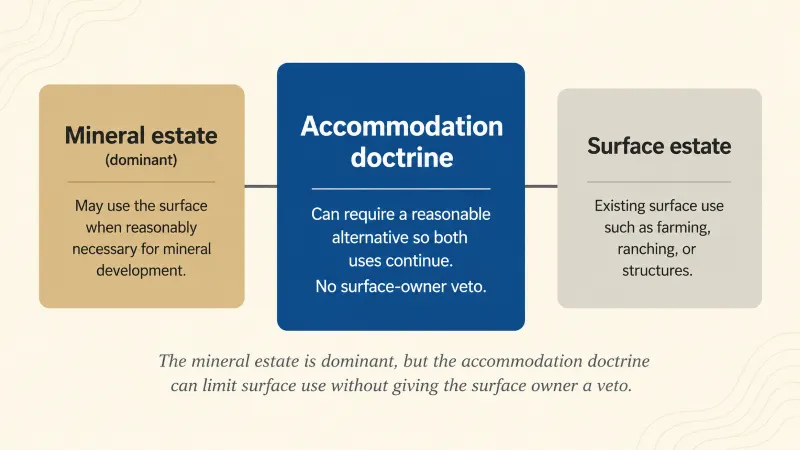
The accommodation doctrine is a Texas rule that limits how the mineral estate may use the surface when a reasonable alternative can prevent substantial disruption to an existing surface use, while preserving the mineral estate's dominant rights.
The doctrine limits surface use; it does not give the surface owner the right to stop mineral development.
What This Means for Mineral Owners
This doctrine often arises in a split-estate setting, where the minerals and surface are owned separately, or where you own both but have leased the minerals to a lessee or operator. In that setting, the mineral estate is dominant: the lessee or operator generally has the right to use the surface as reasonably necessary to explore for and produce the minerals. The accommodation doctrine softens that, but only within limits.
It matters to you in a few situations. If you own both the surface and the minerals and you lease the minerals, your lease terms and any surface-use language usually matter first, with the accommodation doctrine serving as a possible backstop. If you own minerals under someone else's surface, it can shape the lessee's or operator's obligations to that surface owner.
And if you own surface over someone else's minerals, it is part of your limited protection. In all of these, the key thing to understand is that the doctrine balances competing uses; it does not hand the surface owner a veto.
Two Things to Keep in Mind
- The mineral estate is dominant. The lessee or operator generally has the right to use the surface that is reasonably necessary to explore for and produce the minerals, which can include roads, well sites, equipment, and related facilities.
- The accommodation doctrine can require the mineral side to use a reasonable alternative, but the bar is high. It may apply where the operator's use would substantially impair an existing surface use, the surface owner has no reasonable alternative, and reasonable industry-accepted alternatives are available to the operator.
How the Accommodation Doctrine Works
Because the mineral estate is dominant, the mineral owner, lessee, or operator often starts with an implied right to use the surface as reasonably necessary for mineral development. The accommodation doctrine asks whether, in a specific situation, that use must be adjusted to accommodate an existing surface use when there is a reasonable way to do both.
The doctrine comes from the Texas Supreme Court decision in Getty Oil Co. v. Jones, and later cases such as Merriman v. XTO Energy have shown how demanding it is to satisfy, including the requirement that the surface owner identify a reasonable alternative available to the operator on the same land. How these cases apply depends on the specific facts, so a qualified Texas oil and gas attorney should assess any particular situation.
The three-part test
In general terms, a surface owner seeking accommodation must show three things, and the burden is on the surface owner:
- The operator's surface use substantially impairs or precludes an existing surface use.
- There is no reasonable alternative available to the surface owner to continue that existing use.
- There are reasonable, customary, industry-accepted alternative methods available to the operator on that land that would allow mineral production while letting the existing surface use continue.
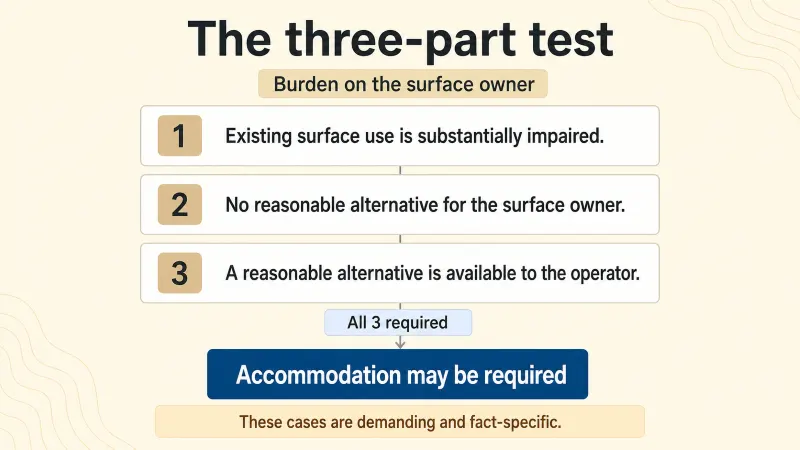
All three generally must be met, which is why accommodation cases are difficult and heavily fact-dependent. The doctrine does not let a surface owner simply object to development; it asks whether a workable, reasonable alternative genuinely exists for the mineral side while protecting an existing surface use.
Accommodation Doctrine and the Rule of Capture
These two doctrines both show how Texas balances oil and gas rights, but they operate in different areas: the rule of capture concerns produced hydrocarbons, while the accommodation doctrine concerns surface use.
- The rule of capture is the mineral, subsurface side. It governs who owns the oil and gas that flows to a well, even across property lines.
- The accommodation doctrine is a surface-use doctrine. It governs how minerals can be produced from the surface of a given tract without unnecessarily destroying an existing surface use.
Texas law gives the mineral estate strong rights, including the right to produce minerals and the dominant right to reasonable surface use, but it also builds in limits on those rights. Correlative rights temper the rule of capture on the mineral side, and the accommodation doctrine tempers surface dominance on the surface side. Seen together, they are a system of strong rights with built-in balance.
What the Accommodation Doctrine Applies To
The accommodation doctrine is most often associated with surface uses such as farming, ranching, or an existing structure, but the underlying question it asks, whether the mineral side must use a reasonable alternative to accommodate an existing use, can arise in other settings as well. Texas law on surface and subsurface rights has continued to develop over time, and questions about how far the mineral estate's surface and subsurface use can extend are shaped by the specific facts and by ongoing court decisions. Because of that, how the doctrine applies to any particular situation is best understood as fact-specific rather than fixed. For an owner, the practical point is not to predict how a court would rule, but to know that the doctrine exists as a possible backstop where an established use is substantially impaired, and that a surface use agreement is generally the more reliable way to address surface concerns in advance.
What to Check
Identify whether you have a split estate
The doctrine may apply where the surface and minerals are owned separately, or where you own both and have leased the minerals, depending on the lease language and facts. Knowing your situation tells you whether the accommodation doctrine is even in play for your land. Mineral View's Map shows wells and activity around your land, which helps you see the development context that makes this doctrine relevant.
Consider a surface use agreement
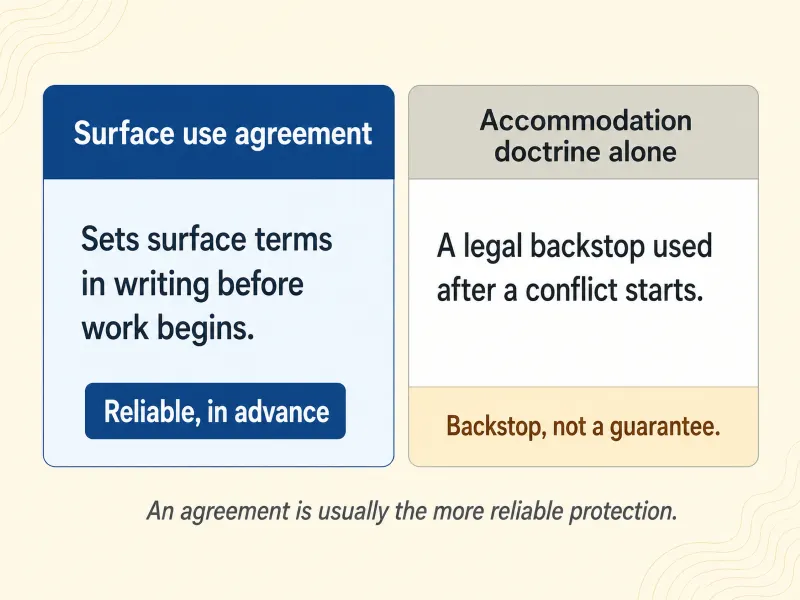
A surface use agreement lets you and the operator define surface use, locations, access roads, compensation, damages, restoration, and accommodations by contract, which is generally more reliable than relying on the doctrine after the fact. If development is coming, this is usually the more practical protection.
Do not assume the doctrine gives you a veto
The accommodation doctrine balances uses; it does not let a surface owner block development. Because the test is demanding and fact-specific, understand the doctrine as a backstop rather than a guarantee, and get specific advice before relying on it.
Important
Mineral View's Lease Activity tracks the permits and filings that signal nearby development around your land. Because the accommodation doctrine turns on a fact-intensive, three-part test shaped by Texas case law, consult a qualified Texas oil and gas attorney about whether it applies to your situation and about negotiating any surface use agreement. This page is general education, not legal advice.
Common Questions
Generally yes. Because the mineral estate is dominant in Texas, the operator usually has the right to use as much of the surface as is reasonably necessary to produce the minerals, even though you still own the surface. The accommodation doctrine can limit that use in specific circumstances, but it does not remove the operator's basic right to reasonable surface use.
No, not by itself. The doctrine does not give a surface owner a veto over development. At most, where its demanding three-part test is met, it may require the operator to use a reasonable alternative method that accommodates an existing surface use. Whether that test is satisfied is a fact-specific legal question.
Usually a surface use agreement is negotiated with the operator, which sets out surface locations, compensation, and accommodations in writing. Relying on the accommodation doctrine alone means depending on a difficult, litigated test, while an agreement lets you define protections in advance. Either way, having an attorney involved is advisable.
Usually, the doctrine protects an existing surface use, not a future plan or preferred use. A surface owner generally needs to show that the operator's proposed surface use would substantially impair a current, established use of the land and that both sides have or lack reasonable alternatives in the way Texas law requires.
In most cases, yes. A surface use agreement is usually more practical because it can set locations, access roads, damages, restoration, fencing, water use, and timing before operations begin. The accommodation doctrine is a legal backstop after a conflict arises, while a written agreement gives the owner clearer protections in advance.
Yes, it may help in the right facts, but it does not give the surface owner control over mineral development. In Texas, the mineral estate is generally dominant, so the lessee or operator may use the surface as reasonably necessary to produce minerals. The doctrine may require a reasonable alternative only when the legal test is met, especially where an existing surface use would be substantially impaired.