The oil and gas industry in the U.S. plays a pivotal role in shaping the nation's economy. Investors prioritize investing in this field, expecting an accurate method to evaluate their mineral assets in order to receive desired returns. One of the most preferred calculation methods is PV10. This article will help you find what PV10 is and how you can calculate it.
PV10 estimates the present value of future cash flow from oil and natural gas reserves. It offers investors and shareholders a brief insight to help them make informed decisions. Let’s understand what PV10 is and why it is important.

What is PV10?

In the oil and gas industry, it is essential to estimate expenditures to analyze cash flow. One of the popular methods utilized to estimate the value of future cash flow is PV10. PV10 stands for "Present Value at a 10% Discount," and it's used to estimate the present value of future cash flow from oil and gas reservoirs.
It's the foremost metric for energy investors, forecasting the current value of expected profits from mineral production by considering future net cash flow from a company’s potential oil and gas reservoirs, production expenses, and market commodity prices at a 10% discount rate.
Additionally, using a PV10 valuation method it can help better evaluate the company’s overall value and potential profitability, allowing companies to make better informed decisions on future investment and operations. For example, if the “cost of capital” is equal to 10%, then for sustainability of the project venture, it must yield positive cash flow using a PV10 evaluation.
Why is PV10 Important?
PV10 acts as a crucial aspect in the oil and gas industries, aiding in the estimation of asset profitability. By determining the present value of expected future cash flow, energy companies can gain a comprehensive understanding of potential return on investment.
It helps companies to make more informed decisions associated with future project development.
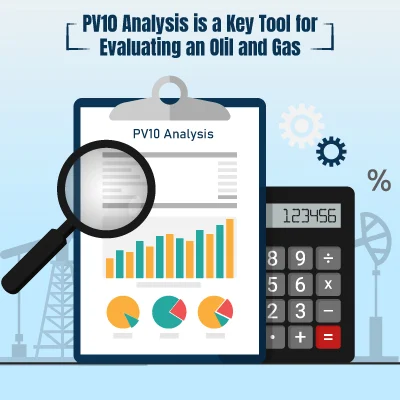
Moreover, PV10 helps determine the best timing for divesting assets by forecasting future cash flow generation. For investors, the PV10 analysis is a key tool for evaluating an oil and gas company’s asset value and expected investment returns.
In particular, PV10 supports assessing the worth of mineral reserves and serves as a pivotal factor in knowing market value. By comparing PV10 results across various companies, investors can easily identify which companies are undervalued or overvalued relative to industry peers.
PV10 is also crucial for analysts, who use it to assess the economic stability of oil and gas companies while offering recommendations to investors. This method helps appraise dividend payment potential, cashflow sustainability, and operational funding capability.
Additionally, analysts can use PV10 to evaluate asset risks and gauge the significant impact of price swings on a company’s profitability. In order to find the profitability of the company, investors should also understand the impact of price volatility on PV10.
Understanding the Impact of Price Volatility on PV10

Price volatility refers to swings in commodity prices over a specific period. It can influence current market prices for a particular asset. In the energy industry, price volatility refers to fluctuations in the prices of minerals like oil, gas, etc., or other commodities that produce energy.
Price volatility in the energy sector can arise from several factors, such as geopolitical affairs, disruptions in supply and demand chains, or changing legal policies. However, PV10 calculations can be carried out by determining the future cash flow from a producing reserve and at a discount rate of 10%.
The price volatility can affect future cash flow as fluctuations in commodity prices can directly impact operating expenditures and generating revenue. Let's assume, if the price of oil suddenly dropped in the market, the revenue generated from production of oil will decline. This decrement affects the future cash flow utilized to determine PV10 and the company will not receive the expected returns.
To alleviate the ramifications of price volatility on PV10, multiple plans of action and strategies can be implemented. Below are a few of them:
-
Obtain a hedge against price swings by using economic tools like futures contracts or options.
-
Diversify the portfolio by investing in multiple assets that are less correlated with each other.
Such transformation helps reduce the impact of price volatility on PV10 as well as on whole portfolio performance. To avoid the risks of price volatility, the investors should understand the calculation and interpretation of PV10.
How is PV10 Calculated and Interpreted?
PV10 is a widely used technique among investors. Here you will find how to calculate and interpret PV10 along with its limitations and alternative options.
Calculating PV10:
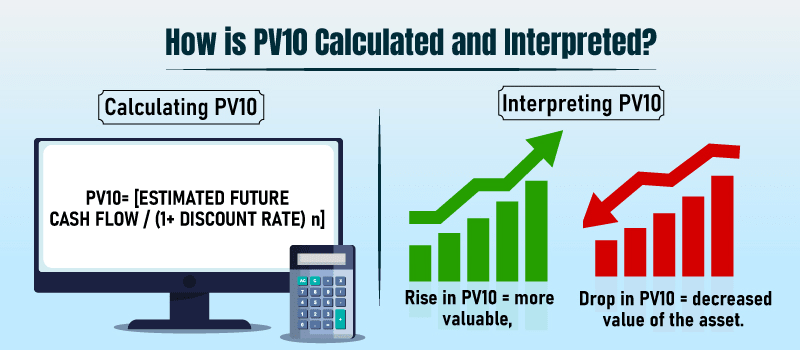
In the PV10 calculation method, calculations are done by determining future cash flow generated from oil and gas reservoirs and discounting them to their present value. Generally, the discount rate is 10%, but many companies use their Weighted Average Cost of Capital (WACC) to determine the rate.
You can use the formula below to calculate your PV10:
PV10 = [ESTIMATED FUTURE CASH FLOW / (1+ DISCOUNT RATE) n]
Here, ‘n’ represents the number of years in the future. The estimated future cash flow involves taxes, all the operating expenditures, and revenue generated from selling oil and gas. The calculation for PV10 is obtained on a per thousand cubic feet for gas and per barrel basis for oil.
Interpreting PV10:
PV10 is a crucial aspect for energy investors as it shows the calculated value of mineral reserves, which depends on the current market scenario. It contrasts the value of divergent oil and gas assets and identifies whether investing in a particular asset is financially applicable or not. The rise in PV10 value specifies the asset is more valuable, whereas the dropped PV10 value indicates the decreased value of the asset.
Limitations of PV10 and Alternative Options
Limitations of PV10:
As the PV10 method is the essential aspect for investors, it also contains some limitations. The values received from this method are the forecasted values of future oil and gas prices, that can be unpredictable and volatile. It is also considered that the mineral reservoirs will be produced at a consistent rate over time, which is practically not viable. Moreover, it does not contemplate the development and exploration expenditures that can be important.
Alternative Options:
There are several alternative options that can be employed to overcome the above limitations. It helps to determine the assets of oil and gas. One of the better options is to use the Internal Rate of Return (IRR), which calculates the Return On Investment (ROI) rate. Another option is to utilize Net Asset Value (NAV), which examines the exploration and development expenses. Even though PV10 holds such concerns, investors prioritize it when determining oil and gas assets.
Conclusion
Present Value at a 10% discount, which is abbreviated as PV10, acts as an essential metric in shaping the oil and gas industry. It determines the present value of future cash flow from mineral reserves to support investors in achieving their desired returns.
It helps investors determine the profitability of the assets, comprehend how price volatility affects their mineral assets, and make wise investment choices. Regardless of some limitations, PV10 remains the leading choice among investors, though there are alternative options such as NAV and IRR.
One of the most valuable features of Mineral View, "Value Analysis," helps you determine the value of your mineral assets. To your convenience, our experts also compute your mineral assets using the PV10 technique.
FAQ's
What does PV10 Mean?
PV10 is the method used to calculate the oil and gas assets. It stands for Present Value at a 10% Discount. It calculates the present value of estimated future oil and gas revenue.
Why Does the Oil and Gas Industry Use PV10?
PV10 serves as a key avenue for the oil and gas sector, aiding in the estimation of asset profitability. By calculating the present value of expected future cash flow, energy industries can receive comprehensive details of a better return on investment.