Texas plays a pivotal role in the exploration and production of oil and gas. Today, we will explore modern-day technologies and innovations in the Texas refineries sector. Texas refineries are now advancing with digital transformation, advanced automation, and the integration of renewable energy. This article provides an in-depth analysis of all the latest technological advancements in Texas refineries.
Introduction to Texas Refineries:
Texas refineries are complex, energy intensive hydrocarbon processing facilities. Refineries primarily function to convert crude oil into a variety of usable petroleum byproducts like gasoline, diesel, and jet fuel. Refined petroleum products have various applications, such as transportation fuel, heating, electricity generation, and producing chemicals and petrochemicals.
Texas refineries play an essential role in meeting both domestic and global energy demands, which contributes to the country's energy independence. With the involvement of the latest technologies the refinery industry is significantly expanding.
Below is the List of Active Oil Refineries in Texas, Updated in 2022:
| Location | Refineries | Oil (Barrels/Day) | Operators |
|---|---|---|---|
| Beaumont | 369,024 | ExxonMobil | |
| Big Spring | 369,024 | Alon USA / Delek Group Ltd | |
| Borger | 149,000 | WRB Refining LP / Phillips 66 | |
| Channelview | 45,000 | Hartree / LyondellBasell | |
| Corpus Christi | Bill Greehey Refineries East and West | 290,000 | Valero |
| Citgo Corpus Christi Refinery | 167,500 | Citgo | |
| Buckeye Corpus Christi Refinery | 60,000 | Buckeye Texas Processing | |
| Magellan Refinery Corpus Christi | 42,500 | Magellan Midstream | |
| Corpus Christi East Refinery | 73,500 | Flint Hills Resources | |
| Corpus Christi West Refinery | 265,000 | Flint Hills Resources | |
| Deer Park | 312,500 | Pemex | |
| El Paso | 131,000 | Western Refining / Marathon Petroleum | |
| Galena Park | 84,000 | Kinder Morgan | |
| Galveston | 45,000 | Texas International Terminals | |
| Houston | Houston Refinery | 263,776 | Houston Refining / Access Industries |
| Valero Houston Refinery | 205,000 | Valero | |
| Houston Refinery | 25,000 | Petromax Refining | |
| Nixon | 14,000 | Lazarus Energy / Blue Dolphin | |
| Pasadena | 112,229 | Chevron | |
| Port Arthur | Port Arthur Refinery | 626,000 | Motiva |
| Port Arthur Refinery | 335,000 | Premcor / Valero | |
| Port Arthur Refinery | 238,000 | TotalEnergies | |
| San Antonio | 20,000 | Starlight Relativity Acquisition Co. | |
| Sunray | 195,000 | Diamond Shamrock / Valero | |
| Sweeny | 265,000 | Phillips 66 | |
| Texas City | 225,000 | Valero | |
| Three Rivers | 89,000 | Diamond Shamrock / Valero | |
| Tyler | 75,000 | Delek |
History of Texas Refineries:
The Industrial Revolution started in the late 1800s along with oil fields in Texas. The first oilfield was established in 1894 near Corsicana, with enormous economic implications for the state. Additionally, Spindletop, near Beaumont, is the most well known event in Texas petroleum history.
With a highly emerging oil field, the first oil refinery company, “J. S. Cullinan and Company” was started in Texas in the year 1898. Later, in 1919, the “Texas Oil and Refining Company” (also called Douglas-Texas Oil and Refining) was organized in Fort Worth, Texas. That refinery was considered at around $200,000 of capital cost.
In the same year, in 1919, “Texas Oil and Refining” supervised the leases inside the counties of Southern Oklahoma. Those counties were Comanche and Tillman. Today, Southern Oklahoma has spread over 2,000 acres northwest of the famed Burkburnett oilfield. After a few years, “Texas Oil and Refining” took ownership of a refinery company in Port Arthur. The involvement of oil refineries resulted in the increased demand for oil globally and became responsible for more oil exploration in the state.
While the Texas oil and gas refineries were flourishing, a major unfortunate event occurred in Texas City. In the year 2005, a prominent Texas City explosion had occurred that killed 15 workers, and around 180 workers got injured. The blast was also responsible for severe damage to the refinery. A vapor cloud of natural gas and petroleum caused this Texas refinery explosion.
The Texas refinery explosion was the most significant incident, and after this, no major accident occurred in the Texas refinery sector. Yet, this event highlighted the industry's safety commitment and increased refinery monitoring.
Technological Advancements in Texas Refineries:
As we move forward, we take steps for positive transformation. Similarly, the state is now excelling in technological innovation and automation across all industries. So why should the refinery business fall behind in oil and gas technologies? Currently, the state has initiated modern day technological advancements and innovations in the Texas refineries industry. This section explores technological advancements in Texas refineries.
Digitalization and Automation in Refineries:
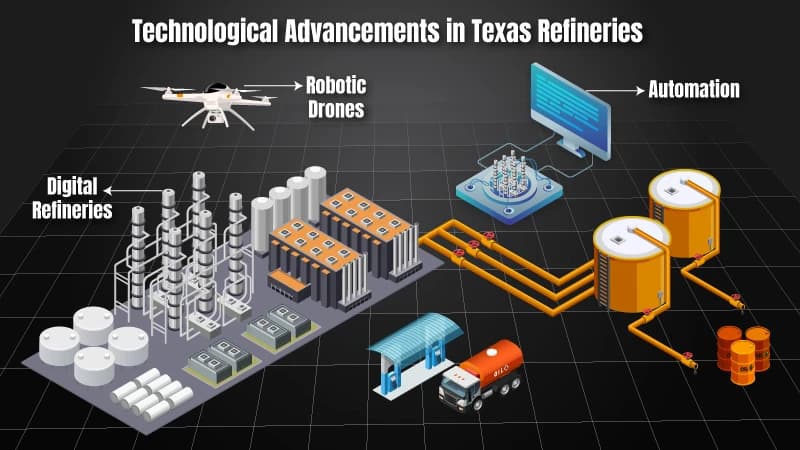
The primary objective of implementing cutting-edge automation and digital technologies in refineries is to optimize operational efficiency, substantially reduce downtime, and significantly enhance productivity. The refinery sector is now integrating advanced Industrial Internet of Things (IIoT) technology and newly introduced software for data analysis. The refinery plant is outfitted with the Industrial Internet of Things (IIoT), encompassing a range of sensors and automated control systems such as DCS, HMI, SCADA, and cloud-based platforms.
The collection and analysis of data from sensors and devices enable the refinery plant to promptly detect operational activities and generate predictive maintenance alerts during abnormal system behavior and derive the warning indicators during abnormal activity in the system. In the current landscape, the vast majority of companies are adopting digitalization and automation strategies to significantly bolster productivity and streamline operations.
Automation and Robotics in Refinery Operations:
The refinery industry is now implementing robotics and automation techniques to minimize human interference in the refinery plant. Automation tools like SCADA enable operators to observe and control the remote devices and activities that belong to them. It also improves the decision-making and response time.
The refinery sector also uses robotic interventions like drones or remotely operated vehicles (ROVs) that can monitor the storage tanks and pipelines to minimize human interference in harmful areas inside the plant. These drones are combined with advanced sensors and cameras to provide real-time information
Programmed robots are emerging to perform tasks such as moving heavy equipment, loading and unloading materials, and more. The involvement of such programmed robots maintains accuracy, enhances productivity, and minimizes human interaction in refinery plants.
Ultimately, Texas oil and gas technologies are improving extraction procedures and increasing operational functionality to satisfy worldwide energy needs.
Environmental and Sustainability Initiatives:
During the oil refining process, gases may be flared or vented into the atmosphere, releasing CO2, methane, and other polluting agents. For heat production and processing, the refinery industry uses fossil fuels, which also contribute to environmental impact. Furthermore, transporting refined oils and managing waste may cause soil and water pollution.
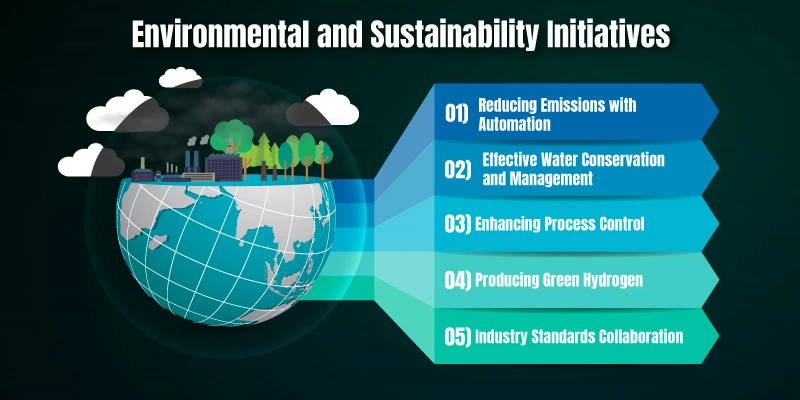
By considering such environmental concerns, Texas’s officials have suggested the following environmental and sustainability initiatives in the refinery sector:
-
Involving Energy-Efficient Technologies.
-
Minimizing the Emission by Automation Tools.
-
Implementing Carbon Capture and Storage Technologies.
-
Performing appropriate Water Conservation and Management.
-
Adding Advanced Process Control and Optimization Techniques.
-
Producing Green Hydrogen.
-
Collaborating with Industry Standards.
-
Arranging Training and Awareness Programs for Employees.
-
Understanding Community Engagement Guidelines and Social Responsibilities.
Texas refineries promote environmental sustainability by reducing emissions, improving energy efficiency, and improving the disposal of waste. Various refineries employ renewable energy, and digitization improves real-time inspection and regulatory compliance, making the business more ecologically friendly.
Renewable Energy Integration in Texas Refineries:
Incorporating renewables into refineries is a green initiative that addresses ecological issues. Solar panels atop refineries, wind power plants, and bioenergy fuels such as organic waste provide sustainable options to the refining process, lowering dependency on fossil fuels.
Technologies Improving Safety and Capability:
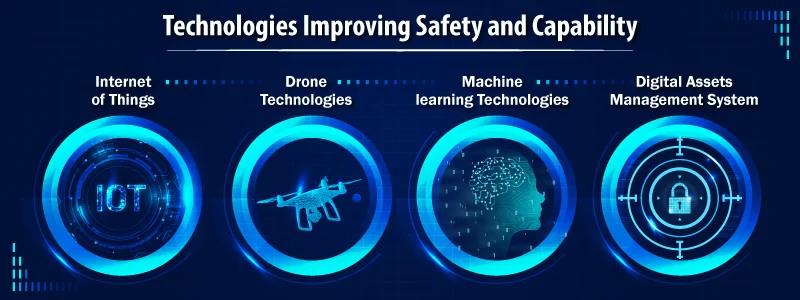
Refineries convert crude oil into valuable products like kerosene, jet fuel, and gasoline. These fuels serve diverse purposes, such as powering airplanes. While refining offers benefits, it requires advanced safety technologies to minimize risks to people and the environment. Here are essential safety measures for refinery plants:
-
For the remote monitoring of refining facilities, the implementation of IoT and drone technologies has become increasingly prevalent. It lowers human error and improves accuracy by protecting humans.
-
Installation of machine learning technologies helps retrieve sensor and device data. ML algorithms monitor data and warn of equipment failure. This prediction allows workers to maintain equipment without causing harm.
-
A new digital assets management system is being adopted at refineries. It monitors and manages refinery assets in real time. Verifying all assets have been maintained or need to be maintained improves refinery safety and efficiency. Thus, a suitable maintenance setup can be developed.
Benefits of Technological Advancements in Texas Refineries:
Technological advancements in the oil refinery sector offer numerous benefits that enhance efficiency, safety, and environmental sustainability. Here are some key advantages:
-
Advanced technologies enable refineries to operate with enhanced efficiency, offering superior monitoring and control capabilities. It ultimately increases efficiency and generates a profit.
-
The existing refineries are capable of producing 6000 BOPD (barrels oil per day) to 750,000 BOPD of oil with the integration of technological improvements.
-
Integrating automation and robotics in the refinery can minimize human error, improves accuracy, and reduces the initial cost.
-
The refinery can include the latest digital monitoring systems that deliver real-time data during the equipment's performance, enabling the system to identify abnormal conditions. Moreover, unnecessary damage to the equipment can be avoided. Technological advances in the refinery process improves safety, prevents accidents, and creates a secure working environment for employees.
-
With the integration of renewables, emissions caused by various pollutants like nitrogen oxide, carbon dioxide, etc., can be reduced. It helps to make a pollution-free environment.
Other Benefits include:
-
Enhanced Waste Management.
-
Easy Energy Recovery.
-
Improved Quality of the Product.
-
Better Environmental Conditions.
-
Providing Predictive Maintenance.
All these technical advances boost capacity utilization and prepare refineries for market needs and frequent shifts. Thus, advanced technological developments stimulate economic growth.
Safety Protocols and Community Engagement:
The refinery industry has introduced safety protocols and community engagement programs in order to create a safe and efficient refinery sector. Community participation guidelines are considered to promote safe and ethical oil refinery development. Here are some safety protocols and community engagement guidelines that must be considered in the Texas refineries:
Safety Protocols:
Safety is an important parameter that should be considered in Texas refineries. Here are some safety protocols that have to be followed by employees in oil and gas refineries and companies associated with them.
| Company Safety Protocols for Refinery Employees/ Workers | Safety Protocols for Refinery Companies |
| Employees should examine equipment timely for safety. | Process safety management workshops should be offered to all workers to help them estimate and track refinery incidents. |
| Plant workers should wear complete safety gear. | A company must carry out frequent safety audits to recognize the condition of the equipment. |
| They should report the sudden abnormal action in equipment to the supervisor to avoid unwanted damage to the refinery. | They should make emergency plans to reduce sudden accidental events. |
| Workers should get proper training to perform the refinery operations carefully to avoid unintentional errors. | They should arrange the necessary training programs for workers to improve accuracy. |
Community Engagement:
Refinery workers should consider these community engagement guidelines.
| Community Engagement Guidelines |
| Have clear and interactive communication with the local community regarding refinery operations, safety awareness, and accidental risks. |
| Organize community awareness programs to inform them about refinery activities, security implementations, and environmental considerations. |
| Develop an advisory panel for the community, in which the settlers, local people, and other communities can participate in the discussion of the latest ongoing refinery work and ask questions. |
| Engage the community in socially responsible undertakings related to the refinery, like investing in local infrastructure estimations, educational activities, health services, etc. |
Conclusion:
Texas refineries have involved multiple technological advancement techniques. The latest techniques help to enhance the operation and efficiency of the refinery plant. The Texas refineries have grown with modern-day digitalization and automation techniques. It has involved automation systems like SCADA, IIoT, and many more. Also, it makes use of robotics for accuracy and to achieve better efficiency as well as productivity.
You can also utilize MView's 'Mapping and Research' feature to look at multiple Texas refineries maps for different elements in the sector. Texas refineries can satisfy energy sector needs while reducing environmental impact by utilizing automation, innovative data analysis, and cutting-edge monitoring systems. These advances demonstrate Texas' determination to lead refining technologies for a more stable and sustainable future.
FAQ’s
How Many Oil Refineries are There in Texas?
Currently, there are about 32 active oil refineries in Tex, as per the US Energy Information Administration recorded till 2022.
What is the List of Technological Advancements in the Oil and Gas Industry?
Technological advances in the oil and gas industry include: Hydraulic Fracturing, Deepwater Drilling, 3D and 4D Seismic Imaging, Horizontal Drilling, Automation and Robotics in Drilling Operations, Advanced Data Analytics, Cloud Computing, Integrating the Industrial Internet of Things (IIoT), Artificial Intelligence, Machine Learning Algorithms, Predictive Maintenance and many more.
How will New Technology Disrupt the Oil and Gas Industry?
With technological advancements, the oil and gas industry has achieved significant growth. These advancements play a crucial role in the oil and gas sector to magnify their performance, minimize initial costs, and improve efficiency. New technologies like deepwater drilling, horizontal drilling, automation, and robotics in drilling have collaborated with AI, Machine Learning (ML), and other technologies.
They maintain accuracy and increase the speed of operation. Therefore, there would be less human intervention. A notable impact of technological advancement is the potential reduction in certain job roles, as automation elevates operational tasks.