Retained Acreage Clause
A Retained Acreage Clause is a lease provision that limits how much leased acreage a company can keep after the primary term or a stated development period, usually allowing it to keep only the acreage tied to producing or qualifying wells.
For a mineral owner, this matters because without it, a single well can hold your entire tract indefinitely. The clause can return your undeveloped acreage to you, which you may then be able to lease again, sometimes for a new bonus and better terms.
What This Means for Mineral Owners
The problem a retained acreage clause solves is one of the most important in leasing. Without a retained acreage clause, Pugh clause, depth clause, or similar limiting language, a single producing well may be able to hold a large leased tract for as long as the lease remains validly held by production. A retained acreage clause limits that. It can limit the acreage the lessee keeps around producing or developed wells and may return the remaining acreage to you, depending on the exact lease language.
That released acreage can be valuable because, once the release is confirmed, you may be able to lease it again, potentially for a new bonus and current lease terms. So a retained acreage clause is really about getting your undeveloped minerals back into your hands instead of leaving them locked under an old lease.
Two Things to Keep in Mind
- A retained acreage clause can limit how much leased acreage a well holds and may release unused acreage back to you so it can potentially be leased again.
- The details are negotiable and they decide the outcome. How many acres the operator retains per well, whether deeper formations are released, and what continuous-drilling exceptions apply all determine how much acreage you actually get back and when.
How a Retained Acreage Clause Works
The clause may take effect at the end of the primary term, at the end of a continuous drilling or continuous development program, or on another trigger date stated in the lease. At that point, the lessee may retain the acreage tied to qualifying wells and may be required to release the remaining acreage, subject to the lease language.
How retained acreage is measured
Leases define the retained acreage in different ways. Some retain a stated number of acres around each well. Some retain the proration unit, spacing unit, or acreage amount recognized under applicable field rules or lease language, which can be especially important in Texas. Some retain the pooled unit the well is part of. The clause may also include a depth-release provision, allowing the lessee to keep only certain producing formations or depths while releasing deeper or shallower rights for possible separate leasing.
Continuous development exceptions
Many leases let the operator keep more acreage by continuing to drill. Under a continuous development or continuous drilling provision, the lessee may retain acreage it would otherwise have to release if it continues drilling or development on the schedule required by the lease. This can delay the return of your acreage, so it is worth understanding alongside the retention terms.
An illustrative example
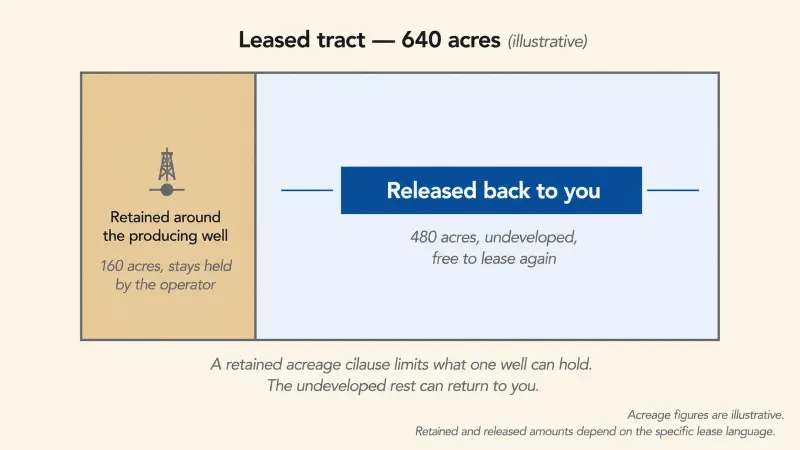
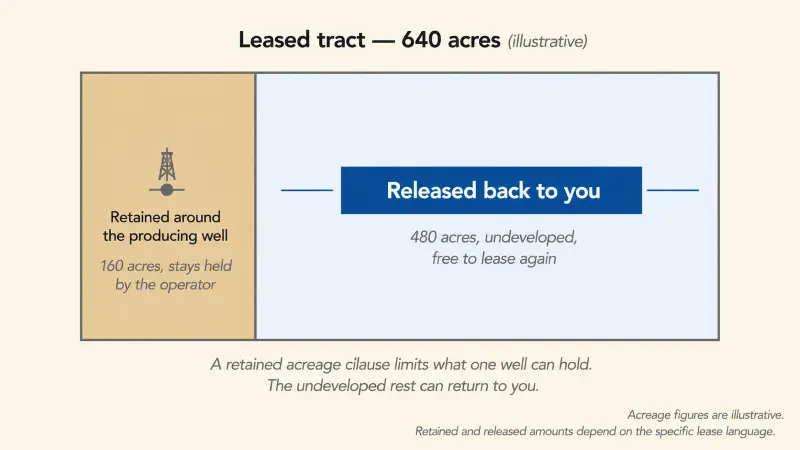
Suppose you lease a 640-acre tract and, by the end of the primary term, the operator has one producing well. If the retained acreage clause lets the operator keep 160 acres around that well, the remaining 480 acres would be released back to you, free to lease again. The numbers are illustrative, but they show the basic effect: the productive portion stays held, and the rest returns to you.
Retained Acreage Clause vs. Pugh Clause
These two are closely related, frequently mentioned together, and easy to confuse, because both prevent one well from holding a whole lease.
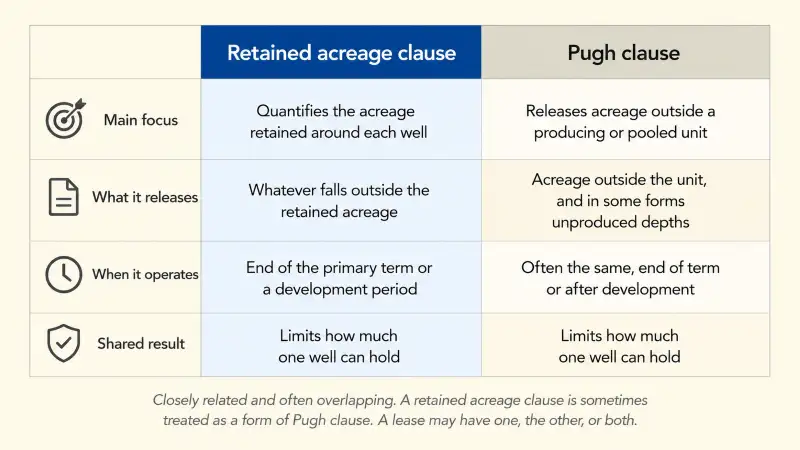
In practice the two overlap, and a retained acreage clause is sometimes treated as a form of Pugh clause. A lease might contain one, the other, or both. What matters for you is the result they share: limiting how much acreage a single well can hold. Both often operate at the end of the primary term or after a stated development period, and both can shape what acreage or depths remain held by production once development settles.
Why a Retained Acreage Clause Matters to You
The reason this clause is worth caring about is that it returns control of your undeveloped minerals to you. Acreage that comes back can be leased again, which can mean a new bonus and the chance to negotiate current terms rather than staying locked under an older lease. If the clause also releases deeper formations, those depths can be leased separately, which can add value you would otherwise never see.
How much benefit you get depends entirely on how the clause is written. A tight clause that retains less acreage per well and releases unproduced depths can return more to you. A loose one, or a strong continuous-development exception, returns less or returns it later. So the existence of a retained acreage clause is good, but its specific terms are what determine the value.
When acreage is released, the release is not always automatic or self-documenting, so it is worth confirming that a release of lease, sometimes called a release of record, is filed in the county records to clear title before you try to lease the acreage again. For owners trying to understand which of their acreage is currently producing and held, Mineral View's Lease Report shows lease status and production, which is useful context for understanding what a retained acreage clause might release.
A Real-World Scenario
Example: the Ramirez family recovering acreage in Reeves County
The Ramirez family leased a large tract in Reeves County, Texas. By the end of the primary term, the operator had drilled and was producing from only one part of the tract, while a sizable share of the acreage had never been developed. Because the lease included a retained acreage clause, the lessee was able to keep only the acreage allowed around its producing well. The remaining undeveloped acreage was released back to the family.
That release mattered, because it returned a meaningful portion of their minerals to them at a time when leasing activity in the area had picked up and terms had improved. Had the lease lacked such a clause, that same acreage could have stayed held under the original lease by the single existing well.
Understanding that the clause was what freed their acreage helped the family recognize the value of those terms for any future lease they signed.
Note: This example is provided for illustrative purposes only and does not represent any specific mineral owner or lease.
What to Check
Check whether your lease has a retained acreage or Pugh clause
The first question is simply whether your lease limits how much acreage a well can hold at all. Texas has no statutory rule that automatically releases undeveloped acreage, so this protection exists only if it was negotiated into your lease. If your lease has neither a retained acreage clause, Pugh clause, depth clause, nor similar limiting language, a single well may be able to hold more of your tract than you expect. Knowing which, if either, your lease contains tells you what to expect.
Understand how much acreage the operator retains per well
If you have a retained acreage clause, the amount retained per well drives how much comes back to you. Whether it is a fixed number of acres, the spacing unit, or the pooled unit makes a real difference to the acreage you recover.
Look for depth and continuous-development terms
Check whether the clause releases deeper formations and how any continuous-drilling exception works. These terms decide whether you get your depths back and how long the operator can keep drilling to retain acreage. Mineral View's Map shows your minerals and nearby activity geographically, which helps you picture which acreage is being developed and which is not.
Important
Mineral View can help you see your lease status, production, and surrounding activity. For questions about whether a retained acreage or Pugh clause has been triggered, what acreage or depths were released, or how to negotiate one, consult a qualified landman or Texas oil and gas attorney, since these are lease and title questions.
Common Questions
Without a retained acreage clause or a Pugh clause, a single producing well can generally hold your entire leased tract in force, including acreage that is never developed. That means undeveloped portions of your minerals can stay locked under the original lease indefinitely, rather than returning to you to lease again.
It depends on how the clause is written. Some clauses retain a set number of acres around each well, some retain the well's spacing or proration unit, and some retain the pooled unit. The specific measure in your lease determines how much stays held and how much is released back to you.
They are closely related and often serve the same purpose, but they are not identical. A Pugh clause typically releases acreage outside a producing or pooled unit, while a retained acreage clause focuses on quantifying the acreage retained around each well. They overlap enough that a retained acreage clause is sometimes considered a form of Pugh clause, and a lease may use one, the other, or both.