Executive Rights
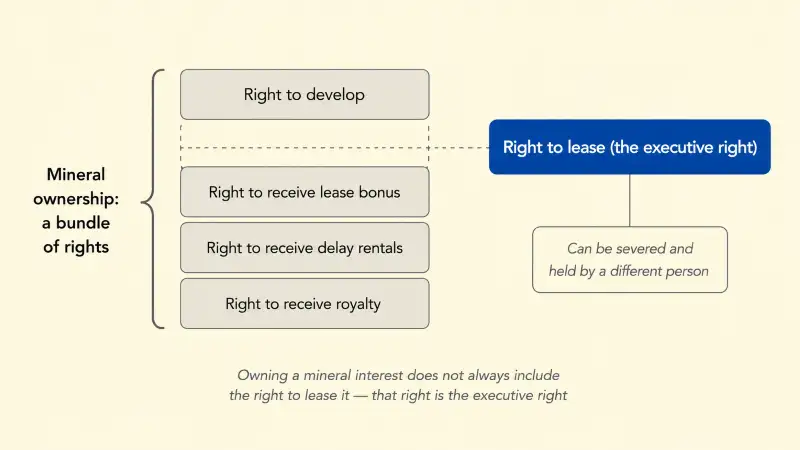
Executive rights are the right to lease a mineral interest, meaning the power to negotiate and sign an oil and gas lease and set its terms. They can be severed from the other rights of mineral ownership and held by a different person, so owning a mineral interest does not always include the power to lease it.
For a Texas mineral owner, that raises one practical question: do you control the leasing of your minerals, or does someone else?
What This Means for Mineral Owners
Owning minerals and controlling how they are leased are not always the same thing. The executive right is the specific power to do the leasing. If you hold the executive right, you generally decide whether to lease, when to lease, to which lessee, and on what terms, including the royalty fraction and lease provisions. Who receives the bonus depends on the deed, reservation, or title instrument creating the interests. If you do not hold the executive right, someone else may make the leasing decisions for the interest, and you are generally bound by a valid lease they sign within the scope of that right.
This often matters most to owners with inherited, fractional, or family-held interests, because executive rights may have been separated, reserved, or concentrated in one person over time. It is possible to own a share of minerals and still have no direct say in how that mineral interest is leased.
Executive rights control the leasing decisions that can shape your future royalty income and lease terms. The royalty fraction, lease terms, and choice of lessee are generally negotiated by whoever holds the executive right. The bonus may or may not belong to that person, depending on the title documents.
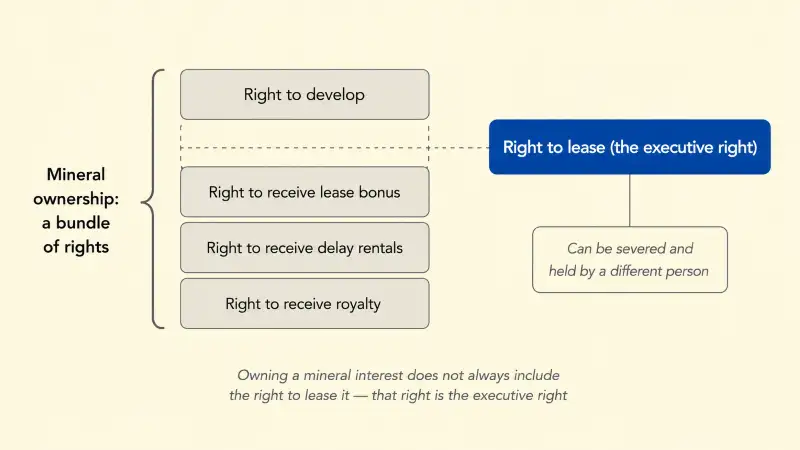
Executive rights can be owned separately from other mineral rights. Owning a mineral interest does not always mean you can sign the lease yourself, because the executive right may have been severed and held by someone else.
How Executive Rights Work
Mineral ownership is often described as a bundle of separate rights, and title documents determine which rights each owner actually holds. These commonly include the right to develop the minerals, the right to lease them, the right to receive lease bonus, the right to receive delay rentals, and the right to receive royalty. The executive right is the right to make leasing decisions, and like the other sticks in the mineral bundle, it can be separated and held on its own.
Executive rights can be severed
Through a deed, reservation, will, trust, or estate plan, the executive right can be split away from other parts of a mineral interest. The result is that one person may own a mineral interest while another person holds the power to lease that interest.
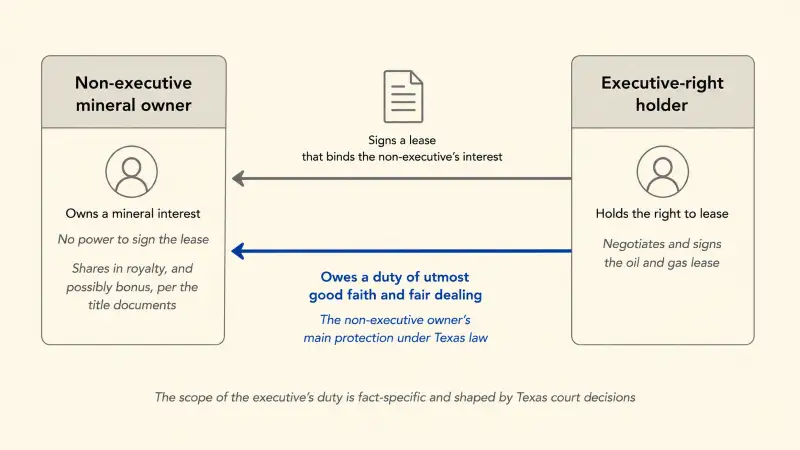
In families with many heirs, executive rights are sometimes concentrated in one person or branch of the family so leasing can happen without gathering every co-owner's signature. That arrangement can be practical, but it leaves non-executive owners depending on the executive's leasing decisions and the duty Texas law places on the executive.
The executive owes a duty to non-executives
Because leasing decisions can affect everyone who shares in the minerals, Texas law places a duty on the holder of executive rights toward non-executive owners. In general terms, the executive is expected to act with utmost good faith and fair dealing and not use the leasing power to unfairly benefit themselves at the expense of non-executive owners.
The exact scope of that duty is fact-specific and has been shaped by Texas court decisions, so it should be reviewed with a qualified Texas oil and gas attorney rather than assumed.
Executive vs Non-Executive Mineral Interest
The distinction owners run into most is between a mineral interest that includes the right to lease and one that does not.
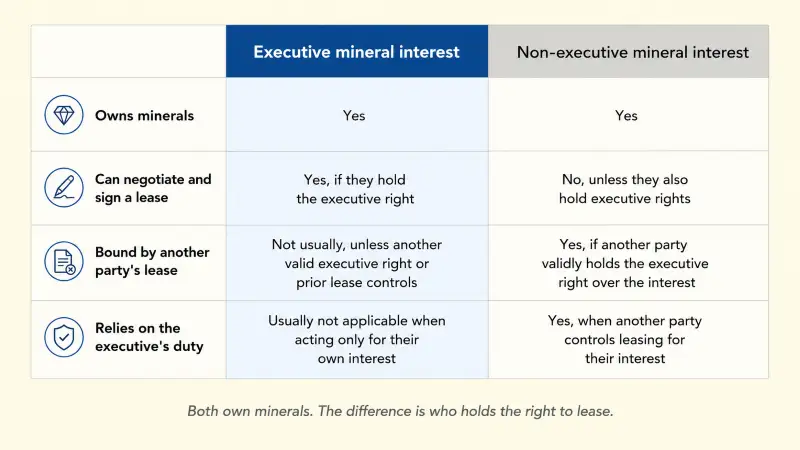
A related but separate idea is the non-participating royalty interest, or NPRI, which is a royalty interest rather than a full mineral interest and usually carries no executive rights. The key difference is that a non-executive mineral owner still owns a mineral interest without leasing power, while an NPRI holder generally owns only a royalty interest and not the broader mineral bundle.
Why Executive Rights Matter to You
Executive rights determine how much control you have over one of the most consequential events for your minerals: signing the oil and gas lease. Whoever holds them negotiates the lease terms that may govern your royalty, deductions, pooling, surface-use language, and other rights for years, because a lease can stay in force for as long as it is validly held by production. A lease signed by the executive may include pooling language, but in Texas, whether that pooling binds a non-executive owner can depend on the title instrument, lease language, and any ratification. Do not assume pooling authority exists simply because someone holds the executive right.
If you hold the executive right, that control is generally yours, along with the responsibility that comes with exercising it for non-executive owners or co-owners. If you do not hold it, your income may be shaped by someone else's leasing decisions, and your main protection is the duty the executive owes you under Texas law. Either way, knowing where the executive right sits tells you how much leasing control you actually have over your mineral interest.
A Real-World Scenario
Example: Hector's non-executive interest in DeWitt County
When family minerals in DeWitt County, Texas, passed down through several generations, the executive rights ended up concentrated in one branch of the family, while Hector inherited a mineral interest without the right to lease.
When a company wanted to lease the tract, Hector expected to negotiate his own terms. Instead, he learned that the cousin who held the executive rights could sign a lease covering the interests subject to that executive right, and Hector would generally be bound by that valid lease. He still shared in royalty, and possibly bonus, according to the deed and title documents, but he had no direct say in the lease terms.
What reassured him was learning that the executive owed non-executive owners a duty of utmost good faith and fair dealing in exercising the leasing power.
Understanding that he held a non-executive mineral interest, and what protection came with it, helped Hector engage with the process realistically rather than assuming leasing control he did not have.
Note: This example is provided for illustrative purposes only and does not represent any specific mineral owner or lease.
What to Check
Determine whether you hold the executive right
The starting point is your title and chain of title. Your deed, reservations, probate documents, and chain of title show whether your interest includes the right to lease or whether that right was severed. Knowing this tells you whether you control leasing for your interest or whether another executive-right holder does.
If you do not hold it, find out who does
If your executive right was severed, identifying who holds it tells you who may negotiate a lease affecting your interest and who may owe you the executive's duty under Texas law. Mineral View's Lease Report shows the lease currently affecting a tract, which can help you see the terms you are subject to even when you did not sign them.
Understand the duty if you hold executive rights over others
If you hold the executive right for non-executive owners or co-owners, you may owe them a duty of utmost good faith and fair dealing when you exercise the leasing power. Understanding the scope of that responsibility before you negotiate can help you avoid disputes later.
Important
Mineral View can help you review lease information and activity affecting your minerals. Questions about whether you hold executive rights, who holds them, who receives bonus or royalty, how rights were severed, or what duty an executive owes are title and legal questions. Review those with a qualified landman or Texas oil and gas attorney.
Common Questions
Not always. The right to lease is the executive right, and it can be severed from other mineral rights. If your executive right was separated and is held by someone else, you may own the minerals but may not be able to sign a lease yourself. Whether you hold the executive right is determined by your deed, reservations, probate documents, and chain of title.
Yes, if they validly hold the executive right over your interest. A person who validly holds executive rights for a mineral interest can usually sign a lease that binds that interest, even without the non-executive owner's signature. The non-executive still shares in royalty, and in many cases still receives their share of the bonus unless the right to bonus was also severed, though this depends on how the deed or title instrument arranges the interests. Either way, the non-executive does not sign the lease.
In Texas, the holder of executive rights owes a duty to non-executive owners, generally described as a duty of utmost good faith and fair dealing in how the leasing power is exercised. The precise scope of that duty depends on the facts, the title documents, and how Texas courts have interpreted the executive's conduct, so if you believe an executive has acted against your interests, it is a question for a qualified Texas oil and gas attorney.